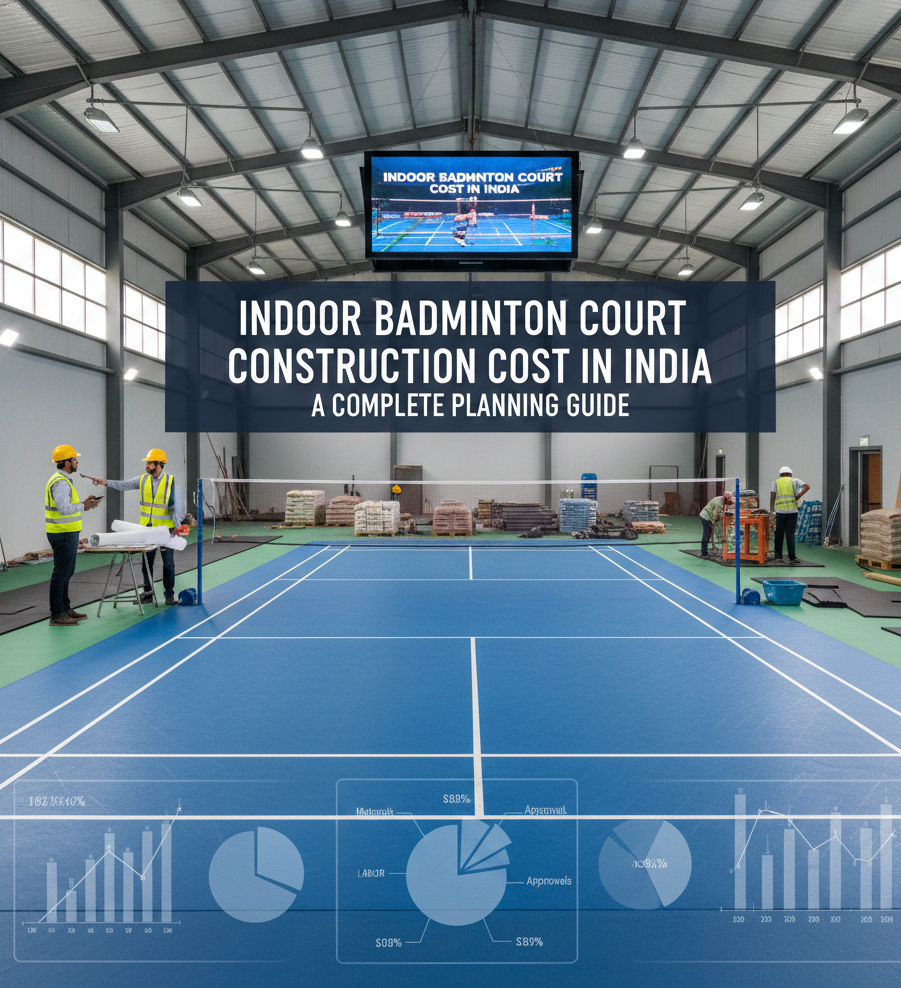
Introduction
Badminton is rapidly gaining popularity across India, creating new opportunities for sports academies, educational institutions, fitness centers, residential communities, and private sports facility owners. As more people look for safe, comfortable, and professionally designed playing environments, indoor badminton court construction has become an important investment in modern sports infrastructure.
Unlike outdoor courts, indoor badminton facilities provide a controlled playing environment with consistent lighting, protection from wind and rain, and better opportunities for year-round training. However, building a high-quality court requires careful planning, suitable flooring, adequate ceiling clearance, proper lighting, and a well-prepared playing surface.
One of the first questions investors and project planners ask is: What is the indoor badminton court construction cost in India?
The total investment depends on whether you already have a suitable building, the number of courts you intend to install, your preferred sports flooring system, and the specifications of the indoor structure. A basic court installation inside an existing hall will generally cost less than developing a complete indoor badminton facility from the ground up.
In this guide, Sports Facility India explains the estimated cost of indoor badminton court construction, flooring prices, civil work requirements, lighting specifications, construction stages, maintenance considerations, and potential revenue opportunities. This information can help you prepare a practical project budget and choose a solution that meets your facility’s requirements.
1. What Is the Cost of Indoor Badminton Court Construction in India?
The cost of constructing an indoor badminton court in India varies according to the scope of work and quality of materials selected. A project involving only flooring installation in an existing building has very different requirements from a turnkey project that includes a new building, foundation, roofing, electrical systems, and sports accessories.
For preliminary planning, the following figures can be used as indicative estimates.
| Type of Construction | Approximate Estimated Cost |
|---|---|
| Basic court setup in an existing hall | ₹4.5 lakh–₹6 lakh |
| Indoor court with professional PVC flooring | ₹4.5 lakh–₹7 lakh |
| Indoor court with wooden sports flooring | ₹6.5 lakh–₹9 lakh |
| Premium court with advanced flooring and lighting | ₹8 lakh–₹12 lakh or more |
| Complete new indoor sports building | Project-specific; potentially several tens of lakhs to multiple crores |
These figures are preliminary budgeting ranges, not confirmed market quotations. They may overlap depending on the materials, scope, location, and contractor. The building construction cost is separate where a new structure is required, unless explicitly included in the quotation.
For an accurate estimate, project owners should obtain a detailed bill of quantities covering civil construction, flooring, roofing, lighting, ventilation, electrical work, and sports equipment.
Explore our indoor badminton court construction services to understand the requirements involved in developing a functional badminton facility.
2. Factors That Determine Indoor Badminton Court Construction Cost
Several technical and commercial considerations influence the final cost of an indoor badminton court. Understanding these factors before starting work helps prevent unexpected expenses and supports better budget management.
A. Sports Flooring Material
Flooring is one of the most important components of an indoor badminton court. The selected surface affects playing comfort, traction, impact absorption, maintenance requirements, and overall project expenditure.
Common options include:
- PVC or synthetic vinyl flooring: Suitable for schools, badminton academies, clubs, and recreational facilities seeking a cushioned playing surface.
- Wooden sports flooring: Designed for facilities that prioritize playing comfort, resilience, and professional sports performance.
- Polyurethane or other specialist sports surfaces: Available for selected indoor sports applications, depending on the product’s suitability for badminton.
The final flooring price depends on material specifications, thickness, cushioning structure, subfloor preparation, adhesive requirements, installation complexity, and supplier terms.
B. Existing Building or New Construction
An existing industrial hall, school auditorium, community center, or sports building may reduce the initial investment if its floor, roof, dimensions, and structural condition are suitable.
A new building requires additional work, which may include:
- Site preparation and foundation work
- Structural steel or other framing systems
- Roofing and weather protection
- Wall construction and finishing
- Flooring base preparation
- Electrical installation and lighting
- Ventilation and fire-safety provisions
For this reason, the cost of building an indoor badminton court from scratch can be substantially higher than installing a court inside an existing facility.
C. Number of Courts
The number of courts affects the total budget and the cost per playing area. Multi-court facilities may share structural systems, access routes, electrical infrastructure, reception areas, and other common amenities.
However, savings depend on the building layout and design. Each additional court still requires sufficient playing clearance, appropriate lighting, flooring, markings, and safe circulation space.
D. Lighting and Electrical Infrastructure
Badminton involves rapid movement and tracking a small shuttlecock, so lighting must provide consistent visibility without distracting glare or excessive shadows.
The budget depends on the number and type of LED fixtures, mounting height, illumination requirements, wiring, electrical panels, and emergency lighting provisions.
A lighting layout should be designed for the actual building dimensions and intended level of play rather than relying only on a fixed number of fixtures.
E. Location and Installation Conditions
Construction expenses vary across Indian cities and regions because of differences in labor charges, transportation, material availability, and site accessibility.
The condition of the existing floor can also influence costs. Uneven concrete, moisture problems, cracks, or unsuitable surface finishes may require additional preparation before sports flooring can be installed.
3. Indoor Badminton Court Flooring Price in India
Selecting the right flooring is essential when estimating the total cost of an indoor badminton facility. The cheapest option is not always the most economical over the long term, particularly when the court will be used for daily coaching sessions or commercial bookings.
PVC Badminton Court Flooring
PVC sports flooring is widely considered for indoor badminton courts because it offers a cushioned surface, consistent traction, and relatively straightforward cleaning.
Key benefits include:
- Textured surfaces designed to support controlled movement
- Cushioning options for different levels of use
- Convenient routine maintenance
- Multiple colors and finish options
- Suitability for schools, clubs, academies, and indoor sports halls
The installed price depends on the flooring grade, thickness, subfloor condition, installation method, and accessories included in the quotation.
Wooden Badminton Court Flooring
Wooden sports flooring is suitable for indoor facilities that require a resilient surface with carefully engineered shock absorption and playing characteristics.
A complete wooden flooring system may include a prepared subfloor, resilient pads or supporting components, a wooden sports surface, court markings, and protective finishing.
The price varies according to the wood species, system design, installation method, finishing requirements, and maintenance provisions.
Specialist Synthetic Sports Flooring
Other synthetic sports surfaces may be considered for indoor facilities, but their suitability depends on their intended application and technical performance.
Before selecting a product, confirm that it is designed for badminton and provides appropriate grip, resilience, surface consistency, and playing characteristics.
Important: Flooring prices should be compared on an installed-cost basis. Ask suppliers to specify the material, thickness, underlay or cushioning system, surface preparation, adhesive, markings, taxes, transport, warranty, and installation charges.
4. Standard Indoor Badminton Court Dimensions and Space Requirements
Correct court dimensions are essential for recreational use, coaching, and competitive play. The playing area should follow the relevant Badminton World Federation (BWF) court dimensions, while the building itself must provide adequate space around the court.
Official Badminton Court Measurements
| Specification | Measurement |
|---|---|
| Court length | 13.40 metres |
| Singles court width | 5.18 metres |
| Doubles court width | 6.10 metres |
| Net height at the centre | 1.524 metres |
| Net height at the posts | 1.55 metres |
| Short service line | 1.98 metres from the net |
The doubles playing area measures approximately 81.74 square metres, or 880 square feet. This measurement covers the marked court itself, not the entire indoor facility.
A practical indoor layout needs additional room for movement beyond the boundary lines, side clearances, access paths, and safe separation between neighboring courts.
For preliminary planning, a space around 18 metres by 10 metres may be considered for a single-court layout, subject to the clearances and conditions required for the intended use. Multi-court layouts need additional space for circulation and separation between playing areas.
Ceiling Height and Roof Design
Adequate clear height is particularly important because the shuttlecock frequently travels high above the net. Roof beams, fans, lights, and other suspended equipment should not interfere with play.
A clear height of approximately 9 metres or more is a useful preliminary design target for many indoor badminton projects. Competitive venues may require greater clearance depending on the level of play and applicable specifications.
A structural engineer should confirm the building design, roof spans, foundations, wind loads, drainage, and other relevant safety requirements.
5. Detailed Cost Breakdown for Indoor Badminton Court Construction
A useful construction estimate separates the playing surface from the building and infrastructure. The following example illustrates possible cost components for one court installed inside a suitable existing hall.
| Work Component | Indicative Budget |
|---|---|
| Floor inspection and base preparation | ₹80,000–₹1,20,000 |
| Sports flooring system | ₹2,50,000–₹5,50,000 |
| LED sports lighting | ₹80,000–₹1,20,000 |
| Electrical wiring and panels | ₹40,000–₹60,000 |
| Wall finishing and anti-glare treatment | ₹40,000–₹60,000 |
| Net posts, net, and accessories | ₹20,000–₹30,000 |
| Fans or ventilation provisions | ₹50,000–₹80,000 |
| Markings and miscellaneous finishing | ₹30,000–₹50,000 |
These are illustrative planning allowances, not verified supplier quotations. Actual prices may be lower or higher depending on the site, chosen products, local rates, and the work included.
The components should not automatically be added together as a universal package price. Some contractors include electrical work, court markings, or base preparation within their flooring or turnkey quotations, while others charge for these items separately.
The estimate also excludes the cost of acquiring land and may exclude a new building, structural steel, roofing, major foundation work, parking, washrooms, reception areas, fire-safety installations, and statutory approvals.
6. Construction Process for an Indoor Badminton Court
Professional construction follows a sequence of planning, preparation, installation, and inspection. Completing each stage correctly helps improve the playing surface and reduce the likelihood of expensive repairs.
Step 1: Site Inspection and Feasibility
The project begins with an assessment of the available land or building. The inspection should consider the dimensions, roof height, floor condition, access, electrical supply, ventilation, drainage, and proposed number of courts.
Step 2: Layout Planning and Court Design
The court layout is prepared according to the playing dimensions and required clearances. For multi-court facilities, the designer must also plan circulation routes, entrances, spectator areas, and separation between playing zones.
Step 3: Civil Work and Floor Preparation
The floor base is checked for level, strength, cracks, and moisture. Necessary repairs, grinding, leveling, and curing are completed before the flooring system is installed.
For new buildings, civil and structural work must be designed and completed according to the approved project specifications.
Step 4: Flooring Installation
The selected flooring is installed according to the manufacturer’s technical instructions. Depending on the system, this may involve an understructure, cushioning components, adhesive, roll-sheet installation, or specialist surface finishing.
Step 5: Lighting and Electrical Installation
Sports lighting is positioned to achieve appropriate illumination while minimizing glare and shadows. Electrical systems should include suitable protection and comply with applicable safety requirements.
Step 6: Court Marking and Equipment Installation
Court lines, net posts, nets, and other accessories are installed after the playing surface is ready. Markings must correspond to the correct singles and doubles layouts.
Step 7: Quality Inspection and Handover
Before opening the facility, the contractor should inspect the surface, markings, lighting, equipment stability, and general finish. The owner should also receive maintenance instructions, applicable warranties, and relevant product documentation.
7. Indoor Badminton Court Lighting and Ventilation Requirements
Lighting and airflow directly influence the comfort and usability of an indoor badminton court.
Lighting Design
A suitable lighting plan should consider the court layout, mounting height, fixture placement, illumination uniformity, and glare control. The required lighting level depends on whether the facility is intended for recreational play, coaching, or competitive events.
Avoid placing lights where they interfere with a player’s view of the shuttlecock. The final design should be based on a lighting calculation rather than an arbitrary fixture count.
Ventilation and Air Circulation
Indoor sports buildings require adequate ventilation to support player comfort and indoor air quality. Fans, exhaust systems, and other ventilation equipment should be positioned so they do not create disruptive air currents across the playing surface.
Because shuttlecock flight is sensitive to airflow, the ventilation strategy should balance fresh air and thermal comfort with stable playing conditions.
8. Maintenance Cost and Expected Lifespan
The long-term cost of an indoor badminton court depends on daily usage, product quality, installation standards, and the maintenance routine.
PVC or Synthetic Flooring Maintenance
Recommended practices include:
- Removing dust and loose dirt regularly
- Cleaning with products approved for the installed surface
- Checking seams, edges, and damaged areas
- Avoiding abrasive tools and unsuitable chemicals
- Keeping the court free from grit and debris
The lifespan of a synthetic sports floor varies according to its construction, usage intensity, and maintenance. Ask the supplier for product-specific durability information and warranty terms.
Wooden Sports Flooring Maintenance
Wooden floors require more careful control of moisture and environmental conditions. Regular cleaning, inspections, and periodic refinishing may be necessary, depending on the system and the amount of use.
The maintenance schedule should follow the flooring manufacturer’s instructions rather than a fixed timetable applied to every wooden court.
Why Preventive Maintenance Matters
Timely maintenance helps preserve traction, surface consistency, appearance, and playing comfort. It can also reduce the likelihood of major repairs and unexpected facility closures.
9. Is Building an Indoor Badminton Court a Profitable Investment?
An indoor badminton facility can generate revenue when it is located in an appropriate market and operated efficiently. However, profitability depends on demand, utilization, operating expenses, financing, and the total investment.
Potential revenue sources include:
- Hourly court rentals
- Monthly memberships
- Individual and group coaching
- Training programs for children and adults
- School and corporate sports partnerships
- Competitions, leagues, and special events
Example of Court Booking Revenue
Suppose a facility charges ₹500 per court-hour and records an average of four paid booking hours per day over 30 days.
The illustrative monthly gross booking revenue would be:
₹500 × 4 hours × 30 days = ₹60,000 per month.
This is an example, not a forecast or guaranteed return. Actual revenue may differ significantly due to local pricing, seasonal demand, occupancy, discounts, coaching arrangements, and cancellations.
Expenses such as rent, staff salaries, electricity, cleaning, repairs, marketing, taxes, and loan repayments must be deducted to calculate operating profit. A realistic feasibility study should model several booking-occupancy scenarios before construction begins.
10. Common Mistakes to Avoid During Indoor Badminton Court Construction
Avoiding design and procurement mistakes can protect the project budget and improve the final playing experience.
Choosing flooring based only on price: Compare technical specifications, cushioning, grip, durability, installation quality, and warranty coverage.
Ignoring the building’s clear height: Roof beams, suspended lights, and other obstructions can reduce the usable playing area.
Underestimating civil work: Moisture, uneven concrete, and poor floor preparation may damage the installed surface or affect its performance.
Using unsuitable lighting: Excessive glare and uneven illumination can make it difficult for players to track the shuttlecock.
Insufficient space between courts: Crowded layouts can compromise player safety and movement.
Failing to calculate total project expenditure: Consider the building, flooring, equipment, electrical systems, ventilation, approvals, taxes, and contingency allowance rather than budgeting for flooring alone.
Overlooking future maintenance: A reliable operating plan should account for routine cleaning, repairs, equipment replacement, and periodic inspections.
11. Why Choose Sports Facility India for Indoor Badminton Court Construction?
Sports Facility India provides badminton court construction and sports flooring solutions for a range of indoor sports projects. A well-planned project should bring together site assessment, court layout, flooring selection, installation coordination, lighting, accessories, and final quality checks.
When evaluating a contractor, consider the following:
- Experience with indoor sports flooring and court layouts
- Clear documentation of materials and technical specifications
- A detailed quotation with inclusions and exclusions
- Suitable floor preparation and installation procedures
- Appropriate court markings and sports accessories
- Written warranty and after-sales support terms
The right construction partner should help you select a system that fits the intended use, available space, budget, and maintenance capacity of your facility.
Whether you are planning a school badminton court, a private coaching academy, a residential sports facility, or a multi-court indoor stadium, careful planning can help deliver a durable and functional playing environment.
Visit Sports Facility India to explore sports facility solutions and discuss your project requirements.
12. Conclusion: Plan Your Indoor Badminton Court Budget Carefully
The indoor badminton court construction cost in India depends on several interconnected factors, including flooring selection, the condition of the building, civil work, lighting, ventilation, equipment, and the number of courts.
For an initial estimate, installing a single court inside a suitable existing hall may require a budget of several lakhs of rupees. Constructing a new indoor badminton facility will require a separate and substantially broader estimate covering the building and associated infrastructure.
Before finalizing your project, assess the available space, determine the expected level of play, compare flooring systems, and request an itemized quotation from an experienced contractor. Proper design and professional installation can help improve player safety, support regular use, and protect the long-term value of your investment.
Planning to build an indoor badminton court in India? Contact Sports Facility India to discuss your site requirements, flooring preferences, and construction budget.
Frequently Asked Questions (FAQs)
1. What is the cost of building an indoor badminton court in India?
The cost depends on the building, flooring, lighting, civil work, and equipment. As an initial planning estimate, a single court in a suitable existing hall may cost approximately ₹4.5 lakh–₹10 lakh or more. A new building requires a separate structural and civil construction budget.
2. What is the cheapest flooring for an indoor badminton court?
PVC sports flooring can be a cost-conscious option for many indoor badminton facilities. The actual price depends on the product specification, cushioning, subfloor preparation, installation, and warranty.
3. How much space is required for one indoor badminton court?
The doubles playing area measures 13.40 metres by 6.10 metres. Additional space is needed around the court for player movement and safe circulation. A preliminary single-court layout may use approximately 18 metres by 10 metres, subject to the intended use and applicable requirements.
4. What ceiling height is suitable for an indoor badminton court?
Approximately 9 metres of clear height is a useful preliminary target for many facilities. Competitive courts may require additional clearance. The final design should account for the level of play and any applicable governing-body requirements.
5. Which is better for indoor badminton: PVC or wooden flooring?
Both can be suitable when designed specifically for badminton. PVC systems offer convenient maintenance and multiple cushioning options, while wooden sports systems can provide a resilient playing surface. The right choice depends on budget, playing requirements, maintenance, and product specifications.
6. How long does indoor badminton court construction take?
The schedule depends on whether the building already exists, the condition of the floor, material availability, and the scope of construction. Flooring installation in a prepared hall generally takes less time than developing a complete building. Request a project-specific timeline before work begins.
7. Can multiple badminton courts be built in one indoor hall?
Yes. Multiple courts can be arranged in one hall if sufficient floor area, ceiling height, clearances, lighting, and circulation space are available. The layout should be finalized before construction starts.
8. Does the estimated court construction cost include the building?
Not necessarily. Many preliminary per-court estimates cover the playing surface and selected equipment inside an existing hall. A new building, roofing, structural framework, foundation, and other major infrastructure should be priced separately unless included in a detailed turnkey quotation.
9. What factors increase badminton court construction costs?
Major cost factors include premium flooring, extensive floor repairs, new building construction, higher roof clearance, advanced lighting, ventilation systems, electrical work, and additional amenities.
10. How can I get an accurate indoor badminton court construction quotation?
Provide the contractor with your project location, available site dimensions, existing-building details, number of courts, preferred flooring, intended usage, and required amenities. Ask for an itemized quotation that clearly identifies materials, labor, civil work, taxes, transportation, exclusions, and warranty coverage.