Introduction
Badminton is one of the most popular sports in India, played across schools, academies, residential complexes, and professional arenas. As the sport continues to grow, the demand for high-quality badminton courts has increased significantly. A well-designed badminton court is not just about markings and flooring—it is a carefully engineered sports surface that ensures player safety, performance consistency, and long-term durability.
Professional badminton court developers play a crucial role in transforming a simple piece of land or indoor space into a fully functional playing arena. From planning and design to construction and finishing, every stage requires technical precision and adherence to international standards.
Developing a badminton court involves multiple considerations such as surface type, drainage, lighting, orientation, and compliance with official dimensions. Whether the court is intended for recreational use or professional tournaments, proper execution ensures a superior playing experience and minimal maintenance over time.
This guide provides a comprehensive overview of badminton court development, including flooring options, construction process, dimensions, official sizing, and key considerations for building a world-class facility.
Types of Badminton Flooring
Selecting the right flooring is one of the most critical decisions in badminton court construction. The surface directly affects player movement, injury risk, and game quality. Different flooring types are suitable for different environments and budgets.
1. Wooden Badminton Flooring
Wooden flooring is considered the premium choice for indoor badminton courts. It is commonly used in professional stadiums and advanced training academies.
Features:
- Excellent shock absorption
- Smooth and consistent surface
- Reduces stress on joints and muscles
- Enhances player agility and performance
Materials Used:
- Maple wood (international standard)
- Teak wood (widely used in India)
Advantages:
- Provides superior comfort
- Ideal for competitive-level play
- Long lifespan with proper maintenance
Limitations:
- Higher installation cost
- Requires controlled indoor conditions
2. Synthetic PVC Flooring
Synthetic PVC flooring is widely used due to its balance between performance and cost. It is suitable for both semi-professional and recreational facilities.
Features:
- Anti-slip surface
- Multi-layer cushioning
- Available in roll or tile format
Advantages:
- Affordable compared to wooden flooring
- Easy to install and maintain
- Good shock absorption
Best For:
- Schools
- Indoor sports complexes
- Residential societies
3. Acrylic Badminton Flooring
Acrylic flooring is primarily used for outdoor courts. It is applied as a coating over a concrete base.
Features:
- Weather-resistant surface
- Strong grip and traction
- UV-resistant coating
Advantages:
- Suitable for all weather conditions
- Low maintenance
- Cost-effective for outdoor use
Limitations:
- Less cushioning compared to indoor surfaces
- Not ideal for professional tournaments
4. Concrete Badminton Surface
Concrete courts are the most economical option and are generally used for recreational purposes.
Features:
- Hard surface
- Basic construction
- Long-lasting base
Advantages:
- Very low cost
- Minimal maintenance
- Durable over time
Limitations:
- No shock absorption
- Higher risk of injuries
- Not suitable for advanced play
Badminton Court Dimensions & Layout
Proper dimensions are essential to ensure fair play and compliance with international standards. Even minor deviations can affect gameplay and player movement.
Standard Court Measurements
- Total Length: 13.4 meters (44 feet)
- Total Width (Doubles): 6.1 meters (20 feet)
- Total Width (Singles): 5.18 meters (17 feet)
Court Markings
A badminton court includes multiple lines, each serving a specific purpose:
- Baseline: Back boundary line
- Sidelines: Define width for singles and doubles
- Center Line: Divides service courts
- Short Service Line: Marks minimum service distance
- Long Service Line (Doubles): Back service boundary for doubles
Net Specifications
- Net Height at Center: 1.524 meters (5 feet)
- Net Height at Posts: 1.55 meters
- Net Width: 6.1 meters
Accurate marking using high-quality paint ensures visibility and durability.
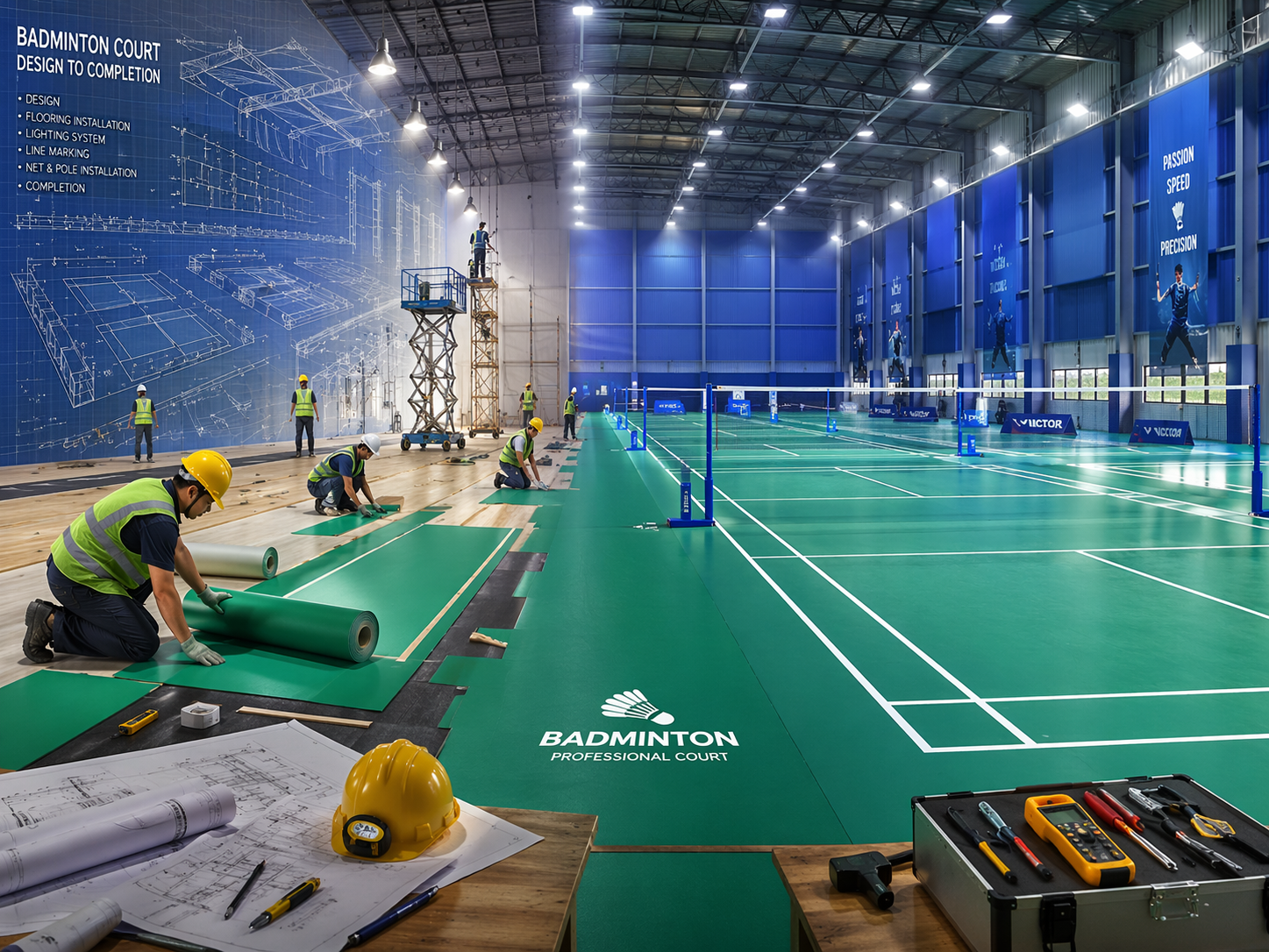
Badminton Court Construction Process
Developing a badminton court involves a systematic and multi-stage process. Each phase contributes to the final quality and performance of the court.
1. Site Evaluation and Planning
The first step is analyzing the location where the court will be built.
Key Considerations:
- Ground condition and soil strength
- Drainage and water flow
- Orientation (to avoid glare from sunlight or lights)
- Space availability for surrounding areas
For indoor courts, ventilation and ceiling height are also crucial.
2. Base Construction
The base is the foundation of the court and determines its longevity.
Steps Involved:
- Excavation and leveling
- Compaction of soil
- Laying of sub-base materials
- RCC (Reinforced Cement Concrete) slab construction
Important Factors:
- Proper leveling to avoid uneven surfaces
- Slight slope for drainage in outdoor courts
- Crack prevention techniques
3. Flooring Installation
After the base is prepared, the chosen flooring system is installed.
Process:
- Surface cleaning and preparation
- Application of cushioning layers (if required)
- Installation of flooring material (wood, PVC, acrylic)
- Finishing and polishing
Precision during this stage ensures uniform surface quality.
4. Court Marking
Court lines are marked according to official standards.
Key Points:
- Use of durable, non-fading paint
- Accurate measurement tools
- Proper line thickness and alignment
Clear markings are essential for gameplay and tournament use.
5. Equipment Installation
Essential equipment is installed after marking is complete.
Includes:
- Net posts and net
- Pole anchoring system
- Protective padding (if required)
6. Lighting and Infrastructure
Lighting plays a vital role, especially for indoor and evening matches.
Features:
- LED sports lighting
- Uniform light distribution
- Glare-free setup
Additional infrastructure may include:
- Seating arrangements
- Fencing for outdoor courts
- Changing rooms
Official Size and Standards
To ensure international-level play, badminton courts must follow official specifications set by governing authorities.
Space Requirements
Apart from the playing area, additional space is necessary for movement and safety.
- Minimum Clearance Around Court: 1.5 to 2 meters
- Recommended Indoor Ceiling Height: 9 to 12 meters
Lighting Standards
- Uniform brightness across the court
- No shadows or dark spots
- Adequate lux levels for professional play
Surface Standards
- Non-slip surface
- Shock-absorbing properties
- Even and consistent bounce
Adhering to these standards ensures that the court can be used for tournaments and professional training.
Cost Considerations for Badminton Court Development
The cost of building a badminton court depends on several factors:
Key Cost Influencers
- Type of Flooring
- Wooden courts are the most expensive
- Acrylic and concrete are more affordable
- Indoor vs Outdoor
- Indoor courts require roofing, lighting, and ventilation
- Outdoor courts mainly require surface and fencing
- Location and Site Condition
- Soil condition affects base construction cost
- Remote areas may increase transportation costs
- Additional Features
- Lighting systems
- Seating arrangements
- Fencing and landscaping
Approximate Cost Range
- Basic courts: Budget-friendly options
- Mid-range courts: Balanced performance and cost
- Premium courts: Professional-level facilities
Investing in quality materials reduces long-term maintenance expenses.
Maintenance and Upkeep
Regular maintenance is essential to preserve the quality and safety of the court.
Routine Maintenance
- Cleaning the surface regularly
- Checking for cracks or damage
- Ensuring proper net tension
Periodic Maintenance
- Re-polishing wooden floors
- Re-coating acrylic surfaces
- Replacing worn-out synthetic layers
Benefits of Maintenance
- Extends court lifespan
- Maintains playing performance
- Reduces repair costs
Advantages of Hiring Professional Developers
Working with experienced badminton court developers ensures a smooth and reliable construction process.
Key Benefits
- Technical expertise and precision
- Use of high-quality materials
- Compliance with official standards
- Efficient project management
- Long-term durability and performance
Professionals also provide guidance on selecting the right flooring and design based on your needs.
Conclusion
A badminton court is more than just a playing surface—it is a carefully engineered space designed to deliver performance, safety, and durability. From selecting the right flooring to ensuring precise dimensions and construction quality, every detail plays a vital role in creating a world-class facility.
Whether you are building a court for a school, academy, residential complex, or professional venue, investing in proper planning and expert development ensures long-term value. High-quality materials, accurate construction, and regular maintenance contribute to a superior playing experience and extended court life.
Choosing the right approach and following standard guidelines will help you build a badminton court that meets both recreational and professional requirements.
Frequently Asked Questions (FAQs)
1. What is the standard size of a badminton court?
A standard badminton court measures 13.4 meters in length and 6.1 meters in width for doubles play. For singles matches, the width is reduced to 5.18 meters.
2. Which flooring is best for badminton courts?
Wooden flooring is considered the best for professional indoor courts due to its cushioning and performance. Synthetic PVC is a popular alternative for budget-friendly indoor courts.
3. Can badminton courts be built outdoors?
Yes, outdoor courts can be constructed using acrylic or concrete surfaces. Acrylic is preferred due to its weather resistance and better playing conditions.
4. How long does it take to build a badminton court?
The construction timeline typically ranges from 3 to 6 weeks, depending on the type of court, site conditions, and additional infrastructure.
5. What is the cost of building a badminton court?
The cost varies based on flooring type, size, and features. It can range from economical options to high-end professional courts.
6. How often does a badminton court need maintenance?
Routine cleaning should be done regularly, while resurfacing or refinishing may be required every few years depending on usage.
7. What is the ideal ceiling height for indoor courts?
The recommended ceiling height for indoor badminton courts is between 9 to 12 meters to allow proper shuttle movement.
8. Is lighting important for badminton courts?
Yes, proper lighting ensures visibility, reduces eye strain, and enhances gameplay, especially for indoor and night matches.