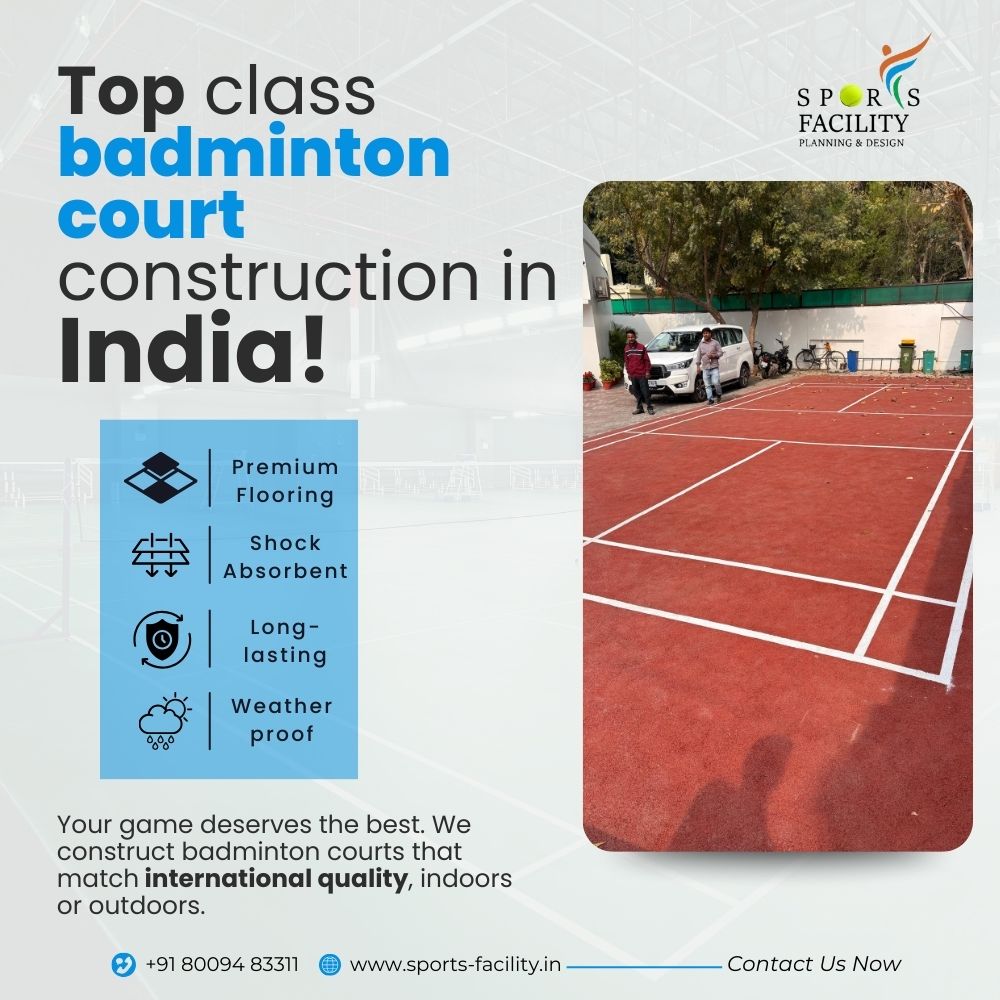
Building a badminton court is far more than laying a playing surface and installing a net. A professionally designed court requires careful planning, engineering expertise, premium sports flooring, accurate dimensions, proper lighting, and a construction process that complies with international badminton standards. Whether you are developing a badminton facility for a school, sports academy, university, residential township, corporate campus, government institution, or commercial sports complex, choosing experienced badminton court contractors is the first step toward creating a safe, durable, and high-performance playing environment.
As badminton continues to grow in popularity across India, the demand for world-class sports infrastructure has increased significantly. Educational institutions, private clubs, fitness centres, indoor stadiums, and real estate developers are investing in professionally constructed badminton courts to encourage sports participation and provide athletes with facilities that meet modern expectations. A professionally built court enhances player performance, reduces the risk of injuries, improves durability, and delivers a superior playing experience for recreational users as well as professional athletes.
Professional badminton court contractors offer complete turnkey solutions that cover every stage of the project. From site evaluation and civil construction to sports flooring installation, lighting, ventilation, court marking, and maintenance, experienced contractors ensure every detail is executed with precision. Their expertise helps clients avoid costly mistakes, maintain compliance with Badminton World Federation (BWF) standards, and maximize the long-term value of their investment.
This comprehensive guide explains everything you need to know about badminton court construction in India, including available services, flooring systems, official dimensions, construction methodology, estimated costs, project planning, and expert recommendations for selecting the right contractor.
Why Professional Badminton Court Construction Matters
A badminton court is a specialized sports facility designed to provide consistent playing conditions, athlete safety, and long-term durability. Unlike conventional flooring, badminton courts require engineered sports surfaces that absorb impact, provide controlled grip, and withstand continuous use without losing performance.
Professional construction ensures that every component of the court works together as a complete sports flooring system. The foundation must remain stable under varying weather conditions, the surface should provide excellent traction, and the lighting layout should minimize shadows while maintaining uniform visibility across the playing area.
Investing in professional badminton court construction offers several long-term advantages:
- Improved player safety through shock-absorbing sports flooring
- Consistent shuttle movement and bounce characteristics
- Greater durability with lower maintenance costs
- Compliance with BWF standards for tournaments and competitions
- Increased property value for educational institutions and sports facilities
- Enhanced user experience for beginners, recreational players, and professionals
- Better return on investment through long service life
A professionally built badminton court is not simply an expense—it is a long-term investment in sports infrastructure that supports athlete development, community engagement, and commercial growth.
Why Choose Professional Badminton Court Contractors?
Selecting an experienced contractor plays a crucial role in the success of any badminton court project. Sports flooring requires specialized knowledge that goes beyond traditional civil construction. Every project involves careful planning, technical expertise, and precision engineering to achieve the desired playing performance.
Professional badminton court contractors understand how different flooring systems behave under varying environmental conditions and recommend the most suitable solution based on the client’s budget, location, and intended usage.
Industry Expertise
Experienced contractors have extensive knowledge of badminton court engineering, construction materials, and sports flooring technologies. Their experience enables them to identify potential challenges before construction begins, reducing delays and minimizing future maintenance issues.
Professional teams also stay updated with modern installation techniques and evolving sports infrastructure standards, ensuring every project meets current industry requirements.
Complete Turnkey Solutions
One of the biggest advantages of hiring professional contractors is the convenience of turnkey project execution. Instead of coordinating multiple vendors, clients receive a single point of responsibility for the entire project.
Typical turnkey services include:
- Site inspection
- Project planning
- Architectural layout
- Civil construction
- Surface preparation
- Sports flooring installation
- Court line marking
- Lighting installation
- Net and pole installation
- Quality inspection
- Final handover
- Maintenance support
This integrated approach improves project efficiency while maintaining consistent quality throughout every stage of construction.
Premium Sports Flooring Materials
Professional contractors source certified sports flooring materials specifically designed for badminton. These systems are engineered to provide excellent grip, shock absorption, resilience, and long-term durability.
Using high-quality flooring materials helps reduce player fatigue, minimizes the impact on knees and ankles, and improves overall playing comfort during training sessions and competitive matches.
Accurate Project Planning
Every badminton court project begins with detailed planning. Contractors evaluate available space, intended usage, player capacity, environmental conditions, and future expansion possibilities before preparing a customized construction plan.
Proper planning minimizes unexpected expenses and ensures smooth project execution from foundation work to final finishing.
Complete Badminton Court Construction Services
Professional badminton court contractors provide end-to-end services that cover every aspect of sports facility development. Each stage is carefully managed to ensure the final court delivers outstanding performance, safety, and durability.
Site Inspection and Feasibility Analysis
Every successful project starts with a comprehensive site evaluation. Contractors inspect the proposed location to determine whether it is suitable for badminton court construction.
During the inspection, experts assess:
- Land dimensions
- Soil stability
- Existing ground conditions
- Drainage system
- Moisture levels
- Accessibility
- Utility connections
- Sunlight exposure
- Wind direction
- Space for future expansion
The findings help determine the most suitable court design and construction methodology.
Court Design and Layout Planning
Once the site assessment is complete, contractors prepare a detailed layout based on the client’s requirements. Every design prioritizes player movement, safety clearance, and efficient space utilization.
Planning also considers spectator areas, walkways, emergency exits, equipment storage, and accessibility requirements.
A well-designed layout ensures that the facility remains functional, aesthetically appealing, and capable of accommodating future upgrades.
Civil Construction and Foundation Development
The strength of any badminton court depends on its foundation. Contractors carry out excavation, grading, soil compaction, and concrete work to create a stable base capable of supporting the sports flooring system for many years.
Precision laser leveling techniques are often used to achieve a perfectly even surface. Proper curing procedures further enhance structural integrity and minimize the risk of cracks or surface irregularities.
Sports Flooring Installation
After the base is fully prepared, the selected sports flooring system is installed using specialized equipment and manufacturer-approved techniques.
Depending on project requirements, contractors may install:
- Wooden sports flooring
- PVC sports flooring
- Polyurethane (PU) flooring
- Acrylic sports flooring
- Hybrid sports flooring systems
Each flooring solution is designed to provide optimal traction, impact absorption, durability, and player comfort.
Court Line Marking
Accurate court markings are essential for fair play. Professional contractors use durable sports-grade paints and precision measuring equipment to ensure all lines conform to international badminton standards.
Permanent markings remain visible even after years of regular use, helping maintain professional playing conditions.
Net, Pole and Sports Equipment Installation
The final construction phase includes installing high-quality badminton poles, tournament-grade nets, protective padding, and additional sports accessories.
Proper net tension and accurate height adjustment ensure players experience professional playing conditions from the first match onward.
Official Badminton Court Dimensions (BWF Standards)
A professionally constructed badminton court must comply with the official standards established by the Badminton World Federation (BWF). Accurate dimensions are essential not only for tournament play but also for player safety, consistent performance, and proper movement around the court.
Professional badminton court contractors use precision measuring equipment and laser-guided layout systems to ensure every line, boundary, and clearance area is perfectly aligned before the flooring installation is completed.
Standard Court Measurements
The official dimensions of a badminton court are internationally recognized and remain the same for schools, sports academies, clubs, stadiums, universities, and professional tournaments.
| Court Specification | Standard Measurement |
|---|---|
| Court Length | 13.40 metres (44 feet) |
| Doubles Court Width | 6.10 metres (20 feet) |
| Singles Court Width | 5.18 metres (17 feet) |
| Net Height at Posts | 1.55 metres |
| Net Height at Centre | 1.524 metres |
| Short Service Line | 1.98 metres from the net |
| Long Service Line (Doubles) | 0.76 metres inside the back boundary |
| Minimum Indoor Ceiling Height | 9–12 metres |
| Recommended Safety Clearance | Minimum 2 metres on all sides |
Following these standards ensures fair competition, unrestricted player movement, and compliance with national and international badminton events.
Importance of Safety Clearance
The playing surface is only one part of a professional badminton court. Adequate safety space around the court allows players to chase difficult shots without colliding with walls, equipment, or spectators.
Professional contractors carefully plan:
- Side run-off areas
- Back clearance zones
- Walkways between courts
- Spectator circulation
- Emergency exits
- Equipment storage areas
Well-planned clearance significantly reduces injury risks while creating a more comfortable playing environment.
Indoor Court Height Requirements
Unlike many indoor sports, badminton involves high shuttle trajectories. Insufficient ceiling height can interfere with play and limit the usability of the facility.
For professional indoor badminton courts, contractors generally recommend:
- High roof structures
- Obstruction-free ceiling design
- Proper lighting suspension height
- HVAC integration without affecting gameplay
- Uniform air circulation
These factors contribute to better shuttle visibility and improved playing conditions.
Indoor vs Outdoor Badminton Courts
Before starting construction, property owners should determine whether an indoor or outdoor badminton court best suits their requirements. Each option has unique advantages depending on budget, available space, climate, and expected usage.
Indoor Badminton Courts
Indoor badminton courts remain the preferred choice for professional training, tournaments, sports academies, schools, and clubs because they offer complete protection from weather conditions.
Advantages
- Consistent playing conditions throughout the year
- No interruption due to rain or wind
- Better player safety
- Superior lighting control
- Longer flooring lifespan
- Professional tournament suitability
- Comfortable environment for intensive training
Best Applications
- Sports academies
- Universities
- Indoor stadiums
- Schools
- Fitness centres
- Commercial sports clubs
- Corporate sports facilities
Although indoor construction requires a higher initial investment, the long-term benefits often outweigh the additional cost.
Outdoor Badminton Courts
Outdoor courts are ideal for recreational activities and locations where budget and space are key considerations.
Modern outdoor courts are constructed using weather-resistant sports flooring systems that withstand sunlight, rainfall, and temperature variations.
Benefits
- Lower construction cost
- Faster installation
- Minimal maintenance
- Suitable for community use
- Long-lasting weather-resistant surfaces
- Attractive appearance
Ideal Locations
- Residential societies
- Public parks
- Community centres
- Resorts
- Hotels
- Farmhouses
- Recreational clubs
Professional contractors recommend acrylic sports flooring for outdoor badminton courts due to its durability, UV resistance, and low maintenance requirements.
Choosing the Right Badminton Court Flooring
Sports flooring is one of the most important components of any badminton court. It directly influences player safety, comfort, speed, traction, and long-term maintenance.
Selecting the appropriate flooring depends on:
- Indoor or outdoor application
- Project budget
- Playing frequency
- Competition level
- Maintenance capability
- Climate conditions
- Expected lifespan
Below are the most widely used badminton court flooring systems in India.
Wooden Sports Flooring
Wooden flooring is regarded as the benchmark for professional indoor badminton courts. It delivers exceptional performance, excellent energy return, and superior shock absorption, making it the preferred choice for national and international competitions.
Modern wooden sports flooring is built using multiple engineered layers that improve stability while reducing stress on joints and muscles.
Key Features
- Outstanding playing comfort
- Excellent grip and traction
- High shock absorption
- Consistent shuttle response
- Premium appearance
- Long service life
- Excellent durability
Common Wood Species
- Maple hardwood
- Engineered maple
- Teak wood
- Multi-layer sports timber
Recommended For
- Indoor stadiums
- Professional badminton academies
- International competition venues
- High-performance training centres
- Sports universities
Although wooden flooring involves a higher investment, it delivers unmatched playing quality and prestige.
PVC Sports Flooring
PVC sports flooring has become one of the most widely installed badminton flooring systems in India because it combines excellent performance with affordability.
Manufactured in multiple cushioned layers, PVC flooring provides a comfortable playing surface suitable for both beginners and professional athletes.
Benefits
- Cushioned surface
- Anti-slip texture
- Excellent durability
- Moisture resistance
- Easy cleaning
- Low maintenance
- Comfortable player movement
- Consistent performance
Suitable Applications
- Schools
- Colleges
- Indoor sports halls
- Training centres
- Clubs
- Community sports complexes
PVC flooring offers an excellent balance between performance, maintenance, and cost, making it one of the most popular choices for institutional projects.
Polyurethane (PU) Sports Flooring
Polyurethane flooring is an advanced seamless sports surface known for its durability, flexibility, and excellent impact resistance.
Its seamless construction minimizes joints, creating a smooth and uniform playing surface that requires minimal maintenance.
Advantages
- Seamless finish
- High durability
- Excellent elasticity
- Comfortable cushioning
- Anti-slip performance
- Resistant to abrasion
- Long operational life
Best Suited For
- Indoor sports arenas
- Multi-purpose sports halls
- Professional academies
- High-traffic sports facilities
PU flooring is especially beneficial for facilities that host multiple sports while maintaining professional-quality performance.
Acrylic Sports Flooring
Acrylic flooring is widely used for outdoor badminton courts due to its excellent resistance to weather conditions and minimal maintenance requirements.
Applied over a properly prepared concrete or asphalt base, acrylic systems create a durable, textured surface suitable for recreational and institutional use.
Major Benefits
- UV-resistant coating
- Waterproof finish
- Attractive colour options
- Non-slip texture
- Crack resistance
- Fast installation
- Easy maintenance
- Long outdoor lifespan
Recommended Applications
- Parks
- Residential communities
- Hotels
- Resorts
- Outdoor sports complexes
- Government playgrounds
Acrylic flooring is an economical yet reliable solution for outdoor badminton infrastructure.
Hybrid Sports Flooring Systems
Hybrid flooring combines the strengths of different sports flooring technologies to deliver superior comfort, durability, and performance.
These systems may integrate engineered wood, resilient underlayers, synthetic cushioning, and high-performance surface finishes to achieve enhanced shock absorption and consistent playing characteristics.
Hybrid systems are increasingly selected for premium sports complexes where long-term performance is a top priority.
Comparison of Popular Badminton Court Flooring Systems
| Flooring Type | Indoor | Outdoor | Comfort | Durability | Maintenance | Investment Level |
|---|---|---|---|---|---|---|
| Wooden Sports Flooring | ✔ | ✘ | Excellent | Excellent | Moderate | Premium |
| PVC Sports Flooring | ✔ | ✘ | Excellent | Very Good | Low | Medium |
| PU Sports Flooring | ✔ | Limited | Excellent | Excellent | Low | Medium to Premium |
| Acrylic Flooring | Limited | ✔ | Good | Very Good | Very Low | Economical |
| Hybrid Sports Flooring | ✔ | ✘ | Outstanding | Excellent | Moderate | Premium |
Every project has unique requirements, and the ideal flooring choice should be based on expected usage, budget, maintenance capability, and performance expectations rather than cost alone.
Emerging Trends in Badminton Court Flooring
The Indian sports infrastructure industry is rapidly embracing innovative flooring technologies that improve player comfort, sustainability, and operational efficiency.
Some of the latest developments include:
- Eco-friendly sports flooring manufactured from recyclable materials
- High-performance cushioned flooring systems with enhanced shock absorption
- Low-VOC installation materials for healthier indoor environments
- Advanced anti-slip surface technologies
- Precision laser-guided court marking systems
- Modular flooring for faster installation and future expansion
- Energy-efficient sports facilities with integrated smart lighting
- Sustainable construction practices that reduce long-term operating costs
These innovations are helping facility owners create badminton courts that are safer, more durable, environmentally responsible, and better suited to the evolving needs of players across India.
Professional Badminton Court Construction Process
Constructing a professional badminton court requires careful planning, engineering precision, and strict quality control at every stage. From initial site inspection to final handover, every phase contributes to the court’s safety, durability, and long-term playing performance.
Professional badminton court contractors follow a systematic construction process that minimizes errors, reduces maintenance requirements, and ensures compliance with international sports infrastructure standards.
Step 1 – Site Survey and Project Planning
Every successful badminton court project begins with a detailed site assessment. This stage helps determine the feasibility of construction and identifies any challenges before work begins.
Site Evaluation
Professional engineers inspect several factors, including:
- Total available land area
- Ground stability
- Soil bearing capacity
- Existing surface condition
- Drainage pattern
- Groundwater level
- Natural slope
- Accessibility for construction equipment
- Electrical and water connections
- Future expansion possibilities
A comprehensive survey ensures the court is built on a stable foundation while avoiding unnecessary construction costs later.
Project Consultation
After evaluating the site, contractors discuss the client’s objectives, including:
- Indoor or outdoor facility
- Number of badminton courts
- Budget expectations
- Flooring preference
- Target users
- Tournament or recreational use
- Additional sports infrastructure
- Timeline for project completion
Based on these discussions, a customized project plan is prepared.
Step 2 – Architectural Planning and Court Layout
A detailed layout is created to optimize space utilization and player movement.
The design includes:
- Court positioning
- Safety clearance zones
- Spectator seating areas
- Walkways
- Equipment storage
- Emergency exits
- Reception areas
- Changing rooms
- Washrooms
- Accessibility features
For multi-court facilities, contractors ensure sufficient spacing between courts to prevent interference during play.
Step 3 – Earthwork and Base Preparation
The durability of a badminton court largely depends on the quality of its foundation.
Professional contractors perform several essential civil engineering activities before installing the sports flooring.
Excavation
The construction area is excavated according to the required depth while removing weak soil, vegetation, debris, and unsuitable materials.
Ground Levelling
Advanced laser-guided levelling equipment is used to create a perfectly even surface.
A level base prevents:
- Water accumulation
- Uneven flooring
- Surface deformation
- Premature wear
- Structural instability
Soil Compaction
Mechanical compactors compress the soil to improve its load-bearing capacity.
Proper compaction reduces the risk of:
- Ground settlement
- Surface cracking
- Foundation movement
- Flooring failure
Step 4 – Concrete Foundation Construction
Once the ground has been stabilized, contractors construct a reinforced concrete base.
This stage includes:
- Steel reinforcement placement
- Formwork installation
- Concrete pouring
- Mechanical vibration
- Surface finishing
- Controlled curing
A properly cured concrete slab provides exceptional structural stability for decades.
Step 5 – Moisture Testing and Surface Inspection
Before sports flooring installation begins, contractors conduct detailed quality inspections.
Moisture Testing
Excess moisture beneath sports flooring can lead to:
- Adhesive failure
- Flooring bubbles
- Surface lifting
- Mold growth
- Reduced flooring lifespan
Professional moisture testing equipment verifies that the concrete has reached acceptable moisture levels before installation.
Flatness Verification
Laser instruments are used to inspect the finished surface.
Even small irregularities can affect:
- Ball and shuttle movement
- Player balance
- Flooring adhesion
- Surface appearance
Any imperfections are corrected before the next stage.
Step 6 – Sports Flooring Installation
This is one of the most specialized stages of the project.
Depending on the selected flooring system, professional installers carefully apply multiple layers to achieve the required cushioning, resilience, and traction.
Wooden Sports Flooring Installation
Typical installation sequence:
- Moisture barrier
- Shock absorption pads
- Engineered support system
- Wooden flooring panels
- Surface sanding
- Protective sports coating
This layered system provides excellent comfort and performance for competitive badminton.
PVC Sports Flooring Installation
PVC flooring is installed using specialized adhesives and precision welding techniques.
Installation includes:
- Surface cleaning
- Primer application
- Adhesive spreading
- Vinyl sheet placement
- Seam welding
- Edge finishing
- Rolling for proper bonding
The finished surface delivers consistent grip and excellent durability.
PU Sports Flooring Installation
Polyurethane flooring is applied in multiple coats.
The process generally includes:
- Primer
- Cushion layer
- Elastic intermediate layer
- Wear-resistant PU finish
- Anti-slip top coating
The result is a seamless, resilient sports surface with outstanding longevity.
Acrylic Court Construction
Outdoor acrylic courts involve:
- Concrete inspection
- Crack repair
- Surface grinding
- Acrylic resurfacer
- Cushion coats (if specified)
- Colour coats
- Textured finish
- Court markings
This system provides excellent weather resistance and vibrant aesthetics.
Step 7 – Professional Court Line Marking
Court markings must be perfectly accurate to ensure fair competition.
Professional contractors use precision measuring instruments to mark:
- Singles sidelines
- Doubles sidelines
- Centre line
- Short service line
- Long service line
- Back boundary line
- Side boundaries
High-performance sports paints are selected for excellent visibility and long-term durability.
Step 8 – Net System Installation
A professional badminton court is incomplete without correctly installed equipment.
Installation includes:
- Tournament-grade poles
- Adjustable net systems
- Protective pole padding
- Stable anchoring
- Net tension adjustment
- Height verification
Proper installation ensures compliance with international playing standards.
Sports Lighting Design
Lighting significantly influences player performance and visibility.
Professional contractors design lighting systems that provide consistent illumination without creating glare or shadows.
Recommended Features
- LED sports lighting
- Uniform brightness
- Anti-glare fixtures
- Energy-efficient operation
- Long service life
- Emergency lighting
- Easy maintenance
A properly designed lighting system improves visibility while reducing energy consumption.
– Ventilation and Indoor Climate Control
Indoor badminton courts require controlled airflow to maintain comfortable playing conditions.
Modern facilities incorporate:
- Fresh air circulation
- Exhaust ventilation
- Roof ventilators
- Energy-efficient fans
- Air-conditioning (where required)
- Humidity management
Proper ventilation protects both athletes and sports flooring.
– Quality Inspection and Performance Testing
Before project handover, every badminton court undergoes comprehensive quality inspections.
Professional contractors verify:
- Surface level accuracy
- Flooring adhesion
- Shock absorption performance
- Slip resistance
- Court dimensions
- Line marking accuracy
- Net height
- Lighting intensity
- Drainage performance (for outdoor courts)
- Overall workmanship
Only after successfully passing these inspections is the court approved for use.
Badminton Court Construction Cost in India
The cost of badminton court construction varies depending on project size, flooring type, location, civil work, and facility specifications.
Estimated Investment
| Court Type | Approximate Cost Range |
|---|---|
| Outdoor Acrylic Court | ₹4 Lakhs – ₹7 Lakhs |
| Indoor PVC Sports Court | ₹6 Lakhs – ₹10 Lakhs |
| Indoor PU Sports Court | ₹7 Lakhs – ₹11 Lakhs |
| Premium Wooden Court | ₹8 Lakhs – ₹12 Lakhs |
| Multi-Court Sports Complex | Custom Project Cost |
These figures are indicative and should be confirmed through a detailed site inspection and project quotation.
Factors That Influence Construction Cost
Several variables affect the overall investment required for a badminton court.
Civil Construction
- Excavation
- Foundation work
- Concrete slab
- Drainage systems
Sports Flooring
The selected flooring material has a major impact on project cost.
Premium flooring systems generally offer:
- Longer lifespan
- Better performance
- Lower maintenance
- Enhanced player comfort
Roofing Structure
Indoor courts require:
- Steel structures
- Roofing sheets
- Insulation
- False ceilings (optional)
Electrical Works
This includes:
- LED sports lighting
- Wiring
- Distribution panels
- Emergency power systems
Additional Infrastructure
Many clients also invest in:
- Spectator galleries
- Player benches
- Scoreboards
- Sound systems
- Washrooms
- Changing rooms
- Reception areas
- Parking facilities
- Landscaping
- Security systems
Typical Project Timeline
Project duration depends on the complexity and scale of the facility.
| Project Type | Estimated Completion Time |
|---|---|
| Outdoor Acrylic Court | 7–12 Days |
| Indoor PVC Court | 10–18 Days |
| Wooden Professional Court | 15–25 Days |
| Multi-Court Sports Complex | 30–60 Days |
Timelines may vary based on weather, site conditions, material availability, and customization requirements.
Why Quality Control Is Essential
Quality control is not limited to the final inspection—it is integrated into every phase of construction.
Professional contractors monitor:
- Material quality
- Workmanship standards
- Surface accuracy
- Installation techniques
- Safety compliance
- Performance testing
A rigorous quality assurance process ensures the finished badminton court delivers reliable performance, minimizes maintenance costs, and provides years of safe and enjoyable use for players of all skill levels.
How to Choose the Best Badminton Court Contractor in India
Selecting the right badminton court contractor is one of the most important decisions in any sports infrastructure project. A professionally built court offers superior playing performance, enhanced player safety, reduced maintenance costs, and a longer service life. On the other hand, choosing an inexperienced contractor may lead to uneven flooring, poor drainage, incorrect dimensions, premature surface damage, and higher repair expenses.
Before finalizing your contractor, evaluate the following factors carefully.
Industry Experience
Experience is one of the strongest indicators of construction quality. Contractors who have completed numerous badminton court projects understand the technical requirements of sports flooring, civil engineering, moisture control, and BWF-compliant layouts.
Look for companies with a proven history of delivering projects for schools, colleges, universities, sports academies, clubs, indoor stadiums, government sports facilities, residential communities, and commercial sports complexes.
Project Portfolio
Always review previous work before making a decision.
A reliable badminton court contractor should be able to demonstrate completed projects that showcase:
- Indoor badminton courts
- Outdoor badminton courts
- Multi-court sports complexes
- School sports infrastructure
- Tournament-standard facilities
- Multi-purpose indoor sports halls
- Community sports centres
A strong portfolio reflects practical experience and the ability to handle projects of varying scales.
Quality of Materials
The performance and durability of a badminton court largely depend on the quality of materials used during construction.
Professional contractors should use:
- Certified sports flooring systems
- Premium adhesives
- High-strength concrete
- Weather-resistant coatings
- Durable line-marking paints
- Professional-grade nets and poles
- Energy-efficient LED sports lighting
High-quality materials reduce maintenance requirements while extending the lifespan of the facility.
Skilled Installation Team
Badminton court construction requires specialized knowledge and precision.
Ensure the contractor employs:
- Civil engineers
- Sports flooring specialists
- Experienced installation technicians
- Electrical professionals
- Quality control inspectors
- Project managers
A trained team ensures accurate execution, timely completion, and adherence to international construction standards.
Custom Design Capabilities
Every project has unique requirements. The contractor should be able to customize the design according to:
- Available space
- Budget
- Number of courts
- Indoor or outdoor application
- Flooring preference
- Tournament requirements
- Future expansion plans
- Accessibility needs
Customized planning results in a facility that is functional, aesthetically appealing, and future-ready.
Warranty and After-Sales Support
A reputable contractor should stand behind the quality of their work.
Look for services such as:
- Manufacturer warranties
- Installation warranties
- Preventive maintenance programs
- Annual inspection services
- Repair and resurfacing support
- Technical assistance
- Spare equipment availability
Strong after-sales support protects your investment and ensures the court remains in excellent condition for years.
Industries We Serve
Professional badminton court contractors provide customized solutions for a wide range of sectors.
Educational Institutions
Schools, colleges, universities, and educational campuses require safe, durable, and low-maintenance badminton courts that encourage student participation in sports while meeting institutional standards.
Sports Academies
High-performance training centres require tournament-quality courts designed for professional coaching, intensive practice sessions, and competitive play.
Government Sports Infrastructure
Municipal bodies, state sports departments, and public authorities invest in badminton courts to promote grassroots sports development and community wellness.
Residential Communities
Modern residential projects increasingly include badminton courts as premium lifestyle amenities that enhance resident engagement and property value.
Corporate Campuses
Many organizations develop indoor sports facilities to support employee wellness, recreation, and team-building activities.
Hotels and Resorts
Hospitality properties add badminton courts to create attractive recreational spaces that enhance guest experiences.
Fitness Centres and Clubs
Sports clubs and fitness facilities benefit from professional badminton courts by expanding their service offerings and attracting a broader membership base.
Common Mistakes to Avoid During Badminton Court Construction
Avoiding common construction errors can significantly improve the performance and longevity of your badminton court.
Some of the most frequent mistakes include:
- Ignoring proper soil testing before construction
- Poor drainage planning that leads to water accumulation
- Uneven base preparation
- Incorrect court dimensions
- Using low-quality flooring materials
- Inadequate cushioning beneath the playing surface
- Improper adhesive application
- Low-quality line markings that fade quickly
- Insufficient lighting causing shadows and glare
- Lack of ventilation in indoor facilities
- Skipping moisture testing before flooring installation
- Choosing contractors based solely on the lowest quotation
Working with experienced sports flooring professionals helps prevent these issues and ensures long-term performance.
Badminton Court Maintenance Guide
Routine maintenance is essential to preserve playing quality, protect the flooring system, and extend the court’s lifespan.
Daily Maintenance
- Remove dust and dirt using soft microfiber mops.
- Clean spills immediately to prevent staining.
- Avoid dragging heavy equipment across the surface.
- Inspect nets and poles for proper tension.
Weekly Maintenance
- Perform a thorough surface cleaning with approved sports-floor cleaners.
- Check court markings for wear.
- Inspect lighting fixtures and electrical systems.
- Remove debris from drainage channels in outdoor courts.
Monthly Maintenance
- Inspect flooring joints and edges.
- Check for moisture-related issues.
- Tighten sports equipment and fixtures.
- Evaluate overall court condition.
Annual Maintenance
Professional servicing may include:
- Surface polishing (for wooden courts)
- PU or acrylic resurfacing where required
- Flooring repairs
- Repainting court markings
- Lighting upgrades
- Comprehensive safety inspections
A preventive maintenance schedule helps minimize unexpected repairs and maximizes the return on investment.
Why Invest in a Professional Badminton Court?
A professionally constructed badminton court delivers long-term value beyond the initial investment.
Key benefits include:
- Enhanced player safety
- Improved playing performance
- Compliance with BWF standards
- Attractive facility aesthetics
- Increased durability
- Lower maintenance costs
- Better athlete development
- Greater tournament readiness
- Higher commercial appeal
- Improved property value
- Long operational lifespan
Whether the court is intended for recreational use or professional competition, quality construction creates a facility that serves players reliably for many years.
Future of Badminton Court Construction in India
India’s sports infrastructure sector continues to evolve rapidly, with increasing demand for high-performance badminton facilities.
Emerging trends include:
- Sustainable sports flooring materials
- Eco-friendly construction practices
- Smart LED lighting with automated controls
- Sensor-based facility monitoring
- Modular court systems
- Energy-efficient sports complexes
- Solar-powered indoor facilities
- Digital scoreboards and booking systems
- AI-enabled facility management
- Multi-sport indoor arenas
These advancements improve operational efficiency while enhancing the playing experience for athletes and recreational users alike.
Why Choose Us for Badminton Court Construction?
We specialize in delivering complete badminton court construction solutions tailored to the needs of educational institutions, sports organizations, commercial facilities, and residential developments across India.
Our strengths include:
- Complete turnkey project execution
- Experienced sports infrastructure professionals
- Premium-quality sports flooring systems
- BWF-compliant court design
- Transparent project planning
- Timely project delivery
- Customized solutions for every budget
- Comprehensive quality control
- Long-term maintenance support
- Dedicated customer service
Our goal is to create badminton courts that combine exceptional performance, lasting durability, and outstanding value.
Frequently Asked Questions
1. What services do badminton court contractors provide?
Professional contractors offer end-to-end services, including site assessment, planning, civil work, flooring installation, line marking, lighting, equipment installation, testing, and maintenance.
2. Which flooring is best for an indoor badminton court?
Wooden sports flooring, PVC sports flooring, and PU sports flooring are among the most popular options, depending on budget, playing level, and maintenance requirements.
3. How much space is required for a badminton court?
In addition to the official playing dimensions, sufficient safety clearance should be provided around the court for unrestricted player movement and compliance with professional standards.
4. How long does badminton court construction take?
The timeline depends on project scope, flooring type, weather conditions, and civil work. Single-court projects are generally completed much faster than multi-court sports complexes.
5. Can existing halls be converted into badminton courts?
Yes. Existing indoor halls can often be upgraded with proper base preparation, sports flooring installation, lighting improvements, and court markings.
6. Which flooring requires the least maintenance?
Acrylic outdoor flooring and high-quality PU sports flooring are known for their relatively low maintenance requirements.
7. Do professional contractors provide maintenance services?
Most experienced contractors offer preventive maintenance, resurfacing, inspections, repairs, and annual service agreements.
8. Are badminton courts suitable for schools and colleges?
Yes. Professionally designed badminton courts are widely installed in schools, colleges, universities, and educational campuses to encourage sports participation and physical fitness.
9. Can multiple badminton courts be constructed in one indoor hall?
Yes. Large indoor facilities can accommodate multiple courts with appropriate spacing, lighting, and safety clearances.
10. Why is professional construction important?
Professional construction ensures correct dimensions, premium flooring performance, player safety, long-term durability, and compliance with recognized badminton standards.
11. What factors influence construction cost?
Project cost depends on flooring type, civil work, roofing, lighting, drainage, accessories, number of courts, and site conditions.
12. How often should a badminton court be inspected?
Routine inspections should be carried out throughout the year, with a comprehensive professional assessment recommended annually to maintain performance and safety.
Conclusion
A professionally designed badminton court is more than just a sports facility—it is a long-term investment in quality, safety, and athletic performance. From initial planning and civil construction to sports flooring installation, lighting design, and ongoing maintenance, every stage contributes to the success of the finished court.
Choosing experienced badminton court contractors ensures that your project is completed with precision, premium materials, and strict attention to recognized construction standards. Whether you are developing a single indoor court for a school or a multi-court sports complex for commercial use, investing in expert workmanship results in a durable, high-performance facility that supports players for years to come.
If you are planning a badminton court construction project anywhere in India, partner with professionals who understand sports infrastructure, prioritize quality, and deliver customized solutions tailored to your specific requirements. A well-built badminton court not only enhances the playing experience but also adds lasting value to your property and strengthens your investment in sports development.