Introduction
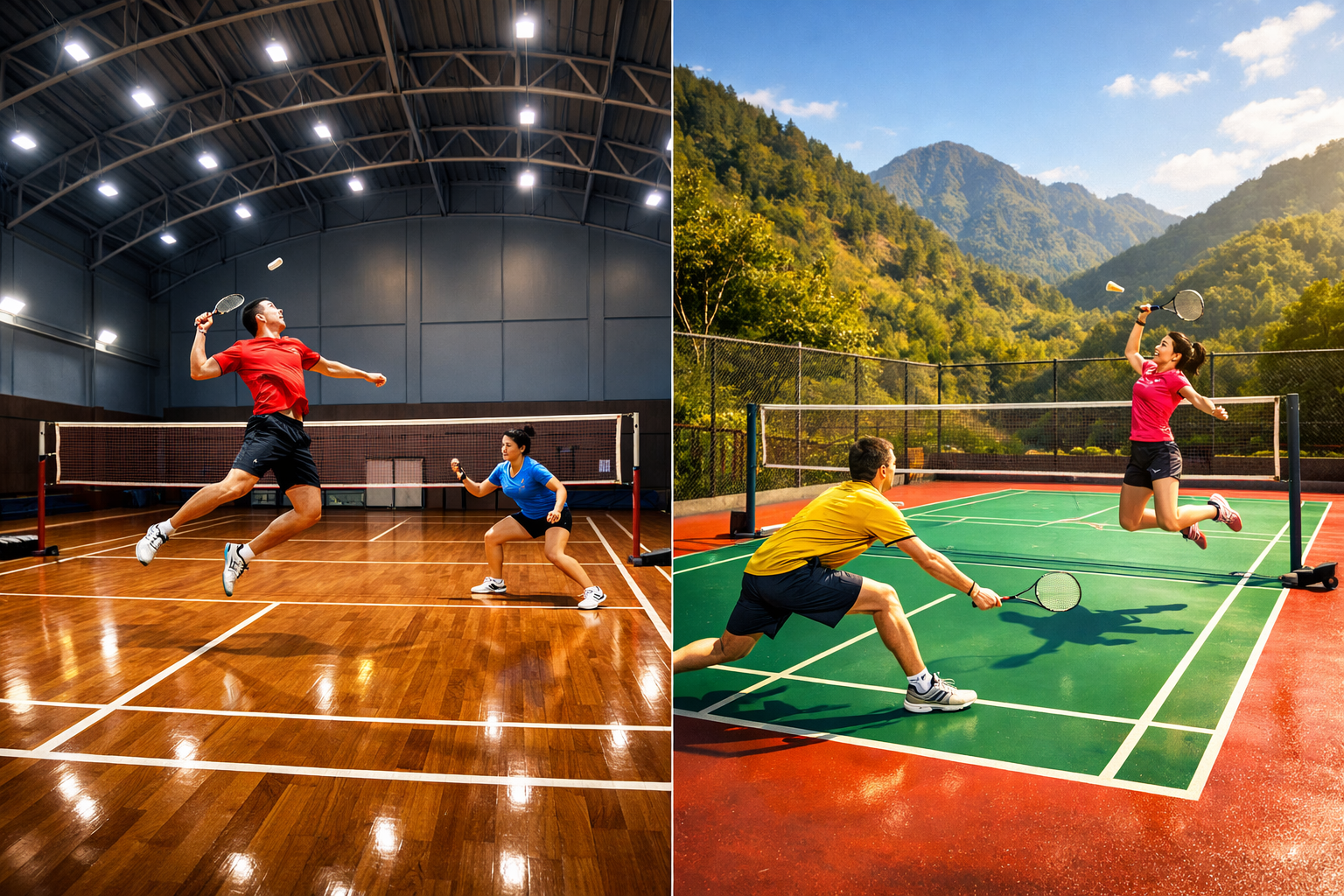
Badminton has become an increasingly popular sport across Arunachal Pradesh, attracting young athletes, school students, fitness enthusiasts, and professional players. From Itanagar and Naharlagun to Pasighat, Tawang, Ziro, and Bomdila, the growing interest in indoor sports and organised athletic training is creating opportunities for modern badminton facilities throughout the state. Schools, colleges, sports academies, residential communities, and government sports complexes are increasingly recognising the importance of developing courts that provide a safe, comfortable, and professional playing environment.
However, constructing a high-quality badminton court involves much more than installing a net and marking the playing area. The flooring system plays a crucial role in determining player comfort, movement, traction, shock absorption, and the overall quality of gameplay. A properly designed badminton court floor helps players perform quick lateral movements, sudden stops, lunges, and jumps while reducing unnecessary stress on their knees, ankles, and other joints.
Choosing the right Badminton Court Flooring in Arunachal Pradesh requires careful consideration of the local climate, building conditions, intended usage, maintenance requirements, and available budget. Heavy rainfall, seasonal humidity, temperature fluctuations, and differences in elevation across the state can influence the performance and longevity of sports flooring systems.
At Sports Facility, we provide badminton court flooring solutions designed to meet the requirements of schools, sports academies, indoor stadiums, recreational facilities, and private sports clubs. Our approach focuses on suitable flooring materials, proper subfloor preparation, accurate court marking, professional installation, and long-term surface performance.
Whether you are planning a new badminton academy in Itanagar, upgrading a school sports hall in Pasighat, or developing a recreational court in another part of Arunachal Pradesh, selecting an appropriate flooring system is an important step towards creating a dependable sports facility.
Why Quality Badminton Court Flooring Matters
Badminton is a fast-paced sport that requires speed, coordination, balance, agility, and precise footwork. During a typical rally, players repeatedly accelerate, decelerate, jump, land, and change direction. These movements place considerable demands on the playing surface.
Poor-quality flooring can create problems such as inconsistent grip, uneven surfaces, excessive hardness, unwanted slipperiness, and premature material deterioration. Such conditions can affect both player confidence and the overall usability of a court.
Professional badminton court flooring is designed to provide a more consistent playing environment while supporting the physical demands of the sport.
Key Benefits of Professional Flooring
1. Improved shock absorption
A suitable sports flooring system helps manage the impact generated during running, jumping, and landing. Depending on the flooring construction, resilient layers can reduce the load transferred to players’ lower limbs and improve comfort during extended training sessions.
2. Reliable grip and traction
Badminton players need sufficient grip to execute quick directional changes without losing their footing. A properly specified sports surface provides controlled traction without being excessively sticky, allowing players to move confidently across the court.
3. Consistent playing conditions
Uniform surface construction supports predictable foot movement and reliable playing conditions. A level, properly installed floor also helps eliminate irregularities that can interfere with movement and increase the risk of trips or slips.
4. Greater durability
Commercial-grade sports flooring is designed to withstand repeated use, frequent foot traffic, and regular training activities. The actual service life depends on material quality, installation standards, maintenance practices, and environmental conditions.
5. Better player comfort
Suitable cushioning and surface characteristics help create a comfortable environment for beginners, school students, recreational players, and competitive athletes.
6. Easier maintenance
Many modern sports flooring systems can be maintained through routine cleaning, periodic inspection, and appropriate surface care. Selecting the right material from the beginning can reduce avoidable repair expenses over time.
For badminton facilities in Arunachal Pradesh, these benefits are particularly important where a court must remain functional despite seasonal changes and demanding daily use.
Types of Badminton Court Flooring in Arunachal Pradesh
Different flooring materials offer different combinations of cushioning, traction, durability, appearance, and maintenance requirements. The most suitable choice depends on whether the court will be installed in an indoor stadium, school hall, private academy, multipurpose facility, or outdoor recreational area.
1. Wooden Badminton Court Flooring
Wooden sports flooring is a traditional choice for premium indoor badminton courts, professional training facilities, and competition venues. It offers a natural appearance and can provide excellent playing characteristics when engineered and installed specifically for sports use.
Maple is widely associated with high-quality indoor sports floors, while other suitable timber species may be considered depending on the specified system and local availability.
Key features:
- Resilient sports-floor construction when supported by an appropriate substructure.
- Comfortable playing characteristics for regular training.
- A professional appearance suitable for premium indoor venues.
- Potential for surface refinishing and maintenance over its service life.
- Compatibility with engineered shock-absorption systems.
Suitable applications: Indoor stadiums, dedicated badminton academies, sports clubs, and institutional sports halls.
In Arunachal Pradesh, wooden flooring requires careful moisture management. Timber can expand, contract, or deteriorate when exposed to unsuitable humidity conditions or water ingress. The subfloor, ventilation, moisture barriers, and building envelope should therefore be assessed before installation.
A professionally specified wooden floor can be a good option for facilities prioritising premium indoor playing conditions and willing to maintain the system appropriately.
2. PVC Vinyl Badminton Court Flooring
PVC sports flooring is a popular option for indoor badminton facilities because it combines a consistent playing surface with practical maintenance requirements. It is generally supplied in rolls or sheets and installed over a suitably prepared subfloor.
Sports-grade PVC flooring may incorporate multiple layers to provide surface durability, traction, and cushioning.
Key features:
- Uniform playing surface.
- Available in different colours and court-finish options.
- Cushioned construction in suitable sports flooring systems.
- Relatively straightforward routine cleaning.
- Practical installation for many indoor facilities.
Suitable applications: Schools, colleges, sports academies, indoor recreation centres, and multipurpose halls.
For projects in Itanagar, Naharlagun, Pasighat, and other locations, PVC flooring can offer a practical balance between playing performance, installation requirements, and ongoing maintenance.
However, not every vinyl product is designed for badminton. Buyers should choose a sports-specific product with documented performance characteristics, suitable traction, and appropriate shock absorption rather than ordinary commercial vinyl flooring.
3. Synthetic Polyurethane (PU) Sports Flooring
Polyurethane flooring is another option for indoor sports facilities. Depending on the system, it may consist of a prepared base, resilient layers, and a durable polyurethane wearing surface.
Its seamless or minimally jointed finish can be beneficial in suitable indoor environments.
Key features:
- Consistent surface finish.
- Configurable cushioning through suitable system design.
- A range of available colours.
- Resistance to routine wear when properly specified.
- Seamless construction in appropriate installations.
Suitable applications: Indoor sports halls, institutional facilities, training centres, and selected multipurpose sports venues.
PU flooring should be evaluated according to the complete system rather than the topcoat alone. The base, cushioning layers, surface texture, installation conditions, and manufacturer specifications all influence its final performance.
For badminton courts in Arunachal Pradesh, the installer should also assess subfloor moisture and ensure that application conditions fall within the product manufacturer’s requirements.
4. Acrylic Sports Flooring for Outdoor Courts
Acrylic sports coatings are commonly used on suitable outdoor sports surfaces, including selected badminton courts. These systems are applied over a properly prepared base, generally concrete or asphalt, and can provide a coloured, textured playing surface.
Key features:
- Available in a variety of colours.
- UV-resistant formulations for outdoor exposure.
- A textured finish designed to provide suitable traction.
- Relatively simple routine surface cleaning.
- Compatibility with certain resurfacing and repair systems.
Suitable applications: Outdoor recreational courts, school playgrounds, community sports areas, and selected institutional facilities.
Arunachal Pradesh receives substantial rainfall in many areas, so outdoor court design requires particular attention to drainage, slope, base stability, and water management. Acrylic coatings themselves should not be treated as a substitute for effective drainage or waterproofing.
An outdoor badminton court should be designed to prevent persistent water accumulation and reduce the risk of a slippery playing surface after rainfall. Players should not use the court until the surface is safe and dry.
5. Rubber Sports Flooring
Rubber flooring is frequently used in fitness rooms, warm-up areas, training zones, and multipurpose indoor facilities. Its resilience and noise-reduction characteristics can be beneficial in these settings.
However, not all rubber products are appropriate for the precise movement and traction requirements of badminton.
Key features:
- Impact cushioning in suitable product designs.
- Noise reduction in selected applications.
- Durable construction for designated training activities.
- Availability in tiles, rolls, and other formats.
- Practical use in exercise and conditioning spaces.
Suitable applications: Gym areas, athlete conditioning zones, warm-up spaces, and selected multipurpose facilities.
For a dedicated badminton court, a sports-specific playing surface should generally be prioritised over standard gym rubber flooring. Product suitability must be confirmed through technical specifications and intended-use testing.
Choosing Flooring for Arunachal Pradesh’s Climate
Climate is one of the most important considerations when developing sports infrastructure in Arunachal Pradesh. Conditions vary significantly across the state, with differences in elevation, seasonal rainfall, temperature, and local humidity.
A flooring system that performs well in a dry, controlled indoor environment may require additional protection or a different construction approach in a building exposed to moisture.
Moisture and Humidity Management
Excess moisture can damage timber, weaken certain adhesives, affect subfloor coatings, and contribute to mould growth in unsuitable environments. Before installation, the project team should assess the condition and moisture content of the subfloor.
Recommended measures include:
- Conducting appropriate subfloor moisture testing.
- Installing compatible moisture-control systems where required.
- Preventing water ingress through roofs, walls, and external openings.
- Maintaining suitable indoor ventilation.
- Following manufacturer recommendations for adhesives and installation materials.
Effective Drainage for Outdoor Courts
Outdoor courts must be designed around local rainfall conditions. Water should drain away efficiently without collecting in low areas or flowing back onto the playing surface.
The design should account for site grading, drainage channels, stable base construction, and the manufacturer’s recommendations for the selected coating system.
Temperature and Material Movement
Changes in temperature and humidity can affect timber, synthetic flooring, adhesives, and the supporting substrate. Appropriate expansion allowances, installation methods, and material selection help reduce the likelihood of gaps, buckling, or surface deterioration.
Ventilation and Indoor Conditions
Indoor courts should have suitable ventilation and, where necessary, humidity management. Roof leakage, condensation, and persistent dampness should be addressed before installing sensitive flooring materials.
The objective is not simply to select a moisture-resistant surface, but to design the entire court system for the conditions in which it will operate.
Professional Badminton Court Flooring Installation Process
A quality flooring system depends on correct installation as much as on the material itself. Even premium products may perform poorly if the base is uneven, moisture levels are unsuitable, or installation instructions are not followed.
A structured installation process helps improve consistency, durability, and player safety.
Site Inspection and Project Planning
The process begins with an assessment of the proposed court location. The team evaluates available space, building conditions, subfloor quality, access, ventilation, lighting, and the intended level of use.
The number of courts, surrounding circulation space, spectator arrangements, and supporting facilities should also be considered during planning.
Court Dimensions and Layout
The playing area must be measured and marked according to the relevant badminton rules.
A standard badminton court measures 13.40 metres in length and 6.10 metres in doubles width. The singles court uses the same length but a narrower playing width of 5.18 metres.
These measurements represent the marked playing area, not the complete building footprint. Additional clearance is required around the court for safe movement, run-off space, access, and any competition-specific requirements.
Subfloor Preparation
The supporting surface should be checked for levelness, structural stability, cracks, contamination, and moisture-related problems.
Necessary preparation may include cleaning, grinding, levelling, crack repair, and application of a compatible primer or moisture-control treatment. The precise method depends on the flooring system.
Flooring Installation
The selected flooring is installed according to the manufacturer’s technical instructions.
For PVC flooring, this may involve sheet positioning, adhesive application, seam treatment, and surface inspection. Wooden systems require appropriate substructure installation and moisture management. PU and acrylic systems require suitable base preparation and controlled application conditions.
Court Line Marking
Court markings must be accurately measured and applied using compatible marking materials. Lines should be clearly visible and consistent with the selected flooring system.
The installer should verify all dimensions before completing the final markings.
Quality Inspection and Handover
Before the court is handed over, the completed surface should be inspected for visible defects, unevenness, loose seams, unsuitable traction, and marking inaccuracies.
Where applicable, product documentation and specified performance tests should be reviewed. The facility manager should also receive guidance on cleaning, maintenance, and permitted footwear.
Badminton Court Flooring Cost in Arunachal Pradesh
The cost of badminton court flooring varies according to the selected material, installation area, subfloor condition, transportation requirements, and project specifications.
Because Arunachal Pradesh includes locations with different accessibility and logistics requirements, the total project cost should be calculated after a site-specific assessment rather than relying on a single statewide rate.
Factors That Influence Flooring Cost
1. Flooring material: Sports-grade PVC, wooden systems, PU flooring, and acrylic coatings have different material and installation costs.
2. Subfloor condition: Uneven concrete, cracks, dampness, and drainage problems can increase preparation expenses.
3. Installation area: A project involving multiple courts may have different material, labour, and equipment costs from a single-court installation.
4. Transportation and accessibility: Delivery to remote or elevated locations may affect freight charges, unloading, and installation scheduling.
5. Court accessories: Nets, posts, lighting, protective padding, and other accessories may be included in or excluded from the flooring quotation.
6. Maintenance requirements: Some systems require periodic refinishing, specialised cleaning, or eventual resurfacing. These costs should be considered alongside the initial investment.
How to Obtain an Accurate Quotation
For a reliable estimate, provide the contractor with the project location, number of courts, indoor or outdoor classification, approximate available area, existing floor condition, preferred material, and intended usage.
Request a written quotation that identifies material specifications, subfloor preparation, installation, line marking, transport, taxes, and applicable warranty conditions.
Comparing complete specifications rather than focusing only on the lowest initial price can help facility owners make a more informed decision.
Technical Specifications for Badminton Court Flooring
The specifications of a badminton flooring system should be selected according to the facility’s purpose and the manufacturer’s verified product data.
The following table provides a practical framework for evaluating an indoor sports flooring proposal.
| Component | What to Evaluate |
|---|---|
| Playing surface | Sports-grade wood, PVC, or another suitable indoor system |
| Subfloor | Stable, level, and appropriately prepared base |
| Cushioning | Verified shock absorption and vertical deformation data |
| Traction | Suitable slip resistance for badminton movements |
| Surface finish | Consistent texture and clear visibility |
| Court markings | Accurate singles and doubles dimensions |
| Moisture control | Appropriate testing and protection for the substrate |
| Maintenance | Manufacturer-approved cleaning and repair procedures |
Performance values should be taken from the selected product’s technical documentation and relevant test reports. Thickness, shock absorption, and surface properties vary between systems, so specifications should not be assumed to be identical across all flooring products.
Why Choose Sports Facility for Badminton Court Flooring?
Selecting an experienced sports flooring contractor can simplify the process of planning, material selection, installation, and long-term maintenance.
At Sports Facility, our service approach focuses on helping clients identify suitable flooring systems for their project requirements.
Complete Project Support
A well-planned sports flooring project involves several connected activities, including site evaluation, material selection, base preparation, installation, line marking, and final inspection. Coordinating these stages helps reduce avoidable errors and improves project management.
Flooring Options for Different Budgets
Schools, residential developments, private academies, and larger sports facilities have different budget requirements. Comparing suitable flooring systems allows clients to balance initial investment, performance expectations, and maintenance costs.
Climate-Conscious Planning
Moisture management, drainage, ventilation, and material compatibility should be considered from the design stage, especially in locations exposed to heavy rainfall or seasonal humidity.
Installation Quality
Correct surface preparation, careful material handling, accurate measurements, and adherence to manufacturer specifications are essential to a successful installation.
Maintenance Guidance
Routine inspection and suitable cleaning practices can help preserve surface performance. Facility managers should receive clear instructions on preventing moisture damage, addressing minor defects, and arranging professional maintenance when required.
When evaluating any contractor, clients should request relevant project references, product technical sheets, installation details, and written warranty terms. Claims relating to certifications or international approvals should be verified for the specific product and application.
Areas We Serve Across Arunachal Pradesh
Badminton court flooring solutions can support sports development in towns and communities throughout Arunachal Pradesh, subject to project access and site requirements.
Our service enquiries can include projects in:
- Itanagar and Naharlagun
- Tawang and Bomdila
- Pasighat and Roing
- Ziro and nearby areas
- Namsai and Tezu
- Changlang and Yingkiong
- Aalo (Along) and Dirang
Potential projects include school sports halls, college facilities, government sports complexes, private badminton academies, community recreation centres, residential developments, and indoor stadiums.
The appropriate flooring system should be selected according to the location, building conditions, available maintenance support, and intended playing level.
Frequently Asked Questions
1. Which flooring is best for a badminton court in Arunachal Pradesh?
For indoor courts, sports-grade PVC flooring and properly engineered wooden flooring are common options. PU systems may also be suitable for selected facilities. The final choice depends on the subfloor, moisture conditions, budget, maintenance capacity, and intended use.
2. Is wooden flooring suitable for humid conditions?
Yes, provided the flooring is properly designed and installed in a suitable indoor environment. Moisture testing, effective building protection, ventilation, and ongoing maintenance are important because timber is sensitive to moisture fluctuations.
3. Can acrylic flooring be used for outdoor badminton courts?
Acrylic sports coatings can be suitable for outdoor courts when applied to an appropriate base. Effective drainage, a stable substrate, and suitable surface texture are essential, particularly in areas receiving heavy rainfall.
4. How much space is needed for a badminton court?
The standard doubles playing area is 13.40 metres by 6.10 metres, while singles play uses a width of 5.18 metres. The total facility needs additional space for player movement, clearance, access, and any applicable competition requirements.
5. How long does badminton court flooring installation take?
The installation period depends on the flooring system, preparation work, site access, material availability, and environmental conditions. A straightforward project may take several days, while more complex installations can require longer. A realistic schedule should be confirmed after site inspection.
6. How should badminton court flooring be maintained?
Routine maintenance generally includes removing dust and grit, using manufacturer-approved cleaning methods, inspecting seams and surface finishes, and promptly addressing leaks or moisture problems. Abrasive cleaning tools and unsuitable chemicals should be avoided.
7. Is PVC flooring suitable for badminton academies?
Sports-grade PVC flooring can be a practical choice for many academies because it offers a consistent playing surface and manageable routine maintenance. Buyers should verify that the selected product is designed for badminton and provides suitable traction and cushioning.
8. What determines the total cost of badminton court flooring?
The main factors include the flooring material, court area, subfloor condition, preparation work, installation complexity, transportation, line marking, and accessories. A site-specific quotation provides a more dependable estimate than a generic per-square-foot rate.
9. Are all sports flooring products internationally approved?
No. Certifications and approvals depend on the specific product, testing process, and intended application. Clients should request current supporting documentation and verify that the product meets the requirements of their facility and competition level.
10. Can an existing badminton court be renovated?
Yes. Depending on the condition of the existing floor, renovation may involve repairs, resurfacing, replacement of worn sections, new line markings, or complete flooring replacement. The existing subfloor should be inspected before deciding on the most appropriate approach.
Conclusion
Developing a reliable badminton facility in Arunachal Pradesh begins with selecting a flooring system that suits the players, building, climate, and expected level of activity. Wooden flooring can offer premium indoor playing characteristics, sports-grade PVC provides a practical option for many academies and schools, and suitable PU or acrylic systems may meet the needs of other indoor and outdoor environments.
However, the material alone does not determine the quality of the finished court. Subfloor preparation, moisture management, accurate line marking, professional installation, and regular maintenance all contribute to long-term performance.
Whether you are planning a new badminton academy, upgrading an institutional sports hall, or creating a community playing facility, a carefully designed flooring system can support safer movement, more consistent gameplay, and better use of your sports infrastructure.
To explore suitable options for Badminton Court Flooring in Arunachal Pradesh, visit Sports Facility and discuss your project requirements, preferred flooring material, site conditions, and budget with the team.