Designing a commercial basketball court is a highly technical process that goes far beyond drawing boundary lines on a floor. It requires strict adherence to standardized dimensions, careful planning of gameplay zones, and a deep understanding of how athletes interact with space during high-intensity movement. Whether the court is intended for a professional arena, a school sports hall, a training academy, or a multi-sport complex, precision in measurement directly influences player performance, safety, and the overall usability of the facility.
This detailed guide provides an in-depth explanation of commercial basketball court measurements, including official dimensions, zone specifications, line markings, flooring considerations, and international compliance standards. The objective is to present a comprehensive understanding of how a regulation basketball court is structured and why each measurement matters in real-world applications.
1. Overview of a Commercial Basketball Court
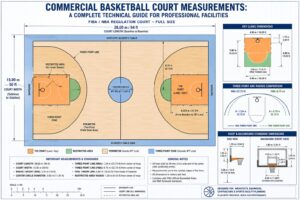
A commercial basketball court is designed to support organized, competitive, and recreational basketball activities under standardized rules. Unlike informal or residential courts, commercial courts must meet defined dimensional requirements so that gameplay remains consistent and fair across different locations.
Two major governing bodies define official court standards:
- Fédération Internationale de Basketball (FIBA) – used internationally
- National Basketball Association (NBA) – used primarily in the United States
While both systems are similar, slight variations exist in court size, three-point line distance, and key area dimensions. Commercial courts are usually built to align with FIBA standards because they are widely accepted globally, especially in schools, academies, and multipurpose sports facilities.
2. Standard Overall Court Dimensions
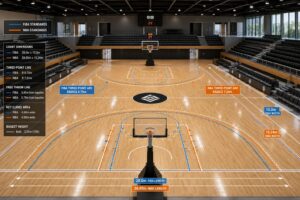
The foundation of any basketball court is its overall playing area. This includes the rectangular surface where all gameplay occurs, bounded by sidelines and baselines.
Official Commercial Court Size (FIBA Standard)
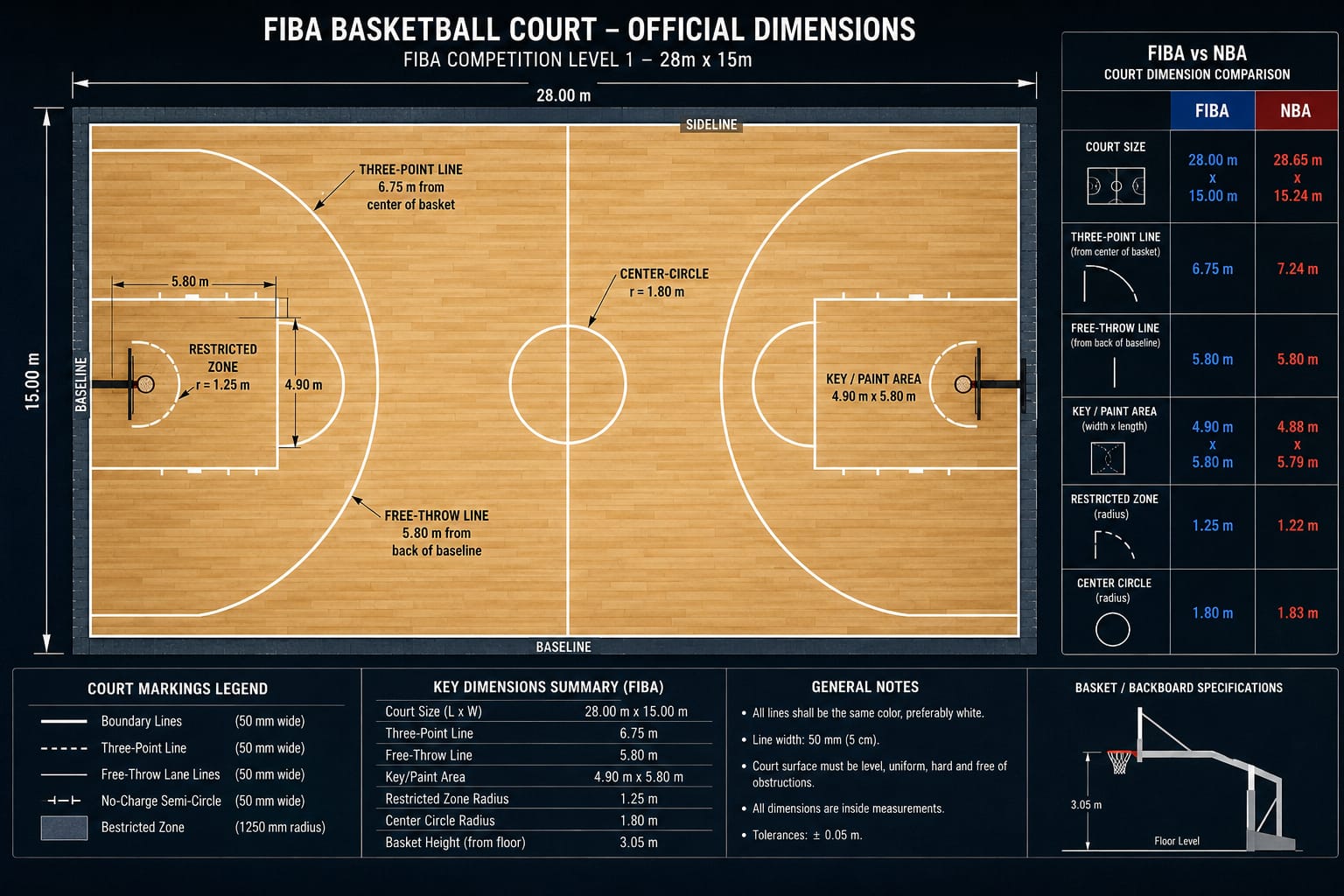
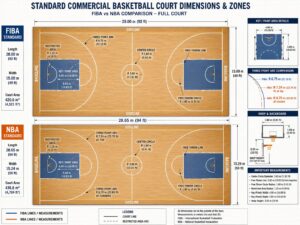
- Court Length: 28 meters (approximately 92 feet)
- Court Width: 15 meters (approximately 49 feet)
These dimensions create a balanced playing field that allows fluid movement, strategic positioning, and fair competition.
NBA Standard Comparison
- Length: 28.65 meters (94 feet)
- Width: 15.24 meters (50 feet)
Although slightly larger, NBA courts follow the same structural layout, ensuring familiarity for players transitioning between leagues.
Importance of Standard Dimensions
Maintaining correct overall measurements is essential because:
- It ensures consistent gameplay across different venues
- It prevents spatial disadvantages for players
- It allows courts to be used for official tournaments
- It supports proper spacing for offensive and defensive strategies
Even minor deviations in court size can significantly affect shooting angles, player spacing, and game tempo.
3. Layout Structure and Court Zones
A basketball court is divided into multiple functional zones, each serving a specific purpose in gameplay. These include the key area, three-point zone, free-throw line, and center circle.
Understanding these zones is crucial for accurate court construction.
3.1 The Key Area (Restricted Area / Paint)
The key, also known as the paint area or restricted area, is one of the most strategically important zones on the court. It is where most close-range scoring, rebounds, and defensive positioning occur.
Dimensions:
- Width: 4.9 meters (16 feet)
- Length: 5.8 meters (19 feet) from baseline to free-throw line
Restricted Arc:
- Radius: 1.25 meters (4 feet) from the center of the basket
Functional Purpose:
- Defines legal positioning for defensive charging calls
- Controls player movement near the basket
- Structures rebound and post-play strategies
- Establishes free-throw lane boundaries
The paint area is often heavily marked and visually distinct because it is one of the most frequently used sections during gameplay.
3.2 Free-Throw Line and Circle
The free-throw system is a critical scoring mechanism in basketball, requiring precise measurement for fairness.
Free-Throw Line:
- Located 5.8 meters (19 feet) from the baseline
- Width: 15 cm (6 inches)
This line determines where players must stand during foul shots.
Free-Throw Circle:
- Radius: 1.8 meters (6 feet)
The circle surrounds the free-throw line and helps regulate player positioning during free-throw attempts.
Importance:
- Ensures equal shooting conditions
- Prevents lane violations
- Maintains structured rebounding positions
- Supports officiating accuracy
Even slight misalignment in this area can lead to unfair advantages during games.
3.3 Three-Point Line (Arc)
The three-point line is one of the most influential features in modern basketball, as it defines long-range scoring opportunities.
FIBA Standard:
- 6.75 meters (22 feet 1.7 inches) from the basket
NBA Standard:
- 7.24 meters (23 feet 9 inches) at the top of the arc
- 6.7 meters (22 feet) in corner areas
Purpose and Impact:
- Encourages long-distance shooting skills
- Expands offensive strategies
- Creates spacing between players
- Adds scoring diversity to the game
The three-point arc significantly shapes modern basketball tactics, making it one of the most strategically important markings on the court.
3.4 Center Circle
The center circle is located at the midpoint of the court and is primarily used during game initiation.
Dimensions:
- Diameter: 3.6 meters (12 feet)
Function:
- Used for jump ball at the start of the game
- Helps in organizing team formations
- Serves as a visual center reference point
This circular marking ensures fair starting conditions for both teams.
3.5 Sidelines and Baselines
These are the boundary lines that define the playable area.
Specifications:
- Clearly marked rectangular boundary
- Must be highly visible and durable
- Typically painted in contrasting colors
Purpose:
- Determines in-bounds and out-of-bounds play
- Helps referees make accurate decisions
- Maintains structural integrity of gameplay space
Without properly marked boundaries, gameplay would lose consistency and fairness.
4. Basket and Backboard Specifications
The basket system is the focal point of the game, and its placement must follow strict regulations.
Basket Height:
- 3.05 meters (10 feet) from the playing surface
Backboard Dimensions:
- Width: 1.8 meters (6 feet)
- Height: 1.05 meters (3 feet 6 inches)
Distance from Baseline:
- 1.2 meters (4 feet) from baseline to backboard support
Importance:
- Ensures uniform shooting conditions
- Maintains global consistency in scoring mechanics
- Supports safe player interaction near the hoop
Incorrect hoop height or placement can significantly distort gameplay and training outcomes.
5. Flooring and Surface Requirements
A commercial basketball court is not defined by measurements alone; the surface material plays an equally critical role.
Common Flooring Types:
1. Hardwood Flooring
- Typically made from maple wood
- Preferred for professional indoor courts
- Provides excellent bounce and shock absorption
2. Synthetic Flooring
- Made from polyurethane, PVC, or acrylic layers
- Suitable for indoor and outdoor multipurpose courts
- Offers high durability and weather resistance
3. Modular Interlocking Tiles
- Easy installation and replacement
- Used in recreational and community courts
- Requires minimal maintenance
Surface Requirements:
- Non-slip finish for player safety
- Consistent ball rebound
- Shock absorption to reduce injuries
- Resistance to wear and moisture
A well-designed surface significantly reduces stress on athletes’ joints and improves performance consistency.
6. Line Markings and Visibility Standards
Court markings must be precise and highly visible to ensure smooth gameplay.
Key Requirements:
- Use of durable, high-contrast paint
- Standard line width (typically 5–7 cm depending on regulation)
- UV-resistant materials for outdoor courts
- Regular maintenance and repainting schedule
Markings Include:
- Boundary lines
- Free-throw lines
- Three-point arc
- Center circle
- Key area markings
- Restricted area arc
Clear markings are essential for referees, players, and spectators to accurately interpret gameplay situations.
7. Compliance with International Standards
Commercial basketball courts must adhere to recognized global standards to ensure compatibility with official gameplay rules.
Key Regulatory Bodies:
- FIBA (international standard)
- NBA (professional American standard)
- National sports authorities (country-specific regulations)
Why Compliance Matters:
- Enables hosting of official tournaments
- Ensures player safety and fairness
- Enhances facility credibility
- Standardizes training conditions
Non-compliant courts may still be usable for recreation but cannot support official competitive events.
8. Conclusion
A commercial basketball court is a carefully engineered sports environment where every measurement plays a vital role in shaping gameplay quality, safety, and competitive fairness. From the overall court dimensions to the smallest marking inside the key area, each specification contributes to a structured and standardized playing experience.
Accurate implementation of court measurements ensures that athletes can perform at their best while minimizing risk and maximizing consistency. Whether used in schools, training centers, or professional arenas, a properly designed basketball court stands as a foundation for athletic development and organized sport.
In essence, precision in design is not just a technical requirement—it is the backbone of modern basketball infrastructure.