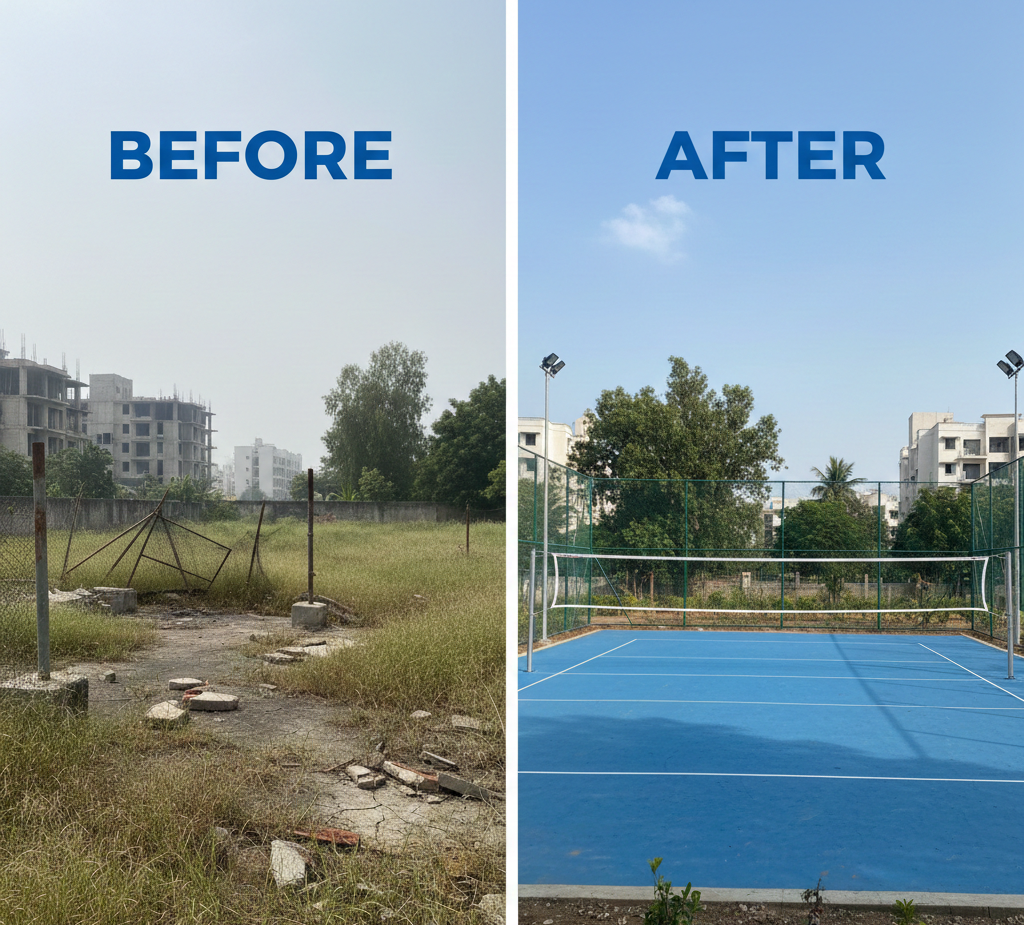
Introduction
The growing interest in sports, fitness, and recreational activities has increased the demand for modern sports facilities across Noida. Schools, colleges, residential societies, sports academies, private clubs, and commercial sports complexes are increasingly investing in well-designed volleyball courts to encourage physical activity and provide better training opportunities. As a result, volleyball court construction in Noida has become an important service for institutions and property developers looking to create durable, safe, and professional-quality sports infrastructure.
Building a volleyball court involves much more than preparing a flat surface and installing a net. The process requires careful planning, accurate court dimensions, suitable flooring materials, a stable foundation, effective drainage, and proper line markings. The choice of construction method also depends on whether the facility is intended for recreational use, school-level competitions, professional training, or beach volleyball.
Noida’s changing weather conditions, including hot summers, dust, and monsoon rainfall, make material selection and surface preparation particularly important for outdoor courts. Indoor facilities require a different approach, with attention to shock absorption, lighting, ventilation, and player comfort.
Sports-Facility.in provides information and solutions for sports court development, helping customers explore suitable construction options for their projects. This guide explains the major aspects of volleyball court construction in Noida, including court types, standard dimensions, flooring systems, installation procedures, estimated costs, maintenance requirements, and important considerations when selecting a contractor.
Why Is Volleyball Court Construction in Noida in Demand?
Noida has developed into a major residential, educational, and commercial destination. The increasing number of schools, housing societies, sports academies, and recreational facilities has created opportunities for organised sports activities.
Volleyball is particularly suitable for community sports because it encourages teamwork, coordination, agility, and physical fitness. A properly constructed court can serve children, teenagers, adults, amateur players, and competitive athletes.
Here are some important reasons why organisations are investing in volleyball court development.
1. Sports Facilities for Schools and Colleges
Educational institutions are incorporating sports into their extracurricular programmes to encourage students to maintain active lifestyles. A professionally designed volleyball court gives students a dedicated space to practise, participate in inter-school competitions, and develop sporting skills.
2. Recreational Amenities in Residential Societies
Modern residential developments increasingly include sports and fitness amenities. Installing a volleyball court can improve the recreational value of a housing society while providing residents with a convenient place to exercise and socialise.
3. Training Infrastructure for Sports Academies
Sports academies require dependable playing surfaces that support regular practice sessions. A suitable court layout, quality flooring, correctly installed net posts, and appropriate lighting can help create a better training environment.
4. Commercial Sports and Recreation Facilities
Private sports centres can use volleyball courts to accommodate coaching programmes, recreational bookings, local tournaments, and group activities. Selecting durable materials and planning the facility efficiently can help support long-term usage.
Types of Volleyball Courts Available in Noida
The ideal court design depends on the available space, expected playing frequency, budget, and intended use. Before beginning construction, it is important to identify the most suitable court type.
1. Outdoor Volleyball Court Construction
Outdoor volleyball courts are commonly developed in schools, residential communities, parks, clubs, and open sports complexes. These facilities generally require weather-resistant flooring, a stable base, proper surface slopes where appropriate, and effective rainwater management.
Common outdoor surface options include acrylic sports flooring, concrete-based surfaces, and other purpose-designed synthetic systems.
Acrylic sports flooring is a popular choice for outdoor facilities because it offers a relatively uniform playing surface and can be installed in different colour combinations. However, the underlying base must be properly prepared to prevent cracks, water accumulation, and premature surface deterioration.
For projects in Noida, outdoor court specifications should account for summer temperatures, dust, rainfall, and exposure to sunlight.
2. Indoor Volleyball Court Construction
Indoor volleyball courts are suitable for sports academies, schools, colleges, professional training centres, and indoor stadiums. Since the playing environment is protected from direct sunlight and rainfall, indoor facilities can support more consistent playing conditions throughout the year.
Common flooring choices include sports-grade wooden flooring, specialised PVC sports flooring, and suitable synthetic sports systems designed for indoor use.
Indoor construction also involves planning the subfloor, ceiling clearance, lighting, ventilation, and safe movement around the playing area. Where competitive play is intended, the complete facility should be designed according to the applicable competition requirements.
3. Beach Volleyball Court Construction
Beach volleyball courts provide a different playing experience and are often installed at resorts, recreational clubs, schools, and specialised sports facilities.
Unlike conventional volleyball courts, beach courts use a properly prepared sand playing surface. The construction process includes excavation, suitable subgrade preparation, drainage planning, and the installation of appropriate sand.
The sand should be clean, suitably graded, and free from harmful debris. Its depth and composition must be selected according to the intended use and applicable beach volleyball specifications.
4. Multipurpose Volleyball Courts
Some schools and residential projects have limited space and need facilities that accommodate several activities. A multipurpose sports court can be designed to support volleyball alongside other compatible sports.
However, each activity has different dimensions, safety clearances, and surface requirements. The layout should therefore be planned carefully to prevent overlapping markings from creating confusion during play.
Standard Volleyball Court Dimensions
Accurate measurements are essential for a functional volleyball court. According to standard indoor volleyball rules, the playing court measures 18 metres long and 9 metres wide.
Important dimensions and design considerations include:
- Playing area: 18 m × 9 m.
- Centre line: Divides the playing court into two equal halves.
- Attack lines: Located 3 metres from the centre line on each side.
- Net height for men: 2.43 metres.
- Net height for women: 2.24 metres.
- Free zone: At least 3 metres wide around the playing court under standard indoor rules, with larger clearances required or recommended for certain competition levels.
- Playing clearance: Vertical space above the court must meet the requirements applicable to the intended level of play.
The overall construction area must be larger than the playing area because players need sufficient room outside the boundary lines for safe movement.
Before construction begins, the contractor should confirm the intended competition level and the relevant requirements for the free zone, overhead clearance, net posts, and other equipment. Beach volleyball and specialised competition facilities have their own specifications.
Step-by-Step Process for Volleyball Court Construction in Noida
A successful sports court project depends on a structured installation process. Every stage, from site inspection to final testing, contributes to the court’s durability and playing quality.
Site Inspection and Project Planning
The first stage involves evaluating the proposed construction location. The contractor examines the available space, existing ground conditions, access routes, surrounding structures, and expected usage.
For outdoor projects, the assessment should also consider natural drainage, exposure to sunlight, and the possibility of waterlogging during the monsoon.
At this stage, the client should determine the court type, flooring preference, required accessories, approximate budget, and intended completion schedule.
Ground Preparation and Levelling
After the site is approved, the construction area is cleared of vegetation, loose soil, debris, and unsuitable materials. Excavation and levelling are then carried out according to the project design.
Proper compaction is particularly important because an unstable subgrade can contribute to settlement, cracking, and uneven playing conditions.
The preparation method depends on the existing soil, the proposed surface system, and the expected loading conditions.
Foundation and Base Construction
The foundation supports the entire playing surface. Depending on the design, the contractor may use a compacted granular base, concrete base, asphalt base, or another engineered foundation system.
For acrylic outdoor courts, the base must provide suitable stability and surface regularity. Indoor wooden and synthetic floors require a compatible subfloor, while beach volleyball courts need a properly prepared sand base and suitable drainage.
The base should be inspected before flooring installation begins. Any significant unevenness, cracks, moisture problems, or other defects should be addressed at the appropriate stage.
Volleyball Court Flooring Installation
Selecting the correct flooring system is one of the most important decisions in the project.
For outdoor courts, acrylic sports flooring can provide a durable, coloured playing surface when installed over a suitable base. Indoor facilities may benefit from sports-grade wooden flooring or specialised synthetic flooring designed for athletic use.
The installation process varies by material. It may involve surface cleaning, primer application, levelling compounds, cushioning layers, multiple surface coats, or the installation of prefabricated flooring components.
The chosen system should be suitable for volleyball, expected playing intensity, maintenance capabilities, and the local environment.
Court Marking and Net Installation
Once the playing surface is ready, the contractor marks the court boundaries, centre line, and attack lines according to the approved layout.
The markings should be clearly visible, accurately positioned, and compatible with the flooring material.
Net posts must be securely installed, with appropriate padding where required. The net should be adjustable to the intended playing height and positioned correctly relative to the centre line.
Lighting and Additional Facilities
Some projects require additional features such as floodlights, perimeter fencing, player seating, spectator areas, storage facilities, and equipment zones.
Lighting should provide suitable visibility without excessive glare. Electrical installations and pole foundations should be designed for the site conditions.
For indoor courts, the project may also require suitable ventilation, emergency access, and adequate overhead clearance.
Final Inspection and Handover
Before the court is handed over, the completed surface should be inspected for visible defects, uneven areas, inaccurate markings, and installation issues.
The contractor should also check the net system, accessory fittings, and relevant safety features. For newly installed synthetic systems, the specified curing or settling period must be observed before regular play begins.
A clear maintenance plan can help the owner preserve the court’s condition after installation.
Best Flooring Options for Volleyball Courts in Noida
Choosing the right playing surface depends on whether the court is indoors or outdoors and how frequently it will be used.
Acrylic Sports Flooring
Acrylic flooring is commonly considered for outdoor volleyball courts in schools, housing societies, and recreational facilities. It provides a coloured surface with clear line markings and can be installed in different combinations.
Its performance depends on the condition of the base, the quality of the materials, installation practices, and ongoing maintenance.
Wooden Sports Flooring
Wooden flooring is a traditional choice for indoor sports halls and facilities designed for competitive play. A suitable sports-grade wooden system can provide controlled surface response and shock absorption.
However, it generally involves a higher initial investment and requires protection against moisture, inappropriate cleaning products, and unsuitable indoor environmental conditions.
Synthetic PVC Sports Flooring
Sports-grade PVC flooring is used in many indoor sports environments. Depending on the system, it can provide cushioning, a consistent playing surface, and relatively straightforward cleaning.
The selected product should be designed for sports applications rather than ordinary domestic use. Subfloor preparation and correct installation remain essential.
Concrete-Based Playing Surfaces
Concrete can be considered for basic outdoor recreational courts because of its relatively straightforward construction and maintenance. However, an untreated hard concrete surface may offer less cushioning than specialised sports flooring.
Where concrete is used, the design should prioritise surface regularity, drainage, slip resistance, and player safety.
Sand Flooring for Beach Volleyball
Beach volleyball requires an appropriate sand playing surface rather than a conventional hard court. Sand selection, depth, drainage, and regular levelling all influence playing quality.
The construction specifications should reflect whether the court is intended for casual recreation or organised competition.
Volleyball Court Construction Cost in Noida
The cost of volleyball court construction in Noida depends on the court dimensions, foundation requirements, flooring material, site conditions, accessories, and additional infrastructure.
The following figures are indicative budgeting estimates, not verified current contractor quotations. Actual project rates may differ depending on the specifications and the supplier.
| Court type | Indicative budget |
|---|---|
| Basic outdoor concrete court | ₹3–6 lakh |
| Outdoor acrylic volleyball court | ₹7–12 lakh |
| Indoor synthetic sports court | ₹10–16 lakh |
| Indoor wooden sports court | ₹15–25 lakh or more |
| Beach volleyball court | ₹5–10 lakh |
These estimates assume a typical small-to-medium project and may not include every civil, electrical, drainage, or building-related expense. A professional indoor facility with extensive structural work may cost substantially more.
Factors That Influence Construction Cost
1. Site conditions: Excavation, soil improvement, levelling, and the removal of existing materials can affect the total budget.
2. Flooring material: Acrylic, PVC, wooden, and sand-based systems have different installation requirements and material costs.
3. Foundation quality: The foundation design must suit the soil conditions and proposed surface. Reducing essential base preparation can result in expensive repairs later.
4. Court accessories: Net posts, nets, padding, fencing, and seating add to the project cost.
5. Lighting requirements: Floodlights, electrical connections, control systems, and supporting structures may increase the budget.
6. Drainage and weather protection: Outdoor courts may need additional drainage measures to manage rainfall and reduce water accumulation.
7. Project size and usage: Recreational courts and competition-level facilities may require different clearances, materials, and equipment.
For a reliable estimate, request a detailed quotation that identifies the flooring system, base construction, line markings, accessories, installation charges, and applicable taxes separately.
How to Choose a Volleyball Court Construction Company in Noida
Selecting an experienced contractor can make a significant difference to the final result. Before appointing a company, consider the following points.
- Relevant project experience: Review previous volleyball courts and similar sports flooring installations.
- Material specifications: Ask for clear details about the proposed flooring, foundation, and installation system.
- Construction methodology: Confirm that the company follows a defined process for site preparation, base construction, and surface installation.
- Transparent pricing: Request an itemised quotation instead of relying only on a single per-square-foot rate.
- Safety and dimensions: Ensure the layout accommodates the required playing area, free zones, net height, and overhead clearance.
- Warranty and maintenance: Understand the coverage offered and obtain written care instructions.
- Project schedule: Confirm the expected duration, including weather-related delays and flooring curing requirements where applicable.
Sports-Facility.in is a resource to explore for sports court construction and flooring solutions. Customers should review the company’s relevant project experience, proposed specifications, and quotation before finalising their contractor.
Maintenance Tips for Long-Lasting Volleyball Courts
Regular maintenance helps protect the playing surface, maintain safe conditions, and reduce the likelihood of major repairs.
Outdoor Acrylic Courts
Remove dust, leaves, and debris through regular sweeping. Clean the surface using methods recommended by the flooring manufacturer, and inspect it periodically for cracks, surface wear, and drainage problems.
Avoid dragging heavy equipment across the playing surface.
Indoor Wooden Courts
Use appropriate sports-floor cleaning products and avoid excessive moisture. Inspect the surface for damage and follow the manufacturer’s recommendations for refinishing, environmental control, and maintenance.
Synthetic Indoor Courts
Clean the surface according to the product guidelines and check for loose seams, damaged areas, or other defects. Use footwear and cleaning equipment appropriate for the flooring system.
Beach Volleyball Courts
Rake the sand regularly to maintain an even playing surface. Remove stones, litter, and other unwanted materials, and inspect the drainage system after heavy rainfall.
General Maintenance Practices
Keep net posts and other accessories secure, inspect protective padding, and replace worn or damaged equipment when necessary. Establishing a regular inspection schedule can help identify small issues before they become costly repairs.
Common Challenges in Volleyball Court Construction in Noida
Local environmental and site conditions should be considered during the planning stage.
Summer heat: Outdoor materials must be suitable for local temperatures and prolonged sunlight exposure.
Monsoon rainfall: Effective drainage and proper base construction help reduce water accumulation and moisture-related damage.
Dust accumulation: Regular cleaning is necessary to maintain the surface condition and playing characteristics.
Limited space: Residential developments and schools may have restricted areas. Careful planning is required to provide the correct playing dimensions and safety clearances.
Budget limitations: Selecting materials based only on the lowest initial price may increase long-term maintenance expenses. The complete lifecycle cost should be considered.
Addressing these challenges during design and construction can improve the usability and service life of the finished court.
Conclusion
Professional volleyball court construction in Noida requires a combination of careful planning, suitable flooring, reliable foundation work, accurate measurements, and quality installation. Whether the project is intended for a school, residential society, sports academy, indoor stadium, or recreational facility, the right construction approach can create a safe and dependable playing environment.
Outdoor acrylic courts, indoor wooden flooring, synthetic sports surfaces, and beach volleyball courts each serve different purposes. The best option depends on the intended use, site conditions, available budget, and maintenance requirements.
Before starting a project, evaluate the available space, confirm the relevant volleyball specifications, compare suitable flooring systems, and obtain a detailed construction estimate. Investing in quality materials and skilled installation can help reduce future repair costs and support long-term performance.
For information about sports flooring and court development, visit Sports-Facility.in or explore its volleyball court solutions. Review the proposed scope of work and project credentials to determine the right solution for your facility.
Frequently Asked Questions About Volleyball Court Construction in Noida
1. What is the standard size of a volleyball court?
A standard indoor volleyball playing court measures 18 metres long and 9 metres wide. Additional space is required around the court for player movement and safety.
2. What is the cost of volleyball court construction in Noida?
The cost depends on the flooring system, foundation, site conditions, and additional features. An outdoor acrylic court may have an indicative budget of ₹7–12 lakh, while a professional indoor wooden court can cost ₹15–25 lakh or more. A site-specific quotation is necessary for accurate pricing.
3. Which flooring is best for an outdoor volleyball court?
Acrylic sports flooring is a common option for outdoor courts. The best choice depends on the existing base, expected usage, weather exposure, maintenance requirements, and budget.
4. Which flooring is suitable for indoor volleyball courts?
Sports-grade wooden flooring and specialised synthetic PVC systems are both options for indoor facilities. The choice should consider player comfort, sports requirements, installation costs, and maintenance.
5. How long does it take to construct a volleyball court?
A straightforward project may take approximately four to eight weeks, although the actual timeline varies. Ground conditions, foundation work, weather, flooring installation, and additional infrastructure can extend the schedule.
6. Can an outdoor volleyball court be used during the monsoon?
An outdoor court can be designed to manage rainfall, but its usability depends on the drainage system, surface material, and weather conditions. The surface should be inspected and allowed to become safe before play resumes after rain.
7. Is it possible to construct a volleyball court in a residential society?
Yes. A residential society can develop a volleyball court if sufficient space is available for the playing area, free zones, access, and any necessary safety features. Local approvals and site-specific requirements should be checked before construction.
8. Can a volleyball court be used for other sports?
A multipurpose court can accommodate selected sports if the dimensions, flooring, and safety clearances are appropriate. Separate line colours and a carefully planned layout can make the facility easier to use.
9. What factors should be considered before hiring a volleyball court contractor?
Review previous projects, material specifications, construction methods, pricing transparency, installation timelines, warranty conditions, and maintenance support. Confirm that the proposed design meets the requirements of the intended users.
10. How can I get a quotation for volleyball court construction in Noida?
Prepare the site dimensions, preferred court type, flooring requirements, intended usage, and accessory requirements. Share these details with a sports court construction company and request an itemised estimate covering civil work, flooring, markings, equipment, and other project expenses.