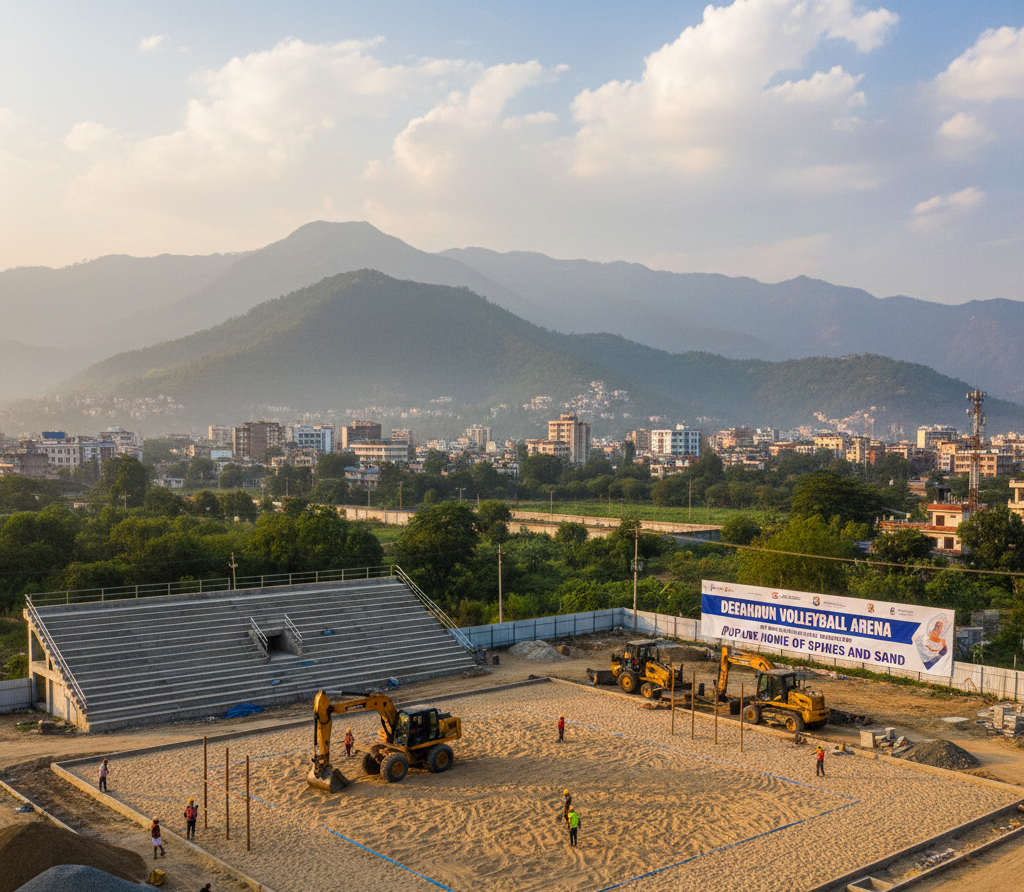
Introduction
Dehradun, the capital of Uttarakhand, is steadily developing as an important destination for education, sports training, recreation, and modern infrastructure. Surrounded by the scenic Doon Valley and located near the foothills of the Himalayas, the city offers promising opportunities for expanding sports facilities across schools, colleges, residential communities, private academies, resorts, and public sports complexes. Among the sports gaining attention, volleyball stands out because it encourages teamwork, physical fitness, coordination, and competitive participation across different age groups.
As interest in organised sports continues to grow, the demand for professionally designed volleyball court construction in Dehradun is becoming increasingly relevant. Educational institutions need reliable courts for physical education and inter-school competitions, sports academies require performance-oriented playing surfaces, and residential developments are looking for recreational facilities that encourage active lifestyles.
Constructing a volleyball court, however, involves much more than installing a net and painting boundary lines. Successful development requires suitable site selection, accurate dimensions, a stable foundation, appropriate flooring, efficient rainwater drainage, quality sports equipment, and a maintenance strategy suited to local weather conditions.
This comprehensive guide explores the essential aspects of volleyball court construction in Dehradun, including court types, technical specifications, construction procedures, flooring options, estimated costs, maintenance requirements, and important considerations for long-term performance.
Why Invest in Volleyball Court Construction in Dehradun?
Volleyball courts can add considerable value to educational campuses, sports facilities, residential projects, and recreational destinations. With proper planning, a well-constructed court can serve beginners, recreational players, school teams, and competitive athletes.
1. Growing Demand for Sports Infrastructure
Schools, colleges, universities, sports academies, and community organisations require accessible facilities where players can practise regularly. A dedicated volleyball court supports structured training, physical education programmes, inter-school tournaments, and community sporting events.
For institutions in Dehradun, investing in a purpose-built court can improve the quality of sports facilities while providing students with a dedicated environment for developing athletic skills.
2. Suitable for Schools, Colleges, and Sports Academies
Volleyball is adaptable to different skill levels and can be introduced through recreational sessions before progressing to advanced training. A properly planned court can accommodate regular practice, coaching sessions, and organised competitions.
Schools may prioritise safety, durability, and ease of maintenance, while professional academies may require higher-performance surfaces, suitable lighting, and additional safety clearances.
3. Enhances Residential and Commercial Developments
Modern residential societies increasingly value shared recreational amenities. A volleyball court can encourage residents to participate in outdoor activities, organise friendly matches, and spend more time engaging with their community.
Hotels, resorts, clubs, and recreation centres can also incorporate volleyball facilities to improve their sports and leisure offerings.
4. Opportunities for Outdoor and Indoor Facilities
Dehradun offers opportunities for both outdoor and indoor volleyball courts. Outdoor facilities can be suitable for institutions and residential developments with adequate open space, while covered courts can provide greater reliability during periods of rain or adverse weather.
The most appropriate option depends on land availability, expected usage, project budget, and the intended level of play.
Types of Volleyball Courts Suitable for Dehradun
Selecting the right court type is one of the most important decisions in a volleyball construction project. Flooring, foundation requirements, weather protection, and installation costs vary according to the intended application.
1. Outdoor Volleyball Courts
Outdoor volleyball courts are commonly considered for schools, colleges, public recreation areas, sports grounds, and residential communities. They provide an accessible playing environment and can be developed using several surface materials.
Popular options include acrylic-coated concrete, synthetic sports flooring, and other appropriately designed outdoor surfaces.
For Dehradun, outdoor court construction should prioritise effective surface drainage, a stable base, weather-resistant materials, and suitable protection against prolonged water exposure. The final design should also consider surrounding vegetation, shade, and the possibility of moss or algae developing in persistently damp areas.
2. Indoor Volleyball Courts
Indoor volleyball courts are suitable for professional training centres, sports academies, educational institutions, and multipurpose sports complexes.
A covered environment helps reduce interruptions caused by rainfall and provides greater control over lighting and playing conditions. Common flooring options include sports-grade polyurethane systems and specialist wooden sports floors.
Indoor construction requires additional planning for roof height, ventilation, lighting, moisture control, shock absorption, and player safety. The roof structure must provide sufficient unobstructed clearance above the playing area and comply with applicable building and sports requirements.
3. Synthetic Volleyball Courts
Synthetic flooring systems can offer consistent playing characteristics, a uniform finish, and a professional appearance. Depending on the product and installation method, these systems may be suitable for outdoor or indoor applications.
Outdoor acrylic systems are frequently considered for hard-court applications, while polyurethane systems can be designed for specific performance requirements. The selected product must be appropriate for the intended location, substrate, weather exposure, and expected usage.
4. Beach Volleyball Courts
Beach volleyball courts can be developed at resorts, recreation clubs, educational campuses, and leisure destinations where sufficient space is available.
These facilities require suitable sand, adequate depth, a stable perimeter, and an effective approach to drainage. The sand should be clean and appropriate for sports use, with attention given to player comfort and the removal of sharp debris.
Because Dehradun experiences substantial seasonal rainfall, beach court projects require particular care in designing drainage and managing sand displacement during wet weather.
Standard Volleyball Court Dimensions and Technical Requirements
Correct dimensions are essential for a volleyball court intended for organised training or competitive play. Construction drawings should follow the relevant Fédération Internationale de Volleyball (FIVB) rules or the requirements of the governing body for which the court is being developed.
The standard indoor volleyball court measures 18 metres long and 9 metres wide. It is divided into two equal halves by the centre line and net.
Important specifications include:
- Playing area: 18 m × 9 m.
- Attack line: Located 3 m from the axis of the centre line on each side.
- Net height for men: 2.43 m.
- Net height for women: 2.24 m.
- Free zone: At least 3 m wide around the playing court under standard FIVB requirements, with larger clearances advisable or required for certain competition levels.
- Court markings: Clearly visible, accurately positioned, and compatible with the selected flooring system.
- Net and posts: Suitable for the intended level of play, with secure post anchoring and appropriate protective padding.
The dimensions above describe the playing court, not the entire construction footprint. Additional space is necessary for the free zone, circulation, spectator access, equipment, and any surrounding fencing.
For outdoor facilities, the site plan should also allow for drainage channels, maintenance access, and safe separation from walls, trees, parked vehicles, and other hazards.
Step-by-Step Volleyball Court Construction Process in Dehradun
A successful volleyball court project follows a planned sequence, from the initial site assessment through final inspection.
Site Selection and Feasibility Assessment
The first step is to identify a location with adequate space, convenient access, and suitable ground conditions. The proposed site should accommodate the playing area, free zone, circulation space, and any additional facilities.
A professional assessment should examine existing ground levels, soil stability, access for construction equipment, nearby structures, underground services, and potential drainage problems.
In areas with sloping terrain, additional earthwork or retaining structures may be necessary. These requirements should be identified before the project budget is finalised.
Soil Testing, Levelling, and Ground Preparation
The existing ground must be assessed to determine whether it can support the proposed court construction. Weak soil, uncontrolled fill, or areas prone to settlement may require additional preparation.
Site preparation generally includes clearing vegetation, removing unsuitable material, establishing design levels, and compacting the subgrade.
Depending on the site conditions and engineering design, a compacted granular sub-base may be required. Proper preparation helps reduce settlement, cracking, and unevenness in the finished surface.
Foundation and Base Construction
The base forms the structural foundation of the playing surface. Outdoor volleyball courts may use an engineered concrete slab or another suitable pavement system selected according to soil conditions, drainage requirements, and the proposed flooring.
The foundation should provide adequate strength, dimensional accuracy, and surface regularity. Expansion joints, reinforcement, concrete thickness, and curing procedures must be specified by the project engineer rather than selected solely on the basis of cost.
For indoor courts, the subfloor must be compatible with the chosen sports flooring and provide the required levelness and moisture protection.
Drainage and Rainwater Management
Drainage is a major consideration for volleyball court construction in Dehradun. Seasonal rainfall can create standing water, accelerate deterioration, and make outdoor courts temporarily unusable.
The design should direct water away from the playing surface and prevent surrounding runoff from entering the court area. Depending on the site, suitable measures may include carefully designed surface falls, perimeter drains, stormwater channels, and appropriate discharge arrangements.
The drainage system should be coordinated with the surrounding landscape and local stormwater infrastructure. Surface gradients must follow the requirements of the selected court system and must not compromise player safety.
Sports Flooring Installation
After the base has been completed and approved, the selected flooring system can be installed.
For an outdoor acrylic court, the process may involve substrate preparation, crack treatment where appropriate, compatible primers, resurfacing layers, and the specified acrylic coating system.
Indoor polyurethane flooring generally requires a suitable prepared substrate and careful installation according to the manufacturer’s technical instructions. Wooden sports floors need an appropriate subfloor, moisture management, and a sports-grade finish.
The installer should verify substrate moisture, surface condition, curing, and environmental conditions before applying the final flooring layers.
Court Markings, Net Posts, and Accessories
Court lines must be measured accurately and applied using products compatible with the selected surface. Poorly positioned markings can interfere with training and competitive play.
The project should include a suitable volleyball net, adjustable posts, secure anchoring, and protective padding where necessary. Outdoor installations may also require fencing, access gates, and equipment storage.
The final layout should ensure that posts, foundations, fencing, and other accessories do not create hazards within the playing area or free zone.
Lighting and Additional Facilities
For courts intended for evening use, lighting should provide adequate and reasonably uniform illumination without excessive glare. Requirements depend on whether the facility serves recreational play, training, or formal competition.
Additional features may include spectator seating, drinking-water access, changing facilities, signage, perimeter fencing, and accessible circulation routes.
Covered or indoor projects require coordinated architectural, structural, electrical, and ventilation planning.
Final Inspection and Handover
Before opening the court, the contractor should inspect surface regularity, visible defects, line accuracy, net height, post stability, drainage performance, and the condition of accessories.
The handover should include product specifications, warranty information, maintenance instructions, and any applicable restrictions on the use of the newly installed surface.
A documented inspection helps establish that the completed facility meets the agreed project requirements.
Best Flooring Options for Volleyball Courts in Dehradun
The right flooring choice depends on budget, playing level, location, expected foot traffic, and maintenance capacity.
Acrylic Sports Flooring
Acrylic flooring is a practical option for many outdoor volleyball courts constructed over a suitable concrete or asphalt base.
Potential advantages include a coloured finish, clear line markings, and relatively straightforward routine cleaning. The quality and lifespan of the system depend on substrate preparation, product specifications, installation quality, and exposure to weather.
Acrylic coatings should not be applied over a damp or unsuitable base. The contractor must also verify that the selected system provides appropriate traction for volleyball.
Polyurethane Sports Flooring
Polyurethane flooring is available in systems designed for indoor sports applications, including installations requiring specified resilience and shock absorption.
A suitable system can improve playing comfort and provide a consistent surface. However, performance varies significantly between products, so the specification should identify the required sports properties rather than relying on the material name alone.
For Dehradun’s climate, moisture protection and indoor environmental control are particularly important where humidity and seasonal dampness may affect the flooring assembly.
Wooden Sports Flooring
Wooden flooring is often considered for high-quality indoor sports halls. A properly engineered sports floor can provide desirable playing characteristics when designed and maintained correctly.
Installation requires careful control of subfloor moisture, ventilation, expansion allowances, and the flooring system’s specified environmental conditions. Water ingress and uncontrolled humidity can damage wood, making building-envelope protection essential.
Concrete with a Suitable Sports Coating
A concrete court with an appropriate sports coating can be considered for budget-conscious outdoor facilities, provided the design meets the project’s safety and performance requirements.
The concrete must be properly engineered, finished, cured, and protected. An ordinary concrete surface without a suitable sports finish may be excessively hard or slippery under certain conditions.
The best option should be determined by comparing total installation costs, playing characteristics, expected service life, and ongoing maintenance.
Volleyball Court Construction Cost in Dehradun
The total investment depends on the construction footprint, ground conditions, flooring system, drainage requirements, accessories, lighting, fencing, and whether the facility is open-air or covered.
Indicative budgeting ranges may be used for initial planning, but they should not be treated as verified current quotations.
| Court type | Preliminary budgeting range |
|---|---|
| Basic concrete court with suitable finish | ₹200–₹300 per sq. ft. |
| Outdoor acrylic or synthetic court | ₹400–₹550 per sq. ft. |
| Indoor sports flooring | ₹650–₹900 per sq. ft. |
| Beach volleyball court | Approximately ₹6–9 lakh for a basic installation |
These figures are illustrative and may not cover every project component. Indoor flooring rates may exclude the building structure, roof, electrical works, and other civil construction. Beach court costs depend on sand specifications, drainage, retaining edges, and site accessibility.
A complete outdoor volleyball court project may require a preliminary budget of approximately ₹8–15 lakh, while a more comprehensive indoor project may reach ₹18–25 lakh or substantially more if major civil works, a roof, lighting, or premium flooring are included.
These overall amounts should be confirmed through a detailed bill of quantities. The court’s 18 m × 9 m playing area alone is 174.4 square metres, but the actual construction footprint must include the free zone and supporting infrastructure.
Before approving a quotation, request separate pricing for earthwork, foundation, drainage, flooring, equipment, lighting, taxes, transport, and warranty coverage. Comparing itemised quotations makes it easier to identify missing work and assess long-term value.
Factors That Influence Construction Costs
Several site-specific factors can change the final project budget.
- Ground conditions: Weak soil, steep slopes, and extensive levelling can increase civil engineering costs.
- Drainage requirements: Perimeter drains and stormwater improvements may be essential at rainfall-prone sites.
- Flooring specification: Different systems vary in material cost, installation requirements, and sports performance.
- Court accessories: Net posts, protective padding, fencing, and lighting contribute to the total.
- Indoor construction: Roof structures, foundations, ventilation, electrical installations, and building approvals add to the investment.
- Transportation and labour: Material availability, delivery distance, and project access influence installation costs.
- Maintenance provisions: Including appropriate drainage access and repair arrangements during construction can reduce future disruption.
An on-site assessment is the most reliable way to prepare an accurate quotation for volleyball court construction in Dehradun.
Maintenance Guidelines for Volleyball Courts in Dehradun
Routine maintenance helps preserve surface quality, player safety, and the useful life of the facility.
Outdoor Court Maintenance
Remove leaves, dust, and other debris regularly. Inspect the surface after heavy rain and clear drainage channels before water begins to accumulate.
Check for cracks, peeling coatings, uneven areas, and slippery patches. Where shade and dampness encourage moss or algae growth, use cleaning methods approved for the flooring system.
Avoid harsh chemicals or aggressive cleaning equipment unless the manufacturer specifically permits them.
Indoor Court Maintenance
Keep the building dry and maintain suitable indoor environmental conditions. Inspect the roof and external walls for leaks, and monitor moisture levels where wooden flooring is installed.
Use flooring-compatible cleaning products and avoid excessive water during cleaning. Check joints, protective finishes, and sports equipment periodically.
Net, Posts, and Accessories
Inspect net tensioning mechanisms, post anchors, padding, fencing, and access gates at regular intervals. Damaged or unstable equipment should be repaired before the court is used again.
A documented maintenance schedule is especially valuable for schools, academies, and facilities with frequent daily usage.
Common Challenges in Volleyball Court Construction in Dehradun
Monsoon Rainfall
Poor drainage and prolonged moisture exposure can damage court coatings and reduce availability. Proper surface design, drainage outlets, and construction sequencing are therefore essential.
Uneven Terrain
Some sites require substantial excavation, filling, or retaining structures. Engineering assessment helps establish the safest and most economical construction approach.
Moisture and Humidity
Indoor wooden floors and certain flooring systems can be affected by moisture. Effective waterproofing, suitable ventilation, and compliance with manufacturer requirements help minimise the risk.
Site Constraints
Urban schools and residential projects may have limited land, nearby buildings, or restricted construction access. Accurate space planning must preserve the required playing area and safety clearances.
Permissions and Building Compliance
Depending on the site and scope of work, approvals may be required from the relevant local development authority, municipal body, or other competent agency. Covered courts and larger sports buildings may require additional structural and building approvals.
Project owners should verify current requirements with the relevant authority before beginning construction.
Government Schemes and Subsidies for Sports Infrastructure
Schools, sports organisations, and eligible private entities may wish to investigate available sports-development grants or infrastructure assistance before committing to a project.
However, subsidy availability depends on the particular scheme, applicant category, project location, eligibility criteria, and current government notifications. A fixed subsidy percentage should not be assumed without written confirmation.
Applicants in Dehradun can consult the Uttarakhand Sports Department and relevant district or local authorities to determine whether any current scheme supports volleyball court development.
Prepare a project report containing land details, proposed dimensions, engineering drawings, cost estimates, intended beneficiaries, maintenance arrangements, and implementation timelines. These documents can help when seeking approval, funding, or institutional support.
Why Choose Professional Volleyball Court Contractors in Dehradun?
Professional planning and installation help ensure that the court is built for its intended purpose. An experienced contractor should understand sports flooring systems, civil foundations, drainage, court markings, and equipment installation.
When evaluating contractors, consider the following:
- Previous experience with comparable volleyball or other sports-court projects.
- References, completed-project photographs, and verifiable site visits.
- Detailed material specifications and an itemised quotation.
- A clear construction schedule and quality-control process.
- Written warranties and product-specific maintenance guidance.
- Coordination between civil, flooring, electrical, and drainage work.
The lowest initial quotation may not provide the best long-term value if it excludes necessary groundwork or uses unsuitable materials. Selecting a contractor on the basis of technical capability, transparent pricing, and documented workmanship helps reduce avoidable construction risks.
Conclusion
Volleyball court construction in Dehradun offers opportunities for educational institutions, residential communities, sports academies, clubs, resorts, and public recreation facilities. A thoughtfully planned court can support recreational participation, structured coaching, and competitive sports while making effective use of available land.
The most important considerations are choosing the appropriate court type, following standard dimensions, preparing a stable foundation, installing suitable sports flooring, and designing drainage for seasonal rainfall. Indoor facilities also require attention to roof clearance, ventilation, moisture control, and lighting.
Costs should be assessed through site-specific quotations rather than relying exclusively on broad estimates. Property owners should also confirm applicable approvals, investigate any currently available funding programmes, and establish a practical maintenance plan before construction begins.
With professional design, appropriate materials, and consistent upkeep, a volleyball court can become a valuable and durable sports facility for the Dehradun community.
Frequently Asked Questions
1. What is the standard size of a volleyball court?
A standard indoor volleyball playing court measures 18 metres × 9 metres. Additional free space is required around the court for safe movement and competition requirements.
2. What is the estimated cost of volleyball court construction in Dehradun?
The cost depends on the flooring, site preparation, drainage, equipment, and additional facilities. Preliminary estimates may range from ₹8–15 lakh for some outdoor projects, while indoor facilities can cost considerably more. A site inspection and detailed quotation are necessary for an accurate figure.
3. Which flooring is best for an outdoor volleyball court in Dehradun?
A suitable acrylic sports coating over a properly engineered base is one option. Other synthetic systems may also be appropriate, provided they are designed for outdoor exposure and installed with effective drainage.
4. How long does volleyball court construction take?
A straightforward outdoor court may take several weeks, while projects involving extensive earthwork, drainage improvements, or covered structures can take longer. Weather, material delivery, concrete curing, and flooring installation conditions all affect the schedule.
5. Can a volleyball court be constructed on sloping land?
Yes, subject to a site assessment and appropriate engineering. Levelling, excavation, retaining structures, and additional drainage may be necessary depending on the slope and soil conditions.
6. Is an indoor volleyball court suitable for Dehradun?
Yes. Indoor courts can support training and recreational use during rainy weather and provide a more controlled environment. The design must account for roof clearance, lighting, ventilation, moisture protection, and the selected sports floor.
7. Does the Uttarakhand government provide subsidies for volleyball court construction?
Funding may be available under eligible sports-development schemes, but current availability and subsidy amounts must be verified with the relevant department. Applicants should not assume that a particular percentage of project cost will be reimbursed.
8. Can one volleyball court accommodate other sports?
A court may support selected additional activities if the available space, surface, equipment, and markings are suitable. Any shared-use arrangement should avoid conflicting lines, unsafe equipment placement, and inadequate clearances.
9. How can I protect an outdoor volleyball court during the monsoon?
Maintain clear drainage channels, remove debris, address surface defects promptly, and use flooring products suitable for outdoor conditions. Avoid applying coatings when the substrate or weather conditions do not meet the manufacturer’s installation requirements.
10. What should I check before hiring a volleyball court construction company?
Review relevant project experience, material specifications, the proposed foundation and drainage design, itemised pricing, installation timelines, warranties, and maintenance instructions. Confirm that the contractor understands the requirements of the intended playing level and local site conditions.