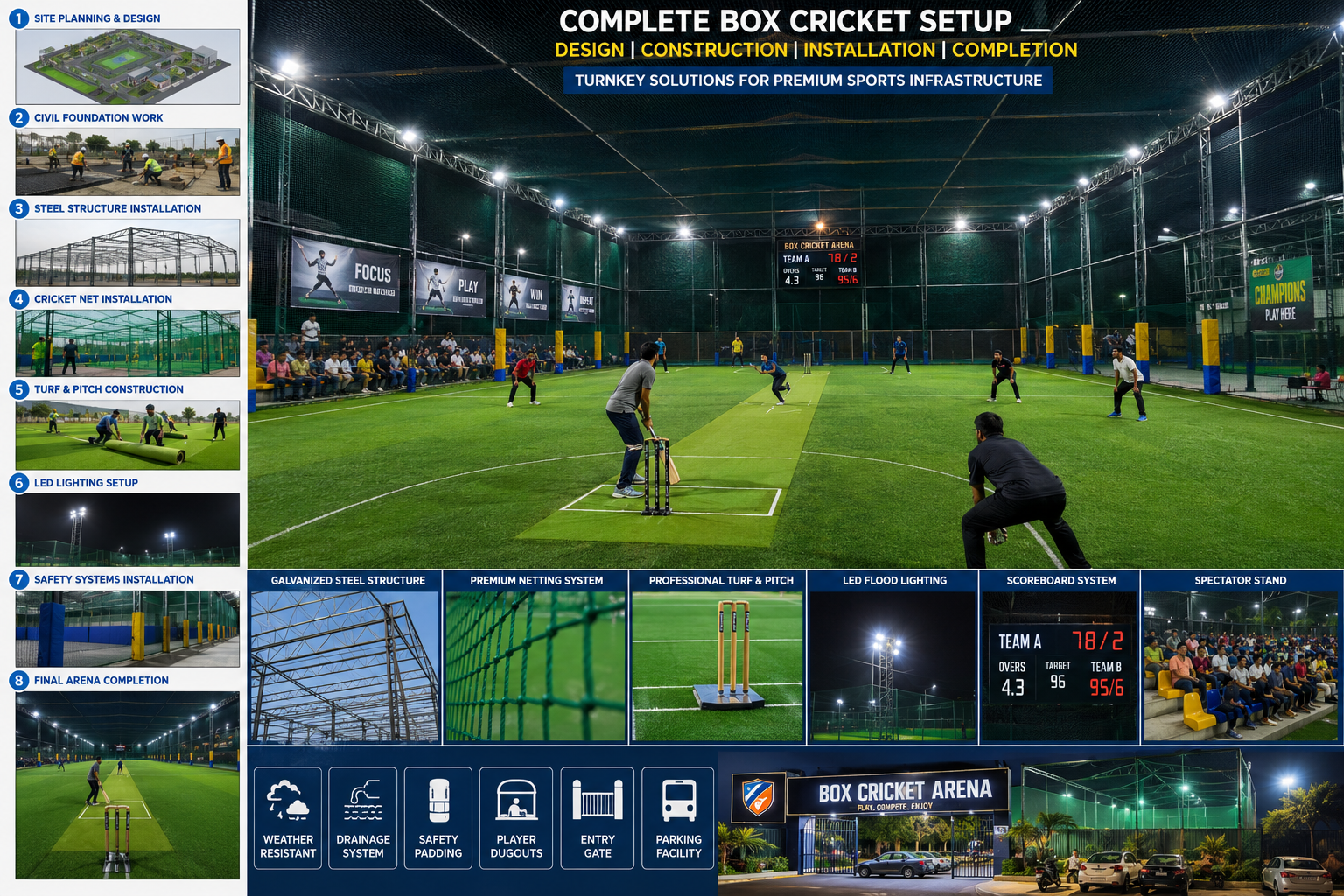
Introduction to Modern Box Cricket Setup
Cricket continues to be one of the most loved sports across India, but the availability of large open grounds is steadily decreasing due to rapid urban development. As cities become more crowded and recreational spaces become limited, sports enthusiasts are seeking innovative ways to enjoy the game without requiring a traditional cricket field. This growing demand has led to the widespread popularity of box cricket.
Box cricket is a compact and exciting version of the game played inside a fully enclosed arena. Designed to maximize gameplay within a limited area, it provides an engaging cricket experience for players of all ages and skill levels. Whether installed in residential communities, educational institutions, sports clubs, commercial sports complexes, or corporate campuses, a professionally developed box cricket facility creates an attractive recreational destination that promotes fitness, social interaction, and competitive sports.
A successful box cricket facility requires much more than simply installing turf and nets. Every aspect of the setup—from planning and foundation preparation to flooring selection, enclosure systems, lighting, and finishing elements—must be carefully designed and executed. A professionally built setup ensures player safety, long-term durability, consistent gameplay, and lower maintenance costs.
This comprehensive guide explains everything involved in creating a high-quality box cricket setup and highlights the importance of professional construction and infrastructure planning.
What Is a Box Cricket Setup?

A box cricket setup refers to a specially designed cricket arena enclosed with protective nets that keep the ball within the playing area throughout the game. Unlike conventional cricket grounds that require large open spaces, box cricket courts are built to fit compact locations while maintaining the excitement and competitiveness of the sport.
The format typically involves smaller teams, shorter match durations, and fast-paced gameplay. The enclosed environment increases player engagement because the ball remains in play for longer periods, creating a more dynamic experience.
A professional box cricket setup generally includes:
- Cricket pitch and playing surface
- Sports-grade flooring system
- Heavy-duty net enclosure
- Structural support framework
- LED floodlighting systems
- Entry and exit access points
- Seating arrangements
- Scoreboards and branding areas
- Drainage infrastructure for outdoor facilities
- Safety features and protective elements
Depending on the available space and project objectives, the setup can be customized for recreational, training, or tournament-level use.
Growing Popularity of Box Cricket Facilities
Box cricket has become one of the fastest-growing recreational sports concepts in India. The format appeals to a broad audience because it requires less space while still delivering the excitement of traditional cricket.
Several factors contribute to its increasing popularity:
Urban Space Constraints
Many urban locations lack sufficient land for full-sized cricket grounds. Box cricket solves this challenge by utilizing compact spaces efficiently.
Flexible Installation Options
Courts can be developed in various locations, including:
- Residential societies
- School campuses
- Corporate parks
- Commercial sports complexes
- Rooftops
- Indoor halls
- Recreational clubs
- Resorts and hospitality properties
Year-Round Usage
Modern facilities are designed to support gameplay throughout the year with weather-resistant materials, proper drainage systems, and artificial lighting.
Revenue Generation
Commercial box cricket facilities offer excellent business opportunities through hourly bookings, tournaments, coaching sessions, and corporate events.
Community Engagement
These facilities encourage physical activity and provide a social gathering space for families, friends, students, and professionals.
Importance of Professional Box Cricket Setup
The quality of construction directly influences the success and longevity of a box cricket facility. Poor workmanship or inadequate planning can lead to uneven playing surfaces, frequent repairs, safety concerns, and reduced user satisfaction.
A professionally executed setup provides several important advantages.
Consistent Playing Conditions
Proper surface preparation and flooring installation ensure predictable ball movement, bounce, and player traction.
Enhanced Player Safety
Sports-grade materials help reduce impact injuries while secure enclosures prevent accidents involving spectators and surrounding property.
Long-Term Structural Stability
A well-engineered foundation supports heavy usage and minimizes deterioration over time.
Lower Maintenance Requirements
Quality materials and proper installation reduce maintenance frequency and operating costs.
Improved Visual Appeal
A professionally finished court creates a premium appearance that attracts users and enhances the property’s value.
Better Return on Investment
Durable infrastructure ensures long-term usability and maximizes revenue potential for commercial operators.
Site Assessment and Planning
Every successful box cricket project begins with detailed planning and site evaluation.
Before construction begins, specialists assess various aspects of the proposed location to determine feasibility and identify potential challenges.
Key Assessment Factors
Available Space
Accurate measurements help determine the most efficient court layout while maintaining safety clearances.
Ground Conditions
Engineers evaluate soil strength, stability, and load-bearing capacity to ensure a reliable foundation.
Surface Drainage
Water flow patterns are analyzed to prevent flooding and standing water during rainfall.
Accessibility
Entry routes for players, spectators, maintenance teams, and emergency services are considered during planning.
Environmental Conditions
Wind exposure, sunlight direction, and surrounding structures influence the final design.
Following the assessment, a detailed layout plan is prepared to optimize performance, safety, and operational efficiency.
Foundation and Base Construction
The foundation serves as the backbone of the entire box cricket facility. A strong base is essential for maintaining surface integrity and preventing structural issues.
Professional construction generally follows a layered approach.
Ground Preparation
The area is cleared, excavated if necessary, and leveled according to project specifications.
Soil Compaction
Mechanical compaction increases stability and minimizes settlement over time.
Aggregate Layer Installation
Crushed stone or gravel layers improve drainage and provide structural support.
Surface Leveling
Fine materials such as stone dust or sand are used to create a smooth and uniform base.
Drainage Integration
Outdoor facilities include carefully engineered drainage systems that channel water away from the playing area.
Proper foundation work significantly extends the lifespan of the facility and reduces future repair requirements.
Choosing the Right Playing Surface
The playing surface is one of the most critical components of a box cricket setup. The selected flooring system influences gameplay quality, player comfort, maintenance requirements, and overall project cost.
Synthetic Turf Cricket Flooring
Synthetic turf remains one of the most widely used solutions for box cricket facilities.
Advantages
- Natural grass-like appearance
- Consistent ball response
- Comfortable playing experience
- Excellent durability
- Minimal maintenance requirements
- Suitable for indoor and outdoor applications
High-quality artificial turf is designed to withstand heavy foot traffic while maintaining performance characteristics for many years.
Polyurethane Sports Flooring
Polyurethane flooring is commonly used in premium indoor sports environments.
Benefits
- Superior shock absorption
- Enhanced player comfort
- Reduced joint stress
- Seamless surface finish
- Excellent slip resistance
- Long-term durability
PU flooring is ideal for facilities prioritizing player safety and professional performance.
Acrylic Sports Flooring
Acrylic surfaces provide a smooth and fast-playing environment.
Features
- Attractive appearance
- High abrasion resistance
- Easy cleaning and maintenance
- Consistent ball speed
- Suitable for covered installations
This option is frequently selected for multipurpose sports facilities.
Concrete-Based Surfaces
Concrete remains a practical solution for budget-conscious projects.
Advantages
- Strong structural durability
- Long service life
- Low construction cost
- Compatibility with turf overlays
Although less forgiving than specialized sports flooring, concrete can provide a reliable playing base when properly constructed.
Net Enclosure Systems
The net enclosure is a defining feature of any box cricket setup. It creates the enclosed environment that distinguishes the game from traditional cricket.
A professionally designed enclosure serves multiple functions:
- Keeps the ball within the playing area
- Protects spectators
- Prevents property damage
- Enhances player safety
- Supports uninterrupted gameplay
Structural Framework
The support structure is typically constructed using:
- Galvanized steel poles
- Powder-coated steel sections
- Heavy-duty brackets and connectors
- Reinforced anchoring systems
These materials provide strength and corrosion resistance under varying environmental conditions.
Netting Materials
High-quality enclosures use:
- UV-stabilized HDPE nets
- Nylon sports nets
- Weather-resistant mesh systems
Proper tensioning ensures durability while maintaining the professional appearance of the facility.
Sports Lighting Solutions

Modern box cricket facilities often operate during evenings and nighttime hours. Effective lighting is therefore a critical component of the overall setup.
Benefits of Professional Sports Lighting
- Extended operating hours
- Improved player visibility
- Enhanced safety
- Better spectator experience
- Professional facility appearance
LED Floodlighting Systems
LED technology has become the preferred choice for sports infrastructure due to its efficiency and performance.
Advantages include:
- Low energy consumption
- Bright and uniform illumination
- Long operational lifespan
- Reduced maintenance costs
- Environmentally friendly operation
Strategic positioning eliminates shadows and ensures consistent visibility across the playing surface.
Standard Dimensions for Box Cricket Setup
Although dimensions may vary depending on site conditions and intended usage, common specifications include:
| Component | Typical Size |
|---|---|
| Pitch Length | 22 Yards (20.12 Meters) |
| Court Length | 60–120 Feet |
| Court Width | 30–60 Feet |
| Net Height | 15–20 Feet |
Professional designers can customize dimensions to suit rooftops, indoor facilities, commercial venues, and recreational installations while preserving gameplay quality.
Additional Features for Enhanced Functionality
Modern box cricket facilities often incorporate supplementary features that improve user experience and operational efficiency.
Seating Areas
Comfortable seating arrangements accommodate players, coaches, and spectators.
Digital Scoreboards
Electronic scoring systems enhance match organization and spectator engagement.
Branding Opportunities
Commercial operators can generate additional revenue through advertising and sponsorship displays.
Entry Control Systems
Secure access management improves safety and operational control.
Practice Zones
Dedicated training areas allow players to develop skills independently of ongoing matches.
Equipment Storage
Storage rooms help maintain organization and protect sports equipment.
Applications of Box Cricket Facilities
Box cricket courts can be successfully installed across numerous environments.
Residential Communities
Provide residents with convenient recreational opportunities.
Educational Institutions
Encourage sports participation among students and support physical education programs.
Corporate Campuses
Promote employee wellness, team-building activities, and recreational engagement.
Sports Academies
Offer structured coaching and skill-development programs.
Commercial Sports Centers
Generate revenue through bookings, leagues, tournaments, and events.
Hospitality Properties
Enhance guest experiences at resorts, clubs, and recreational destinations.
Maintenance Requirements
Routine maintenance is essential for preserving the performance and appearance of a box cricket facility.
Regular Maintenance Activities
- Surface cleaning
- Turf grooming
- Net inspection
- Pole and framework inspection
- Lighting system maintenance
- Drainage system cleaning
- Surface repair and patching
A preventive maintenance program significantly extends the lifespan of the facility while reducing long-term operating costs.
Renovation and Upgrade Opportunities
Existing facilities can be upgraded to meet evolving user expectations and modern sports standards.
Common improvement projects include:
- Turf replacement
- Net enclosure upgrades
- Lighting modernization
- Court expansion
- Surface resurfacing
- Structural reinforcement
- Branding enhancements
These upgrades help maintain competitiveness and improve overall user satisfaction.
Why Invest in a Professional Box Cricket Setup?
A professionally designed box cricket facility offers lasting value for property owners, educational institutions, sports operators, and community organizations.
Key benefits include:
- Efficient utilization of available space
- Increased property value
- Enhanced recreational opportunities
- Improved community engagement
- Revenue generation potential
- Long-term durability
- Professional playing experience
- Reduced maintenance costs
By combining quality construction, advanced materials, and expert planning, a box cricket setup becomes a sustainable sports infrastructure asset capable of serving players for many years.
Conclusion
Box cricket has revolutionized recreational cricket by making the sport accessible within compact spaces while maintaining excitement, competitiveness, and player engagement. Whether developed for residential communities, schools, sports academies, corporate campuses, or commercial sports centers, a professionally constructed box cricket facility delivers exceptional value and long-term performance.
From site planning and foundation development to flooring installation, net enclosure construction, lighting integration, and finishing enhancements, every element contributes to the overall success of the project. Careful attention to design, material quality, and engineering standards ensures a safe, attractive, and durable facility that players can enjoy throughout the year.
Investing in a professional box cricket setup is not merely about building a sports court—it is about creating a vibrant destination that encourages fitness, fosters community interaction, and delivers memorable sporting experiences for generations to come.
(FAQs) – Box Cricket Setup
1. What is a box cricket setup?
A box cricket setup is a compact cricket facility enclosed with nets, designed for fast-paced cricket matches in limited spaces.
2. What is the standard size of a box cricket court?
Most box cricket courts range between 60–120 feet in length and 30–60 feet in width, depending on available space and project requirements.
3. Which flooring is best for box cricket?
Synthetic turf is the most popular choice due to its durability, low maintenance, player comfort, and consistent playing performance.
4. Can a box cricket court be installed indoors?
Yes, box cricket facilities can be developed in indoor halls, warehouses, sports complexes, and covered structures.
5. Is box cricket suitable for residential societies?
Absolutely. Box cricket courts are ideal for residential communities, providing a safe and engaging recreational space for residents.
6. How long does it take to build a box cricket setup?
The construction timeline varies based on size and specifications, but most projects are completed within a few weeks.
7. What type of nets are used in box cricket courts?
High-strength HDPE or nylon sports nets are commonly used to ensure durability, safety, and long-term performance.