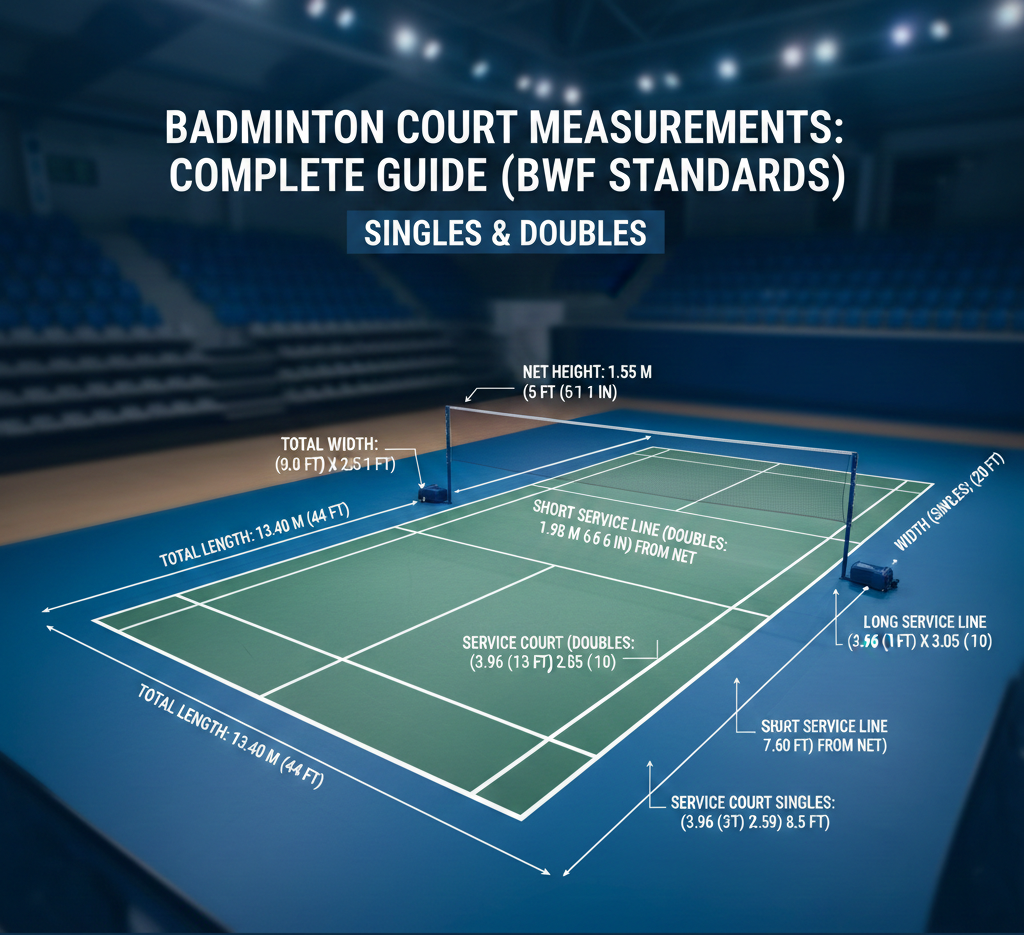
Badminton is a fast-paced sport that combines speed, agility, precision, and strategy. However, an enjoyable and professional badminton experience begins with a properly designed playing surface. Whether you are planning to construct a badminton court for a school, sports academy, indoor stadium, club, or recreational facility, understanding the standard badminton court measurements is essential.
The Badminton World Federation (BWF) establishes international standards for badminton court dimensions, boundary markings, net height, and other playing requirements. Following these specifications ensures consistency, fair gameplay, player safety, and compliance with international badminton regulations.
In this comprehensive guide, we will explain the official badminton court size, singles and doubles dimensions, court layout, line markings, net specifications, flooring options, and surrounding space requirements to help you plan and construct a high-quality badminton court.
Official Badminton Court Measurements (BWF Standards)
A standard badminton court is rectangular, with the same overall length for both singles and doubles matches. However, the playing width and service boundaries vary depending on the format.
Standard Badminton Court Dimensions
The official measurements of a badminton court are:
- Court Length: 13.40 metres (44 feet)
- Court Width for Doubles: 6.10 metres (20 feet)
- Court Width for Singles: 5.18 metres (17 feet)
- Total Playing Area: Approximately 81.74 square metres (880 square feet) for doubles.
The outer boundary lines define the full doubles court, while the inner sidelines determine the narrower singles playing area.
These measurements are internationally recognised and should be followed when constructing courts for competitive and professional use.
Badminton Court Size for Singles Matches
In singles badminton, only the inner sidelines are used to determine the width of the playing area. The entire length of the court remains in use.
Singles Court Dimensions
- Length: 13.40 metres (44 feet)
- Width: 5.18 metres (17 feet)
The narrower playing area requires players to demonstrate excellent footwork, accuracy, stamina, and court coverage.
For singles matches, the back boundary line also acts as the long service line. This provides a longer service area compared with doubles badminton.
Badminton Court Size for Doubles Matches
Doubles badminton involves two players on each side of the net and uses the entire width of the court.
Doubles Court Dimensions
- Length: 13.40 metres (44 feet)
- Width: 6.10 metres (20 feet)
Although the full court width is used, the service area is shorter in doubles. A separate doubles long service line is marked 0.76 metres (2 feet 6 inches) inside the back boundary.
The wider playing area encourages teamwork, quick reactions, tactical positioning, and coordinated movement between partners.
Badminton Court Layout and Markings
Correct court marking is essential for determining the boundaries of play and identifying the service areas. Every badminton court should have clearly visible and accurately measured lines.
According to standard badminton specifications, all court lines should be 40 mm (4 cm) wide and preferably white or yellow to provide sufficient contrast against the flooring.
Important Badminton Court Lines
1. Baseline or Back Boundary Line
The baseline runs across the width of the court at both ends. It marks the rear boundary of the playing area and also serves as the long service line in singles matches.
2. Singles Sidelines
These are the inner side boundary lines that define the 5.18-metre-wide singles court.
3. Doubles Sidelines
The outer side boundary lines define the full 6.10-metre-wide doubles court.
4. Short Service Line
The short service line is positioned 1.98 metres (6 feet 6 inches) from the net on both sides. During a serve, the shuttlecock must travel beyond this line to land in the correct service court.
5. Long Service Line for Doubles
The doubles long service line is located 0.76 metres (2 feet 6 inches) inside the back boundary line. It establishes the rear limit of the doubles service area.
6. Centre Line
The centre line runs perpendicular to the net and divides each side of the court into left and right service courts. It helps determine the correct service area during a match.
Badminton Court Layout: Singles vs Doubles
Although singles and doubles use the same court structure, the applicable boundary lines differ.
| Specification | Singles | Doubles |
|---|---|---|
| Court Length | 13.40 m | 13.40 m |
| Playing Width | 5.18 m | 6.10 m |
| Side Boundaries | Inner sidelines | Outer sidelines |
| Front Service Line | 1.98 m from net | 1.98 m from net |
| Rear Service Boundary | Back boundary line | Doubles long service line |
| Playing Format | One player per side | Two players per side |
Understanding these differences is important when marking a court that will be used for both singles and doubles matches.
Official Badminton Net Measurements
The badminton net separates the two playing sides and plays an important role in maintaining the standard of competitive gameplay.
Standard Badminton Net Specifications
- Net Height at Posts: 1.55 metres (5 feet 1 inch)
- Net Height at Centre: 1.524 metres (5 feet)
- Net Width: At least 6.10 metres (20 feet)
- Net Mesh Size: Between 15 mm and 20 mm
- Net Depth: Approximately 0.76 metres (2 feet 6 inches)
The net should be made from fine, dark-coloured cord with uniform square mesh. Its top edge must be covered with white tape measuring 75 mm in width, folded over the cord or cable.
The net must be properly secured to the posts and remain at the specified height throughout the match.
Recommended Flooring for Badminton Courts
Choosing the right flooring is just as important as following the correct court dimensions. A suitable playing surface improves player comfort, supports quick movements, and reduces the risk of injuries.
Popular Badminton Court Flooring Options
1. Wooden Sports Flooring
Wooden flooring is commonly used in professional indoor sports facilities. It offers good shock absorption, consistent playing performance, and a premium appearance.
2. Synthetic Sports Flooring
Synthetic flooring provides a durable and relatively low-maintenance surface. It is suitable for sports academies, schools, clubs, and multipurpose indoor facilities.
3. PVC Badminton Flooring Mats
PVC badminton mats are widely used in indoor badminton courts. They offer a specialised playing surface with good grip, cushioning, and consistent shuttle movement.
Important Flooring Requirements
A good badminton court floor should have:
- Excellent grip to support quick footwork.
- Adequate shock absorption to reduce impact on joints.
- A smooth and uniform playing surface.
- Durable construction for regular use.
- Low-glare properties for better visibility.
- Proper maintenance and cleaning requirements.
The flooring should also be installed over a suitable, level subfloor to achieve consistent playing conditions.
Badminton Court Space Requirements and Ceiling Height
Apart from the marked playing area, sufficient clearance around the court is essential for safe and uninterrupted gameplay.
When planning an indoor badminton facility, consider the following factors:
- Side Clearance: Provide sufficient free space along both sides of the court.
- End Clearance: Maintain adequate space behind the baseline for player movement.
- Ceiling Height: A clear height of approximately 9 metres or more is recommended for competitive indoor play.
- Lighting: Install uniform lighting while avoiding glare and shadows.
- Ventilation: Ensure proper airflow without strong drafts that can affect shuttlecock movement.
The exact clearance requirements depend on the intended level of play and applicable BWF competition regulations. Professional tournament facilities may require greater clearances than recreational courts.
Quick Reference: Badminton Court Measurement Chart
| Court Specification | Standard Measurement |
|---|---|
| Full Court Length | 13.40 m (44 ft) |
| Doubles Court Width | 6.10 m (20 ft) |
| Singles Court Width | 5.18 m (17 ft) |
| Short Service Line | 1.98 m from net |
| Doubles Long Service Line | 0.76 m inside back boundary |
| Line Width | 40 mm |
| Net Height at Posts | 1.55 m |
| Net Height at Centre | 1.524 m |
| Net Width | At least 6.10 m |
| Net Mesh Size | 15–20 mm |
Why Are Accurate Badminton Court Measurements Important?
Accurate court dimensions and proper markings are essential for creating a professional badminton playing environment.
Following standard measurements provides several benefits:
- Fair Gameplay: Ensures that all players compete within the same standardised playing area.
- Regulatory Compliance: Helps meet recognised BWF court specifications.
- Player Safety: Provides sufficient space for movement and reduces the risk of collisions.
- Professional Standards: Makes the facility suitable for training, competitions, and tournaments.
- Better Playing Experience: Proper flooring, markings, and net positioning improve the overall quality of play.
Even small measurement errors can affect service areas, boundary decisions, and the fairness of a badminton match.
Frequently Asked Questions About Badminton Court Measurements
1. What is the standard size of a badminton court?
The official badminton court measures 13.40 metres in length and 6.10 metres in width for doubles. For singles matches, the playing width is reduced to 5.18 metres.
2. What is the badminton court size in feet?
A standard badminton court measures 44 feet in length and 20 feet in width for doubles. The singles playing width is 17 feet.
3. What is the standard badminton net height?
The badminton net must be 1.55 metres high at the posts and 1.524 metres high at the centre.
4. What is the distance of the short service line from the net?
The short service line is positioned 1.98 metres (6 feet 6 inches) from the net on each side of the court.
5. What is the doubles long service line distance?
The doubles long service line is positioned 0.76 metres (2 feet 6 inches) inside the back boundary line.
6. What is the standard width of badminton court lines?
All badminton court boundary and service lines should be 40 mm (4 cm) wide. They should be clearly visible and distinguishable from the flooring.
7. How much space is required to construct a badminton court?
The marked doubles playing area is approximately 13.40 m × 6.10 m. Additional space is required around the court for safe player movement, access, and maintenance. The total facility dimensions depend on the level of play and applicable competition standards.
8. What is the recommended ceiling height for an indoor badminton court?
A clear ceiling height of approximately 9 metres or more is recommended for competitive indoor badminton. Higher ceilings may be required for major tournaments.
9. Which flooring is best for badminton courts?
PVC sports flooring, synthetic sports flooring, and wooden sports flooring are popular choices. The ideal option depends on the facility’s budget, usage, maintenance requirements, and playing standards.
10. Are badminton court lines considered inside or outside the playing area?
Court boundary lines are considered part of the playing area. If the shuttlecock touches any boundary line, it is considered in.
11. Can a single badminton court be used for singles and doubles?
Yes. A standard badminton court includes both singles and doubles boundary markings. The applicable lines are used according to the match format.
12. Can badminton courts have different coloured markings?
Yes. Multiple sports can share an indoor facility, provided each sport’s markings are clearly distinguishable. Badminton lines should remain highly visible and easy to identify.
Conclusion: Build a Professional Badminton Court with Accurate Measurements
A properly designed badminton court is the foundation of a safe, enjoyable, and competitive sporting experience. From the official 13.40-metre court length and 6.10-metre doubles width to accurate service lines, net height, flooring, and surrounding clearance, every detail contributes to the quality of the facility.
Whether you are developing a badminton court for a school, sports academy, residential community, club, or professional indoor stadium, following recognised BWF specifications is essential.
By selecting suitable sports flooring, maintaining accurate court markings, and providing sufficient playing space, you can create a durable and professional badminton facility that meets the requirements of players at every level.