Introduction
Badminton is a dynamic, high-speed racket sport that demands agility, precision, and quick decision-making. Every movement on the court is governed by clearly defined rules and spatial boundaries. These boundaries are not arbitrary—they are carefully structured through standardized court markings that ensure fairness, consistency, and professional gameplay.
Badminton court markings form the foundation of the sport. They define where a player can serve, where the shuttle is considered in or out, and how each rally is structured. Without accurate markings, the game would lose its structure, making officiating unreliable and gameplay inconsistent.
To maintain uniformity across all levels of play, the Badminton World Federation (BWF) has established strict guidelines for court dimensions and line placements. These standards are followed worldwide in schools, training academies, recreational clubs, and international tournaments.
This comprehensive guide explains every aspect of badminton court markings, including their purpose, layout, dimensions, types, materials, and maintenance practices. It also highlights common mistakes and professional standards to ensure proper installation and long-term durability.
1. Importance of Badminton Court Markings
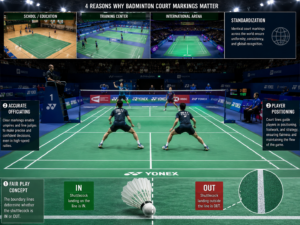
Court markings are essential to the structure and integrity of badminton. They serve as visual guides that define the playing area and ensure that the sport is played under consistent conditions.
1.1 Ensuring Fair Play
One of the primary roles of court markings is to ensure fairness. Every rally depends on whether the shuttle lands inside or outside the boundary lines. Without clear markings, decisions would become subjective and inconsistent.
1.2 Supporting Accurate Officiating
Referees and line judges rely entirely on court markings to make decisions. Well-defined lines help eliminate confusion during fast-paced rallies where shuttle speeds can exceed 300 km/h.
1.3 Improving Player Positioning
Players use markings as reference points for movement, positioning, and shot selection. Understanding boundaries helps athletes strategize their gameplay effectively.
1.4 Standardization Across All Levels
From school courts to Olympic arenas, standardized markings ensure that every player competes under identical conditions, regardless of location.
2. Standard Dimensions of a Badminton Court
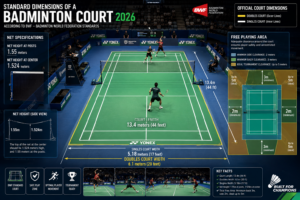
Before understanding individual markings, it is essential to understand the overall court structure on which these lines are based.
2.1 Court Size
- Total Length: 13.4 meters (44 feet)
- Doubles Width: 6.1 meters (20 feet)
- Singles Width: 5.18 meters (17 feet)
The court remains the same size; only the usable boundaries change depending on singles or doubles play.
2.2 Net Specifications
- Height at posts: 1.55 meters
- Height at center: 1.524 meters
The net divides the court into two equal halves and is a critical reference point for service and rally rules.
2.3 Free Playing Area
For safe and professional gameplay, additional space around the court is recommended:
- Side clearance: Minimum 2 meters
- Back clearance: Minimum 3 meters
- Ideal tournament space: Up to 5 meters
This ensures players have enough movement space without injury risk.
3. Structure of Badminton Court Markings
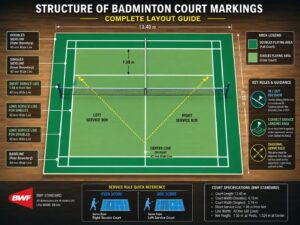
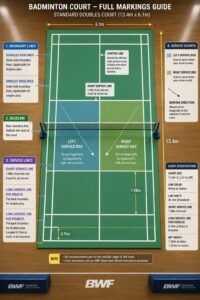
A badminton court contains multiple interconnected markings, each serving a specific function in gameplay. These markings are typically 40 mm wide and must be clearly visible.
3.1 Boundary Lines
Boundary lines define the outer limits of the court.
Sidelines
- Doubles Sideline: Outer boundary used in doubles matches
- Singles Sideline: Inner boundary used only in singles matches
These lines determine the lateral width of the court during play.
Baseline
The baseline runs at the back of the court and marks the farthest legal depth for rallies and serves.
Importance of Boundary Lines
Boundary lines are critical for judging whether a shuttle is in or out. Even a slight contact with the line is considered “in,” making precision essential.
3.2 Service Lines
Service lines regulate how serves are executed and where they must land.
Short Service Line
Located 1.98 meters from the net, this line ensures that serves are not too short. Any serve falling before this line is considered invalid.
Long Service Line for Singles
In singles play, the serve must land within a deeper area compared to doubles. This line is positioned slightly inside the baseline.
Long Service Line for Doubles
In doubles, the service area is shorter, making rallies faster and more dynamic.
3.3 Center Line
The center line runs vertically from the short service line to the baseline, dividing each side of the court into left and right service boxes.
Purpose of the Center Line
- Ensures correct serve placement
- Prevents serving into wrong service box
- Helps maintain structured gameplay flow
It is one of the most important markings during service execution.
3.4 Service Courts
Each side of the court is divided into two service areas:
- Left service box
- Right service box
Players must serve diagonally into the opposite service box, depending on the score and rotation rules.
4. Line Color, Width, and Visibility Standards
For maximum clarity during gameplay, badminton court markings must meet strict visibility requirements.
4.1 Line Width
- Standard width: 40 mm (4 cm)
This ensures lines are clearly visible without interfering with gameplay.
4.2 Color Standards
- White is most commonly used
- Yellow is used on darker flooring
The key requirement is high contrast with the court surface.
4.3 Material Quality
Court lines must be:
- Non-reflective
- Slip-resistant
- Durable under heavy usage
- Resistant to moisture and wear
Proper materials reduce glare and improve visibility under artificial lighting.
5. Flooring Types and Marking Methods
Different flooring systems require different marking techniques.
5.1 Wooden Courts
- Lines are either painted or inlaid
- Inlaid markings offer long-term durability
- Requires periodic refinishing
Wooden courts provide premium performance and aesthetics.
5.2 Synthetic PVC Courts
- Lines are heat-bonded or embedded
- Highly durable and low maintenance
- Suitable for training and recreational facilities
5.3 PU Sports Flooring
- Seamless surface allows precise marking
- High resistance to wear and tear
- Ideal for professional indoor courts
5.4 Acrylic Outdoor Courts
- Painted markings applied over textured surfaces
- Requires periodic repainting
- Weather-resistant coatings improve durability
6. Maintenance of Badminton Court Markings
Proper maintenance ensures long-lasting visibility and accuracy.
6.1 Regular Cleaning
Dust and dirt must be removed using soft brushes or microfiber mops to prevent abrasion.
6.2 Inspection Routine
Courts should be inspected frequently for:
- Fading lines
- Peeling paint
- Surface cracks
- Loss of contrast
6.3 Repainting and Repair
Depending on usage:
- Wooden courts may require repainting every 2–3 years
- Synthetic courts may need line replacement or resurfacing
6.4 Avoid Chemical Damage
Harsh chemicals can damage line visibility and flooring texture.
7. Professional vs Recreational Court Markings
Professional Courts
- Exact measurements required
- High visibility standards
- Certified installation methods
Recreational Courts
- Slight variations allowed
- Focus on usability rather than competition compliance
8. Common Mistakes in Court Marking
Improper marking can negatively affect gameplay quality.
8.1 Faded or Incomplete Lines
Poor visibility leads to incorrect decisions during matches.
8.2 Incorrect Dimensions
Even small measurement errors can disrupt professional gameplay.
8.3 Low Contrast Colors
Poor contrast reduces visibility, especially under indoor lighting.
8.4 Slippery Marking Materials
Unsafe coatings can increase injury risk for players.
9. Role of Court Markings in Player Development
Court markings are not only structural elements—they also play a crucial role in skill development.
Players use markings to:
- Improve positioning
- Develop serving accuracy
- Understand court coverage
- Plan tactical movements
For beginners, clear markings help in learning rules faster and building strong fundamentals.
10. Conclusion
Badminton court markings are a fundamental component of the sport, forming the structural framework that governs gameplay, fairness, and competition standards. From boundary lines to service boxes and center divisions, each marking plays a precise role in ensuring consistency and accuracy.
Properly designed and maintained court markings improve player performance, support fair officiating, and enhance the overall quality of the playing experience. Whether used in professional tournaments or recreational facilities, adherence to standardized guidelines is essential for achieving reliable and safe gameplay conditions.
A well-marked badminton court is not just a playing surface—it is a carefully structured environment that ensures every rally is played with clarity, precision, and fairness.
Badminton Court Markings – FAQ
1. What are badminton court markings?
They are standardized lines on the court that define playing areas, service boxes, and boundaries for singles and doubles matches.
2. Who sets the rules for court markings?
The Badminton World Federation (BWF) defines the official standards for court dimensions and line placements.
3. What is the width of badminton court lines?
Court lines are typically 40 mm (4 cm) wide for clear visibility during play.
4. What color are badminton court lines?
They are usually white or yellow, depending on the floor color for better contrast.
5. What is the short service line?
It is a line located 1.98 meters from the net, beyond which all valid serves must cross.
6. What is the difference between singles and doubles markings?
Singles uses the inner sidelines and longer service area, while doubles uses the outer sidelines and a shorter service area.
7. Why are court markings important?
They ensure fair play, accurate scoring decisions, proper positioning, and standardized gameplay conditions.