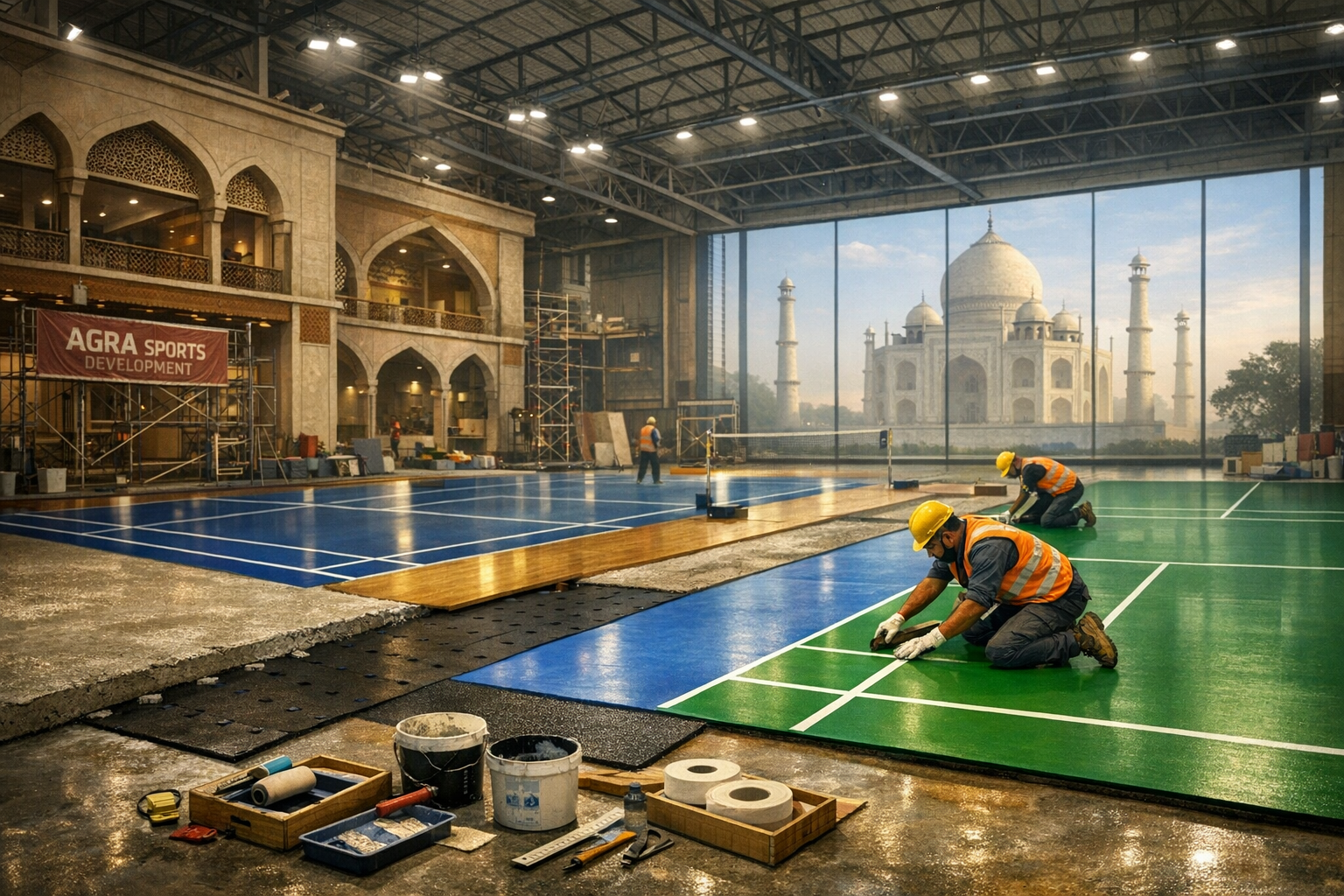
Badminton is no longer limited to casual recreation. Across India, the sport has become an important part of school education, professional training, fitness programs, residential amenities, and commercial sports facilities. Agra is also seeing growing interest in professionally developed badminton infrastructure as schools, academies, clubs, hotels, housing societies, and private investors look for reliable indoor and outdoor sports facilities.
A successful badminton court construction project in Agra requires considerably more than preparing a rectangular playing area. Court orientation, foundation strength, moisture protection, flooring performance, shock absorption, lighting, ventilation, ceiling clearance, line marking, equipment installation, and maintenance planning all influence the final quality of the facility.
At Sports Facility, the objective is to develop badminton courts that combine player safety, playing comfort, durability, professional appearance, and long-term performance. From initial site inspection and base preparation to sports flooring installation and finishing, every stage should be planned according to the intended level of play and available space.
This expert guide explains the major considerations involved in badminton court construction in Agra, including dimensions, flooring systems, construction stages, cost factors, indoor and outdoor solutions, maintenance, and practical planning recommendations.
Why Badminton Court Construction Is Growing in Agra
Agra has a diverse mix of educational institutions, residential developments, hotels, fitness facilities, sports clubs, and private properties. This creates opportunities for badminton courts in both institutional and commercial environments.
Badminton is particularly suitable for urban facilities because several courts can be developed within a relatively compact indoor sports building. A professionally designed facility can support recreational games, coaching sessions, school competitions, corporate activities, and competitive training.
The increasing focus on physical fitness is another important factor. Parents and educational institutions are looking for structured sports environments for children, while residential communities and commercial facilities are adding sports amenities to improve user experience.
For sports academies, a properly constructed court can also become an important revenue-generating asset through coaching programs, memberships, hourly bookings, tournaments, and training camps.
What Makes a Good Badminton Court?
A high-quality badminton court should provide a controlled and predictable playing environment. Players need adequate grip without excessive friction, comfortable impact absorption, accurate court dimensions, consistent lighting, and sufficient overhead clearance.
The quality of the finished court depends on several interconnected components:
- Properly engineered foundation
- Accurate surface leveling
- Suitable sports flooring
- Adequate shock absorption
- Correct court dimensions
- High-quality line marking
- Professional net-post installation
- Uniform lighting
- Appropriate ventilation
- Effective moisture management
- Regular maintenance
Ignoring any one of these areas can affect player comfort, flooring life, or overall court performance.
Standard Badminton Court Dimensions
Court dimensions should be established before construction begins so that the available building or land can accommodate not only the playing area but also safety clearances, walkways, equipment, seating, and circulation space.
According to standard badminton regulations, the playing court measures:
| Court Specification | Standard Measurement |
|---|---|
| Court Length | 13.40 metres |
| Doubles Court Width | 6.10 metres |
| Singles Court Width | 5.18 metres |
| Net Height at Centre | 1.524 metres |
| Net Height at Posts | 1.55 metres |
The complete facility should provide additional space around the marked court. The exact clearance requirements can vary according to the type of facility and level of competition, so professional planning is recommended for tournament or academy projects.
Ceiling height is also important. Indoor badminton facilities require sufficient vertical clearance to prevent shuttlecocks from contacting lights, structural members, fans, ducts, or the roof.
Types of Badminton Courts in Agra
The right court system depends on location, expected usage, budget, climate exposure, and performance requirements.
Indoor Badminton Courts
Indoor courts provide the greatest control over environmental conditions. They protect the playing surface from direct sunlight, rain, dust, and temperature fluctuations.
Indoor facilities are suitable for:
- Badminton academies
- Schools and colleges
- Sports clubs
- Fitness centers
- Indoor stadiums
- Corporate sports facilities
- Residential complexes
For professional or high-frequency use, indoor construction is generally the preferred approach because the flooring can be maintained under controlled conditions.
Outdoor Badminton Courts
Outdoor courts can be a practical solution when an enclosed sports building is not feasible. However, outdoor installations must be designed specifically for exposure to sunlight, rain, dust, and temperature changes.
A suitable outdoor system should include:
- Strong base construction
- Effective drainage
- Weather-resistant surfacing
- UV-resistant coatings
- Anti-slip texture
- Proper slope control
- Durable court markings
Acrylic sports surfacing is commonly considered for outdoor recreational badminton facilities.
Badminton Court Flooring Options
Flooring is one of the most important decisions in any badminton court project. The surface affects traction, impact absorption, movement, comfort, maintenance, and overall playing experience.
PVC Synthetic Badminton Flooring
PVC sports flooring is widely used in indoor badminton facilities because it can provide a resilient playing surface with controlled grip and cushioning.
Advantages include:
- Good player comfort
- Consistent surface characteristics
- Easy routine cleaning
- Professional appearance
- Suitable for frequent usage
- Availability in different thicknesses and constructions
PVC flooring is suitable for schools, academies, clubs, and commercial sports centers where regular gameplay is expected.
PU Sports Flooring
Polyurethane-based sports flooring can be designed as a resilient multi-layer system. Depending on the specification, PU flooring can provide cushioning, durability, and a seamless appearance.
It can be considered for:
- Indoor sports halls
- Training facilities
- Multi-purpose sports centers
- Professional sports environments
The final performance depends heavily on the complete flooring system and installation quality rather than simply the surface coating.
Wooden Badminton Flooring
Wooden flooring remains a premium option for high-level indoor sports facilities. Properly engineered wooden systems can provide excellent playing comfort and controlled shock absorption.
A professional wooden system may include:
- Structural subfloor
- Shock-absorbing components
- Engineered timber or hardwood surface
- Protective sports finish
- Precision line marking
Wood flooring requires controlled indoor conditions and regular maintenance. It is particularly suitable for premium academies, competition venues, and high-end sports centers.
Acrylic Sports Flooring
Acrylic surfacing is commonly associated with outdoor courts. A properly prepared acrylic system can provide an attractive, durable, and weather-resistant playing surface.
Its advantages include:
- UV resistance
- Attractive appearance
- Anti-slip texture
- Easy cleaning
- Relatively simple maintenance
- Suitable for outdoor recreational applications
Badminton Court Construction Process in Agra
A professional construction project should follow a structured sequence rather than treating flooring installation as the entire construction process.
1. Site Survey
The first stage involves examining the proposed location.
The survey should consider:
- Available land or floor area
- Existing structural conditions
- Soil characteristics for new outdoor construction
- Drainage
- Moisture levels
- Building height
- Access for construction equipment
- Electrical requirements
- Existing flooring condition
For indoor conversion projects, the existing slab should be checked carefully before sports flooring is installed.
2. Layout and Design Planning
The court layout is developed according to the intended usage. The designer should allow enough space for playing, movement, spectator circulation, equipment, storage, and maintenance.
For an academy, multiple courts may be arranged within the same hall. For a residential society, a single recreational court may be sufficient.
3. Foundation and Base Preparation
The foundation determines the stability of the entire court.
Outdoor projects may require excavation, soil compaction, sub-base preparation, reinforcement, concrete work, leveling, and drainage provisions.
Indoor projects generally begin with inspection and preparation of the existing concrete slab.
The base must be sufficiently stable and level before any resilient flooring system is installed.
4. Moisture Protection
Moisture is a major concern for sports flooring. Excess moisture can affect adhesives, flooring layers, wooden components, and the long-term performance of the court.
Proper moisture testing and an appropriate moisture-management system should therefore be included in the construction plan.
5. Sports Flooring Installation
Once the base is ready, the selected flooring system is installed according to the manufacturer’s technical requirements.
Installation may involve:
- Surface preparation
- Primer or bonding layer
- Resilient or cushioning layer
- Main sports surface
- Protective finish
- Court marking
- Final inspection
The installation environment should be controlled to achieve consistent results.
6. Court Marking
Precise line marking is essential. The lines should be accurately positioned and clearly visible without creating excessive surface texture.
Professional sports-grade marking materials should be used to provide good adhesion and long-term visibility.
7. Net and Sports Equipment Installation
The final stage includes installation of the badminton equipment.
Depending on the facility, this may include:
- Badminton net
- Net posts
- Umpire chair
- Scoreboard
- Player benches
- Protective padding
- Storage systems
- Spectator seating
8. Lighting and Ventilation
Indoor badminton courts require carefully planned lighting. Glare, shadows, uneven illumination, and poorly positioned fixtures can interfere with a player’s ability to track the shuttle.
LED sports lighting can provide energy-efficient and consistent illumination when properly designed.
Ventilation is equally important. Air movement should be controlled because strong drafts can significantly affect shuttlecock flight.
Badminton Court Construction Cost in Agra
The cost of badminton court construction in Agra cannot be represented accurately by one fixed figure. The final investment depends on the condition of the site and the specification selected.
Important cost factors include:
- Court size
- Number of courts
- Flooring type
- Foundation requirements
- Indoor or outdoor construction
- Roofing structure
- Lighting
- Electrical work
- Ventilation or air conditioning
- Drainage
- Sports equipment
- Seating
- Changing rooms
- Wall finishing
- Branding and signage
- Labour and installation requirements
A basic outdoor recreational court will have a substantially different budget from a complete indoor badminton academy containing multiple courts, specialized flooring, lighting, changing facilities, and spectator areas.
For an accurate project estimate, the site should be inspected and a detailed scope of work prepared before final pricing.
Indoor Badminton Court vs Outdoor Badminton Court
Choosing between an indoor and outdoor facility depends primarily on the intended usage and available investment.
| Feature | Indoor Court | Outdoor Court |
|---|---|---|
| Weather Protection | Excellent | Limited |
| Playing Environment | Controlled | Weather dependent |
| Flooring Choices | Wide range | Weather-resistant systems |
| Maintenance | More controlled | Higher exposure |
| Professional Training | Highly suitable | Limited by conditions |
| Initial Infrastructure | Higher | Usually lower |
| Year-Round Usage | Excellent | Weather dependent |
For commercial academies and professional coaching facilities, indoor construction generally provides greater operational reliability.
Factors to Consider Before Starting Construction
Before beginning a badminton court project in Agra, consider the following:
Available Space
Do not measure only the marked court. Include circulation, clearances, equipment, seating, and service areas.
Flooring Selection
Select flooring according to usage intensity and player requirements rather than choosing solely on initial price.
Drainage
Outdoor facilities require an effective drainage strategy to prevent standing water and moisture-related damage.
Lighting
Plan lighting before construction so that fixture positions, electrical loads, ceiling structures, and maintenance access can be coordinated.
Ceiling and Structural Clearance
Indoor courts should have sufficient height and clear space above the playing area.
Ventilation
Avoid uncontrolled air movement across the court. Fans, air-conditioning outlets, and ventilation systems should be positioned carefully.
Maintenance Access
A court should be designed so that flooring, lighting, nets, and other components can be inspected and serviced easily.
Maintenance of Badminton Courts
Regular maintenance protects the surface and preserves player safety.
For synthetic flooring, routine cleaning should remove dust, dirt, and contaminants that can affect traction.
Recommended practices include:
- Use suitable sports-floor cleaning methods
- Avoid harsh chemicals
- Do not drag heavy equipment across the surface
- Repair damaged flooring promptly
- Inspect joints and edges
- Maintain clear court markings
- Check net posts regularly
- Inspect lighting periodically
Wooden floors require additional attention to moisture, humidity, surface finish, and mechanical damage.
Outdoor acrylic courts should be inspected for cracks, surface wear, drainage problems, and faded markings.
Common Mistakes to Avoid
Many court problems can be prevented during the planning stage.
Choosing Flooring Only on Price
The cheapest surface may not provide the required cushioning, grip, or service life.
Ignoring the Base
Even premium sports flooring cannot compensate for a poorly prepared or unstable foundation.
Insufficient Clearance
A court may technically fit into a room while still being unsuitable for comfortable play because of inadequate surrounding or overhead space.
Poor Lighting Design
Bright lights do not automatically mean good sports lighting. Fixture placement and glare control are equally important.
Improper Drainage
Outdoor water accumulation can damage the surface and shorten the life of the court.
Using General Contractors Without Sports-Flooring Experience
Sports flooring requires specialized installation practices. Experience with ordinary construction does not automatically translate into sports-flooring expertise.
Benefits of Professional Badminton Court Construction
Hiring experienced sports infrastructure professionals can provide several advantages:
- Accurate court layout
- Appropriate flooring selection
- Better surface preparation
- Professional installation
- Improved player safety
- Long-term durability
- Better project coordination
- Reduced maintenance problems
- Professional facility appearance
- Support for future upgrades
A specialist can also help coordinate civil work, flooring, lighting, sports equipment, and finishing so that the different components work together as one complete facility.
Badminton Court Construction for Different Facilities in Agra
Schools and Colleges
Educational institutions can use badminton courts for physical education, inter-school competitions, extracurricular programs, and student fitness.
Sports Academies
Academies need durable flooring because courts may remain occupied for several hours each day. Surface comfort, resilience, and maintenance become particularly important.
Residential Societies
Residential projects generally prioritize safe, attractive, low-maintenance sports facilities that can serve children and adults.
Hotels and Resorts
Badminton courts can strengthen recreational offerings and improve the overall sports and wellness experience for guests.
Commercial Sports Complexes
Commercial operators require durable construction, efficient maintenance, attractive finishes, and flooring capable of handling frequent bookings.
Why Professional Planning Matters in Agra
Local climate and site conditions should be considered during project planning. Hot summers, seasonal rainfall, dust, and moisture exposure can influence the choice of materials and construction methods.
Outdoor courts need weather-resistant systems and effective drainage. Indoor facilities require proper insulation, ventilation, lighting, and moisture control.
Instead of selecting a standard design without examining the site, the project should be customized around the building structure, expected usage, budget, and long-term maintenance plan.
Frequently Asked Questions
What is the standard size of a badminton court?
A regulation badminton court is 13.40 metres long. The doubles playing width is 6.10 metres, while the singles width is 5.18 metres.
Which flooring is best for badminton courts?
For indoor facilities, resilient synthetic PVC, PU, or professionally engineered wooden systems can provide excellent performance. The best choice depends on usage, budget, maintenance requirements, and the desired playing characteristics.
How much does badminton court construction cost in Agra?
The investment varies considerably according to flooring, civil construction, roofing, lighting, equipment, and facility specifications. A site-specific quotation is more reliable than a generic per-court figure.
Can badminton courts be built outdoors?
Yes. Outdoor badminton courts can be constructed using suitable concrete and acrylic sports surfacing systems, together with appropriate drainage and weather protection measures.
How long does badminton court construction take?
Project duration depends on the number of courts, site preparation, civil work, flooring system, building requirements, and finishing scope. A straightforward project may take several weeks, while a complete indoor facility can require considerably more time.
Is wooden flooring suitable for badminton?
Yes. Properly engineered wooden sports flooring can provide excellent comfort and shock absorption and is suitable for premium indoor badminton facilities.
Is PVC flooring suitable for badminton academies?
Yes. Quality PVC sports flooring is widely considered for badminton academies because it can combine resilience, player comfort, durability, and manageable maintenance.
What type of lighting is recommended?
Modern LED sports lighting is commonly used for indoor courts. The lighting design should focus on uniform illumination, glare reduction, suitable fixture positioning, and player visibility.
How can I reduce badminton court maintenance costs?
Use appropriate sports flooring, prepare the base correctly, follow recommended cleaning procedures, prevent moisture exposure, and address small defects before they become larger problems.
Final Thoughts
A professionally developed badminton court in Agra can become a valuable long-term facility for education, fitness, recreation, coaching, and competitive sport. However, the quality of the finished court depends on decisions made well before the flooring is installed.
The right combination of site planning, structural preparation, sports flooring, lighting, ventilation, drainage, equipment, and maintenance creates a facility that players can use safely and comfortably for years.
Whether the project is a single court for a residential community, a school sports facility, or a multi-court professional badminton academy, the construction process should be based on the intended level of play and long-term operational requirements.
For reliable results, work with experienced badminton court construction professionals in Agra who can assess the site, recommend the appropriate flooring system, coordinate construction activities, and deliver a complete sports facility designed around performance, safety, durability, and value.