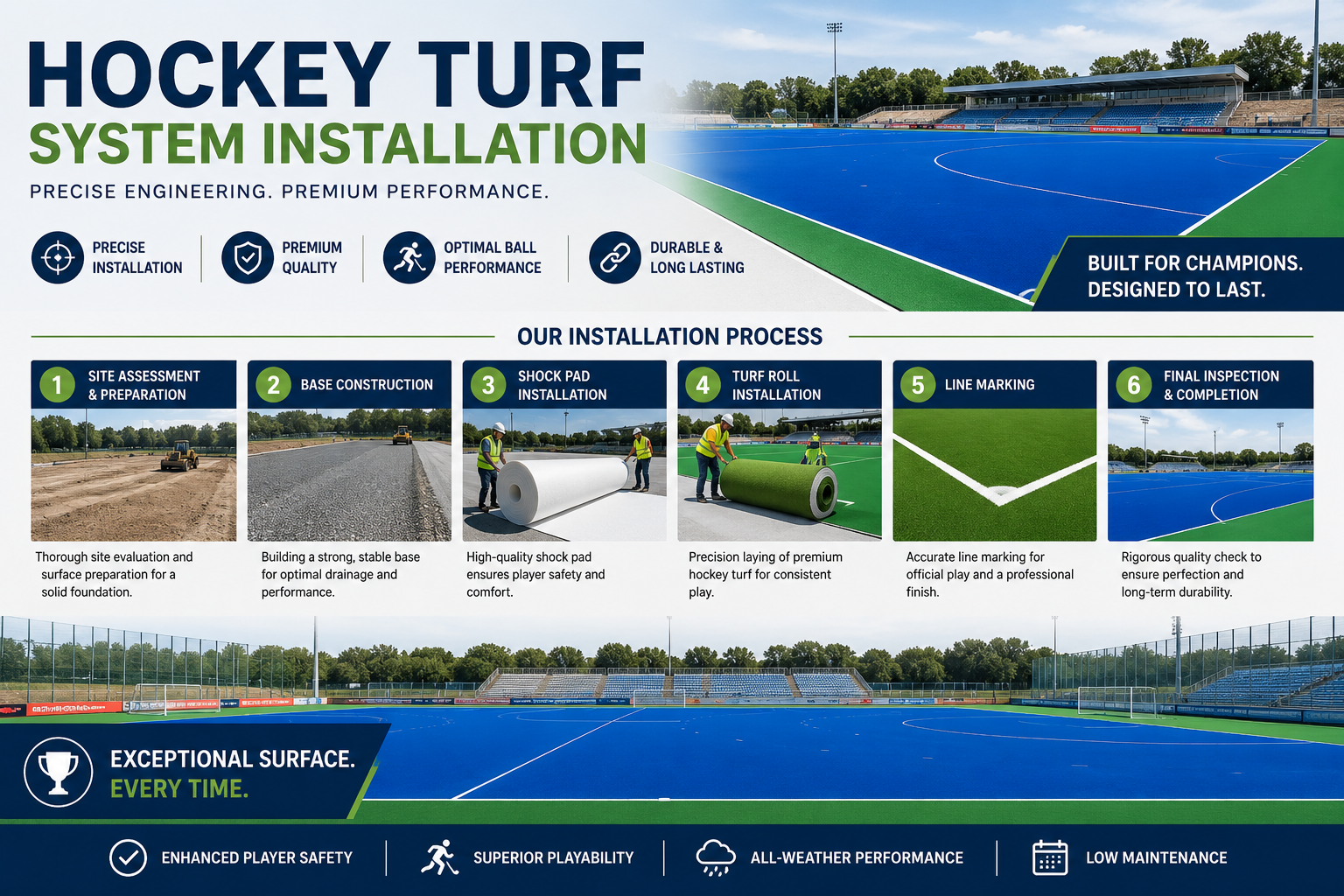
Professional Synthetic Hockey Turf Installation Services for High-Performance Sports Facilities
A professionally installed hockey turf system is the foundation of a world-class hockey facility. Whether the project involves a school sports ground, university campus, sports academy, community recreation center, government sports complex, or professional training facility, the quality of the turf installation directly impacts player performance, safety, durability, and long-term operational efficiency.
Modern hockey has evolved significantly over the years, and playing surfaces have become one of the most important factors influencing the speed, accuracy, and quality of the game. Natural grass fields have largely been replaced by advanced synthetic hockey turf systems that provide consistent playing conditions throughout the year. These engineered surfaces offer improved ball roll, predictable bounce characteristics, enhanced player movement, and superior durability compared to traditional sports fields.
Hockey Turf System Installation involves much more than simply laying artificial grass. It is a comprehensive process that requires detailed planning, site preparation, drainage engineering, foundation construction, turf installation, line marking, quality testing, and ongoing maintenance planning. Every component of the system must work together to create a durable, safe, and high-performance playing environment.
Our Hockey Turf System Installation services provide complete turnkey solutions designed to meet the needs of educational institutions, sports organizations, municipalities, private clubs, and professional sports facilities. From initial consultation through final project completion, every stage is managed with precision and attention to detail to ensure exceptional results.
Understanding Modern Hockey Turf Systems
Synthetic hockey turf systems are specifically designed to support the unique requirements of hockey gameplay. Unlike general-purpose artificial grass systems, hockey turf is engineered to provide smooth ball movement, optimal traction, player comfort, and long-lasting performance under intensive use.
Modern turf technology utilizes advanced synthetic fibers that closely replicate the characteristics required for competitive hockey. These fibers are manufactured to resist wear, maintain structural integrity, and deliver consistent performance throughout their service life.
The primary objectives of a hockey turf system include:
- Consistent ball speed
- Accurate ball control
- Reliable ball bounce
- Enhanced player movement
- Improved safety
- Reduced maintenance requirements
- Weather resistance
- Long-term durability
Proper installation ensures that these performance characteristics remain consistent across the entire playing surface.
Importance of Professional Hockey Turf Installation
The performance of a hockey turf system depends heavily on installation quality. Even the highest-grade synthetic turf materials can fail to deliver expected results if installed incorrectly.
Professional installation ensures:
Consistent Playing Conditions
A properly installed turf system provides a level and uniform playing surface. This consistency allows athletes to develop skills, improve performance, and compete under predictable conditions.
Enhanced Player Safety
Surface irregularities can increase the risk of slips, falls, and injuries. Professional installation minimizes hazards and creates a safer environment for players.
Maximum Durability
Proper construction techniques extend the lifespan of the turf system and reduce long-term maintenance costs.
Improved Drainage Performance
Effective drainage systems prevent water accumulation and ensure rapid recovery after rainfall.
Better Return on Investment
High-quality installation protects the owner’s investment by maximizing surface longevity and reducing repair requirements.
Site Assessment and Project Planning
Every successful hockey turf installation begins with a comprehensive site evaluation. This stage provides essential information about the project location and helps determine the most appropriate construction methods.
Site assessment typically includes:
- Land survey
- Soil analysis
- Topographical evaluation
- Drainage assessment
- Utility identification
- Environmental review
- Accessibility analysis
- Construction feasibility study
Professional engineers and project planners analyze these factors to develop an installation strategy tailored to the specific site conditions.
The planning phase also establishes:
- Project dimensions
- Surface specifications
- Drainage requirements
- Construction schedules
- Material selections
- Budget considerations
- Future expansion opportunities
Proper planning minimizes risks and contributes significantly to project success.
Ground Preparation and Excavation
Ground preparation is one of the most critical stages of hockey turf installation. The quality of the foundation directly affects surface performance, drainage efficiency, and long-term durability.
The process begins with clearing the construction area and removing vegetation, debris, and unsuitable materials.
Ground preparation activities may include:
- Site clearing
- Excavation work
- Soil stabilization
- Land grading
- Level correction
- Compaction procedures
- Foundation preparation
Professional contractors use advanced surveying equipment to ensure precise grading and elevation control.
The objective is to create a stable platform capable of supporting the entire turf system without settlement or deformation.
Base Construction and Foundation Systems
The foundation serves as the structural backbone of the hockey turf system. A properly engineered base provides stability, drainage, and long-term performance.
Foundation construction generally involves multiple layers designed to distribute loads and facilitate water movement.
Common foundation components include:
Subgrade Layer
The prepared natural ground forms the subgrade layer. This layer is compacted and stabilized to provide foundational support.
Aggregate Base Layer
Crushed stone or engineered aggregate materials are installed to create a durable structural base.
Benefits include:
- Load distribution
- Surface stability
- Improved drainage
- Long-term durability
Fine Grading Layer
A precision-graded layer creates the smooth surface required for synthetic turf installation.
This layer is carefully leveled to ensure consistent playing conditions across the entire field.
Advanced Drainage System Installation
Drainage is one of the most important components of a hockey turf facility. Water accumulation can negatively affect playing conditions, damage infrastructure, and shorten surface lifespan.
Professional hockey turf systems incorporate advanced drainage solutions designed to efficiently remove water from the playing surface.
Drainage systems may include:
- Perimeter drainage channels
- Underground drainage pipes
- Collection chambers
- Drainage outlets
- Stormwater management systems
- Surface grading systems
The drainage network is engineered to accommodate local rainfall conditions and site-specific requirements.
Efficient water management helps maintain optimal playing conditions throughout the year.
Synthetic Hockey Turf Selection
Selecting the right turf system is essential for achieving desired performance outcomes.
Several turf options are available depending on facility requirements, usage intensity, and budget objectives.
Sand-Filled Hockey Turf
Sand-filled systems utilize synthetic fibers supported by specialized sand infill materials.
Benefits include:
- Good durability
- Consistent performance
- Cost-effective installation
- Low maintenance requirements
Sand-Dressed Hockey Turf
These systems incorporate a controlled sand layer that supports the turf fibers while maintaining excellent ball movement characteristics.
Advantages include:
- Enhanced playability
- Improved ball roll
- Increased durability
Water-Based Hockey Turf
Water-based systems are widely used for professional and international-level competition.
Benefits include:
- Exceptional speed
- Accurate ball movement
- Professional playing characteristics
- Superior athlete performance
High-Performance Synthetic Systems
Advanced synthetic technologies provide premium playing conditions for elite-level facilities.
These systems are often selected for:
- Professional training centers
- Sports academies
- Competition venues
- National sports facilities
Hockey Turf Installation Process
Once the foundation and drainage systems are completed, the synthetic turf installation process begins.
The installation procedure requires specialized equipment and experienced technicians.
Key installation stages include:
Turf Placement
Synthetic turf rolls are positioned according to detailed layout plans.
Seam Construction
Adjacent turf sections are joined using specialized adhesives and seam tapes.
This process ensures:
- Structural integrity
- Uniform appearance
- Long-term durability
Surface Tensioning
The turf is carefully stretched and secured to eliminate wrinkles and irregularities.
Edge Anchoring
Perimeter anchoring systems secure the turf and prevent movement over time.
Surface Finishing
Final adjustments ensure a smooth, professional-quality playing surface.
Every stage is carefully monitored to maintain installation accuracy.
Sports Line Marking and Field Layout
Accurate field markings are essential for organized gameplay and regulatory compliance.
Professional line marking services ensure all playing dimensions are correctly positioned according to hockey standards.
Markings may include:
- Boundary lines
- Center line
- Goal circles
- Penalty areas
- Shooting circles
- Training zones
- Custom markings
Specialized sports coatings provide excellent visibility and long-term durability.
Perimeter Fencing and Ball Containment Systems
Many hockey facilities incorporate fencing and containment systems to improve safety and operational efficiency.
Fencing solutions may include:
- Chain-link fencing
- Sports mesh systems
- Ball-stop netting
- Spectator barriers
- Access gates
- Security fencing
These systems help maintain a controlled playing environment while protecting spectators and surrounding property.
Sports Lighting Integration
Modern hockey facilities often support evening training sessions and competitive matches.
Professional lighting systems are designed to provide uniform illumination across the entire field.
Lighting solutions may include:
- LED sports lighting
- High-efficiency floodlights
- Smart control systems
- Energy-saving technology
- Competition-grade illumination
Proper lighting improves visibility, enhances player safety, and extends facility operating hours.
Quality Control and Performance Testing
Quality assurance is essential throughout the installation process.
Professional testing verifies that the completed facility meets performance standards and project specifications.
Testing procedures may include:
- Surface level verification
- Drainage performance testing
- Seam strength inspection
- Turf anchoring assessment
- Ball roll evaluation
- Surface consistency testing
- Safety inspections
These assessments help ensure long-term performance and reliability.
Benefits of Synthetic Hockey Turf Systems
Professionally installed hockey turf systems offer numerous advantages over traditional natural grass surfaces.
Consistent Performance
Players benefit from predictable ball movement and reliable playing conditions.
All-Weather Usability
Synthetic turf remains playable in a wide range of weather conditions.
Reduced Maintenance
Compared to natural grass, synthetic surfaces require significantly less maintenance.
Enhanced Durability
Modern turf systems are engineered to withstand intensive use and heavy traffic.
Improved Safety
Advanced surface technologies support player comfort and reduce injury risks.
Increased Facility Utilization
Year-round usability maximizes facility value and operational efficiency.
Applications of Hockey Turf Systems
Hockey turf installations are suitable for a wide variety of facilities.
Common applications include:
School Hockey Grounds
Educational institutions benefit from safe and durable sports infrastructure.
College and University Sports Facilities
Higher education campuses utilize synthetic turf for training and competition.
Sports Academies
Professional training centers require high-performance surfaces for athlete development.
Community Recreation Centers
Public sports facilities benefit from low-maintenance and durable turf systems.
Government Sports Projects
Municipal and state-level sports infrastructure often incorporates synthetic hockey turf.
Professional Training Facilities
Elite athletes require surfaces capable of supporting advanced training programs.
Maintenance of Hockey Turf Systems
Although synthetic turf requires less maintenance than natural grass, routine care remains essential.
Maintenance activities may include:
- Surface cleaning
- Debris removal
- Grooming procedures
- Drainage inspections
- Seam inspections
- Repair work
- Performance evaluations
Regular maintenance helps preserve surface quality and extend system lifespan.
Sustainable Hockey Turf Solutions
Modern sports construction increasingly emphasizes environmental responsibility.
Many hockey turf systems incorporate sustainable features such as:
- Recyclable materials
- Energy-efficient lighting
- Water-saving technologies
- Reduced chemical usage
- Long-life surface systems
These features contribute to environmentally responsible facility development.
Why Choose Professional Hockey Turf Installation Services
Professional installation provides the expertise, equipment, and quality control necessary to achieve exceptional results.
Experienced installation teams ensure:
- Accurate construction
- Superior drainage
- Long-term durability
- Enhanced safety
- Reliable performance
- Regulatory compliance
Professional execution protects the investment and delivers a facility capable of supporting years of competitive play.
Conclusion
A professionally installed hockey turf system creates the foundation for exceptional athletic performance, player safety, and long-term facility success. From site preparation and drainage engineering to turf installation and final testing, every stage contributes to the overall quality of the playing surface.
Modern synthetic hockey turf systems provide consistent gameplay, superior durability, reduced maintenance requirements, and year-round usability. Whether the project involves a school sports facility, sports academy, university campus, community recreation center, or professional training venue, expert Hockey Turf System Installation ensures a high-performance surface capable of meeting the demands of today’s athletes.
Investing in professional hockey turf installation delivers lasting value, improved player experiences, and a durable sports infrastructure designed for the future of hockey.