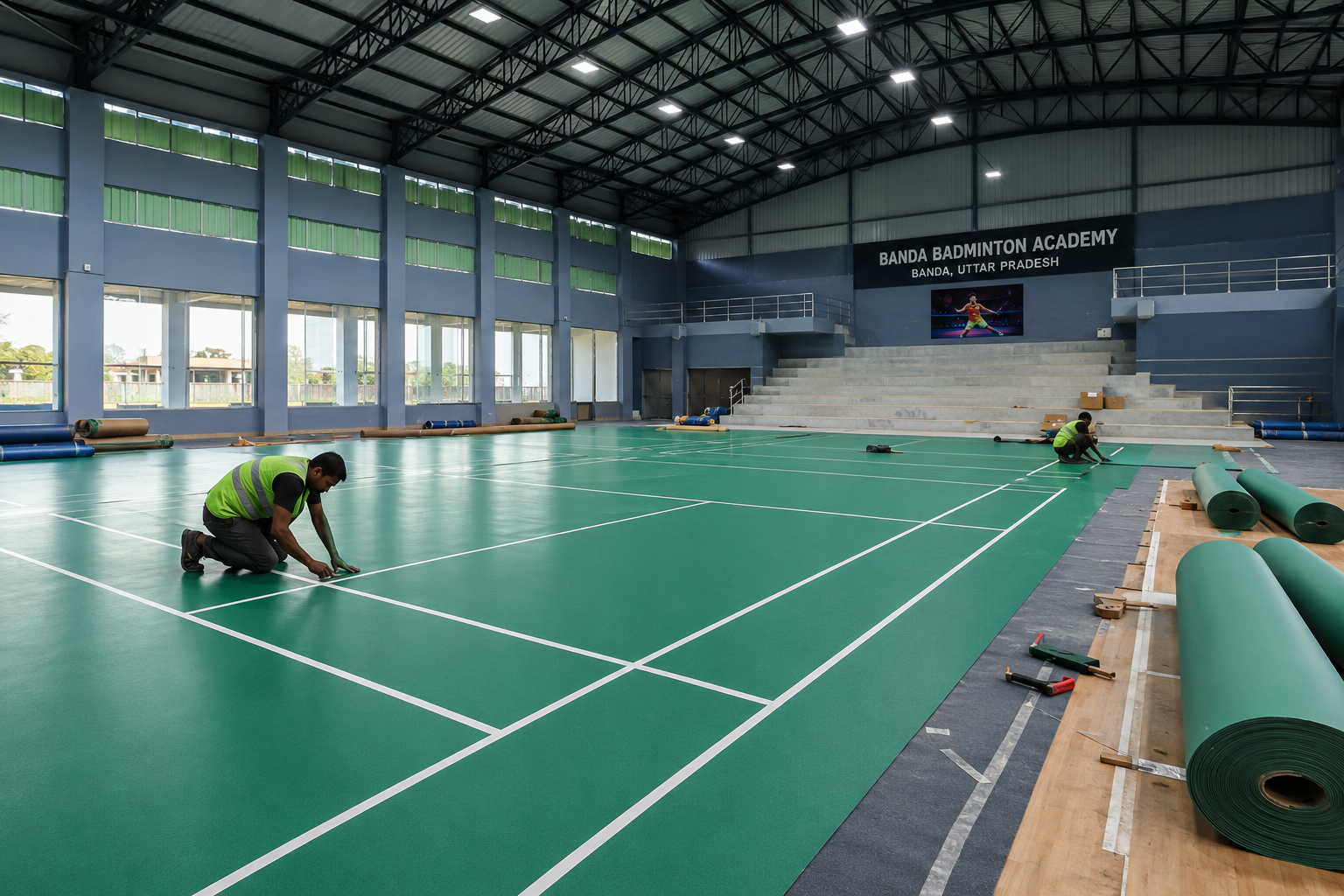
Introduction
Badminton has evolved into one of India’s most popular indoor sports, attracting players of all ages—from school children and college athletes to fitness enthusiasts and professional competitors. In Banda, Uttar Pradesh, the growing focus on sports infrastructure, healthy living, and recreational facilities has significantly increased the demand for professionally designed badminton courts. Educational institutions, sports academies, residential townships, indoor stadiums, government sports complexes, clubs, hotels, and corporate campuses are investing in modern badminton courts that meet international playing standards.
Constructing a badminton court is a specialized engineering project that requires far more than installing a net and marking boundary lines. Every stage—from site selection and base preparation to sports flooring installation, lighting design, ventilation, and court markings—must be carefully planned to create a safe, durable, and high-performance playing environment. Even minor inaccuracies in floor leveling or material selection can affect shuttle movement, player comfort, and overall game quality.
Whether you are planning a single recreational court or a multi-court indoor badminton facility, choosing the right construction techniques and certified sports flooring materials is essential. Professional badminton court construction ensures excellent shock absorption, superior grip, consistent shuttle response, player safety, and long-term durability while minimizing maintenance costs over the years.
As Banda continues to strengthen its educational institutions, residential developments, and public sports infrastructure, the need for premium-quality badminton facilities is expected to grow steadily. Modern courts not only encourage active lifestyles but also create opportunities for professional coaching, district-level tournaments, state competitions, and community sports programs.
This comprehensive guide explores every aspect of Badminton Court Construction in Banda, including court types, flooring systems, construction methodology, BWF specifications, project planning, installation techniques, investment estimates, maintenance practices, and the latest innovations shaping the future of badminton infrastructure in 2026.
Why Invest in Badminton Court Construction in Banda?
The sports industry in Banda is experiencing remarkable growth as schools, colleges, private organizations, and government bodies increasingly recognize the importance of high-quality sports facilities. A professionally constructed badminton court offers long-term value by promoting fitness, enhancing recreational opportunities, and supporting competitive sports development.
Growing Interest in Indoor Sports
Badminton has become one of the most accessible and enjoyable indoor games in Banda. Its fast-paced nature, relatively simple equipment requirements, and suitability for players of all age groups have made it a preferred sport for families, students, professionals, and senior citizens alike. As awareness of physical fitness continues to increase, more people are choosing badminton as a regular form of exercise that improves cardiovascular health, coordination, agility, flexibility, endurance, and mental focus.
Rising Demand from Educational Institutions
Schools, colleges, universities, and coaching institutes are expanding their sports infrastructure to provide students with well-rounded educational experiences. A professionally built badminton court enables institutions to organize inter-school competitions, sports training programs, annual tournaments, and extracurricular activities while encouraging student participation in physical education.
Modern badminton facilities also enhance the overall reputation of educational institutions by demonstrating a commitment to student wellness and sports excellence.
Expansion of Sports Academies and Coaching Centers
The popularity of professional badminton coaching is increasing throughout Uttar Pradesh, including Banda. Sports academies require courts that provide consistent playing conditions, accurate shuttle speed, excellent grip, and proper shock absorption. Courts built according to Badminton World Federation (BWF) guidelines help athletes train under professional conditions and prepare for district, state, and national-level tournaments.
High-quality sports flooring also reduces fatigue and minimizes the risk of injuries during intensive practice sessions.
Growth of Residential Townships and Community Spaces
Modern residential societies and integrated townships are increasingly including sports amenities as part of their lifestyle offerings. Indoor badminton courts have become one of the most sought-after recreational facilities because they promote healthy living, encourage community interaction, and add value to residential projects.
Families appreciate having access to safe and professionally designed sports facilities within their communities, making badminton courts a valuable long-term investment for developers and housing societies.
Government Support for Sports Infrastructure
Government initiatives promoting grassroots sports development have encouraged the construction of indoor sports halls, community recreation centers, youth clubs, and public badminton facilities throughout Uttar Pradesh. Investments in sports infrastructure are helping identify emerging talent while providing accessible recreational opportunities for local communities.
Professionally constructed badminton courts support these initiatives by creating durable facilities that can accommodate regular training sessions, coaching camps, and organized competitions.
Corporate Wellness and Institutional Facilities
Many corporate offices, industrial organizations, hotels, and institutional campuses are introducing indoor sports facilities to promote employee wellness and improve workplace engagement. A badminton court offers an excellent recreational option that encourages physical activity, stress reduction, teamwork, and employee interaction.
For hospitality businesses, premium sports facilities also enhance guest experiences and increase the overall attractiveness of the property.
Year-Round Playing Environment
Unlike outdoor sports that are affected by heat, rainfall, dust, or strong winds, indoor badminton courts provide uninterrupted playing conditions throughout the year. Proper lighting, ventilation, and climate control create a comfortable environment for both recreational and professional players regardless of seasonal weather changes.
This all-season usability ensures maximum utilization of the sports facility and delivers excellent long-term returns on investment.
Types of Badminton Courts in Banda
Selecting the right type of badminton court depends on factors such as budget, intended usage, expected player traffic, maintenance requirements, and whether the facility will be used for recreational play or professional tournaments. Each flooring system offers distinct advantages that make it suitable for specific applications.
1. Wooden Indoor Badminton Courts
Wooden badminton courts are regarded as the highest standard for professional badminton facilities across the world. They are commonly installed in international tournament venues, indoor stadiums, elite sports academies, and professional training centers because of their exceptional playing characteristics.
A premium wooden badminton court typically consists of carefully selected hardwood flooring installed over an engineered shock-absorbing subfloor system. This construction provides outstanding resilience, excellent energy return, superior grip, and consistent shuttle performance while significantly reducing stress on players’ knees, ankles, and joints.
Key Features
- Premium hardwood sports flooring
- Engineered floating subfloor system
- Advanced shock absorption technology
- Uniform ball and shuttle response
- Excellent traction and slip resistance
- Long service life with proper maintenance
- Professional tournament-quality finish
Major Advantages
- Outstanding player comfort during extended matches
- Reduced risk of sports-related injuries
- Exceptional durability and structural stability
- Smooth, consistent playing performance
- Ideal for professional coaching and competitions
- Meets international sports facility standards
Recommended Applications
- Indoor badminton stadiums
- Professional sports academies
- National and state tournament venues
- Universities and sports institutes
- High-performance training centers
- Premium sports clubs
Considerations
Although wooden courts offer unmatched playing quality, they require controlled indoor humidity, periodic refinishing, and routine maintenance to preserve their appearance and performance. Their higher installation cost is often justified by their longevity and premium playing experience.
2. Synthetic PVC and PU Badminton Courts
Synthetic badminton flooring has become the preferred choice for schools, colleges, residential societies, sports clubs, and indoor recreation centers throughout Banda. PVC (Polyvinyl Chloride) and PU (Polyurethane) sports flooring systems combine affordability, durability, player safety, and low maintenance, making them ideal for facilities with regular daily usage.
These flooring systems are engineered with multiple resilient layers that provide excellent cushioning, anti-slip performance, moisture resistance, and consistent gameplay. Their versatility allows them to be installed over properly prepared concrete bases while maintaining international-quality playing conditions.
Key Features
- High-performance PVC or PU sports flooring
- Multi-layer resilient construction
- Anti-slip textured surface
- Shock-absorbing cushion layers
- Moisture-resistant finish
- UV-stable surface colors
- Easy cleaning and maintenance
Major Advantages
- Comfortable playing experience
- Reduced impact on joints and muscles
- Excellent grip and player movement
- Durable under heavy daily usage
- Quick installation process
- Cost-effective long-term investment
- Suitable for multi-purpose indoor sports facilities
Best Applications
- Schools and educational institutions
- Colleges and universities
- Sports academies
- Community centers
- Residential societies
- Indoor sports clubs
- Fitness and recreation centers
Synthetic badminton courts continue to dominate the sports flooring market because they deliver an excellent balance between professional performance, affordability, durability, and ease of maintenance.
3. Acrylic Outdoor Badminton Courts
Outdoor badminton courts have become increasingly popular in Banda, particularly in schools, public parks, residential townships, community centers, and recreational clubs. Among the various outdoor flooring options, acrylic sports flooring is widely preferred because of its excellent weather resistance, attractive finish, and long-lasting performance.
Unlike conventional concrete surfaces, acrylic flooring consists of multiple specialized coating layers that create a textured, anti-slip playing surface. These coatings protect the court from sunlight, rainfall, temperature fluctuations, and regular wear while providing consistent grip and ball response. Acrylic courts require comparatively low maintenance and retain their appearance for many years when installed over a properly prepared concrete or asphalt base.
Key Features
- Multi-layer acrylic sports coating system
- UV-resistant color pigments
- Anti-slip textured finish
- Weather-resistant surface
- Fade-resistant colors
- Durable outdoor performance
- Low maintenance requirements
Major Advantages
- Performs efficiently in varying weather conditions
- Resistant to cracking and surface wear
- Attractive professional appearance
- Excellent drainage compatibility
- Long operational lifespan
- Economical maintenance over time
Ideal Applications
- Public parks
- Government sports facilities
- Educational campuses
- Residential societies
- Community recreation centers
- Outdoor sports complexes
- Multi-purpose play areas
4. Reinforced Concrete Badminton Courts
Concrete badminton courts remain a practical choice for recreational sports facilities where affordability and structural durability are the primary considerations. Although they are not recommended for professional tournaments because of limited shock absorption, they provide an economical solution for community-level sports infrastructure.
A reinforced cement concrete (RCC) base offers excellent structural strength and can withstand heavy foot traffic with minimal maintenance. These courts are commonly used in village playgrounds, government schools, community parks, and recreational centers.
Key Features
- Reinforced cement concrete construction
- High structural stability
- Long service life
- Minimal maintenance
- Strong load-bearing capacity
Advantages
- Lowest construction cost
- Highly durable foundation
- Suitable for outdoor recreational play
- Easy cleaning and maintenance
- Long-lasting structural performance
Limitations
- Hard playing surface
- Limited player cushioning
- Increased stress on knees and ankles
- Not suitable for competitive tournaments
- Lower player comfort compared to synthetic flooring
Standard Badminton Court Dimensions (BWF Guidelines)
Every professional badminton court should comply with the official specifications established by the Badminton World Federation (BWF). Accurate dimensions ensure fair competition, proper player movement, and tournament eligibility while maintaining consistency across all levels of play.
| Specification | Standard Measurement |
|---|---|
| Court Length | 13.40 meters |
| Doubles Court Width | 6.10 meters |
| Singles Court Width | 5.18 meters |
| Net Height at Posts | 1.55 meters |
| Net Height at Centre | 1.524 meters |
| Short Service Line | 1.98 meters from the net |
| Back Boundary Line | As per BWF standards |
| Recommended Side Clearance | Minimum 2 meters |
| Recommended Rear Clearance | Minimum 2 meters |
| Recommended Ceiling Height | 9–12 meters |
In addition to the official playing area, sufficient clearance around the court is essential to allow players to move freely and safely during competitive matches. Indoor facilities should also incorporate proper ventilation, glare-free lighting, and unobstructed ceiling height for optimal shuttle visibility.
Step-by-Step Badminton Court Construction Process in Banda
Professional badminton court construction follows a systematic engineering process that ensures durability, safety, precision, and long-term performance. Every construction stage contributes to the overall quality of the finished sports facility.
Site Survey and Project Planning
Every successful badminton court begins with comprehensive planning and technical evaluation. A detailed site survey helps engineers identify potential challenges before construction starts, reducing delays and unnecessary costs.
Professional planning generally includes:
- Topographical survey
- Land measurement
- Soil investigation
- Site accessibility assessment
- Indoor or outdoor feasibility analysis
- Drainage planning
- Structural design evaluation
- Utility planning
- Environmental assessment
- Budget estimation
- Material selection
- Project scheduling
Proper planning ensures that the court remains structurally stable, safe, and compliant with sports construction standards for many years.
Ground Preparation and Base Construction
The foundation forms the backbone of every badminton court. Even premium sports flooring cannot perform effectively if installed over an uneven or unstable base.
Ground preparation generally involves:
- Site excavation (where required)
- Removal of loose soil and debris
- Earth filling and grading
- Mechanical soil compaction
- Installation of crushed stone sub-base (if necessary)
- PCC layer construction
- Reinforced Cement Concrete (RCC) base
- Surface curing
- Moisture barrier installation
- Laser-guided leveling
- Precision grinding and finishing
For indoor wooden courts, an engineered floating subfloor system with resilient shock pads is installed above the concrete base to improve player comfort and reduce impact forces.
A properly prepared foundation significantly improves flooring life, minimizes maintenance, and prevents structural defects such as settlement, cracks, and uneven surfaces.
Sports Flooring Installation
Sports flooring is the most critical component of a badminton court because it directly influences player performance, comfort, safety, and injury prevention.
Professional installers carefully select flooring systems according to project requirements, usage intensity, budget, and expected lifespan.
Synthetic PVC Flooring Installation
PVC sports flooring remains one of the most widely used flooring systems in Banda because of its excellent durability and affordability.
Installation process includes:
- Surface inspection
- Moisture testing
- Primer application
- Adhesive spreading
- PVC sheet installation
- Roller compaction
- Seam welding
- Edge trimming
- Final inspection
The finished floor provides excellent grip, shock absorption, and consistent playing performance.
Polyurethane (PU) Sports Flooring
Polyurethane flooring is known for its seamless finish and exceptional resilience. It offers superior elasticity, outstanding durability, and excellent resistance to abrasion.
PU flooring provides:
- Seamless surface finish
- High impact resistance
- Anti-slip performance
- Superior player comfort
- Excellent durability
- Long service life
Wooden Sports Flooring Installation
Professional wooden badminton courts involve multiple engineered layers to maximize performance and safety.
Construction generally includes:
- Moisture barrier installation
- Shock-absorbing resilient pads
- Engineered subfloor framework
- Hardwood plank installation
- Surface sanding
- Protective sports coating
- Line marking
- Final polishing
Premium hardwood flooring provides exceptional energy return, consistent shuttle response, and outstanding playing comfort.
Acrylic Sports Flooring Installation
Outdoor acrylic courts require carefully controlled application procedures.
Typical installation includes:
- Concrete surface preparation
- Crack repair
- Primer coating
- Cushion layers (if specified)
- Acrylic color coatings
- Anti-slip texture application
- Line marking
- Protective finishing coat
Proper curing ensures excellent weather resistance and long-term durability.
Court Marking
Accurate court markings are essential for professional gameplay and compliance with BWF standards.
Experienced installers use precision measuring instruments and sports-grade paints to create sharp, durable, and highly visible markings.
Court markings include:
- Baselines
- Singles sidelines
- Doubles sidelines
- Centre line
- Short service line
- Long service line
- Back boundary line
Premium sports paints resist fading, abrasion, and frequent cleaning, ensuring long-lasting visibility.
Installation of Sports Equipment
A world-class badminton facility requires more than quality flooring. Professional sports equipment enhances safety, functionality, and the overall playing experience.
Standard installations include:
- Professional badminton net
- Powder-coated steel net posts
- Adjustable net tension system
- LED anti-glare sports lighting
- Electronic scoreboards
- Umpire chair
- Spectator seating
- Protective wall padding
- Court divider curtains
- Storage racks
- Emergency safety equipment
- Ventilation systems
- Air conditioning (for indoor stadiums)
Modern LED lighting systems are designed to eliminate glare and provide uniform illumination across the entire playing area, ensuring excellent shuttle visibility during competitive matches.
Badminton Court Construction Cost in Banda (2026)
The total investment required for badminton court construction depends on several factors, including flooring type, court dimensions, site conditions, roofing requirements, lighting systems, spectator facilities, and additional infrastructure.
While premium materials involve a higher initial investment, they offer superior durability, reduced maintenance costs, and better long-term value.
Approximate Flooring Cost
| Flooring Type | Estimated Cost (Per Sq. Ft.) |
|---|---|
| Concrete Court | ₹150 – ₹250 |
| Acrylic Sports Flooring | ₹250 – ₹400 |
| Synthetic PVC Flooring | ₹350 – ₹550 |
| Polyurethane (PU) Flooring | ₹400 – ₹600 |
| Wooden Sports Flooring | ₹500 – ₹800 |
Estimated Total Project Cost
| Court Type | Approximate Investment |
|---|---|
| Outdoor Concrete Court | ₹3 – ₹6 Lakhs |
| Outdoor Acrylic Court | ₹5 – ₹8 Lakhs |
| Indoor Synthetic PVC Court | ₹8 – ₹15 Lakhs |
| Premium Wooden Court | ₹15 – ₹25 Lakhs |
Additional Cost Factors
Depending on project requirements, the following components may influence the final construction budget:
- Indoor steel building or roofing structure
- Civil construction work
- Foundation strengthening
- Sports lighting installation
- Air-conditioning and ventilation
- Acoustic treatment
- Seating arrangements
- Changing rooms
- Washrooms
- Storage facilities
- Drainage systems
- Safety padding
- Electrical works
- Fire safety systems
- Professional design and engineering consultancy
A detailed site inspection and project assessment help determine the most suitable construction solution while ensuring cost efficiency without compromising quality or compliance with international badminton standards.
Badminton Court Maintenance Guidelines
Building a high-quality badminton court is only the first step toward creating a long-lasting sports facility. Regular maintenance plays a vital role in preserving court performance, ensuring player safety, and maximizing the lifespan of the flooring system. Whether the court features synthetic PVC, polyurethane (PU), hardwood, acrylic, or concrete flooring, adopting a preventive maintenance schedule helps reduce repair costs and keeps the facility in excellent condition throughout the year.
Proper cleaning, routine inspections, and timely repairs not only maintain the professional appearance of the court but also ensure consistent playing conditions for recreational and competitive badminton.
Maintenance of Synthetic PVC & PU Badminton Courts
Synthetic PVC and polyurethane flooring systems are among the most popular choices for badminton court construction in Banda because they are durable, comfortable, and easy to maintain. Even so, regular care is essential to preserve their anti-slip properties and shock-absorbing performance.
Recommended Maintenance Practices
- Sweep or vacuum the playing surface daily to remove dust and dirt.
- Clean the flooring with manufacturer-approved cleaning solutions.
- Wipe spills immediately to prevent staining or moisture penetration.
- Avoid dragging heavy equipment across the surface.
- Inspect welded joints and seams periodically.
- Check for scratches, cuts, or loose edges.
- Maintain recommended indoor temperature and humidity levels.
- Replace damaged flooring sections promptly to prevent further deterioration.
- Conduct periodic professional inspections for long-term performance.
Routine maintenance helps synthetic flooring maintain its original appearance and playing characteristics for many years.
Maintenance of Wooden Badminton Courts
Wooden sports flooring delivers outstanding playing comfort and professional performance, but it requires greater care than synthetic surfaces. Proper environmental control and periodic refinishing are essential for maintaining the integrity of hardwood flooring.
Best Maintenance Practices
- Maintain stable indoor humidity levels throughout the year.
- Keep the floor dry at all times.
- Use microfiber dust mops for routine cleaning.
- Avoid excessive water during cleaning.
- Install entrance mats to reduce dust and grit.
- Inspect the flooring for cracks, loose boards, or movement.
- Recoat protective finishes when required.
- Polish or refinish the surface every few years, depending on usage.
- Avoid sharp furniture or equipment that may damage the floor.
Consistent maintenance preserves the natural beauty of hardwood while ensuring optimal playing performance.
Maintenance of Acrylic Outdoor Courts
Outdoor badminton courts are continuously exposed to sunlight, rain, dust, and seasonal weather conditions. Regular inspections and surface care help maintain safety and extend the service life of acrylic coatings.
Recommended Maintenance
- Remove leaves, sand, and debris regularly.
- Keep drainage channels free from blockages.
- Pressure wash the surface when necessary.
- Repair minor cracks before they expand.
- Reapply acrylic coatings as recommended by the manufacturer.
- Inspect court markings and repaint faded lines when required.
- Monitor the surface for signs of wear after heavy rainfall or extreme temperatures.
Preventive maintenance minimizes repair costs while preserving the appearance and functionality of the court.
Common Challenges in Badminton Court Construction in Banda
Constructing a professional badminton court requires specialized knowledge, quality materials, and precise execution. Understanding potential challenges during planning and construction helps ensure successful project completion.
Climate and Environmental Conditions
Banda experiences high summer temperatures, seasonal monsoon rainfall, and occasional humidity fluctuations. These environmental conditions can affect flooring materials, sub-base stability, and overall court durability if proper precautions are not taken.
Professional construction incorporates:
- Moisture protection systems
- Waterproofing measures
- Proper drainage design
- Expansion joints
- Weather-resistant construction materials
- Climate-appropriate flooring systems
These measures significantly improve the long-term performance of the facility.
Base Preparation and Surface Leveling
An uneven or poorly compacted base is one of the most common causes of flooring failure. Improper leveling can result in inconsistent player movement, premature wear, and expensive repairs.
Professional contractors use advanced surveying equipment and laser-guided leveling systems to achieve precise surface tolerances before flooring installation begins.
Selecting the Right Flooring System
Every badminton court has unique functional requirements. Choosing the wrong flooring can increase maintenance costs and reduce player comfort.
Key factors to evaluate include:
- Indoor or outdoor installation
- Expected daily usage
- Budget
- Level of competition
- Maintenance capability
- Climatic conditions
- Desired lifespan
- Future expansion plans
Consulting experienced sports flooring professionals ensures the most suitable flooring solution for each project.
Availability of Skilled Installation Teams
Professional badminton court construction requires experienced civil engineers, sports flooring specialists, electricians, and finishing experts. Improper installation can lead to uneven flooring, poor adhesion, inaccurate court markings, and reduced durability.
Hiring qualified contractors with experience in sports infrastructure significantly improves construction quality and long-term performance.
Budget Planning
While it may be tempting to reduce initial project costs by choosing lower-grade materials, this often results in higher maintenance expenses and shorter flooring life.
A balanced investment in certified materials, professional installation, and quality equipment delivers greater value over the lifecycle of the court.
Latest Trends in Badminton Court Construction (2026)
The sports infrastructure industry continues to evolve with innovations that improve player safety, sustainability, and operational efficiency. New construction techniques and advanced materials are transforming badminton facilities across India.
Eco-Friendly Sports Flooring
Environmentally responsible construction is becoming a priority for educational institutions, sports academies, and government organizations. Manufacturers are introducing recyclable flooring materials, low-emission adhesives, and sustainable production methods that reduce environmental impact while maintaining excellent performance.
Advanced Shock-Absorbing Flooring Systems
Modern flooring systems are engineered to reduce stress on players’ knees, ankles, and lower back. Enhanced shock absorption improves comfort during training sessions and minimizes the risk of sports-related injuries.
These systems are particularly beneficial for coaching centers and high-performance training facilities where athletes spend several hours on the court every day.
Smart LED Sports Lighting
Energy-efficient LED lighting has become the preferred choice for modern badminton courts. Advanced lighting systems provide:
- Uniform illumination
- Reduced glare
- Lower energy consumption
- Longer operational life
- Improved shuttle visibility
- Lower maintenance costs
Smart lighting controls also allow facility managers to optimize energy usage based on occupancy and training schedules.
Digital Scoreboards and Smart Court Technology
Many modern badminton facilities are integrating digital technologies to enhance the player and spectator experience.
Popular upgrades include:
- Electronic scoreboards
- Match timing systems
- Tournament management software
- Video recording systems
- Performance analysis tools
- Online court booking platforms
- Smart access control systems
These features improve operational efficiency and support professional tournament management.
Multi-Purpose Indoor Sports Facilities
Instead of constructing single-sport venues, many institutions are investing in flexible indoor sports complexes that accommodate badminton, volleyball, basketball, table tennis, and other activities.
Multi-purpose sports halls maximize facility utilization, increase revenue opportunities, and provide greater value for schools, colleges, sports academies, and community centers.
Sustainable Sports Infrastructure
Modern badminton court construction increasingly focuses on long-term sustainability through:
- Solar-powered lighting systems
- Rainwater harvesting
- Energy-efficient ventilation
- Recyclable construction materials
- Low-maintenance flooring
- Green building practices
These initiatives reduce operational costs while supporting environmentally responsible development.
Why Choose Professional Badminton Court Construction?
Partnering with experienced sports infrastructure specialists ensures every aspect of the project is executed according to industry standards and international specifications.
Professional construction offers numerous advantages, including:
- Compliance with Badminton World Federation (BWF) standards
- High-quality certified sports flooring
- Accurate court dimensions and markings
- Superior shock absorption and player safety
- Long-lasting structural durability
- Efficient project management
- Reduced maintenance requirements
- Better return on investment
- Enhanced facility aesthetics
- Reliable post-installation support
A professionally designed badminton court creates an outstanding playing environment while protecting your investment for many years.
Conclusion
The demand for Badminton Court Construction in Banda is steadily increasing as educational institutions, sports academies, residential communities, government organizations, and private developers continue investing in modern sports infrastructure. A professionally constructed badminton court is more than a recreational facility—it is a long-term investment in health, athletic development, community engagement, and sporting excellence.
From meticulous site planning and precision base preparation to premium sports flooring, BWF-compliant court markings, advanced lighting systems, and quality sports equipment, every stage of construction contributes to the overall performance and durability of the court.
Whether your project involves an indoor wooden court, a synthetic PVC or PU sports floor, an outdoor acrylic court, or a recreational concrete facility, selecting experienced badminton court construction professionals ensures exceptional workmanship, long-lasting quality, and superior player safety.
As Banda continues to embrace modern sports infrastructure, investing in a world-class badminton court will help create opportunities for fitness, professional training, competitive tournaments, and community recreation for years to come.
Frequently Asked Questions
1. What is the average cost of badminton court construction in Banda?
The total project cost generally ranges from ₹3 lakh to ₹25 lakh or more, depending on the flooring system, court type, civil work, lighting, roofing, seating, and additional infrastructure requirements.
2. Which flooring is best for a badminton court?
The ideal flooring depends on the intended use:
- Wooden flooring is the preferred option for professional tournaments and advanced training facilities.
- Synthetic PVC or PU flooring is ideal for schools, colleges, sports clubs, residential societies, and indoor recreation centers because it offers excellent durability, player comfort, and value for money.
- Acrylic flooring is best suited for outdoor badminton courts.
3. Can badminton courts be constructed outdoors?
Yes. Outdoor badminton courts are commonly built using acrylic sports flooring or reinforced concrete surfaces. Acrylic systems provide better grip, weather resistance, and durability for schools, parks, residential communities, and public sports facilities.
4. How long does badminton court construction take?
Most badminton court projects are completed within 3 to 8 weeks, depending on the project size, flooring type, weather conditions, civil work, and site readiness.
5. What are the official BWF badminton court dimensions?
A standard doubles badminton court measures 13.40 metres in length and 6.10 metres in width, while the singles playing width is 5.18 metres. Professional courts should also include adequate safety clearances and recommended ceiling height as specified by the Badminton World Federation.
6. How long does badminton court flooring last?
The expected lifespan varies depending on flooring type and maintenance:
- Synthetic PVC/PU flooring: 8–12 years
- Wooden sports flooring: 15–20 years
- Acrylic outdoor flooring: 6–10 years
- Reinforced concrete courts: 10–15 years
Regular maintenance can significantly extend the life of each flooring system.
7. Who should invest in badminton court construction?
Professional badminton courts are an excellent investment for:
- Schools and colleges
- Universities
- Sports academies
- Indoor stadiums
- Residential societies
- Clubs and fitness centers
- Hotels and resorts
- Government sports complexes
- Corporate campuses
- Community recreation centers
These facilities encourage physical fitness, support athletic development, and provide long-term recreational value while enhancing the overall appeal of the property.