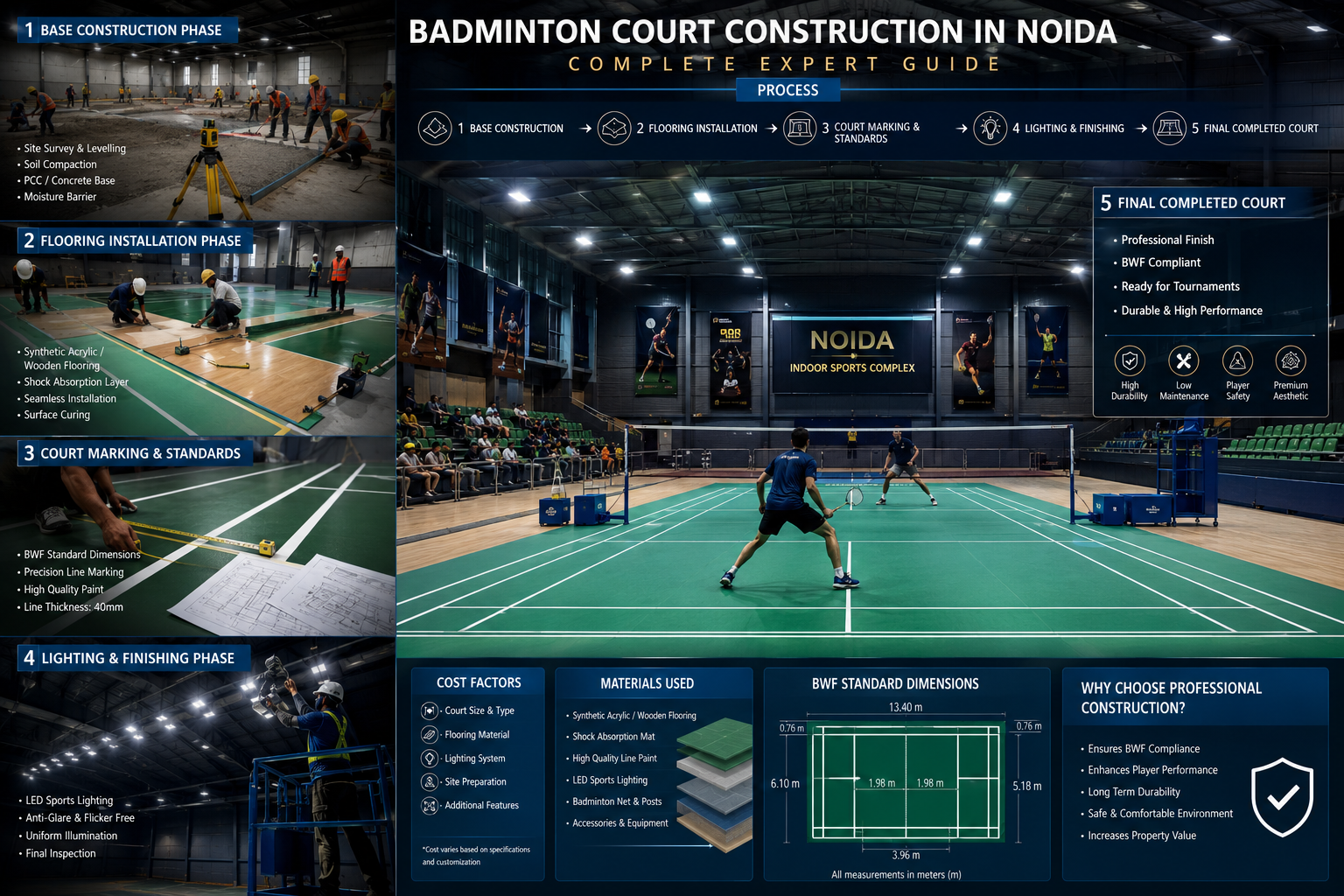
Badminton has rapidly evolved into one of the most popular indoor sports in India, especially in urban regions like Noida where lifestyle, fitness culture, and sports infrastructure are expanding at a fast pace. With increasing participation from schools, residential societies, sports academies, corporate campuses, and recreational clubs, the demand for high-quality badminton court construction in Noida has grown significantly.
Constructing a badminton court is not simply about marking a rectangular area. It is a technical process that requires precision engineering, appropriate material selection, structural planning, and compliance with international sports standards. A professionally built court ensures player safety, enhances performance, and provides long-term durability with minimal maintenance.
This comprehensive guide explains everything you need to know about badminton court construction in Noida, including types of courts, standard dimensions, flooring systems, construction process, cost structure, and maintenance best practices.
Growing Demand for Badminton Courts in Noida
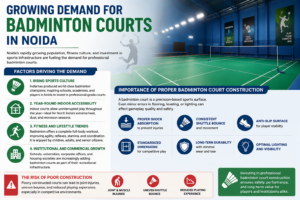
Noida has become a major hub for sports infrastructure due to its planned development, urban population, and increasing awareness of fitness-oriented lifestyles. Several factors are driving the demand for badminton courts:
1. Rising Sports Culture
Badminton is no longer just a recreational activity. India has produced world-class athletes, and this has inspired schools and academies in Noida to invest in professional-grade courts.
2. Year-Round Indoor Accessibility
Unlike outdoor sports, badminton can be played throughout the year when facilities are indoors. This makes it highly suitable for the weather conditions of North India, including heat, dust, and monsoon seasons.
3. Fitness and Lifestyle Trends
Badminton is a full-body workout that improves agility, reflexes, stamina, and coordination. It is widely preferred by children, adults, and senior citizens alike.
4. Institutional and Commercial Growth
Schools, universities, corporate offices, and housing societies are increasingly adding badminton courts as part of their recreational infrastructure.
Importance of Proper Badminton Court Construction
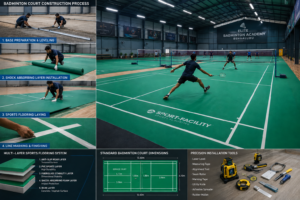
A badminton court is a precision-based sports surface. Even minor errors in flooring, leveling, or lighting can affect gameplay quality and safety.
Professional badminton court construction ensures:
- Proper shock absorption to prevent injuries
- Consistent shuttle bounce and movement
- Anti-slip surface for player stability
- Standardized dimensions for competitive play
- Long-term durability with minimal wear and tear
- Optimal lighting and visibility
Poorly constructed courts often lead to joint injuries, uneven bounce, and reduced playing experience, especially in competitive environments.
Types of Badminton Courts in Noida
Different types of badminton courts are constructed depending on usage, budget, and performance requirements.
1. Concrete Badminton Courts
Concrete courts are the most basic form of construction.
Features:
- Economical and easy to construct
- Suitable for outdoor or recreational use
- Requires minimal maintenance
Limitations:
- Very hard surface causing stress on joints
- Not suitable for professional or competitive play
- Poor shock absorption
Concrete courts are generally used in parks, small societies, or temporary setups.
2. Wooden Badminton Courts
Wooden courts are widely used in indoor stadiums and professional academies.
Features:
- Excellent bounce and playing response
- Natural shock absorption reduces injury risk
- Premium sports experience
Limitations:
- Higher cost compared to other types
- Requires regular polishing and maintenance
- Sensitive to moisture and humidity
Wooden courts are ideal for training centers and tournament-level facilities.
3. Synthetic PVC / PU Badminton Courts
Synthetic flooring has become the most preferred option in India, especially in cities like Noida.
Features:
- Anti-slip and cushioned surface
- Low maintenance requirements
- Durable and long-lasting
- Suitable for schools, societies, and academies
- Installed over RCC or wooden base
Advantages:
- Balanced performance for beginners and professionals
- Resistant to moisture and weather changes
- Cost-effective compared to premium wooden systems
Synthetic courts are considered the best all-round solution for modern badminton infrastructure.
Standard Badminton Court Dimensions (BWF Guidelines)
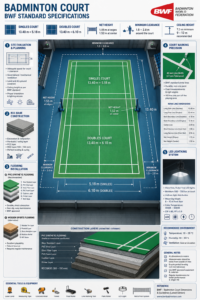
A professionally constructed court must follow international standards set by the Badminton World Federation (BWF).
Court Measurements:
- Singles Court: 13.40 m × 5.18 m
- Doubles Court: 13.40 m × 6.10 m
Other Standards:
- Net height: 1.55 m at edges, 1.52 m at center
- Minimum clearance: 1.5–2 meters around the court
- Ceiling height:
- Minimum: 7.5 meters
- Recommended: 9–12 meters for tournaments
Flooring Markings:
Court lines must be marked using durable, non-slip paint that ensures visibility and accuracy during play.
Step-by-Step Badminton Court Construction Process
Constructing a badminton court involves multiple technical stages. Each stage contributes to the final performance and durability of the court.
Site Evaluation and Planning
The first step is selecting a suitable site based on:
- Available space and dimensions
- Indoor height clearance
- Ventilation and airflow
- Drainage (for outdoor courts)
- Accessibility and usage purpose
Proper planning ensures long-term functionality and avoids structural issues later.
Base Construction
A strong foundation is essential for a high-quality court.
- RCC base (usually 100–125 mm thick) is constructed
- Surface is leveled precisely to avoid uneven bounce
- Moisture-proofing layers are applied
- Cracks and imperfections are eliminated
A well-prepared base determines the lifespan of the entire court.
Flooring Installation
Flooring is the most critical component of a badminton court.
Options include:
- PVC Synthetic Flooring: Installed over leveled base
- Wooden Sports Flooring: Used for premium setups
- Hybrid Systems: Wooden base with synthetic overlay
The flooring must ensure grip, shock absorption, and consistent shuttle movement.
Court Marking
Accurate marking is essential for official gameplay.
- Lines are drawn according to BWF standards
- Non-slip, high-durability paint is used
- Proper alignment is maintained for singles and doubles zones
Lighting and Accessories
Proper lighting is crucial for indoor courts.
- LED lighting systems are installed to reduce glare
- Standard badminton poles and nets are fixed
- Optional installations include seating, fencing, and cooling systems
Lighting levels are usually maintained between 300–750 lux depending on usage level.
Cost of Badminton Court Construction in Noida
The cost of building a badminton court depends on several factors such as flooring type, base quality, lighting systems, and indoor or outdoor design.
Estimated Cost Breakdown:
- PVC Synthetic Flooring: ₹75 – ₹110 per sq. ft
- Wooden Flooring: ₹180 – ₹250 per sq. ft
- Outdoor RCC Court: ₹3 – ₹5 lakhs
- Indoor Professional Court: ₹6 – ₹12 lakhs
Average Cost:
A standard indoor badminton court in Noida typically costs between ₹7 – ₹10 lakhs, including flooring, base construction, lighting, nets, and installation.
Maintenance of Badminton Courts
Proper maintenance ensures long-term performance and reduces repair costs.
Synthetic Courts:
- Regular sweeping and mopping
- Use mild cleaning solutions
- Avoid heavy or sharp objects
Wooden Courts:
- Regular polishing every 3–5 years
- Humidity control to prevent expansion or damage
General Maintenance:
- Inspect nets and poles periodically
- Ensure lighting systems function properly
- Avoid wearing outdoor shoes on the court
Challenges in Badminton Court Construction in Noida
While demand is high, several challenges affect construction quality:
1. Space Constraints
Indoor courts require proper ceiling height and clearance, which is often difficult in existing buildings.
2. Climate and Moisture Issues
Humidity during monsoons can affect flooring durability if moisture-proofing is not properly done.
3. Poor Installation Practices
Unskilled labor or low-quality materials can reduce court lifespan and performance.
4. Budget Mismanagement
Many projects underestimate long-term maintenance costs, leading to higher expenses later.
Conclusion
Badminton court construction in Noida is witnessing rapid growth due to increasing demand from educational institutions, residential communities, sports academies, and corporate facilities. However, building a high-performance court requires more than just installation—it demands proper planning, engineering precision, and the use of high-quality materials.
Whether you are developing a recreational court for a society or a professional-grade facility for tournaments, the key to success lies in choosing the right flooring system, following international standards, and ensuring expert execution at every stage of construction.
A well-constructed badminton court not only enhances gameplay experience but also ensures safety, durability, and long-term value for players and facility owners alike.
Badminton Court Construction in Noida – FAQs
Q1. What is the standard size of a badminton court?
13.40 m × 6.10 m for doubles (as per BWF standards)
Q2. Which flooring is best for badminton courts?
PVC synthetic flooring is the most popular and low-maintenance option
Q3. How much does a badminton court cost in Noida?
Around ₹5 lakh to ₹10 lakh for a standard indoor court
Q4. How long does construction take?
Usually 20–30 days depending on site condition
Q5. Is indoor or outdoor court better in Noida?
Indoor courts are better due to dust, heat, and weather conditions
Q6. What lighting is used in badminton courts?
LED lights with 300–750 lux brightness and low glare
Q7. Which base is required for court construction?
RCC concrete base with proper leveling and moisture protection
Q8. Can courts be built in societies or schools?
Yes, they can be customized for any available space