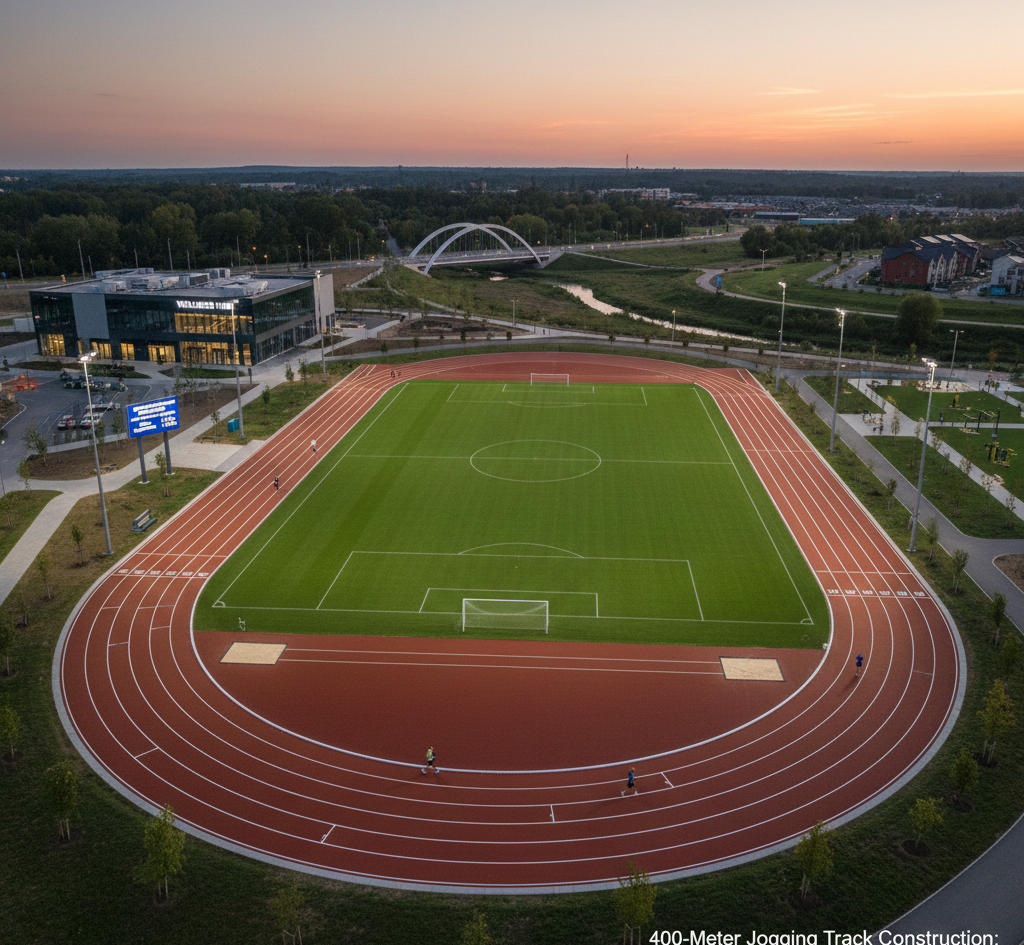
A professionally constructed jogging track is an essential sports facility that provides a safe, dedicated, and comfortable space for running, walking, fitness activities, and athletic training. A 400-meter jogging track is one of the most preferred options for schools, colleges, universities, sports academies, stadiums, residential townships, and public parks. Its standardized circuit makes it suitable for recreational exercise as well as organized athletic programs.
Constructing a high-quality running track involves much more than laying a synthetic surface. It requires proper site evaluation, accurate track measurements, strong foundation preparation, efficient drainage arrangements, and the selection of appropriate sports flooring materials. Every construction stage plays an important role in determining the track’s durability, performance, safety, and maintenance requirements.
Whether you are developing a new sports facility or renovating an existing playground, understanding the construction process can help you select the right materials, plan your investment, and achieve better long-term results.
In this comprehensive guide, we explain everything about 400-meter jogging track construction, including track dimensions, surface options, installation procedures, technical specifications, construction costs, maintenance, and frequently asked questions.
Why Is a 400-Meter Jogging Track a Good Investment?
A 400-meter jogging track is a versatile sports infrastructure solution designed to support different fitness and athletic activities. It provides a dedicated running environment where individuals can exercise without dealing with road traffic, uneven ground, or unsuitable outdoor spaces.
1. Accurate Running Distance
A properly designed 400-meter track offers a standardized circuit that allows runners to measure their running distance and monitor their fitness progress.
It is particularly useful for coaches and athletes conducting sprint practice, endurance training, interval running, warm-up sessions, and physical fitness assessments.
2. Supports Multiple Sports and Fitness Activities
A 400-meter jogging track can be used for various recreational and athletic activities, such as:
- Daily jogging and walking.
- Sprinting and endurance exercises.
- School and college sports activities.
- Athletic training and coaching.
- Physical education programs.
- Fitness and wellness activities.
- Running competitions and community events.
This makes it a valuable facility for educational institutions, sports organizations, and recreational developments.
3. Comfortable and Consistent Running Surface
Modern synthetic running track systems are designed to provide suitable traction, resilience, and surface consistency.
Depending on the selected material and system configuration, they can offer cushioning that improves the underfoot experience during running and walking.
4. Promotes Health and Physical Fitness
Having a dedicated jogging track encourages students, athletes, employees, and community members to participate in regular physical activities.
Schools can use it for physical education, while residential societies and public parks can provide residents with a convenient place for daily exercise.
5. Enhances Sports Infrastructure
A professionally developed jogging track improves the functionality and appearance of a sports facility.
It can be integrated with football grounds, outdoor gyms, landscaped areas, playgrounds, and other recreational amenities to create a complete sports and fitness environment.
Where Can 400-Meter Jogging Tracks Be Installed?
A 400-meter running track can be constructed at different types of properties, provided the available space, ground conditions, and project requirements are suitable.
Some common applications include:
- Schools and colleges.
- Universities and educational campuses.
- Sports academies and training centers.
- Professional athletic stadiums.
- Government sports complexes.
- Police and defense training facilities.
- Public parks and recreational grounds.
- Residential townships and housing societies.
- Corporate campuses and industrial facilities.
- Private sports clubs and fitness centers.
The design should be customized according to the intended usage. For example, educational institutions may require a recreational running facility, whereas professional sports stadiums may need competition-oriented track geometry, specialized surfacing, and certified measurements.
Different Types of Surfaces Used in 400-Meter Jogging Track Construction
Selecting the right running track surface is one of the most important decisions during project planning. The material influences running comfort, traction, durability, maintenance, and overall construction expenditure.
The selection should consider the expected number of users, local weather conditions, available budget, and whether the facility is intended for recreational or competitive athletics.
1. Polyurethane (PU) Synthetic Running Track
Polyurethane is one of the widely used materials for modern synthetic athletics track installations. It can be formulated into different track systems to provide consistent surface performance, resilience, and traction.
Key advantages:
- Provides a resilient running surface.
- Offers controlled cushioning depending on the system.
- Suitable for regular athletic training.
- Available in different colors and specifications.
- Can be designed for demanding sports applications.
- Offers good wear resistance when properly installed and maintained.
Suitable applications:
- Professional sports stadiums.
- Athletic training facilities.
- Sports academies.
- Universities and colleges.
- Competition-oriented running tracks.
PU running tracks are available in different configurations, including spray-coated, sandwich, and full-PU systems. Each option has different performance characteristics and installation requirements.
2. EPDM Rubber Running Track Surface
EPDM stands for ethylene propylene diene monomer. It is a synthetic rubber material commonly used in sports and recreational flooring applications.
EPDM granules can be incorporated into multi-layer synthetic running track systems to create a textured and resilient surface.
Key advantages:
- Available in multiple color options.
- Provides a textured surface finish.
- Suitable for various outdoor applications.
- Can be used in resilient flooring systems.
- Offers flexibility in surface design.
Suitable applications:
- School playgrounds.
- Community recreation areas.
- Residential fitness zones.
- Walking and jogging facilities.
- Selected outdoor sports surfaces.
The final performance depends on granule quality, binder composition, layer thickness, and installation methodology.
3. Acrylic Sports Flooring
Acrylic sports flooring is commonly used for outdoor sports courts and selected recreational surfaces.
It is generally applied as a coating system over a properly prepared base and offers a smooth, colorful, and relatively easy-to-maintain finish.
Key advantages:
- Available in different colors.
- Easy to clean and maintain.
- UV-resistant formulations are available.
- Suitable for selected multi-purpose sports areas.
- Offers a practical solution for certain recreational applications.
Suitable applications:
- Multi-purpose sports facilities.
- Selected recreational fitness areas.
- Outdoor school sports spaces.
However, acrylic surfacing should not automatically be considered a substitute for a purpose-designed synthetic athletics track. Its suitability depends on the intended activity and required impact absorption.
4. Prefabricated Rubber Running Track
Prefabricated running track systems are manufactured in factories in the form of rubber sheets, rolls, or modular components. These products are transported to the project location and installed over a suitable prepared foundation.
Key advantages:
- Factory-controlled manufacturing.
- Consistent product dimensions.
- Efficient installation for suitable projects.
- Potentially convenient component replacement.
- Available for selected indoor and specialist applications.
Suitable applications:
- Indoor running tracks.
- Specialized athletic training facilities.
- Selected sports infrastructure projects.
For outdoor installations, the system must be evaluated for weather resistance, joint durability, drainage compatibility, and the manufacturer’s recommended application.
Step-by-Step Process of 400-Meter Jogging Track Construction
A successful running track project requires a systematic construction approach. Every stage, from initial land inspection to final surface marking, must be completed according to the approved design and technical specifications.
The major construction stages are explained below.
1. Site Inspection and Track Design
The first step involves inspecting the proposed construction location and evaluating whether the available land can accommodate the required track layout.
The project team generally assesses:
- Total available land area.
- Soil condition and ground stability.
- Existing ground elevation.
- Drainage and water-flow patterns.
- Nearby buildings and underground utilities.
- Construction equipment accessibility.
- Space for safety zones and additional facilities.
Based on the site assessment, a suitable track layout is prepared.
For competition-standard facilities, track geometry, curve radius, lane dimensions, and measurement lines must be designed according to the relevant athletics regulations.
2. Land Clearing and Excavation
After finalizing the layout, the construction area is cleared of vegetation, debris, unwanted materials, and unsuitable soil.
Excavation is performed to achieve the required formation level. The ground is then shaped and compacted to create a stable foundation for subsequent construction activities.
If weak or unsuitable soil is identified, additional ground treatment or soil stabilization may be necessary.
Proper excavation and earthwork help minimize future settlement, unevenness, and structural problems.
3. Subgrade and Sub-Base Preparation
The subgrade forms the supporting foundation of the entire jogging track. Its stability directly affects the durability of the completed surface.
Depending on the site conditions and engineering design, preparation may involve:
- Soil stabilization.
- Ground compaction.
- Geotextile installation.
- Removal of weak soil.
- Additional ground improvement.
After preparing the subgrade, granular sub-base materials are placed in specified layers and compacted to the required density.
The material composition and thickness should be determined according to geotechnical conditions and the approved construction specifications.
4. Drainage System and Base Construction
An efficient drainage system is essential for outdoor running tracks, particularly in areas that experience heavy rainfall.
Poor drainage can cause water accumulation, damage to the foundation, surface deterioration, and premature maintenance problems.
Common drainage components include:
- Perimeter drainage channels.
- Underground drainage pipes.
- Catch pits and collection chambers.
- Stormwater outlets.
- Properly designed surface gradients.
After completing the necessary drainage arrangements, the structural base is constructed using asphalt or another approved base system compatible with the selected synthetic surface.
The base must be stable, sufficiently smooth, and properly prepared before applying the sports flooring material.
5. Synthetic Running Track Surface Installation
Once the base construction is completed and inspected, the selected synthetic running track system can be installed.
The installation procedure depends on the material and system specification.
Typical activities may include:
- Cleaning and preparing the base.
- Applying a suitable primer.
- Installing the specified resilient layer.
- Applying polyurethane binder and rubber granules where required.
- Completing the specified surface coating.
- Maintaining the required thickness and uniformity.
- Allowing sufficient curing time.
Professional installation is important to ensure proper bonding, surface consistency, and reliable performance.
All materials should be applied according to the manufacturer’s technical recommendations and suitable environmental conditions.
6. Lane Marking and Finishing Work
After the synthetic surface has cured, lane markings and other required track details are completed.
These may include:
- Lane boundary lines.
- Start and finish lines.
- Staggered starting positions.
- Event-specific markings.
- Lane identification numbers.
- Directional indicators.
For competition-level facilities, marking positions must follow the applicable athletics regulations. Recreational tracks can use simpler markings based on the facility’s intended requirements.
7. Quality Inspection and Project Handover
The final stage involves inspecting the completed jogging track to verify its quality, dimensions, and overall condition.
Important inspection points include:
- Accuracy of track measurements.
- Lane width and geometry.
- Surface thickness and uniformity.
- Proper material bonding.
- Drainage efficiency.
- Quality of lane markings.
- Visible cracks, bubbles, or surface defects.
- Compliance with approved material specifications.
Where necessary, qualified professionals should conduct additional performance and compliance testing.
The project handover should include relevant technical documents, maintenance guidelines, product details, and warranty information.
Technical Specifications of a 400-Meter Jogging Track
A 400-meter athletics track is designed around specific geometric and measurement requirements. Its overall dimensions depend on the curve radius, straight lengths, number of lanes, and designated measurement line.
The following are useful reference specifications for a standard outdoor athletics track:
- Track length: 400 meters per circuit along the designated measurement line.
- Track layout: Two parallel straights connected by two semicircular bends.
- Typical lane width: Approximately 1.22 meters under World Athletics specifications.
- Common lane configurations: Six-lane and eight-lane layouts.
- Running surface: A suitable synthetic athletics surface or another system appropriate for the intended usage.
- Foundation: Properly engineered subgrade, sub-base, and structural base.
- Drainage: A system designed according to site conditions and local rainfall.
- Land requirement: Determined by the complete track geometry, safety margins, and additional facilities.
For example, an eight-lane track with a nominal lane width of 1.22 meters requires approximately 9.76 meters for the combined lane widths alone.
However, the total track width also depends on additional design requirements, and the overall land area must be established through a site-specific layout.
Accurate measurement, curve geometry, lane marking, and track construction should be verified against the relevant technical standards before installation.
Major Benefits of Professional Jogging Track Construction
A professionally constructed running track provides several advantages for educational institutions, sports organizations, property developers, and facility operators.
Accurate Track Measurements
Proper surveying and layout preparation help maintain consistent running distances, making the facility suitable for structured fitness programs and athletic training.
Better Running Comfort
A suitable synthetic surface offers a consistent underfoot experience and can provide appropriate cushioning depending on the selected track system.
Effective Water Drainage
A well-planned drainage arrangement reduces water accumulation and helps protect the structural foundation and synthetic flooring.
Lower Risk of Premature Damage
Using suitable materials and following correct installation procedures can minimize common problems such as cracking, surface separation, and unevenness.
Multiple Usage Opportunities
A jogging track can support daily exercise, school sports, athletic coaching, community fitness activities, and organized running programs.
Attractive Sports Infrastructure
Modern track systems offer different color combinations, markings, and design possibilities, allowing the facility to complement its surrounding environment.
Maintenance Tips for a 400-Meter Jogging Track
Regular maintenance is essential to preserve the appearance, performance, and durability of a synthetic running track.
Although many modern track systems are designed for outdoor use, they still require periodic inspection and appropriate cleaning.
1. Clean the Track Frequently
Remove dust, leaves, mud, and other unwanted materials from the running surface.
Use cleaning equipment and methods recommended by the surfacing manufacturer to avoid damaging the surface texture.
2. Maintain the Drainage System
Inspect drainage channels, pipes, outlets, and collection chambers regularly.
Remove accumulated dirt and debris to prevent blockages, especially before and during the rainy season.
3. Check for Surface Defects
Periodically inspect the running surface for cracks, blistering, loose rubber granules, open joints, and worn areas.
Early identification and repair can prevent minor defects from developing into more extensive damage.
4. Prevent Unnecessary Surface Damage
Avoid unauthorized vehicle movement, dragging heavy objects, and using unsuitable equipment on the track.
Follow the contractor’s recommendations regarding footwear, maintenance machinery, and permitted activities.
5. Maintain Lane Markings
Inspect the lane lines, starting positions, and other markings to ensure that they remain visible and accurate.
Any repainting should use compatible materials and appropriate surface preparation methods.
6. Arrange Periodic Professional Inspection
A qualified sports flooring contractor can inspect the track and recommend repairs, recoating, or resurfacing according to its condition.
The maintenance schedule should depend on the selected system, usage intensity, weather exposure, and manufacturer’s recommendations.
400-Meter Jogging Track Construction Cost in India
The cost of constructing a 400-meter jogging track in India depends on several technical and site-related factors. These include the running surface, track dimensions, foundation design, drainage arrangements, material specifications, and construction location.
For accurate budgeting, it is important to consider the complete project cost rather than calculating only the synthetic flooring price.
A project estimate may include:
- Site clearing and excavation.
- Earthwork and ground preparation.
- Subgrade and sub-base construction.
- Drainage arrangements.
- Asphalt or other structural base construction.
- Synthetic running track installation.
- Lane marking and finishing.
- Quality inspection and testing.
An indicative preliminary budgeting range sometimes considered is ₹600 to ₹1,200 per square foot. However, this is not a verified current market quotation or a guaranteed construction rate. Actual prices may vary considerably depending on the project specifications, surface system, and civil construction requirements.
For a reliable estimate, obtain a detailed quotation based on the actual site area, engineering drawings, material specifications, and complete scope of work.
Factors Affecting the Cost of Jogging Track Construction
1. Running Track Surface Material
Different materials have different prices and installation requirements. PU systems, EPDM-based surfacing, acrylic coatings, and prefabricated rubber systems should be compared according to their intended application and performance.
2. Existing Ground Conditions
Uneven terrain, weak soil, excavation depth, and additional ground stabilization can increase construction expenditure.
3. Foundation and Base Requirements
The thickness and composition of the sub-base and structural base depend on the site’s engineering requirements. A strong foundation is essential for long-term surface performance.
4. Drainage Infrastructure
Drainage channels, underground pipes, catch pits, and stormwater connections contribute to the project budget.
5. Track Size and Number of Lanes
The total paved area, lane configuration, curve design, and supporting safety areas influence the quantity of materials and construction work.
6. Transportation and Labour Costs
Project location, equipment availability, workforce requirements, and transportation distances can affect the final quotation.
7. Additional Sports Facilities
Lighting, fencing, landscaping, spectator seating, walkways, and other supporting infrastructure may increase the overall investment.
How to Choose the Right Jogging Track Construction Company
Selecting an experienced contractor is essential for achieving a durable, functional, and professionally finished running track.
A contractor should understand both civil construction and synthetic sports flooring installation because the performance of the final surface depends on the quality of the complete construction system.
Before finalizing a company, consider these important points:
- Experience in jogging track and athletics track projects.
- Previous installation work and project references.
- Knowledge of synthetic sports flooring systems.
- Detailed material and construction specifications.
- Proper foundation and drainage planning.
- Quality inspection and testing procedures.
- Written warranty and service commitments.
- Availability of repair and maintenance assistance.
Always request a detailed quotation explaining the materials, construction layers, installation process, exclusions, and project completion schedule.
For competition-oriented facilities, confirm how the completed track will be checked against the applicable athletics standards.
Customization Options for Modern Jogging Tracks
Modern running tracks can be customized to match the architectural design, branding, and functional requirements of the facility.
Some popular customization possibilities include:
- Different synthetic surface colors.
- Lane numbering and directional markings.
- School or sports academy logos.
- Contrasting track borders.
- Perimeter lighting systems.
- Spectator seating arrangements.
- Landscaping and walking pathways.
- Integration with outdoor gym equipment.
All customization features should be included in the initial design to ensure they do not interfere with running safety, drainage, or future maintenance.
Environmental Considerations in Running Track Construction
Environmental planning is an important part of developing sustainable sports infrastructure.
Project owners can consider durable materials, responsible sourcing, efficient water management, and proper construction waste disposal.
Certain synthetic track systems incorporate recycled rubber materials. However, their environmental characteristics depend on the product composition and manufacturing process.
Choosing a suitable surface for the local climate and expected usage can also help reduce premature replacement and unnecessary material consumption.
Long-Term Benefits of Investing in a 400-Meter Jogging Track
A 400-meter jogging track is more than an outdoor sports surface. It is a long-term investment in fitness, recreation, sports development, and community well-being.
Educational institutions can use it for physical education and athletic training. Sports academies can provide athletes with a dedicated space for endurance and running practice. Residential communities and public parks can encourage residents to participate in regular exercise.
The long-term performance of the facility depends on combining proper engineering, suitable surfacing materials, efficient drainage, professional installation, and regular maintenance.
With the right planning and construction approach, a jogging track can become a valuable sports facility that serves different age groups and fitness levels for many years.
Conclusion
400-meter jogging track construction requires a well-coordinated approach involving site assessment, engineering design, earthwork, foundation preparation, drainage installation, synthetic surface application, and accurate lane marking.
Each stage contributes to the final quality, durability, safety, and usability of the running facility.
Whether you are planning a track for a school, college, university, sports academy, stadium, residential township, or public park, selecting appropriate materials and working with an experienced sports infrastructure contractor are essential steps.
By following suitable technical specifications, maintaining proper construction standards, and implementing regular maintenance, you can develop a reliable jogging track that supports fitness activities, athletic training, and long-term recreational use.
Frequently Asked Questions (FAQs) About 400-Meter Jogging Track Construction
1. What is the standard length of a 400-meter jogging track?
A standard outdoor athletics track measures 400 meters for one complete circuit along its designated measurement line. Its layout consists of two straight sections and two semicircular bends.
2. How much land is needed for a 400-meter jogging track?
The land requirement depends on the number of lanes, track geometry, curve radius, safety clearances, infield area, and supporting facilities. A detailed site layout should be prepared before determining the exact land requirement.
3. What is the construction cost of a 400-meter jogging track in India?
Construction costs depend on the selected surface material, foundation design, drainage, track area, and site conditions. An indicative preliminary budgeting range of ₹600 to ₹1,200 per square foot may be considered, but an actual quotation requires a site-specific assessment.
4. Which surface material is best for a 400-meter running track?
Polyurethane synthetic track systems are commonly used for athletics facilities because they can provide suitable resilience, traction, and consistent running performance. EPDM-based systems may be suitable for selected recreational applications.
5. How much time is required to construct a 400-meter jogging track?
The construction period depends on excavation, foundation preparation, drainage work, surface installation, weather conditions, and curing requirements. Many projects require several weeks, but the actual timeline should be confirmed by the contractor.
6. What is the lifespan of a synthetic jogging track?
The service life depends on the surface system, material quality, installation standards, weather conditions, traffic, and maintenance practices. Always request a system-specific lifespan estimate and warranty from the manufacturer or contractor.
7. How do you maintain a synthetic running track?
Maintenance includes regular cleaning, drainage inspection, surface defect checks, lane marking maintenance, and timely repairs. Professional inspections are recommended to identify deterioration at an early stage.
8. Can a jogging track be constructed in different colors?
Yes. Many synthetic running track systems are available in different colors. Facilities can also include lane numbering, contrasting borders, and selected branding elements.
9. What type of foundation is required for a 400-meter track?
A typical foundation includes a properly prepared subgrade, compacted granular sub-base, and suitable structural base. The exact construction depends on soil conditions, drainage requirements, and the selected surface system.
10. Is a drainage system necessary for outdoor jogging tracks?
Yes. Proper drainage prevents water accumulation and protects the track foundation and surface. The drainage design should consider local rainfall, ground gradients, and the site’s stormwater arrangements.
11. Can a 400-meter jogging track be constructed at schools and colleges?
Yes. Schools and colleges can install 400-meter tracks for physical education, running practice, athletic competitions, and general fitness activities. The design should be based on available space and student requirements.
12. What materials are used in jogging track construction?
Common materials include granular sub-base aggregates, asphalt, polyurethane binders, EPDM or other rubber granules, primers, and compatible line-marking materials. The actual combination depends on the selected construction system.
13. Is a 400-meter running track suitable for public parks?
Yes, provided sufficient land is available. Public park tracks can be designed for walking, jogging, recreational running, and community fitness activities.
14. Can an existing playground be converted into a jogging track?
Yes. However, the existing ground must first be assessed for soil stability, available dimensions, drainage, surface condition, and elevation. Additional civil construction may be required before installing the new surface.
15. What safety features are important in jogging track construction?
Important safety considerations include suitable surface traction, consistent running levels, proper lane markings, adequate safety margins, effective drainage, and safe access arrangements.
16. How many lanes are generally available in a 400-meter track?
Six-lane and eight-lane configurations are commonly used. The final number of lanes depends on available land, intended usage, project budget, and applicable sporting regulations.
17. Are synthetic running tracks suitable for Indian weather conditions?
Many synthetic running track systems are designed for outdoor weather exposure. However, material selection should consider high temperatures, UV exposure, rainfall, humidity, drainage, and manufacturer recommendations.
18. Why should I hire a professional jogging track contractor?
Professional contractors understand track geometry, foundation construction, drainage planning, synthetic material application, and lane marking. Their experience can help minimize installation defects and future repair expenses.
19. Which facilities can benefit from 400-meter jogging tracks?
Schools, colleges, universities, stadiums, sports academies, government training facilities, residential communities, corporate campuses, and large public parks can benefit from professionally constructed jogging tracks.
20. How can I select the best jogging track construction company?
Evaluate the company’s previous projects, technical expertise, material specifications, construction methods, quality-control procedures, warranty conditions, and after-installation support.
21. Can a 400-meter jogging track be used for recreational running and athletic training?
Yes. A properly designed track can support both activities. If competitive athletics is planned, the dimensions, surface specifications, and markings should comply with the applicable sporting standards.
22. What details should be included in a jogging track construction quotation?
A professional quotation should include site preparation, excavation, foundation layers, drainage arrangements, surface materials, installation charges, lane markings, testing, taxes, exclusions, project schedule, and warranty terms.