Introduction
Hockey has a deep-rooted legacy in India, and especially in the state of Punjab, where the sport is not just a game but a part of cultural identity. Punjab has produced some of the finest hockey players in the country, and the demand for high-quality playing surfaces has increased rapidly in recent years. Traditional grass fields are now being replaced with modern synthetic hockey turfs that meet international standards set by the International Hockey Federation (FIH).
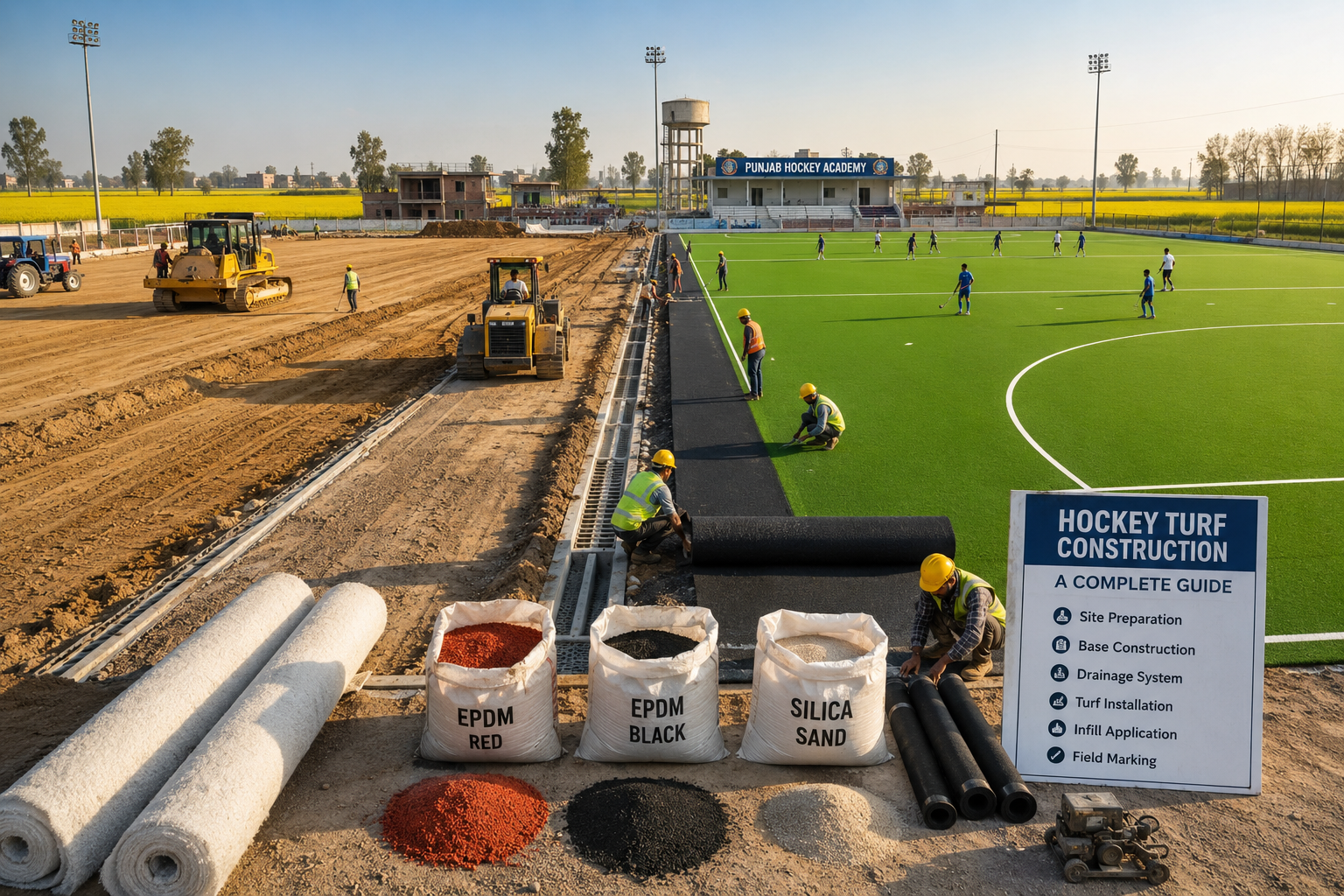
Hockey turf construction in Punjab is not just about laying artificial grass; it involves scientific planning, engineering precision, drainage management, surface leveling, and material selection suited for local climate conditions. This article explains the complete process of hockey turf construction in a detailed, original, and practical manner.
1. Importance of Synthetic Hockey Turf in Punjab
Punjab experiences extreme weather variations—hot summers, monsoon rains, and cool winters. Natural grass fields struggle to maintain consistency under these conditions. This is where synthetic hockey turf becomes essential.
Key advantages include:
- Uniform playing surface throughout the year
- Faster gameplay suitable for modern hockey standards
- Reduced maintenance compared to natural grass
- Better shock absorption and injury prevention
- Ability to host national and international tournaments
For a sports-rich state like Punjab, upgrading infrastructure to synthetic turfs ensures that athletes can train and compete at global levels.
2. Types of Hockey Turf Used in Modern Construction
Before starting construction, it is important to understand the types of artificial turf systems used.
2.1 Water-Based Turf (FIH Preferred)
- Requires watering before matches
- Extremely fast surface
- Used in international stadiums
- Reduces friction and player injuries
2.2 Sand-Dressed Turf
- Partially filled with sand
- Medium speed gameplay
- Lower maintenance cost
- Suitable for training academies and schools
2.3 Sand-Filled Turf
- Fully filled with silica sand
- Slower gameplay
- Economical option
- Mostly used in rural sports complexes
2.4 Hybrid Turf Systems
- Combination of synthetic fibers and natural elements
- Less common in hockey compared to football
In Punjab, most new projects prefer water-based or sand-dressed turfs depending on budget and usage.
3. Site Selection and Planning
Proper planning is the foundation of a successful hockey turf project.
Key considerations:
- Land size (standard hockey field: 91.4m × 55m)
- Orientation (north-south direction preferred to avoid sun glare)
- Soil testing for stability
- Accessibility for players and spectators
- Drainage feasibility
- Availability of water and electricity
In Punjab, land near sports academies, schools, and universities is commonly selected for turf construction.
4. Ground Preparation and Earthwork
Once the site is finalized, ground preparation begins.
Steps involved:
4.1 Clearing and Excavation
- Removal of vegetation, debris, and topsoil
- Excavation up to required depth (usually 300–500 mm)
4.2 Grading and Leveling
- Laser-guided leveling machines ensure precision
- Proper slope (usually 0.5%–1%) is maintained for drainage
4.3 Soil Compaction
- Heavy rollers compact the base soil
- Ensures long-term stability of the surface
Proper earthwork is critical because any unevenness will affect gameplay quality.
5. Base Layer Construction
The base layer supports the entire turf system.
5.1 Sub-Base Layer
- Made of crushed stone or gravel
- Thickness: 100–150 mm
- Provides structural strength and drainage
5.2 Wet Mix Macadam (WMM)
- Layer of stone aggregates mixed with water
- Compacted to create a solid foundation
5.3 Bituminous or Asphalt Layer
- Applied for high-end FIH-approved fields
- Ensures smooth and durable surface
- Thickness: 40–50 mm
5.4 Shock Pad Layer (Optional but Recommended)
- Made of rubber or foam
- Improves player safety
- Reduces impact injuries
This layered system ensures long-term durability and consistent performance.
6. Drainage System Design
Punjab receives heavy monsoon rainfall, making drainage a critical aspect.
Drainage components:
- Underground perforated pipes
- Side drains around the field
- Sloped base design
- Water collection chambers
A well-designed drainage system ensures that the field becomes playable within minutes after rain, preventing waterlogging and turf damage.
7. Artificial Turf Installation
This is the most important stage of hockey turf construction.
7.1 Turf Roll Placement
- Synthetic turf rolls are transported and unrolled on site
- Alignment is carefully checked
7.2 Seaming and Joining
- Turf sheets are joined using strong adhesive tapes and polyurethane glue
- Seams are hidden to ensure smooth surface
7.3 Cutting and Marking
- Field lines are cut precisely
- White inlaid lines are preferred over painted ones for durability
7.4 Sand Filling (if applicable)
- Silica sand is spread evenly using mechanical spreaders
- Brushing ensures uniform distribution
7.5 Water-Based Turf Setup
- Requires irrigation system installation
- Sprinklers are placed around the field
The installation must be done under controlled temperature and dry conditions for best results.
8. Material Selection for Hockey Turf in Punjab
Quality materials determine the lifespan of the turf.
Common materials used:
- Polyethylene or polypropylene fibers
- UV-stabilized yarn for hot climates
- High-grade silica sand
- Rubber shock pads (SBR or EPDM-based)
- Industrial-grade adhesives
Given Punjab’s high summer temperatures, UV resistance is extremely important to prevent fiber degradation.
9. Maintenance of Hockey Turf
Even though synthetic turf requires less maintenance than natural grass, regular care is essential.
Routine maintenance includes:
- Brushing the surface weekly
- Removing dust and debris
- Checking seam integrity
- Refilling sand when required
- Periodic deep cleaning
- Irrigation for water-based turfs
Proper maintenance can extend turf life up to 10–12 years.
10. Cost of Hockey Turf Construction in Punjab
The cost depends on multiple factors:
Approximate cost range:
- Basic sand-filled turf: ₹2.5–4 crore
- Sand-dressed turf: ₹4–6 crore
- Water-based FIH standard turf: ₹6–10 crore
Cost factors:
- Quality of turf material
- Base construction type
- Drainage system complexity
- Imported vs domestic materials
- Lighting and stadium facilities
Government-supported sports projects in Punjab often receive funding to reduce financial burden.
11. Challenges in Turf Construction in Punjab
Despite growing infrastructure, some challenges remain:
11.1 Climate Impact
Extreme heat can affect turf fibers if low-quality materials are used.
11.2 Water Management
Water-based turfs require a consistent water supply, which can be challenging in certain regions.
11.3 High Initial Investment
Although maintenance is low, installation costs are high.
11.4 Skilled Labor Requirement
Proper installation requires trained professionals; otherwise, turf quality may suffer.
12. Government and Sports Development in Punjab
The sports ecosystem in Punjab is supported by various government initiatives focusing on athlete development and infrastructure improvement. Hockey academies, school sports programs, and district-level stadium upgrades have increased demand for synthetic turf fields.
Modern sports complexes are being developed in cities like Ludhiana, Jalandhar, Amritsar, and Patiala to promote hockey at grassroots and professional levels.
13. Benefits of Modern Hockey Turf Infrastructure
- Produces international-level athletes
- Increases participation in sports
- Improves training quality
- Attracts national tournaments
- Enhances Punjab’s sports reputation globally
With improved infrastructure, Punjab continues to remain a powerhouse of Indian hockey.
14. Future of Hockey Turf Construction in Punjab
The future of hockey infrastructure in Punjab is moving towards:
- Smart irrigation systems
- Eco-friendly turf materials
- Hybrid shock-absorbing surfaces
- AI-based maintenance monitoring
- Solar-powered stadium lighting
These innovations will make sports facilities more sustainable and efficient.
Conclusion
Hockey turf construction in Punjab is a highly technical and structured process that combines engineering, sports science, and environmental planning. From ground preparation to final turf installation, each stage requires precision and expertise. With Punjab’s strong sporting culture and increasing investment in infrastructure, the adoption of synthetic hockey turfs is transforming the way the sport is played and trained.
A well-constructed turf not only enhances performance but also ensures safety, durability, and long-term usability. As Punjab continues to develop its sports ecosystem, modern hockey turfs will play a central role in producing world-class athletes and maintaining the state’s proud legacy in Indian hockey.