Introduction
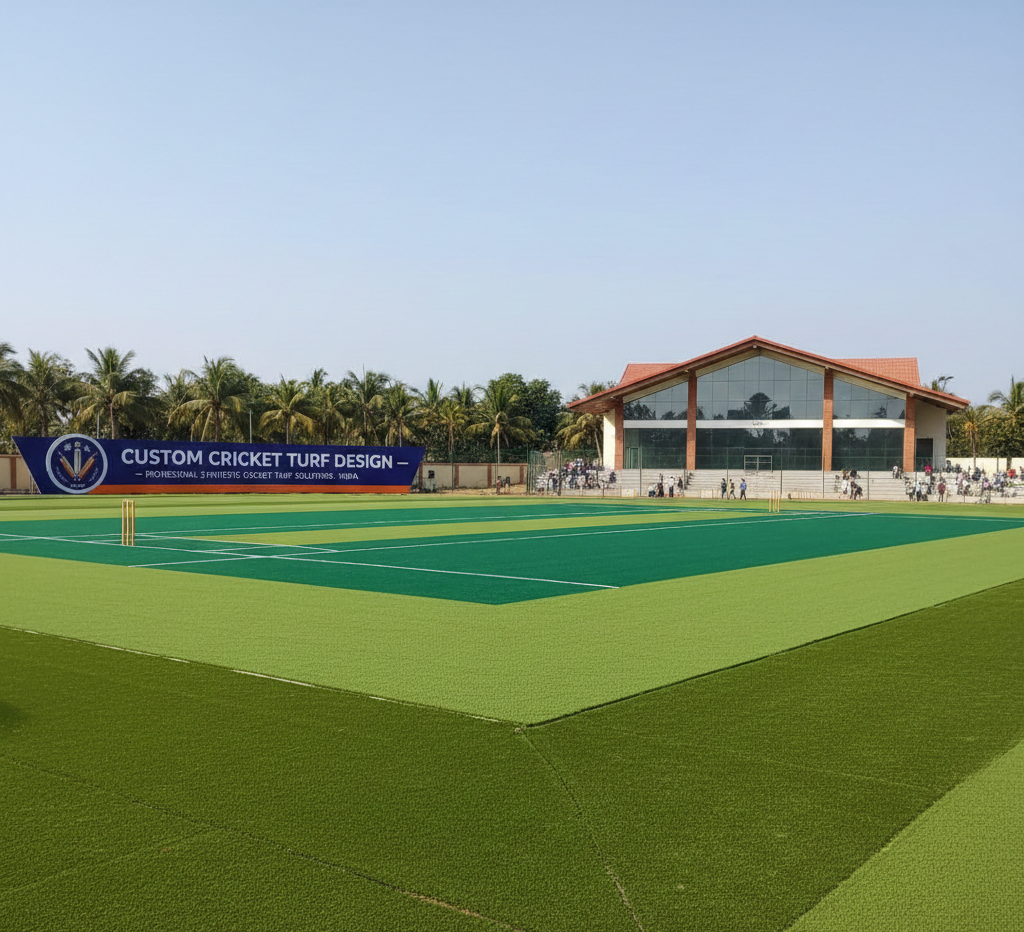
Cricket facilities in India are changing rapidly. Schools, cricket academies, sports clubs, residential communities, hotels, corporate campuses, and commercial sports centres are investing in dedicated cricket areas that can handle frequent practice sessions without the maintenance demands of a natural grass ground. In these environments, custom cricket turf design has become an important part of creating a dependable and player-friendly sports surface.
A professionally planned cricket turf is more than artificial grass installed over a flat area. The overall system may include the sub-base, drainage, shock-absorbing layers, synthetic grass, pitch configuration, markings, run-up areas, safety zones, and finishing details. Each element influences how the surface performs during batting, bowling, fielding, and repeated player movement.
A custom approach allows the turf system to be developed around the actual site rather than forcing the site to accommodate a standard product. Ground dimensions, climate, expected usage, available budget, drainage requirements, playing level, and maintenance expectations can all be considered during the planning stage.
For facilities looking to create a reliable cricket environment, Sports Facility India provides customized cricket turf design and installation solutions for a wide range of sports projects across India.
What Is Custom Cricket Turf Design?
Custom cricket turf design is the process of planning a synthetic cricket playing surface according to the specific requirements of a facility.
Unlike a basic turf installation, custom design considers the entire playing environment. The design may cover the dimensions of the available area, playing zones, cricket pitch, bowling run-up, batting area, safety clearance, drainage arrangement, turf specifications, base preparation, and court or field markings.
The appropriate turf system can differ considerably depending on whether the project is intended for:
- Cricket academies
- School and college grounds
- Residential societies
- Sports clubs
- Professional training centres
- Indoor cricket facilities
- Box cricket venues
- Hotels and resorts
- Corporate sports facilities
- Commercial sports complexes
- Community recreation centres
A school practice area may require a different configuration from an academy that hosts several training sessions every day. Similarly, an outdoor cricket facility in a high-rainfall region may need a stronger drainage strategy than an indoor training centre.
Custom planning helps address these differences before installation begins.
Why Custom Cricket Turf Is Important for Modern Sports Facilities
The quality of the playing surface has a direct relationship with the usability of a cricket facility. An uneven or poorly constructed surface can create inconsistent ball response, premature wear, drainage problems, and unnecessary maintenance requirements.
A professionally designed synthetic cricket turf can provide a more controlled playing environment while supporting intensive usage.
Consistent Ball Response
One of the primary objectives of a cricket surface is predictable ball behaviour. Players need to understand how the ball will react after pitching so they can develop timing, footwork, batting technique, and bowling accuracy.
A properly selected and installed cricket turf can provide a relatively consistent surface across the playing area. Correct base preparation is particularly important because variations underneath the turf can eventually affect the surface above it.
For training facilities, consistency can make repetitive drills more effective and allow players to concentrate on technique instead of adapting to unpredictable surface conditions.
Better Traction for Players
Cricket involves constant acceleration, stopping, turning, jumping, and lateral movement. Bowlers also generate considerable force during their run-up and delivery stride.
The turf surface therefore needs to provide appropriate traction without becoming excessively abrasive. Turf selection, infill where applicable, backing construction, and installation quality all contribute to how the surface feels underfoot.
A correctly engineered cricket turf can help create a stable environment for batting, bowling, and fielding activities.
Reduced Surface Maintenance
Natural cricket grounds require regular mowing, irrigation, fertilization, aeration, pest management, and seasonal care. Synthetic turf eliminates many of these requirements.
Although artificial cricket grass still requires maintenance, the routine is generally focused on cleaning, brushing, inspection, debris removal, and addressing high-wear areas.
This makes synthetic turf particularly practical for facilities where the playing area receives frequent use.
Improved Facility Availability
A well-planned artificial turf can support repeated training sessions without the lengthy recovery periods sometimes required by natural surfaces.
For commercial academies and sports facilities, this can be valuable because the ground may need to accommodate multiple bookings throughout the day.
The ability to use a dedicated cricket area more consistently can improve the practical value of the available space.
Key Components of a Professionally Designed Cricket Turf
A cricket turf should be viewed as a complete surface system rather than simply a roll of artificial grass.
1. Site Assessment
The project normally begins with an assessment of the available location.
Important considerations include:
- Ground dimensions
- Existing surface condition
- Soil characteristics
- Water drainage
- Ground slope
- Accessibility
- Surrounding structures
- Intended usage
- Player capacity
- Lighting requirements
- Available installation area
A site assessment helps identify potential construction challenges before materials are ordered.
2. Engineered Base Preparation
The base is one of the most important parts of a synthetic cricket installation.
The underlying area needs to provide stability and support while allowing appropriate drainage. Depending on the project, the construction may include compacted aggregate layers, leveling materials, geotextiles, drainage components, or other engineered solutions.
If the foundation is poorly prepared, problems such as depressions, movement, unevenness, and water accumulation may appear later.
3. Synthetic Cricket Grass
Artificial cricket turf is available in different fiber types, pile heights, densities, backing structures, and performance specifications.
The appropriate product depends on the intended application.
For example, a training facility with heavy daily usage may prioritize durability and resilience, while a specialized practice area may place greater emphasis on playing characteristics.
The turf should be selected according to the expected workload rather than simply choosing the thickest or most expensive option.
4. Shock-Absorbing Layers
Certain cricket facilities benefit from an underlay or shock pad beneath the synthetic surface.
These layers can improve cushioning and help manage impact from repeated player movement. They may be especially relevant in high-use areas such as bowling run-ups and training zones.
The appropriate construction depends on the overall turf system and project requirements.
5. Drainage System
Water management is critical for outdoor cricket facilities in India.
Heavy rainfall can quickly make an improperly designed playing area unusable. Standing water can also damage the foundation and reduce the service life of synthetic surfaces.
A suitable drainage strategy may include surface grading, drainage channels, perforated systems, aggregate layers, or other site-specific solutions.
The objective is to move water away from the playing surface efficiently.
Custom Cricket Pitch Design
The pitch is the centre of cricket activity, so its configuration deserves particular attention.
A custom cricket pitch can be designed around the type of cricket being played and the available area.
Training academies may require several parallel practice lanes, while a residential or recreational venue may need a compact cricket pitch combined with an open fielding area.
Pitch planning can include:
- Batting crease areas
- Bowling crease areas
- Run-up zones
- Practice lanes
- Safety clearance
- Net practice areas
- Fielding zones
- Boundary planning
The final layout should allow players to move safely while making efficient use of the available space.
Cricket Turf for Academies and Professional Training Centres
Cricket academies typically place greater demands on their playing surfaces because players may train for several hours every day.
A well-designed academy turf can incorporate multiple practice lanes, reinforced bowling run-ups, dedicated batting areas, and efficient drainage.
Different training activities can also be assigned to specific zones. This allows coaches to organize batting drills, bowling practice, fielding exercises, and fitness activities more effectively.
For high-use facilities, durability should be considered alongside playing performance. A surface that looks attractive initially but wears quickly can create higher long-term costs.
Cricket Turf for Schools and Educational Institutions
Schools and colleges often need sports infrastructure that balances performance, safety, durability, and maintenance.
Synthetic cricket turf can be a practical option when the available ground is limited or when the institution wants a surface that can accommodate frequent student use.
The design can be adapted to the available campus area. Depending on the site, a school may choose a compact practice pitch, a larger cricket field, or a multi-purpose sports zone.
Low routine maintenance is another advantage for educational facilities where dedicated ground-maintenance resources may be limited.
Cricket Turf for Box Cricket and Commercial Facilities
Box cricket facilities are designed around compact playing areas and high player turnover. Because the surface may receive continuous bookings, durability and maintenance become important design considerations.
Custom turf planning can incorporate:
- Compact pitch dimensions
- Artificial grass field surfaces
- Bowling and batting zones
- Perimeter safety areas
- Netting structures
- Drainage
- Lighting
- Branding
- Player circulation areas
A professionally finished surface can also improve the overall appearance of a commercial venue and contribute to a more organized customer experience.
Outdoor vs Indoor Cricket Turf
The environmental conditions surrounding the turf influence the design approach.
Outdoor Cricket Turf
Outdoor installations must account for:
- Sun exposure
- Rainfall
- Humidity
- Dust
- Temperature changes
- Drainage
- UV exposure
UV-resistant materials and appropriate drainage construction can be important for long-term outdoor performance.
Indoor Cricket Turf
The design can focus heavily on player comfort, surface consistency, lighting, and efficient space utilization.
Custom Turf Markings and Branding
A cricket facility does not have to look generic.
Custom markings can help define different playing areas and improve visual organization. Depending on the facility, branding can also be incorporated into selected areas.
Potential customization includes:
- Academy logos
- Team branding
- Sponsor graphics
- Training-zone markings
- Boundary indicators
- Custom colour combinations
For commercial sports facilities, professional branding can contribute to a stronger visual identity.
However, markings and graphics should be selected using materials and installation methods compatible with the turf system so that appearance and functionality are maintained.
Cricket Turf Installation Process
A professional installation generally follows a structured sequence.
Step 1: Consultation and Site Inspection
The project begins with understanding the client’s objectives, available area, expected usage, and budget.
Step 2: Design and Layout Planning
The playing zones, pitch configuration, safety areas, drainage, and turf specifications are planned according to the site.
Step 3: Ground Preparation
The existing surface is cleared and prepared. Uneven areas are corrected, and the required foundation layers are constructed and compacted.
Step 4: Drainage Development
Where required, drainage channels and supporting systems are installed to manage rainwater and surface runoff.
Step 5: Base Leveling
The foundation is accurately leveled and compacted to provide a stable installation surface.
Step 6: Turf Installation
The synthetic grass is measured, positioned, aligned, and secured according to the planned layout.
Step 7: Joint Finishing
Individual turf sections are professionally joined to create a stable and visually consistent playing surface.
Step 8: Marking and Finishing
Cricket markings, branding, and designated playing zones are completed.
Step 9: Quality Inspection
The finished area is inspected for alignment, surface condition, stability, drainage, and overall installation quality before handover.
How Much Does Custom Cricket Turf Cost in India?
The cost of cricket turf construction in India varies from project to project. There is no single price that applies to every installation because the final budget depends on the complete construction scope.
Common cost factors include:
- Total turf area
- Type and quality of synthetic grass
- Turf density and specifications
- Ground preparation
- Existing subfloor condition
- Base construction
- Drainage requirements
- Shock pad or underlay
- Number of cricket pitches
- Boundary configuration
- Branding requirements
- Site accessibility
- Location
- Transportation
- Installation complexity
- Lighting or additional infrastructure
A small practice pitch on an existing prepared base can have a very different cost from a complete commercial cricket facility requiring civil construction, drainage, fencing, lighting, and multiple playing zones.
For accurate budgeting, the site should be assessed and the project scope defined before requesting a final quotation.
Maintenance Requirements for Synthetic Cricket Turf
Artificial turf does not mean zero maintenance.
Regular maintenance helps preserve surface quality and appearance.
A basic maintenance program may include:
- Removing leaves and debris
- Regular brushing
- Cleaning dust and dirt
- Checking high-use areas
- Inspecting seams and edges
- Maintaining drainage outlets
- Removing unwanted vegetation
- Checking pitch markings
- Repairing damaged sections promptly
High-traffic areas such as bowling run-ups may require more frequent inspection than lightly used sections.
Following the manufacturer’s maintenance recommendations can also help protect the turf warranty and extend its usable life.
How to Select the Right Cricket Turf Design Partner
Choosing a contractor is an important part of the project because installation quality can influence long-term performance.
Before finalizing a service provider, consider:
Experience With Sports Surfaces
Look for a company that understands sports-surface construction rather than treating cricket turf as a conventional landscaping project.
Complete Project Capability
A turnkey provider can coordinate design, base preparation, turf installation, markings, drainage, and finishing work.
Material Specifications
Ask about turf fiber, pile construction, backing, durability, UV resistance, shock absorption, and installation methodology.
Site-Specific Planning
The proposed solution should reflect the actual ground conditions and intended usage.
Maintenance Support
A good installation should be accompanied by practical guidance regarding cleaning, brushing, inspections, and repairs.
Why Choose Sports Facility India for Custom Cricket Turf Design?
Sports Facility India provides customized cricket turf solutions for clients developing professional and recreational sports environments.
Our approach focuses on understanding the site before recommending a surface system. Projects can be planned around the intended level of play, frequency of usage, available space, environmental conditions, and infrastructure requirements.
Our cricket turf services can include:
- Site inspection
- Cricket turf design
- Synthetic grass selection
- Ground and base preparation
- Drainage planning
- Turf installation
- Cricket pitch construction
- Field markings
- Branding integration
- Maintenance guidance
Whether the requirement is a school practice area, cricket academy, residential facility, commercial box cricket venue, or larger sports complex, the objective is to create a surface that combines practical durability with dependable playing performance.
Final Thoughts
A successful cricket turf project starts long before the synthetic grass is installed. The ground needs to be assessed, the playing requirements understood, the foundation engineered, drainage planned, and turf specifications selected according to actual usage.
Custom cricket turf design in India provides the flexibility to create sports surfaces for different environments and levels of play. With the right combination of synthetic turf, foundation construction, drainage, safety features, markings, and professional installation, a facility can achieve a reliable cricket environment that is easier to maintain and capable of handling regular use.
For academies, schools, clubs, residential communities, and commercial sports operators, investing in proper turf design can help turn available space into a functional and attractive cricket facility built around the needs of its players.