Introduction
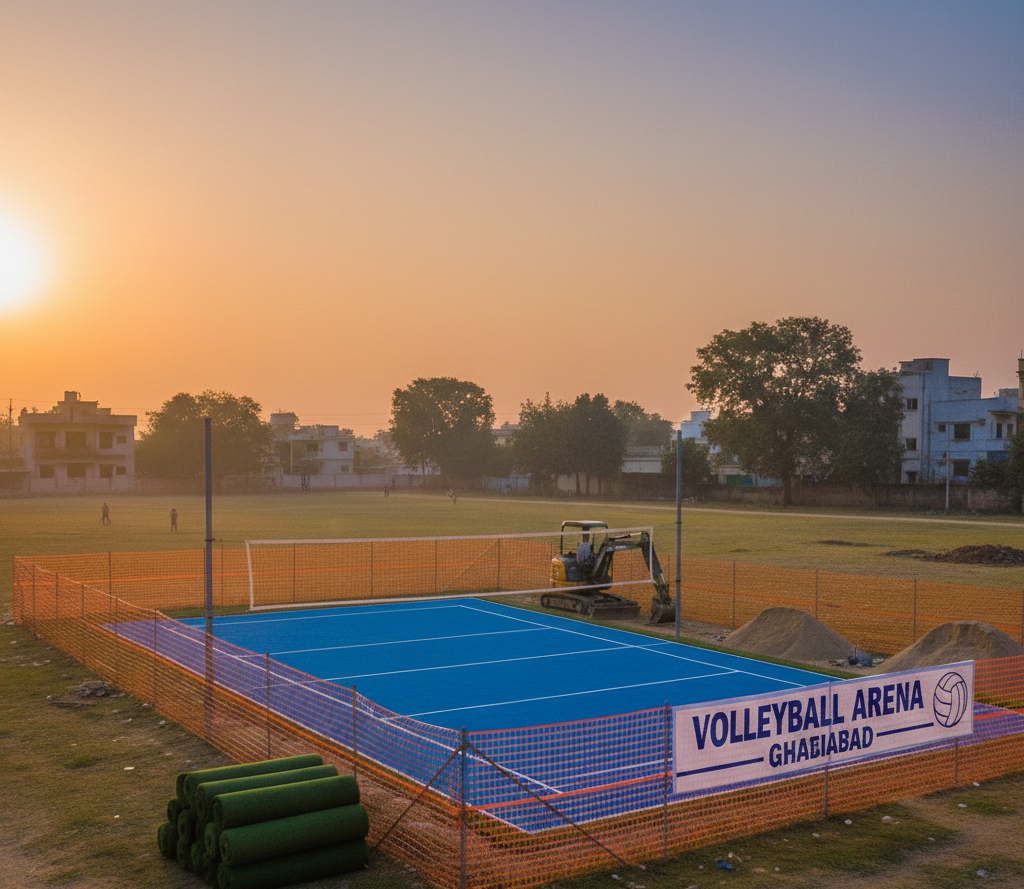
Volleyball is gaining popularity in Ghaziabad, with schools, colleges, sports academies, residential societies, and sports clubs increasingly investing in modern sports facilities. As interest in fitness, recreational activities, and competitive sports continues to grow, the demand for volleyball court construction in Ghaziabad is steadily increasing.
A well-designed volleyball court provides a safe, durable, and high-performance playing surface for beginners, recreational players, and professional athletes. Building a quality court requires careful planning, including site selection, ground preparation, base construction, flooring installation, drainage, and accurate court markings.
Whether you are planning a volleyball court for a school, residential complex, private academy, sports club, or commercial sports facility, choosing the right construction method and flooring material is essential for long-term performance.
In this guide, we explore everything you need to know about volleyball court construction in Ghaziabad, including court types, standard dimensions, flooring options, construction steps, estimated costs, and maintenance requirements.
Why Invest in Volleyball Court Construction in Ghaziabad?
Ghaziabad’s expanding residential developments, educational institutions, and recreational facilities have created opportunities for better sports infrastructure. Constructing a volleyball court can provide several benefits.
- Growing Sports Participation: Schools, colleges, and sports academies can encourage students and athletes to participate in volleyball.
- Fitness and Recreation: A dedicated court offers an excellent space for physical activity, coordination, agility, and teamwork.
- Professional Training: Properly constructed courts support coaching sessions, practice matches, and local competitions.
- Residential Amenities: Housing societies and gated communities can provide residents with an engaging outdoor recreational facility.
- Long-Term Value: Durable flooring and quality construction can reduce maintenance requirements and improve the usability of the facility.
Choosing an experienced volleyball court construction company helps ensure that the project meets its intended performance, safety, and durability requirements.
Types of Volleyball Courts
Before starting construction, it is important to select a court type based on the available space, intended use, budget, and location.
1. Indoor Volleyball Court
Indoor volleyball courts are suitable for schools, sports complexes, professional training centres, and indoor stadiums. They provide a controlled playing environment and allow games to continue regardless of outdoor weather conditions.
Common flooring options include:
- Wooden sports flooring
- PVC vinyl sports flooring
- PU sports flooring systems
Indoor courts also require adequate lighting, sufficient ceiling clearance, proper ventilation, and a suitable subfloor. Wooden and other sports-specific flooring systems should be selected according to the required shock absorption, traction, and playing characteristics.
2. Outdoor Volleyball Court
Outdoor volleyball courts are popular in schools, parks, residential societies, colleges, and open sports facilities throughout Ghaziabad.
Depending on the project requirements, flooring options may include:
- Synthetic acrylic sports flooring
- Concrete or cement-based surfaces
- Outdoor sports flooring systems designed for the intended application
Outdoor courts must be constructed on a stable base with appropriate slope and drainage. Since Ghaziabad experiences hot summers and seasonal monsoon rainfall, weather resistance and effective water management are important considerations.
3. Beach Volleyball Court
Beach volleyball courts are suitable for resorts, recreational clubs, sports academies, and specialised training facilities.
These courts use properly selected, washed sand over a prepared base with suitable drainage. Sand depth and quality should be determined according to the intended level of play and applicable competition requirements.
Beach volleyball courts also require boundary lines, net posts, and a clearly defined playing area with sufficient surrounding space.
Standard Volleyball Court Dimensions
Following recognised volleyball court dimensions is essential for safe and consistent gameplay. The official playing court dimensions used under FIVB rules are:
- Court length: 18 metres
- Court width: 9 metres
- Court area: 162 square metres
- Attack line: 3 metres from the centre line on each side
- Net height for men’s volleyball: 2.43 metres
- Net height for women’s volleyball: 2.24 metres
The free zone around the court must also be considered during planning. A minimum free zone of 3 metres is commonly specified for standard play, while larger clearances may be required or recommended for higher-level competitions.
For outdoor projects in Ghaziabad, the overall site area should account for the playing court, surrounding safety space, access paths, drainage arrangements, and any additional facilities.
Accurate line markings, appropriate net systems, and correctly positioned poles help create a court suitable for training and competitive play.
Step-by-Step Volleyball Court Construction in Ghaziabad
Professional volleyball court construction involves several stages. Each stage contributes to the court’s structural stability, playing quality, and service life.
1. Site Inspection and Planning
The first step is to assess the proposed location and determine whether it is suitable for volleyball court construction.
Important factors include:
- Available land and required court dimensions
- Ground level and soil conditions
- Water drainage and rainwater flow
- Accessibility for players and maintenance equipment
- Lighting requirements and surrounding obstructions
For indoor projects, the assessment should also consider ceiling height, ventilation, building conditions, and the suitability of the existing floor.
2. Ground Preparation and Base Construction
A stable base is essential for preventing uneven surfaces, cracks, and premature flooring damage.
For outdoor courts, the process may involve excavation, soil compaction, sub-base preparation, and construction of a suitable concrete or other engineered base. The design should reflect the ground conditions, drainage requirements, and selected flooring system.
Indoor courts may require a prepared concrete subfloor, a sports-specific underlay, or a wooden subfloor system, depending on the chosen finish.
Beach volleyball courts require a suitable sand-retaining structure, drainage arrangement, and prepared sand base.
3. Flooring Selection and Installation
Selecting the correct flooring depends on whether the court is intended for recreational use, school sports, professional training, or competition.
Acrylic sports flooring: Suitable for many outdoor installations when applied over an appropriate base. It provides a coloured, clearly marked playing surface.
Wooden sports flooring: Commonly selected for indoor courts requiring sports-specific traction, resilience, and shock absorption.
PVC vinyl flooring: An indoor option that can provide a consistent playing surface when installed over a compatible subfloor.
PU sports flooring: Depending on the system, polyurethane flooring can provide a durable surface with performance characteristics suited to indoor or outdoor sports applications.
Concrete flooring: A comparatively economical option for basic outdoor facilities, although its hardness makes careful consideration of player comfort and safety important.
The flooring system should be selected based on the court’s intended use, expected foot traffic, environmental exposure, and maintenance budget.
4. Court Marking and Finishing
Once the surface is ready, the court markings are installed according to the required dimensions and applicable volleyball rules.
This stage includes:
- Marking the 18 m × 9 m playing area
- Identifying the centre line and attack lines
- Applying suitable line colours and widths
- Checking the accuracy of measurements
- Inspecting the finished surface for defects
For beach volleyball, boundary lines and sand preparation are completed according to the chosen court specification.
5. Installation of Volleyball Equipment
The final stage involves installing the required playing equipment and additional facilities.
Depending on the project, these may include:
- Volleyball net and posts
- Post sleeves and protective padding
- Floodlights for evening matches
- Perimeter fencing or ball-stop netting
- Player seating and spectator areas
- Signage and access pathways
Equipment should be installed securely, with particular attention to post stability, protective padding, and player safety.
Cost of Volleyball Court Construction in Ghaziabad
The cost of volleyball court construction in Ghaziabad depends on the court type, site condition, flooring material, base construction, drainage, equipment, and overall project specifications.
The following figures are indicative budget estimates, not verified current contractor quotations.
| Court type | Indicative cost |
|---|---|
| Basic concrete outdoor court | ₹150–₹250 per sq. ft. |
| Synthetic acrylic court | ₹350–₹500 per sq. ft. |
| Indoor wooden sports court | ₹600–₹800 per sq. ft. |
| Beach volleyball court | Approximately ₹5–₹8 lakh |
A standard outdoor synthetic volleyball court may cost approximately ₹7–₹12 lakh, while a professional indoor wooden court may require a budget of around ₹15–₹20 lakh or more.
Actual costs can vary considerably depending on whether the quotation includes excavation, earthwork, the structural base, flooring, drainage, lighting, fencing, equipment, taxes, and other site-specific requirements. A beach volleyball project also depends on the sand-retaining structure, sand specification, and drainage system.
Before finalising a contractor, request a detailed quotation that clearly separates civil work, flooring, equipment, and additional facilities.
Maintenance Tips for Volleyball Courts
Regular maintenance helps preserve the playing surface and extend the court’s service life.
Synthetic Acrylic Courts
- Remove dust, leaves, and debris regularly.
- Clean the surface using suitable cleaning methods.
- Inspect for cracks, peeling, or surface deterioration.
- Keep drainage outlets clear to prevent water accumulation.
- Repair damaged areas before the problem spreads.
Wooden Indoor Courts
- Sweep or dust-mop the surface frequently.
- Use cleaning products approved for sports flooring.
- Control indoor humidity and address water leaks promptly.
- Inspect the finish, joints, and surface condition periodically.
- Schedule refinishing when required by the flooring manufacturer.
Beach Volleyball Courts
- Rake and level the sand regularly.
- Remove stones, debris, and other foreign objects.
- Inspect the sand depth and quality.
- Maintain drainage and check the court boundaries.
- Inspect net posts, anchors, and boundary lines.
A planned maintenance schedule helps reduce avoidable repair costs and keeps the court suitable for regular use.
Challenges in Volleyball Court Construction in Ghaziabad
Several factors should be considered before beginning a volleyball court project in Ghaziabad.
Weather exposure: High summer temperatures and monsoon rainfall can affect outdoor surfaces. Weather-resistant materials and effective drainage are important for long-term performance.
Limited space: Residential societies and urban properties may have restrictions on available land. Proper site planning helps accommodate the court and its safety zones.
Base quality: Poor compaction, an unsuitable base, or inadequate drainage can lead to cracks, surface damage, and uneven playing conditions.
Flooring selection: Choosing flooring without considering the intended sport, level of play, and environmental conditions can affect player comfort and performance.
Budget management: Additional work such as lighting, fencing, earthwork, and drainage may increase the total project cost if it is not included in the initial estimate.
Working with an experienced sports infrastructure contractor can help address these challenges through appropriate planning, material selection, and quality control.
Why Quality Volleyball Court Construction Matters
A professionally constructed volleyball court offers more than a designated playing area. It creates a reliable environment for physical education, recreational activities, structured training, and competitive matches.
For schools and colleges, a quality court can support sports programmes and student participation. Residential societies can provide residents with an accessible fitness facility, while sports academies can use purpose-built courts for coaching and player development.
The right combination of base preparation, flooring, drainage, equipment, and maintenance planning can improve durability and help minimise long-term repair requirements.
Choosing a Volleyball Court Construction Company in Ghaziabad
Selecting the right contractor is an important part of achieving a successful project.
Before making a decision, consider the following:
- Experience in volleyball and other sports court projects
- Knowledge of recognised court dimensions and relevant sports requirements
- Quality of proposed flooring materials
- Expertise in base preparation and drainage
- Availability of installation and maintenance support
- Clear quotations, project timelines, and warranty terms
- References, completed projects, and examples of previous work
A professional contractor should assess the site, understand your requirements, recommend a suitable construction system, and provide a transparent project estimate.
Conclusion
Volleyball court construction in Ghaziabad is a valuable investment for schools, colleges, sports academies, residential communities, clubs, and commercial sports facilities. A well-planned court provides a suitable environment for recreational play, athlete training, and competitive volleyball.
By selecting the appropriate flooring, preparing a stable base, providing effective drainage, following recognised court dimensions, and installing quality equipment, you can create a durable and functional sports facility.
If you are planning a new volleyball court or upgrading an existing facility, Sports-Facility.in offers a starting point for exploring sports court construction solutions. Visit Sports-Facility.in to learn more about available services and discuss the requirements of your project.
Frequently Asked Questions (FAQs)
1. What are the standard dimensions of a volleyball court?
The standard playing court measures 18 metres long and 9 metres wide. Additional space is required around the playing area for player movement and safety.
2. What is the cost of volleyball court construction in Ghaziabad?
An outdoor synthetic volleyball court may cost approximately ₹7–₹12 lakh, while an indoor wooden court may cost ₹15–₹20 lakh or more. The final price depends on site conditions, flooring, civil work, and additional facilities.
3. Which flooring is best for a volleyball court?
Wooden sports flooring is a common choice for indoor courts, while acrylic sports flooring is suitable for many outdoor installations. Beach volleyball requires a properly prepared sand surface.
4. How long does it take to construct a volleyball court?
A typical project may take approximately 4–8 weeks, depending on site preparation, weather, flooring installation, equipment, and project complexity. Larger projects may require additional time.
5. Can a volleyball court be used for other sports?
Yes. A suitably designed facility can accommodate other sports when the available space, surface characteristics, safety clearances, and line markings meet the requirements of each activity.
6. Is drainage necessary for an outdoor volleyball court?
Yes. Proper drainage helps prevent water accumulation and reduces the risk of damage to the playing surface and base.
7. What factors affect volleyball court construction costs?
The main factors include site preparation, soil conditions, base construction, flooring material, drainage, lighting, fencing, sports equipment, and the overall project specifications.