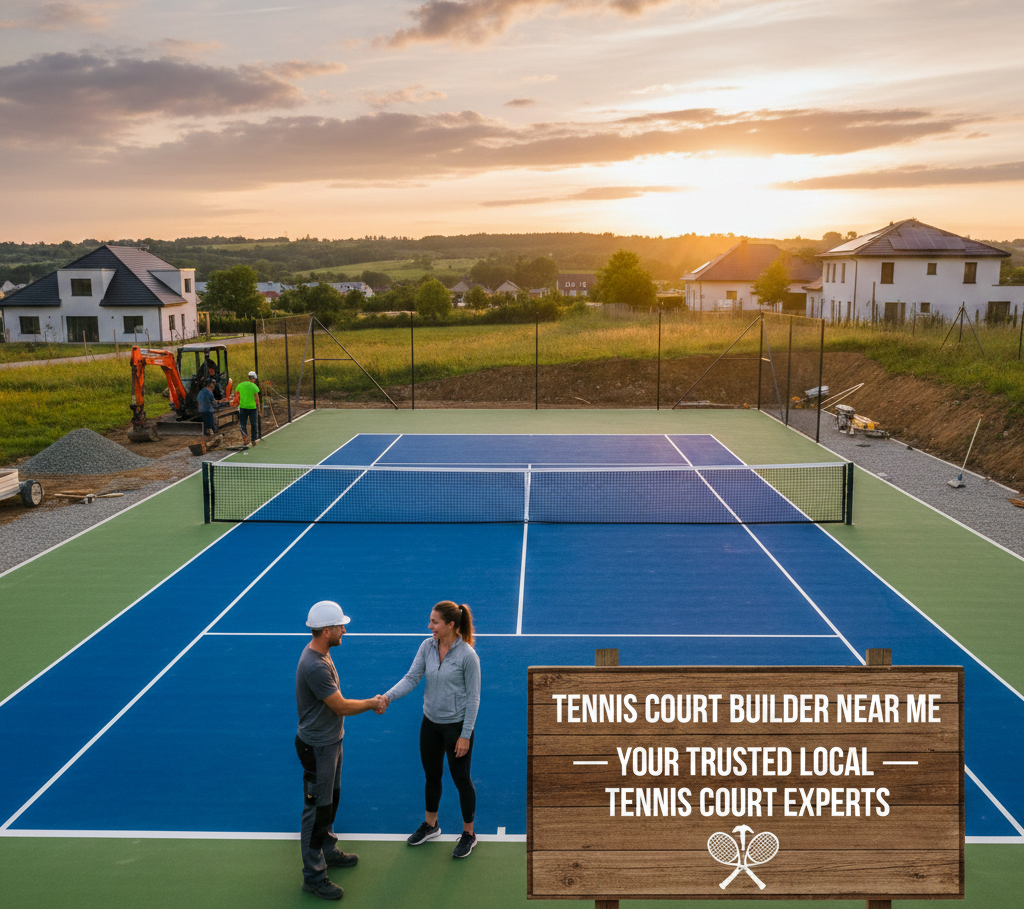
Are you searching for a reliable tennis court builder near me who can transform your available space into a professionally designed, durable, and high-performance tennis court? Whether you are planning a private tennis court for your home, developing a sports academy, upgrading a school playground, or constructing a commercial sports facility, choosing the right construction partner is essential for achieving lasting results.
At Sports Facility India, we provide comprehensive tennis court construction solutions designed around your site conditions, playing requirements, surface preferences, and project budget. Our services cover the complete construction journey, including site inspection, court layout planning, ground preparation, base construction, sports flooring installation, court marking, fencing, lighting, and finishing.
Every tennis court project requires careful planning, accurate dimensions, effective water management, and appropriate surface selection. A properly constructed court supports consistent ball bounce, comfortable movement, and reliable playing conditions while helping reduce maintenance requirements over time.
Whether you need an outdoor tennis court, an indoor training facility, or a professional court for an academy or sports club, our team can help you identify a suitable construction approach. Explore our tennis court construction solutions and discover how a thoughtfully designed sports surface can improve your facility.
Why Choose a Professional Tennis Court Builder Near You?
Finding a tennis court builder in your area is about more than obtaining a quotation. You need a construction partner who understands sports flooring, ground conditions, drainage requirements, court dimensions, and the practical needs of players.
Working with an experienced tennis court construction company helps coordinate the different stages of development and reduces the risk of avoidable construction problems.
1. Convenient Site Inspection and Project Planning
A site inspection helps establish whether your available land is suitable for tennis court construction. Important considerations include the ground level, soil stability, access for construction equipment, surrounding structures, available space, and water drainage.
A professional builder evaluates these factors before recommending a court layout. This early assessment supports more accurate budgeting and helps identify potential challenges before construction begins.
2. Customized Tennis Court Construction
Every property has different requirements. A residential tennis court may prioritize privacy and efficient use of space, while a sports academy may require a durable surface designed for frequent training sessions.
A reliable tennis court builder can customize the project according to your preferred playing surface, court surroundings, fencing, lighting, colors, and intended usage.
3. Better Coordination and Local Support
Choosing a contractor who can serve your location may make site visits, material coordination, project supervision, and maintenance arrangements more convenient. Before appointing a builder, confirm the actual service area, expected response time, and availability of after-sales assistance.
4. Suitable Materials and Construction Methods
The longevity of a tennis court depends on more than the visible playing surface. The underlying base, surface coating, drainage arrangements, installation quality, and weather exposure all influence performance.
Experienced professionals help select suitable materials and construction methods based on the project’s requirements rather than recommending the same solution for every site.
Complete Tennis Court Design and Construction Services
Sports Facility India offers end-to-end tennis court construction solutions for residential, educational, recreational, and commercial sports facilities. Our project planning approach considers the playing surface, supporting infrastructure, and long-term usability of the court.
Our services may include the following, depending on project scope:
- Site survey and feasibility assessment: Evaluation of land conditions, available space, access, and drainage.
- Court layout and design: Planning the playing area, safety clearances, surrounding facilities, and access points.
- Excavation and ground preparation: Preparing the site to establish a stable foundation.
- Base construction: Developing a suitable concrete or asphalt base according to the selected surface system.
- Tennis court flooring installation: Applying the selected acrylic, synthetic turf, cushioned, or other appropriate surface system.
- Court line marking: Applying accurate playing lines suitable for the intended format.
- Fencing and access gates: Installing perimeter fencing to improve ball containment and facility management.
- Net posts and accessories: Providing essential playing equipment and compatible fixtures.
- Sports lighting: Planning suitable lighting for evening practice and recreational use.
- Maintenance and resurfacing: Supporting surface upkeep, repairs, and refurbishment where available.
Combining these services under a coordinated project plan helps maintain consistency between the foundation, playing surface, and supporting infrastructure.
Types of Tennis Courts We Build
Selecting the right tennis court surface is one of the most important decisions in any construction project. Different surfaces offer different playing characteristics, maintenance requirements, installation costs, and weather performance.
1. Acrylic Tennis Court Construction
Acrylic tennis courts are a popular choice for schools, residential properties, sports clubs, academies, and public sports facilities. These systems are generally installed over a properly prepared concrete or asphalt base.
Acrylic sports coatings can provide a consistent playing surface, defined court markings, and a choice of color combinations. Cushioning layers may also be incorporated into suitable systems to improve underfoot comfort.
Key advantages include:
- A clean and professional appearance.
- Multiple surface color options.
- Relatively straightforward routine maintenance.
- Suitability for many outdoor and indoor court projects.
- Resurfacing options when the existing base remains serviceable.
The final playing characteristics depend on the selected coating system, base quality, and installation specifications.
2. Synthetic Turf Tennis Courts
Synthetic turf courts use artificial grass surfaces designed for sports or recreational applications. They may appeal to facilities seeking a grass-like appearance and a different playing experience from conventional hard courts.
The appropriate turf pile, backing, infill, drainage arrangement, and installation method depend on the intended use and product specification.
Synthetic turf should be selected specifically for tennis rather than assuming that every landscaping turf product is suitable for sports. Buyers should discuss ball response, player movement, maintenance, and drainage with the installer before making a decision.
3. Clay Tennis Court Construction
Clay courts provide a traditional playing experience and are often associated with longer rallies and sliding movement. Depending on the system, the surface may use crushed brick or other suitable mineral materials.
Clay courts require more regular maintenance than many hard-court systems. Watering, brushing, surface leveling, line maintenance, and seasonal care may be necessary to preserve playing quality.
This surface can be suitable for clubs, specialized academies, and facilities that have the staff, water access, and maintenance resources needed to manage it properly.
4. Concrete and Asphalt Tennis Court Bases
Concrete and asphalt are commonly used as foundation systems for hard tennis courts. They provide the structural platform required for compatible sports coatings and other approved surface systems.
However, the base itself is not the only factor determining court quality. Correct levels, surface tolerances, curing, joint detailing where applicable, and drainage design must be considered before applying the final sports flooring.
A professional builder will recommend the appropriate base based on ground conditions, engineering requirements, climate, and the selected playing surface.
5. Cushioned Tennis Court Systems
Cushioned tennis court systems incorporate additional elastic layers beneath or within the playing surface. These systems may be appropriate for clubs, academies, and facilities seeking enhanced underfoot comfort.
The cushioning level, ball response, maintenance needs, and cost vary by product. The system should be evaluated as a complete assembly, including the base, cushion layers, and finish coatings.
Custom Tennis Court Solutions for Homes, Schools, Clubs, and Academies
Our tennis court construction solutions can be planned for a range of environments. Each project requires a design that reflects how the facility will be used.
Residential tennis courts: Homeowners can create a dedicated space for recreation, family activities, and private coaching. Planning should consider available land, safe movement around the court, landscaping, lighting, and convenient access.
Schools and colleges: Educational institutions benefit from thoughtfully designed sports areas that support physical education, extracurricular activities, and student recreation. Durable surfaces and manageable maintenance requirements are important considerations.
Sports academies: Training facilities need a layout and surface appropriate for repeated practice, coaching sessions, and player development. Depending on the academy’s goals, additional lighting, seating, equipment storage, and spectator facilities may be included.
Sports clubs and resorts: Clubs and hospitality properties may prioritize appearance, visitor experience, durability, and efficient facility management. Surface selection should balance playing quality with the expected frequency of use.
Government and community sports projects: Public facilities require careful budgeting, practical maintenance planning, and construction that meets the applicable project specifications. Accessibility, safe circulation, drainage, and long-term operational requirements should be addressed during design.
Standard Tennis Court Dimensions and Space Planning
Accurate dimensions are essential when constructing a tennis court. Under standard tennis rules, the playing court measures 78 feet (23.77 metres) in length.
The width of the playing area is:
- Singles: 27 feet (8.23 metres).
- Doubles: 36 feet (10.97 metres).
These measurements describe the marked playing area, not the complete land required for construction. Additional space is needed behind the baselines and beyond the sidelines to allow players to move safely.
The total site requirement depends on the level of play, available land, surrounding facilities, fencing, lighting positions, and applicable design standards. Competitive facilities should have their layout reviewed against the relevant International Tennis Federation (ITF) guidance and project requirements.
If your site is relatively small, a tennis court builder can assess whether a modified practice area or training court would be more practical than a full-size court. The proposed layout should clearly distinguish between a regulation playing court and a smaller recreational or practice facility.
Our Tennis Court Construction Process
A structured construction process helps ensure that each stage is completed in the correct sequence.
Consultation and Site Assessment
The project begins with a discussion about your objectives, preferred surface, budget, and expected usage. The site is then assessed for ground conditions, dimensions, drainage, access, and construction feasibility.
Court Design and Cost Estimation
Based on the site assessment, a proposed layout and construction scope are prepared. The quotation should identify the selected surface system, foundation work, accessories, lighting, fencing, and any exclusions that may affect the final price.
Ground Preparation and Drainage
The construction area is prepared according to the approved design. Excavation, grading, compaction, and drainage work are undertaken where required. Proper water management is particularly important for outdoor tennis courts exposed to rainfall.
Foundation and Base Construction
A suitable base is constructed according to the engineering design and selected surface system. Levels, smoothness, stability, and drainage provisions should be checked before the next stage begins.
Sports Surface Installation
The specified acrylic coating, synthetic turf, cushioned system, or other selected surface is installed following the manufacturer’s recommendations. Weather conditions, surface preparation, curing requirements, and installation quality can influence the finished result.
Court Marking and Accessory Installation
Court lines are measured and marked accurately. Net posts, the net, fencing, gates, and other approved accessories are installed according to the agreed project specifications.
Final Inspection and Handover
The completed facility is inspected for surface finish, visible defects, line accuracy, drainage performance, and accessory installation. The client should receive relevant maintenance instructions and product information before the court is put into regular use.
What Is the Cost of Building a Tennis Court Near Me?
The cost of tennis court construction depends on several variables, so a site-specific quotation is more useful than relying on a single standard rate.
Important cost factors include:
- Total site area and court dimensions.
- Existing ground conditions and excavation requirements.
- Concrete or asphalt base construction.
- Selected flooring material and cushioning system.
- Drainage and rainwater management.
- Fencing, gates, net posts, and accessories.
- Lighting poles, fixtures, and electrical work.
- Transportation, labour, and project location.
- Surface preparation, finishing, and future maintenance needs.
For budgeting purposes, ask your tennis court contractor to provide a detailed breakdown covering civil work, flooring, accessories, taxes, and any optional features. Clarify whether the quotation includes the full construction area or only the marked playing surface.
The price of sports flooring per square foot should not be confused with the total cost of building a complete tennis court. Site development, foundations, drainage, fencing, and lighting can contribute substantially to the final investment.
At Sports Facility India, you can discuss your proposed project and request a customized estimate based on the site, selected surface, and construction requirements.
Tennis Court Maintenance and Resurfacing
Regular maintenance helps preserve the playing surface and identify developing problems before they become more expensive to repair.
Recommended maintenance practices include:
- Remove leaves, dust, and loose debris regularly.
- Use cleaning methods recommended for the installed surface.
- Inspect court markings for fading or deterioration.
- Check for standing water, drainage blockages, and surface cracks.
- Examine fencing, gates, net posts, and lighting fixtures periodically.
- Address damaged areas using compatible repair materials.
- Arrange professional inspections when surface performance changes.
Acrylic courts may eventually require repairs or recoating, while synthetic turf and clay systems have different maintenance requirements. Maintenance frequency depends on climate, usage intensity, surface type, and the manufacturer’s recommendations.
Before investing in resurfacing, have the existing foundation and drainage inspected. Applying a new surface coating without addressing underlying defects may lead to recurring problems.
Why Choose Sports Facility India for Tennis Court Construction?
Choosing the right construction partner means evaluating more than advertising claims. You should consider relevant project experience, surface expertise, installation methods, quotation transparency, and the availability of ongoing support.
Sports Facility India offers a coordinated approach to tennis court development, helping customers plan the playing surface and supporting infrastructure according to their requirements.
Our service approach focuses on:
- Project planning based on available space and intended use.
- Surface recommendations suited to the proposed application.
- Coordination of ground preparation and flooring installation.
- Planning for drainage, fencing, lighting, and accessories.
- Clear discussion of construction scope and cost factors.
- Maintenance guidance for the installed surface.
Before confirming your project, request details about comparable completed work, material specifications, applicable warranties, and the scope of after-sales support. These checks help establish realistic expectations and support an informed purchasing decision.
Frequently Asked Questions About Tennis Court Builders Near Me
1. How can I find a reliable tennis court builder near me?
Look for a sports construction company with relevant tennis court experience, suitable surface options, transparent quotations, and examples of completed projects. Confirm its service area and ask about site inspections, installation procedures, warranties, and maintenance support.
2. How much does it cost to build a tennis court in India?
The total cost depends on the site, foundation, surface material, drainage, fencing, lighting, and other project requirements. A detailed quotation based on a site inspection is the best way to estimate your investment.
3. What is the standard size of a tennis court?
A regulation tennis court is 78 feet long. It is 27 feet wide for singles and 36 feet wide for doubles. Additional surrounding space is necessary for safe player movement and facility access.
4. Which tennis court surface is best?
Acrylic surfaces are commonly selected for hard courts, while synthetic turf, clay, and cushioned systems suit different playing preferences and maintenance capabilities. The best option depends on the intended use, budget, climate, and desired playing characteristics.
5. How long does tennis court construction take?
The construction schedule depends on site preparation, foundation work, drainage, surface selection, weather, and accessory installation. The contractor should provide a project-specific timeline after assessing the site and scope.
6. Can you build a tennis court in a residential property?
Yes, a residential tennis court may be possible if sufficient space and suitable site conditions are available. Planning should account for playing dimensions, safety clearances, drainage, fencing, local permissions, and lighting requirements.
7. Is drainage necessary for an outdoor tennis court?
Yes. Appropriate grading and drainage help prevent standing water and protect the court’s foundation and playing surface. The design should account for rainfall, soil conditions, and the selected surface system.
8. Can I customize the court color and design?
Depending on the surface system, customization may include playing-area colors, contrasting outer zones, fencing, lighting, seating, and approved logos. Court markings must remain accurate and clearly visible.
9. Does a tennis court require regular maintenance?
Yes. Regular cleaning, drainage checks, inspection of court lines, and timely repairs help maintain playing quality. Specific maintenance requirements depend on the installed surface.
10. Do tennis court builders provide resurfacing services?
Some tennis court construction companies also provide resurfacing, repairs, and refurbishment. Confirm whether these services are available in your area and whether the existing foundation needs repairs before a new surface is installed.
Build Your Tennis Court with Trusted Local Experts
If you are searching for a tennis court builder near me, Sports Facility India can help you explore practical construction options for residential properties, schools, academies, clubs, and commercial sports facilities.
From initial site assessment and court design to foundation preparation, sports flooring, line marking, fencing, and lighting, a well-planned project brings all the essential elements together.
The right construction solution should balance playing performance, durability, appearance, and long-term maintenance costs. By choosing an appropriate surface and investing in proper foundation work, you can develop a tennis facility that serves its intended purpose for years to come.
Planning a new tennis court or upgrading an existing facility? Visit Sports Facility India to discuss your requirements and request a project-specific quotation.