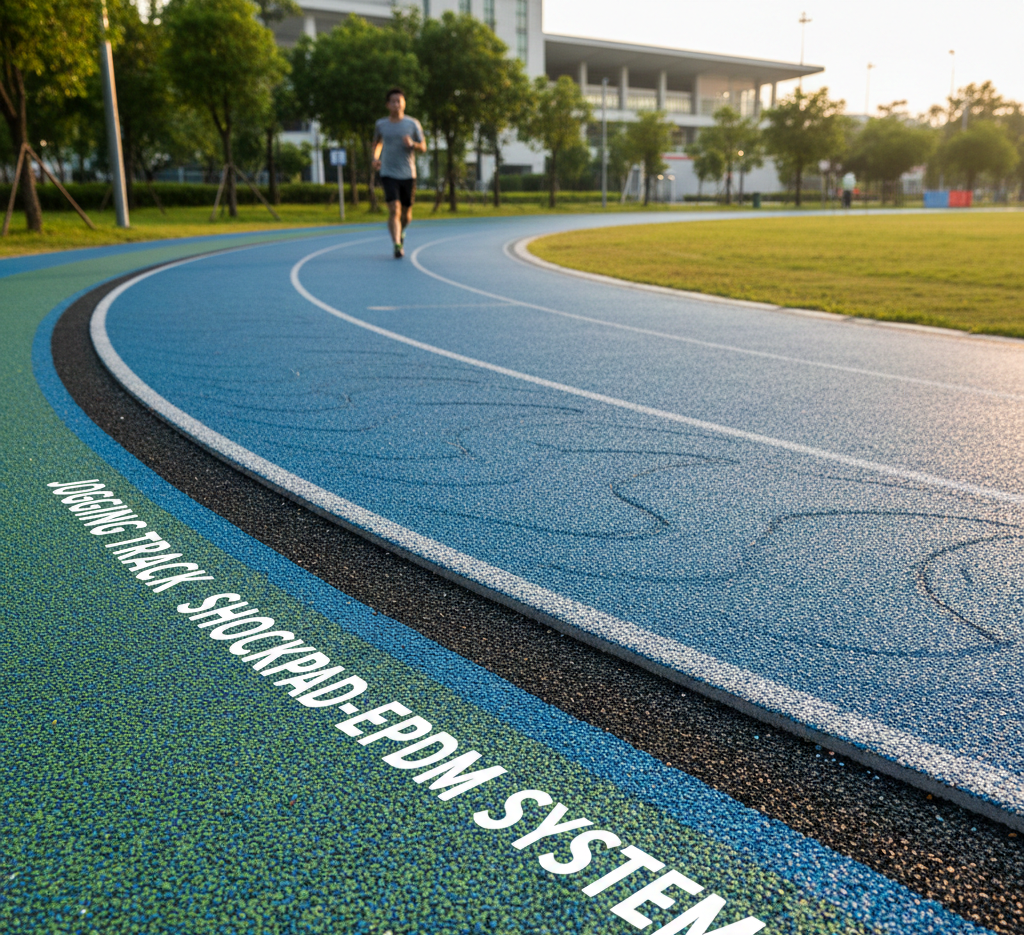
Jogging and running are among the most effective activities for maintaining physical fitness, improving cardiovascular health, and promoting an active lifestyle. However, the quality and type of running surface play an important role in ensuring safety, comfort, and performance. Traditional surfaces such as concrete and asphalt may provide limited cushioning, increasing repetitive impact on the knees, ankles, and other joints.
To overcome these challenges, modern sports infrastructure is increasingly adopting the Jogging Track Shockpad-EPDM System. This advanced synthetic flooring solution combines a shock-absorbing rubber base with a durable EPDM top layer to create a comfortable, resilient, and visually attractive running surface.
Designed for schools, colleges, residential societies, public parks, sports complexes, fitness centres, and commercial developments, the Shockpad-EPDM system offers an effective combination of impact absorption, slip resistance, weather durability, and low maintenance.
This comprehensive guide explores the features, advantages, applications, installation process, maintenance requirements, and cost of Jogging Track Shockpad-EPDM Systems in India.
What is a Jogging Track Shockpad-EPDM System?
A Jogging Track Shockpad-EPDM System is a multi-layer synthetic sports flooring solution engineered to provide cushioning, traction, and durability for jogging and running activities. It generally consists of two primary layers: a shock-absorbing base layer and a coloured EPDM rubber surface.
1. Shockpad Layer
The shockpad is the bottom cushioning layer of the jogging track system. It is generally manufactured using recycled rubber granules bonded with polyurethane or specially designed foam materials.
Its key functions include:
- Absorbing impact generated during running and walking.
- Reducing repetitive loading on knees, ankles, and joints.
- Providing uniform cushioning throughout the track.
- Improving surface elasticity and running comfort.
- Supporting the durability and performance of the complete flooring system.
2. EPDM Rubber Top Layer
The EPDM layer is the uppermost surface, manufactured using Ethylene Propylene Diene Monomer rubber granules mixed with a suitable polyurethane binder.
Its important characteristics include:
- Excellent resistance to UV exposure and outdoor weather conditions.
- Textured surface that provides reliable traction.
- Vibrant colours and attractive finishing options.
- Resistance to normal wear and outdoor environmental exposure.
- Flexibility for customised designs, lane markings, and distance indicators.
Together, these layers create a resilient and comfortable jogging track suitable for regular recreational and fitness activities.
Key Benefits of Jogging Track Shockpad-EPDM Systems
Installing a Shockpad-EPDM jogging track offers several advantages compared with conventional concrete, asphalt, and other hard surfaces.
1. Effective Shock Absorption
The shockpad layer helps absorb impact forces generated during running and walking. Its cushioning properties reduce the harshness of repeated foot contact and improve overall surface comfort.
This makes the system particularly suitable for jogging tracks used by children, adults, senior citizens, and recreational fitness enthusiasts.
2. Slip-Resistant Surface
The textured EPDM rubber finish provides good grip and traction during everyday outdoor use. It helps minimise slipping risks when the surface is exposed to moisture, provided that the correct texture and drainage design are selected.
3. Excellent Weather and UV Resistance
EPDM rubber is designed to withstand outdoor environmental conditions, including sunlight, rain, and temperature variations. High-quality materials and suitable polyurethane binders help maintain the surface’s appearance and performance over time.
4. Improved Running Comfort
Unlike conventional rigid flooring, the cushioned construction provides a more resilient surface for jogging and walking.
The combination of shock absorption and surface elasticity helps improve user comfort and makes regular fitness activities more enjoyable.
5. Long-Term Durability
A properly designed and professionally installed Shockpad-EPDM system can withstand regular pedestrian traffic and outdoor exposure.
Its durability depends on material quality, installation standards, layer thickness, drainage, and maintenance practices.
6. Attractive Colours and Customised Designs
EPDM granules are available in multiple colours, allowing developers and facility owners to create visually appealing jogging tracks.
Customisation options include:
- Single-colour and multi-colour surfaces.
- Running lanes and directional markings.
- Distance indicators.
- Decorative patterns and logos.
- Customised track layouts.
7. Low Maintenance Requirements
The seamless rubber surface is relatively easy to maintain. Regular cleaning, removal of debris, inspection, and timely repairs help preserve its appearance and functionality.
8. Sustainable Material Options
Recycled rubber can be used in the shockpad layer, helping reduce rubber waste. Material selection should consider environmental certifications, chemical safety, and the quality of the polyurethane binder.
Applications of Jogging Track Shockpad-EPDM Systems
The versatility and cushioning characteristics of this flooring solution make it suitable for several types of recreational and sports infrastructure.
Schools and Educational Institutions
Schools and colleges can install Shockpad-EPDM jogging tracks to provide students with comfortable outdoor surfaces for physical education, running, walking, and recreational activities.
Residential Societies and Housing Complexes
Residential developments can incorporate synthetic jogging tracks into landscaped gardens, community parks, and fitness zones to encourage healthier lifestyles among residents.
Public Parks and Recreational Areas
Municipal parks and public recreational spaces can benefit from durable, colourful, and cushioned jogging paths designed for regular community use.
Sports Academies and Training Facilities
Sports academies can use EPDM-based surfaces for recreational running, warm-up areas, and general fitness training. Competition-grade athletics tracks may require a different certified surface specification.
Corporate Campuses and Commercial Properties
Corporate offices, IT parks, hotels, and commercial developments can install jogging tracks to promote employee wellness and provide convenient outdoor fitness facilities.
Hotels, Resorts, and Clubs
Hotels and resorts can enhance their outdoor recreational infrastructure with attractive and comfortable jogging paths for guests and members.
Installation Process of a Jogging Track Shockpad-EPDM System
Proper installation is essential for achieving a smooth, durable, and high-performing jogging track. The process generally involves the following stages.
Site Inspection and Base Preparation
The installation team first evaluates the site conditions, dimensions, existing surface, and drainage requirements.
Preparation includes:
- Removing vegetation, dust, loose particles, and debris.
- Levelling and compacting the sub-base.
- Preparing a suitable concrete, asphalt, or engineered aggregate base.
- Ensuring adequate slope for water drainage.
- Repairing cracks and surface irregularities.
A stable and properly drained foundation is essential for preventing premature surface damage.
Shockpad Layer Installation
After preparing the base, the shockpad material is installed according to the specified thickness and system design.
Polyurethane-bound rubber granules are generally mixed uniformly and applied over the prepared surface. The material is then levelled and compacted to achieve consistent thickness and cushioning.
EPDM Top Layer Application
The EPDM granules are mixed with the specified polyurethane binder in the recommended proportions.
The mixture is spread evenly over the shockpad layer using suitable application tools.
Care is taken to maintain:
- Uniform surface thickness.
- Consistent granule distribution.
- Proper bonding between layers.
- Smooth edges and finishing.
- The required surface texture and colour.
Curing and Surface Finishing
After application, the EPDM surface is allowed to cure under the environmental conditions specified by the material manufacturer.
Curing time depends on temperature, humidity, binder formulation, and installation specifications. Many systems require approximately 24–48 hours or longer before use.
Lane markings, directional indicators, and decorative elements can then be completed.
Quality Inspection and Handover
The completed track undergoes a final inspection to evaluate:
- Surface uniformity and thickness.
- Layer adhesion and bonding.
- Surface texture and finish.
- Drainage performance.
- Colour consistency.
- Marking accuracy and overall workmanship.
Once the specified quality checks are completed and the surface has fully cured, the track can be opened for use.
Maintenance Guidelines for Shockpad-EPDM Jogging Tracks
Although EPDM jogging tracks require relatively little maintenance, regular care is important for extending their service life.
1. Regular Cleaning: Remove dust, leaves, mud, and other debris using a soft brush or water.
2. Periodic Washing: Clean the surface with water and a mild, compatible detergent when required. Avoid harsh chemicals and aggressive cleaning methods.
3. Avoid Heavy Loads: Prevent cars, construction equipment, and heavy machinery from travelling over the track.
4. Routine Surface Inspection: Check for loose granules, cuts, cracks, or damaged areas and arrange timely repairs.
5. Maintain Proper Drainage: Keep drainage channels and surrounding outlets clear to prevent standing water.
6. Professional Repairs: Use compatible EPDM granules and polyurethane materials for repairing damaged sections to maintain surface consistency.
With quality materials, proper installation, and regular maintenance, an EPDM jogging track can offer a long service life. Actual lifespan varies depending on usage, climate, construction quality, and maintenance.
Jogging Track Shockpad-EPDM System Cost in India
The cost of installing a Jogging Track Shockpad-EPDM System depends on several technical and site-specific factors.
The primary cost components include:
- Track length, width, and total installation area.
- Shockpad material type and thickness.
- EPDM granule quality and thickness.
- Polyurethane binder specifications.
- Base preparation and civil construction.
- Drainage and slope requirements.
- Colour combinations and customised designs.
- Labour, transportation, and installation charges.
Indicative Material and Installation Cost
The following figures are indicative estimates and should not be considered fixed market rates.
| Component | Approximate Cost |
|---|---|
| Shockpad layer | ₹300–₹600 per sq. m. |
| EPDM top layer | ₹900–₹1,800 per sq. m. |
| Combined system | ₹1,200–₹2,400 per sq. m. |
Note: Actual quotations may vary depending on thickness, material specifications, project location, base condition, and installation requirements. Civil work, drainage, GST, and additional features may be charged separately.
Although the initial investment may be higher than conventional asphalt or concrete surfaces, the improved cushioning, user comfort, visual appeal, and maintenance advantages can make this system a worthwhile long-term investment.
Why Choose a Shockpad-EPDM System Over Traditional Jogging Track Surfaces?
Traditional concrete and asphalt tracks are rigid and offer limited impact cushioning. In comparison, a properly designed Shockpad-EPDM system provides a more resilient surface for recreational running and walking.
| Feature | Concrete / Asphalt | Shockpad-EPDM |
|---|---|---|
| Surface cushioning | Limited | Enhanced |
| Impact absorption | Low | Higher |
| Running comfort | Relatively rigid | Cushioned |
| Surface grip | Depends on finish | Textured EPDM finish |
| Colour options | Limited | Multiple options |
| UV resistance | Material-dependent | Good with quality EPDM |
| Maintenance | Crack and surface repairs | Cleaning and local repairs |
| Customisation | Limited | Flexible designs and markings |
The Shockpad-EPDM system is particularly suitable for recreational jogging tracks where cushioning, aesthetics, and outdoor durability are important considerations.
Conclusion
The Jogging Track Shockpad-EPDM System is a modern synthetic flooring solution designed to improve the comfort, safety, and appearance of jogging and running facilities. By combining an impact-absorbing shockpad base with a durable and weather-resistant EPDM rubber surface, it provides a resilient alternative to traditional hard-surface tracks.
Its excellent cushioning characteristics, textured finish, colour flexibility, and relatively low maintenance requirements make it suitable for schools, colleges, residential complexes, public parks, sports facilities, corporate campuses, and recreational developments.
However, achieving long-term performance requires proper base preparation, appropriate material selection, professional installation, and regular maintenance.
Investing in a high-quality Shockpad-EPDM jogging track is an investment in better recreational infrastructure, improved user comfort, and a healthier community.
Frequently Asked Questions (FAQs) – Jogging Track Shockpad-EPDM System
1. What is a Jogging Track Shockpad-EPDM System?
A Jogging Track Shockpad-EPDM System is a multi-layer synthetic flooring solution consisting of a shock-absorbing rubber base and a coloured EPDM top surface. It is designed to provide cushioning, traction, durability, and comfort for jogging and walking activities.
2. What materials are used in a Shockpad-EPDM jogging track?
The system generally consists of:
- Shockpad: Recycled rubber granules bonded with polyurethane or suitable cushioning foam.
- EPDM surface: Coloured EPDM rubber granules mixed with a compatible polyurethane binder.
- Optional markings: Specialised materials for lanes, directional indicators, and distance markings.
3. What are the main advantages of Shockpad-EPDM jogging tracks?
The major benefits include improved impact absorption, enhanced running comfort, good surface traction, UV resistance, weather durability, attractive colours, and relatively low maintenance requirements.
4. Can Shockpad-EPDM tracks be installed outdoors?
Yes. EPDM rubber flooring is suitable for outdoor installations when the materials, binder, base, and drainage system are correctly specified.
Common installation locations include parks, schools, residential societies, sports complexes, and commercial campuses.
5. What is the standard thickness of a Shockpad-EPDM jogging track?
The thickness depends on the required cushioning, material properties, intended usage, and base conditions.
Indicative specifications include:
- Shockpad layer: 8–20 mm.
- EPDM top layer: 5–15 mm.
- Overall system: Approximately 15–35 mm.
The final thickness should be determined according to the project design and performance requirements.
6. How is a Shockpad-EPDM jogging track installed?
The installation generally involves five stages:
- Site inspection and sub-base preparation.
- Application of the shockpad layer.
- Installation of the EPDM rubber top layer.
- Curing and surface finishing.
- Final quality inspection and handover.
7. How many days are required to install an EPDM jogging track?
Installation time depends on the total area, base preparation, weather conditions, and project specifications.
Indicative project durations are:
- Small residential tracks: 3–5 days.
- Medium-sized school or park tracks: 7–10 days.
- Large sports facilities: 2–4 weeks.
These estimates may change depending on civil work, material curing, and site conditions.
8. What is the cost of a Shockpad-EPDM jogging track in India?
The indicative combined system cost ranges from ₹1,200 to ₹2,400 per square metre.
The final price depends on shockpad thickness, EPDM layer specifications, material quality, site preparation, drainage, design requirements, and installation charges.
9. How long does a Shockpad-EPDM jogging track last?
A professionally installed system can provide many years of service.
The expected lifespan depends on material quality, installation workmanship, weather exposure, pedestrian traffic, and maintenance. Regular inspections and timely repairs help extend the service life.
10. Is an EPDM jogging track suitable for children and senior citizens?
Yes. Its resilient and cushioned construction makes it suitable for recreational jogging and walking facilities used by different age groups. However, the surface should be designed with appropriate cushioning, traction, drainage, and accessibility considerations.
11. Can different colours and designs be used in EPDM jogging tracks?
Yes. EPDM granules are available in various colours and can be combined to create customised patterns, running lanes, directional markings, distance indicators, and decorative designs.
12. How should an EPDM jogging track be maintained?
Regular cleaning and periodic inspections are generally sufficient for routine maintenance.
Recommended practices include removing dust and leaves, washing with mild detergent when necessary, preventing heavy vehicle movement, checking for surface damage, and maintaining drainage outlets.
13. Can Shockpad-EPDM systems be used for professional running tracks?
They can be used for recreational running and general fitness facilities. However, professional competition tracks may require specialised synthetic athletics surfaces that comply with the applicable World Athletics certification and performance requirements. A standard recreational Shockpad-EPDM system should not automatically be considered competition-certified.
14. What additional facilities can be incorporated into a jogging track project?
Several additional features can be included, such as:
- Lane markings and distance indicators.
- Outdoor benches and seating areas.
- Water fountains and hydration stations.
- LED lighting for evening activities.
- Landscaping and green spaces.
- Outdoor fitness and exercise stations.
- Directional signs and safety indicators.
15. Who provides Jogging Track Shockpad-EPDM installation services?
Specialised sports flooring manufacturers, suppliers, and installation contractors provide Shockpad-EPDM jogging track solutions. Depending on the project, services may include site inspection, material supply, base preparation, installation, colour customisation, line marking, and maintenance guidance.
Before selecting a contractor, verify material specifications, previous project experience, installation methodology, warranty terms, and quality standards.