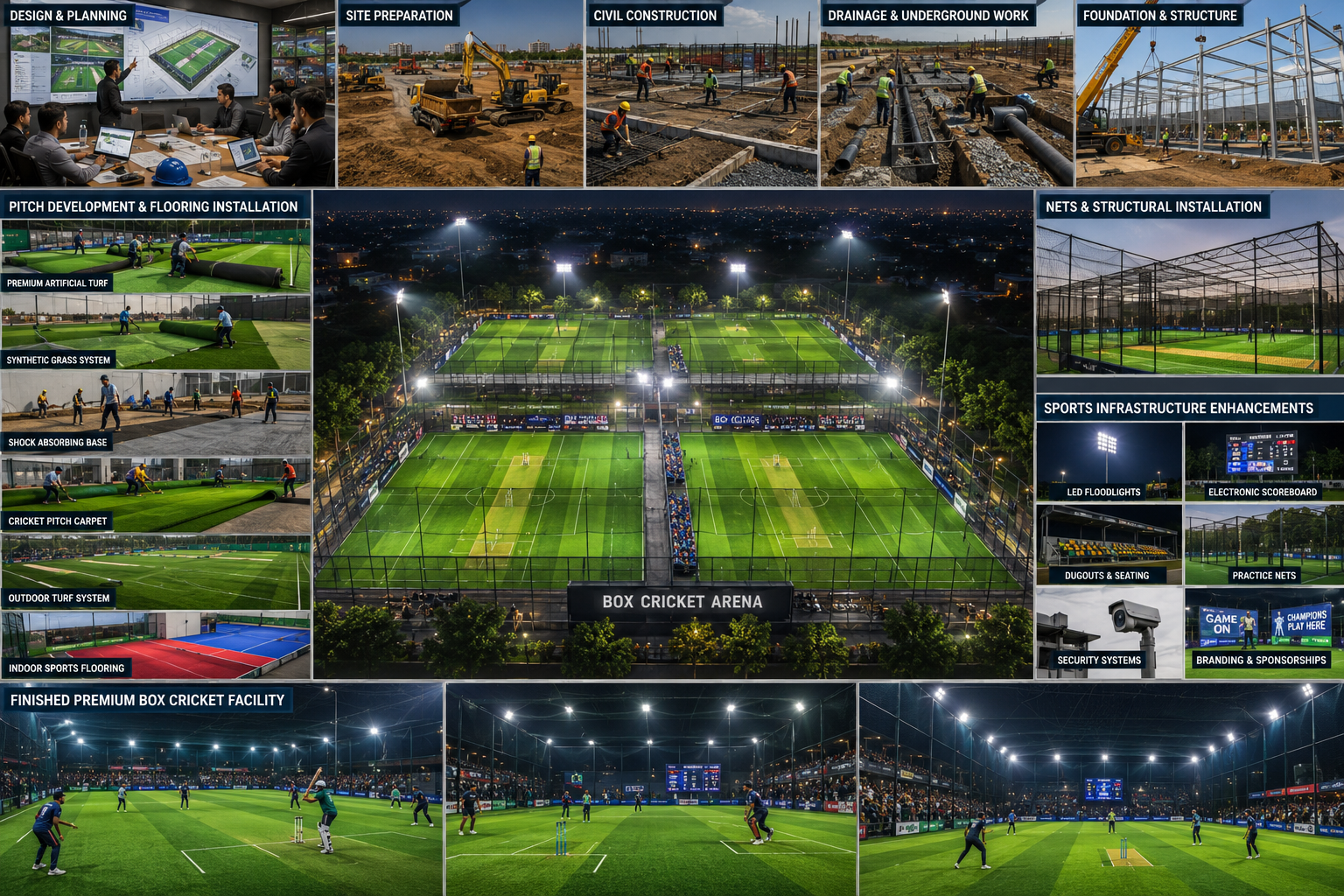
Cricket has always been an important part of India’s sporting culture. From neighbourhood matches to professional tournaments, the game continues to bring people together. However, as cities expand and open playgrounds become increasingly difficult to find, the demand for compact and well-designed cricket facilities is growing.
This is where box cricket has created new opportunities. It brings the excitement of cricket into a smaller, enclosed playing area, making the sport accessible to people who do not have access to traditional cricket grounds.
Today, box cricket pitch construction is becoming a popular investment for residential societies, schools, colleges, sports academies, corporate offices, recreational clubs, and commercial sports operators. A properly planned facility can turn an unused plot, rooftop, or available outdoor space into an attractive destination for sports and recreation.
However, building a successful box cricket facility involves much more than installing artificial grass and surrounding the court with nets. The foundation, flooring, drainage, enclosure structure, lighting, and safety arrangements must work together to deliver a comfortable and reliable playing environment.
With professional planning and quality materials, a box cricket court can offer long-term performance, efficient space utilization, and excellent recreational value.
What Is Box Cricket and Why Is It Becoming Popular?
Box cricket is a compact version of traditional cricket played inside a specially enclosed area. Strong perimeter nets or fencing keep the ball within the playing zone, allowing players to enjoy continuous matches without requiring a large ground.
Unlike conventional cricket grounds, box cricket facilities can be developed in relatively limited spaces. This makes them particularly suitable for urban locations where land availability is a major challenge.
Its popularity is increasing because it offers:
- A convenient way to enjoy cricket in cities.
- Shorter matches suitable for busy schedules.
- Opportunities for friendly competitions and tournaments.
- Recreational activities for different age groups.
- Potential business opportunities through hourly bookings.
- Better utilization of vacant or underused spaces.
A professionally developed box cricket facility can serve both recreational and commercial purposes while encouraging more people to participate in sports.
Why Professional Box Cricket Pitch Construction Matters
The quality of a box cricket facility depends heavily on its construction. Even an attractive-looking court may deliver a disappointing experience if the playing surface is uneven, the nets are poorly secured, or the drainage system is inadequate.
Professional construction focuses on the complete playing environment rather than individual components.
1. Better Playing Conditions
A properly prepared base and suitable sports flooring help maintain consistent surface conditions. Players can move, run, turn, and perform batting and bowling activities more comfortably.
2. Improved Player Safety
Sports facilities must be designed with player protection in mind. Suitable flooring, secure netting, properly finished edges, and protective padding around structural poles help reduce avoidable playing hazards.
3. Stronger Structural Performance
A well-engineered foundation and correctly installed enclosure system help the facility withstand regular use and environmental exposure.
4. Lower Long-Term Maintenance
Using suitable materials and following correct installation practices can reduce common problems such as surface damage, loose netting, water accumulation, and structural deterioration.
5. Greater Commercial Potential
For businesses operating paid sports facilities, a comfortable and well-maintained box cricket court can encourage repeat bookings, group activities, tournaments, and membership programmes.
Complete Box Cricket Pitch Construction Process
Every project requires a different approach depending on the available land, intended use, budget, and location. A systematic construction process helps ensure that the facility meets its functional and aesthetic requirements.
1. Site Inspection and Initial Assessment
Before preparing the design, the construction team evaluates the proposed location.
The inspection generally covers:
- Total available space.
- Existing ground levels.
- Soil condition and load-bearing capacity.
- Accessibility for construction equipment.
- Natural drainage conditions.
- Nearby buildings and surrounding structures.
- Availability of electricity and water connections.
- Indoor or outdoor installation requirements.
This information helps identify possible challenges and determine the most practical construction solution.
2. Box Cricket Court Design and Layout
Once the site assessment is complete, the next step is preparing a customized layout.
The design should make effective use of the available space without compromising player movement or safety.
Important design elements include:
- Overall court dimensions.
- Playing pitch location.
- Boundary and enclosure height.
- Entry and exit gates.
- Lighting tower positions.
- Player waiting areas.
- Spectator seating, where required.
- Equipment storage arrangements.
- Branding and advertising spaces.
A detailed layout also helps coordinate the civil work, electrical installation, flooring, and enclosure construction.
3. Ground Preparation and Base Construction
The foundation is one of the most important parts of a durable box cricket facility.
If the base is not prepared correctly, problems such as uneven flooring, settlement, cracks, and poor drainage may develop over time.
The groundwork generally involves:
- Clearing the site and removing unwanted material.
- Excavating the area according to the approved levels.
- Preparing and stabilizing the soil.
- Compacting the subgrade.
- Installing suitable aggregate layers.
- Developing the required surface levels.
- Constructing the specified base according to the selected flooring system.
The exact base construction method depends on the soil condition, project design, flooring material, and expected usage.
4. Drainage and Water Management
Water accumulation can damage flooring systems and interrupt outdoor sports activities. Therefore, drainage should be considered during the initial design rather than treated as an additional feature.
A suitable drainage arrangement may include:
- Proper surface gradients.
- Perimeter drainage channels.
- Rainwater collection points.
- Underground drainage pipes.
- Appropriate discharge connections.
- Water-resistant construction materials.
These measures help prevent waterlogging and protect the playing surface from unnecessary deterioration.
5. Installation of the Playing Surface
Flooring selection has a direct influence on the appearance, comfort, maintenance, and overall performance of a box cricket court.
The appropriate surface should be selected after considering the playing format, player requirements, indoor or outdoor conditions, and project budget.
Best Flooring Options for Box Cricket Pitch Construction
There is no single flooring material that suits every box cricket project. Different surfaces offer different characteristics, and the final selection should depend on the intended application.
Artificial Turf Flooring
Artificial turf is one of the most widely selected options for modern box cricket facilities.
It provides a green, natural-looking finish while offering a practical alternative to maintaining natural grass.
Key advantages include:
- Consistent and attractive appearance.
- No regular mowing or watering.
- Suitable for frequent recreational use.
- Available in different pile heights and specifications.
- Relatively straightforward cleaning and maintenance.
- Suitable for many indoor and outdoor applications.
For cricket applications, the turf specification, pile height, density, backing, infill, and underlying base should be selected according to the intended playing conditions.
Natural Grass Flooring
Natural grass is suitable for projects where a conventional cricket-ground appearance and natural playing environment are preferred.
Its advantages include:
- Authentic natural appearance.
- Comfortable playing environment.
- Traditional sporting aesthetics.
- Natural cooling characteristics.
However, natural grass requires regular mowing, irrigation, fertilization, pest management, and surface maintenance. It may not be the most practical choice for compact commercial box cricket facilities with heavy daily usage.
Concrete Base with Turf Overlay
Concrete is frequently used as a structural base for sports flooring installations.
When properly designed and finished, it provides a stable foundation for suitable synthetic turf systems.
Important characteristics include:
- Strong structural support.
- Long-lasting base construction.
- Easy integration with different surface systems.
- Reduced risk of ground settlement when correctly engineered.
The concrete base must have suitable levels, drainage provisions, and surface preparation before the turf is installed.
Acrylic Sports Flooring
Acrylic sports flooring is commonly used in multi-purpose sports facilities and selected recreational court applications.
Its main features include:
- Attractive colour combinations.
- UV-resistant surface options.
- Easy cleaning.
- Customizable court markings.
- Suitable performance for designated sports applications.
For box cricket, acrylic flooring should be selected only after checking its suitability for cricket-specific ball behaviour and player movement.
Polyurethane (PU) Flooring
Polyurethane flooring is an option for specialized indoor sports environments where cushioning and surface comfort are important.
Potential benefits include:
- Comfortable underfoot performance.
- Seamless surface finish.
- Different cushioning specifications.
- Easy maintenance when correctly installed.
The suitability of PU flooring depends on the cricket format and the performance requirements of the facility.
EPDM Rubber Flooring
EPDM flooring is generally used in recreational zones, activity areas, and selected sports applications.
Its properties include:
- Resilient surface characteristics.
- Shock-absorbing options.
- Different colour choices.
- Outdoor-grade formulations.
- Comfortable surface finishes.
For the main cricket playing zone, EPDM should be evaluated carefully because its playing characteristics may differ from those of dedicated cricket turf.
6. Net Enclosure and Structural Framework Installation
A secure enclosure is what makes box cricket different from an ordinary open playing area.
The netting system must be designed to contain the ball while providing sufficient clearance for batting, bowling, and fielding activities.
The installation generally includes:
- Strong structural support poles.
- Properly designed foundations or anchoring.
- High-strength sports netting.
- UV-resistant net materials for outdoor installations.
- Secure fixing arrangements.
- Entry and exit gates.
- Protective padding around exposed structural members.
Net height, mesh size, material strength, and support spacing should be determined according to the court dimensions and expected level of play.
A properly installed enclosure also helps protect nearby buildings, vehicles, spectators, and surrounding property.
7. Sports Lighting Installation
Lighting is an important investment for facilities that operate during evening hours.
A well-planned LED lighting arrangement provides better visibility and allows the court to accommodate matches beyond normal daylight hours.
Lighting design should consider:
- Uniform illumination across the playing area.
- Appropriate brightness for recreational or competitive use.
- Glare reduction.
- Pole positioning and mounting height.
- Electrical safety.
- Energy efficiency.
- Weather-resistant fixtures for outdoor installations.
Instead of simply installing powerful lights, the objective should be to distribute illumination evenly across the entire court.
Additional Features That Improve Box Cricket Facilities
A basic box cricket court can be upgraded with several features to create a more complete sports destination.
Spectator Seating
Dedicated seating allows friends, family members, and visitors to watch matches comfortably.
Player Rest Areas
Covered waiting zones or dugouts provide players with a convenient space to relax between matches.
Digital Scoreboards
Electronic scoreboards make it easier to display scores, overs, and match information.
CCTV and Security Systems
Surveillance cameras and suitable access arrangements improve facility monitoring and operational management.
Reception and Booking Area
Commercial box cricket centres can include a reception counter, booking desk, waiting area, and equipment storage.
Branding and Advertising Panels
Custom branding, sponsor boards, and promotional displays can improve the professional appearance of commercial sports facilities.
Recommended Box Cricket Court Dimensions
Box cricket dimensions are flexible and can be customized according to the site and intended playing format.
Some commonly considered configurations include:
| Court Size | Approximate Area | Suitable Application |
|---|---|---|
| 20 m × 10 m | 200 sq. m | Compact recreational facilities |
| 24 m × 12 m | 288 sq. m | Residential and community courts |
| 30 m × 15 m | 450 sq. m | Commercial and larger sports facilities |
These are indicative layout options rather than universal standards. Actual playing dimensions should be finalized after considering the number of players, bowling distance, boundary arrangements, net height, safety clearances, and local site restrictions.
A customized design can help make the best use of irregular plots, rooftops, and other space-constrained locations.
Indoor Box Cricket Court Construction
Indoor box cricket facilities are gaining attention because they allow sports activities to continue throughout the year.
These facilities are particularly useful for commercial sports operators, training academies, and urban recreation centres.
Major benefits include:
- Protection from direct rainfall.
- Reduced exposure to harsh weather.
- Better control over lighting conditions.
- More predictable operating schedules.
- Opportunities for year-round bookings.
- Suitable environments for organized events and training.
Indoor projects require additional planning for roof height, ventilation, lighting, fire safety, and structural clearances.
Outdoor Box Cricket Pitch Construction
Outdoor box cricket courts are suitable for residential societies, educational institutions, sports clubs, and commercial facilities with available open land.
They offer greater flexibility in terms of layout and can be developed without the expense of constructing a complete indoor building.
However, outdoor installations require special attention to:
- Rainwater drainage.
- UV-resistant turf and netting.
- Corrosion-resistant structural components.
- Weatherproof electrical installations.
- Foundation stability.
- Proper surface gradients.
Selecting suitable materials for local environmental conditions helps maintain the facility’s appearance and performance over time.
Where Can Box Cricket Facilities Be Developed?
One of the biggest advantages of box cricket is its adaptability. The facility can be incorporated into different types of properties and sports infrastructure projects.
Residential Townships
Housing societies can develop box cricket courts as part of their recreational amenities. These facilities encourage physical activity and create opportunities for residents to participate in friendly matches.
Schools and Colleges
Educational institutions can use box cricket courts for physical education, inter-house competitions, recreational activities, and cricket practice.
Sports Academies
Training centres can incorporate compact cricket courts for skill development, batting drills, bowling practice, and fitness activities.
Corporate Offices
Corporate campuses can introduce box cricket as part of employee wellness programmes, recreational facilities, and team-building activities.
Commercial Sports Centres
Entrepreneurs can establish dedicated box cricket venues and generate revenue through hourly bookings, tournaments, memberships, and group events.
Hotels and Recreation Clubs
Hospitality properties can offer box cricket as an additional recreational attraction for guests and visitors.
Box Cricket Pitch Maintenance and Repair Services
Regular maintenance is essential to keep a sports facility safe, attractive, and functional.
Even premium flooring and enclosure materials require periodic inspection, particularly in commercial facilities that experience frequent use.
Our maintenance solutions may include:
- Artificial turf brushing and cleaning.
- Removal of dust and accumulated debris.
- Turf seam and joint inspections.
- Replacement of damaged turf sections.
- Netting inspection and repairs.
- Structural pole and anchor checks.
- LED lighting inspection.
- Drainage cleaning.
- Surface repair and refurbishment.
A preventive maintenance schedule helps identify minor problems before they develop into expensive repairs.
Renovation and Upgradation of Existing Box Cricket Courts
An existing box cricket facility does not always need complete reconstruction to meet modern requirements.
In many cases, selected improvements can significantly enhance its appearance and usability.
Renovation services may include:
- Replacement of worn-out artificial turf.
- Installation of improved sports flooring.
- Replacement of damaged netting.
- Strengthening of support structures.
- LED lighting upgrades.
- Drainage improvements.
- Repainting and branding.
- Addition of player seating and scoreboards.
A site inspection helps determine whether the facility requires minor repairs, partial refurbishment, or complete redevelopment.
Factors That Influence Box Cricket Pitch Construction Cost in India
The overall investment depends on the size, design, material specifications, and site conditions.
There is no fixed construction price that applies to every project.
The major cost components include:
1. Site Preparation: Excavation, soil stabilization, leveling, and base construction influence the initial project budget.
2. Flooring Selection: Artificial turf specifications, underlayers, installation methods, and surface requirements affect the overall cost.
3. Netting and Structural Work: Pole material, enclosure height, net quality, foundations, and fabrication requirements contribute to the project expense.
4. Lighting Arrangements: The number of LED fixtures, electrical infrastructure, mounting arrangements, and illumination requirements influence costs.
5. Drainage Infrastructure: Outdoor projects may require additional drainage channels, pipes, and water discharge arrangements.
6. Additional Amenities: Seating, dugouts, scoreboards, reception areas, CCTV, and branding can increase the total investment.
A professional site assessment and detailed bill of quantities help establish a more accurate project estimate.
Why Choose an Experienced Box Cricket Construction Company?
Developing a sports facility requires coordination between civil construction, flooring installation, structural fabrication, electrical work, and sports infrastructure planning.
Working with an experienced contractor helps bring these elements together under one project.
When selecting a box cricket construction company, consider the following:
- Previous sports infrastructure projects.
- Experience with artificial turf installation.
- Understanding of sports flooring requirements.
- Quality of netting and structural materials.
- Customized design and planning capabilities.
- Project management and execution standards.
- Maintenance and post-installation support.
A dependable construction partner focuses not only on completing the installation but also on creating a facility that remains functional and attractive over the long term.
Conclusion: Build a Box Cricket Facility That Delivers Long-Term Value
Box cricket has opened new possibilities for developing sports facilities in locations where traditional cricket grounds are not practical. Its compact format, recreational appeal, and commercial potential make it a valuable addition to residential, educational, corporate, and commercial properties.
However, the success of any facility depends on thoughtful planning, a stable foundation, appropriate flooring, secure netting, efficient drainage, and properly designed lighting.
Whether you are planning a new box cricket court or upgrading an existing sports facility, choosing the right construction approach can make a significant difference to its performance and lifespan.
Our box cricket pitch construction solutions cover the complete project journey, from initial site evaluation and customized design to flooring installation, enclosure development, lighting, and maintenance.
Planning to develop a box cricket facility?
Visit Sports Facility to explore our sports infrastructure solutions. Get in touch with our team to discuss your site requirements and receive a customized proposal for your box cricket construction project.
Frequently Asked Questions About Box Cricket Pitch Construction
1. What is box cricket pitch construction?
Box cricket pitch construction involves developing a compact cricket-playing facility with a suitable base, playing surface, net enclosure, structural framework, and lighting arrangements. The facility is designed to accommodate cricket matches within a limited and controlled space.
2. How much space is required to build a box cricket court?
The required space depends on the playing format and project design. Common indicative layouts include 20 m × 10 m, 24 m × 12 m, and 30 m × 15 m. Additional space may be necessary for access, safety clearances, and supporting amenities.
3. Which flooring is best for box cricket?
Artificial turf is a popular choice because it offers an attractive appearance, practical maintenance requirements, and suitability for frequent recreational use. The final selection should depend on turf specifications, playing requirements, and the installation environment.
4. Can box cricket courts be constructed on rooftops?
Yes, rooftop box cricket facilities are possible, provided the building structure can safely support the additional loads. A structural engineer should assess the roof’s load-bearing capacity, waterproofing, drainage, wind exposure, and anchoring requirements before construction.
5. How long does box cricket pitch construction take?
The construction period depends on the site condition, court size, design complexity, material availability, and scope of work. A smaller project may take less time than a fully equipped commercial facility.
6. What is the approximate cost of constructing a box cricket facility in India?
The project cost varies according to dimensions, flooring, foundation work, netting, lighting, drainage, and additional amenities. A detailed quotation should be prepared after evaluating the site and finalizing the specifications.
7. Is artificial turf suitable for outdoor box cricket courts?
Yes, suitable outdoor-grade artificial turf can be used for outdoor box cricket facilities. UV resistance, drainage capability, backing quality, and turf specifications should be considered before installation.
8. What type of net is used for box cricket?
Box cricket facilities generally use strong sports-grade netting designed to contain cricket balls. The material, mesh size, height, and fixing arrangement should be selected according to the court design and expected usage.
9. Can an existing box cricket court be renovated?
Yes. Existing facilities can be upgraded through turf replacement, net repairs, structural improvements, lighting upgrades, drainage work, and other refurbishment activities.
10. Are box cricket facilities suitable for commercial businesses?
Yes. Commercial operators can generate revenue through hourly bookings, memberships, corporate events, tournaments, and group activities. Proper location selection, facility quality, pricing, and operational management influence business performance.
11. What lighting is recommended for box cricket courts?
LED sports lighting is commonly preferred because of its energy efficiency and availability in different illumination specifications. Fixture positioning should minimize glare and provide uniform visibility across the playing area.
12. Do box cricket courts require regular maintenance?
Yes. Periodic cleaning, turf inspection, net repairs, structural checks, drainage maintenance, and lighting inspections help preserve the facility’s condition and playing quality.