Introduction
Badminton has become one of the most popular recreational and professional sports in India. From schools, colleges, residential societies, and sports academies to fitness centres, hotels, clubs, and corporate facilities, the demand for well-designed badminton courts is increasing rapidly. As more people take an interest in the sport, investing in quality badminton court infrastructure has become an important consideration.
One of the most important aspects of constructing a badminton court is selecting the right flooring system. Understanding the badminton court flooring price in India helps facility owners, contractors, schools, and sports enthusiasts plan their budgets effectively.
Badminton flooring is not simply a decorative surface. It directly affects player comfort, grip, stability, shock absorption, and overall playing performance. A properly selected flooring system provides a suitable surface for quick movements, sudden stops, jumping, and continuous footwork while supporting a comfortable playing experience.
The cost of badminton court flooring varies according to the material, thickness, quality, installation method, court dimensions, and existing floor condition. Popular options include PVC synthetic flooring, wooden flooring, polyurethane (PU), acrylic, and rubber sports flooring.
In this guide, we will explore different badminton flooring options, their approximate prices, installation requirements, important cost factors, and tips for choosing the right surface for your facility.
Why Is Quality Badminton Court Flooring Important?
Badminton involves continuous movement, quick direction changes, jumping, lunging, and sudden stopping. Therefore, the playing surface must provide an appropriate balance of grip, cushioning, stability, and durability.
Good-quality badminton flooring offers several advantages:
- Provides better shock absorption during movement.
- Improves traction and foot stability.
- Supports comfortable playing conditions.
- Helps reduce the risk of surface-related injuries.
- Provides consistent playing characteristics.
- Withstands regular sports activities.
- Improves the overall appearance of the facility.
- Simplifies routine cleaning and maintenance.
Choosing flooring based only on its initial cost can lead to additional expenses in the future. A professionally designed and installed surface can offer better long-term value through durability, performance, and reduced maintenance requirements.
Badminton Court Flooring Price in India
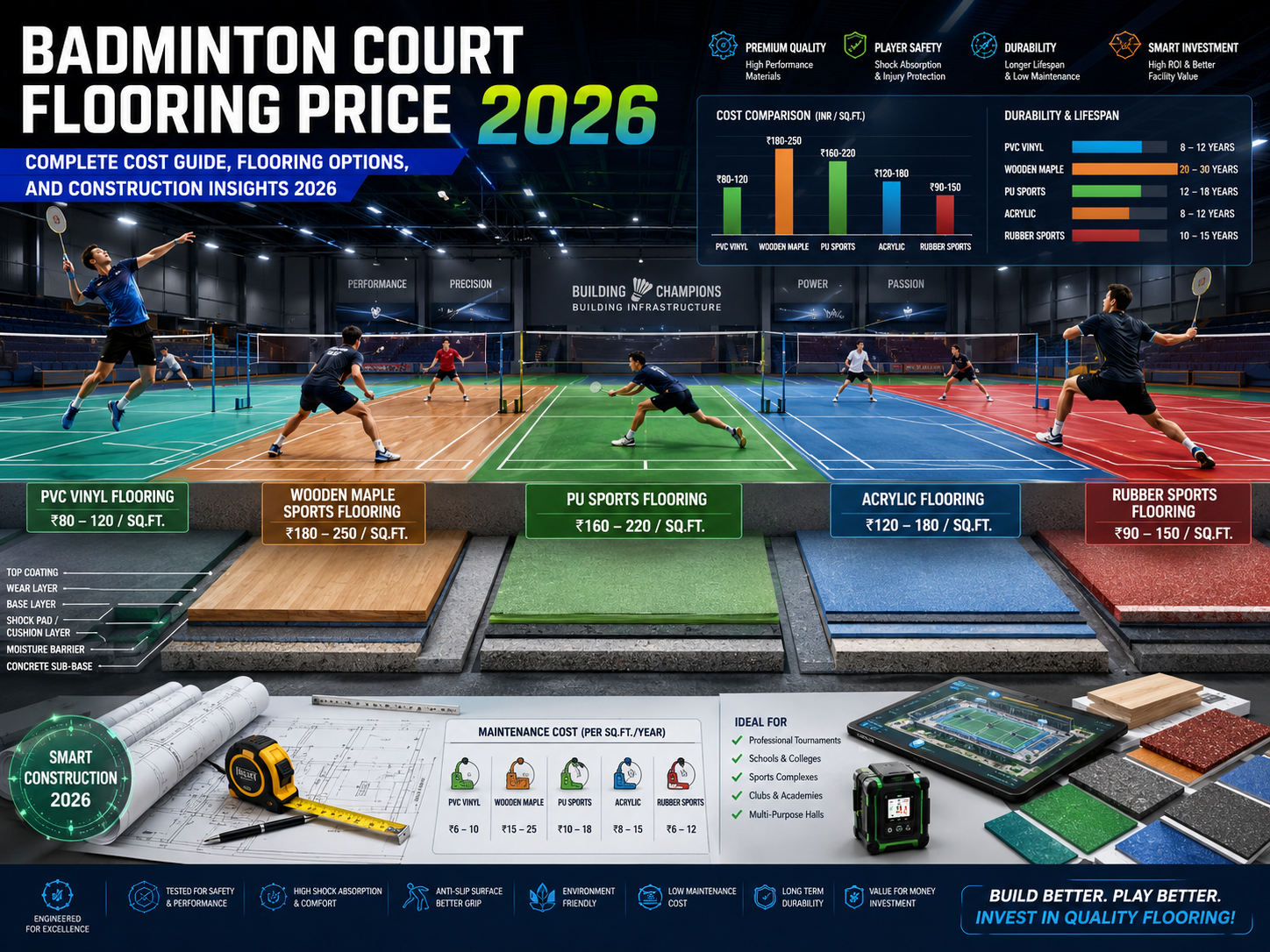
The badminton court flooring cost depends primarily on the selected material, product specifications, and installation requirements. The following table provides indicative project-level estimates for a single court.
| Flooring Type | Approximate Cost Per Court |
|---|---|
| Acrylic Flooring | ₹3.5–₹6 lakh |
| PVC Synthetic Flooring | ₹4.5–₹7.5 lakh |
| Rubber Sports Flooring | ₹6–₹9 lakh |
| PU Sports Flooring | ₹6–₹10 lakh |
| Wooden Sports Flooring | ₹7–₹12 lakh or more |
These prices are approximate and may vary according to flooring thickness, brand, surface preparation, labour, transportation, taxes, and project location. The final quotation should be prepared after evaluating the actual site conditions and flooring specifications.
Different Types of Badminton Court Flooring
Selecting the right flooring material is essential for achieving the desired playing experience and ensuring long-term durability. Here are the most commonly considered badminton court flooring options.
1. PVC Synthetic Badminton Court Flooring
PVC synthetic flooring is a popular choice for indoor badminton courts. It is manufactured using multiple layers, with certain systems incorporating cushioning layers to improve comfort and impact absorption.
The flooring is generally supplied in rolls and installed over a properly prepared, smooth, and level concrete or other suitable base. Adhesives and professional joint finishing are used according to the manufacturer’s installation specifications.
Advantages of PVC Flooring:
- Good shock absorption.
- Comfortable playing surface.
- Suitable for regular badminton activities.
- Consistent surface performance.
- Available in different thicknesses.
- Easy routine maintenance.
- Professional appearance.
- Suitable for schools, academies, and sports clubs.
PVC badminton flooring is commonly available in thicknesses ranging from approximately 4.5 mm to 8 mm, depending on the manufacturer and product specification.
Approximate PVC Badminton Flooring Price: ₹4.5 lakh to ₹7.5 lakh per court.
It is a practical option for indoor sports academies, educational institutions, residential communities, and commercial badminton facilities.
2. Wooden Badminton Court Flooring
Wooden flooring is a premium solution for professional badminton facilities and high-end indoor sports complexes. It is valued for its appearance, playing characteristics, and ability to provide a comfortable sports environment.
Professional wooden sports flooring generally includes more than timber boards. Depending on the system, it may incorporate a supporting framework, resilient cushioning components, engineered panels, hardwood boards, and a protective finishing layer.
Benefits of Wooden Flooring:
- Premium appearance.
- Comfortable playing experience.
- Effective impact management.
- Suitable for professional sports environments.
- Long service potential with proper maintenance.
- Appropriate for dedicated indoor sports facilities.
Wooden badminton flooring is commonly considered for professional academies, indoor stadiums, tournament venues, premium clubs, and sports complexes.
Approximate Wooden Flooring Price: ₹7 lakh to ₹12 lakh or more per court.
The final investment depends on the wood species, substructure, cushioning system, finishing, material availability, and installation complexity.
3. PU Sports Flooring
Polyurethane, commonly known as PU flooring, is another suitable option for selected indoor sports facilities. It is generally installed as a multi-layer system over a properly prepared substrate.
Depending on the product, the installation may include primer, cushioning layers, polyurethane coating, and a protective topcoat.
Key Benefits of PU Flooring:
- Seamless surface finish.
- Good elasticity.
- Comfortable playing characteristics.
- Wear-resistant surface options.
- Attractive appearance.
- Easy cleaning.
- Suitable for multi-purpose indoor sports halls.
Approximate PU Flooring Price: ₹6 lakh to ₹10 lakh per court.
PU flooring can be considered for facilities that accommodate badminton alongside other indoor sporting and recreational activities. The product specification should be checked to ensure it is suitable for badminton use.
4. Acrylic Badminton Court Flooring
Acrylic flooring is generally preferred for suitable outdoor badminton courts. It is applied over a prepared hard base using multiple coating layers designed for outdoor conditions.
Outdoor courts are exposed to sunlight, rain, dust, and changing temperatures. Therefore, selecting an appropriate outdoor-grade acrylic system and ensuring proper drainage are important.
Advantages of Acrylic Flooring:
- Suitable for outdoor applications.
- UV-resistant product options.
- Weather-resistant coating systems.
- Available in different colours and textures.
- Relatively easy maintenance.
- Attractive court appearance.
- Economical compared with premium indoor sports flooring.
Approximate Acrylic Flooring Price: ₹3.5 lakh to ₹6 lakh per court.
Acrylic surfaces are commonly considered for schools, residential societies, community sports facilities, and outdoor recreational areas.
5. Rubber Sports Flooring
Rubber sports flooring is known for its cushioning, resilience, and ability to withstand regular use. It can be considered for training areas and multi-purpose sports environments where impact management is an important requirement.
Main Benefits:
- Good cushioning properties.
- Durable material options.
- Slip-resistant surface finishes.
- Comfortable for training activities.
- Available in different thicknesses.
- Suitable for selected multi-purpose facilities.
Approximate Rubber Flooring Price: ₹6 lakh to ₹9 lakh per court.
The actual price depends on the rubber composition, thickness, product quality, installation technique, and site preparation.
Factors Affecting Badminton Court Flooring Cost
Several factors influence the final badminton court flooring quotation. Understanding these elements helps buyers compare suppliers and avoid unexpected expenses.
1. Flooring Material and Quality
The selected material is one of the biggest contributors to the project cost. Acrylic systems are generally economical for outdoor applications, whereas premium PVC, PU, rubber, and wooden systems may require a higher investment.
Product quality, manufacturer specifications, and performance characteristics should always be considered alongside price.
2. Flooring Thickness
Flooring thickness can influence material consumption, cushioning characteristics, and overall cost. Different synthetic sports flooring products are available in different thicknesses to suit specific applications.
A thicker floor is not automatically the best choice. The system should be selected according to the manufacturer’s recommendations and the expected level of court usage.
3. Existing Floor Condition
The existing concrete or other substrate plays an important role in determining installation expenses.
If the base is smooth, dry, level, and structurally sound, preparation costs may be relatively low. However, cracks, uneven surfaces, moisture, damaged concrete, and old coatings may require additional treatment.
Grinding, leveling, crack repairs, and moisture management can increase the total project budget.
4. Court Dimensions and Flooring Area
A standard badminton court measures approximately 13.4 metres by 6.1 metres, equivalent to 44 feet by 20 feet.
However, the total flooring area may be larger because additional space is required around the playing lines for safe movement and circulation.
The overall project cost also depends on the number of courts being installed and the total area covered.
Outdoor courts require attention to drainage, rainwater management, UV exposure, and weather-resistant materials.
These requirements can influence both construction and flooring costs.
6. Installation and Labour Charges
Professional installation is essential for achieving a consistent and durable playing surface. The cost may include material handling, adhesives, surface preparation, installation labour, joint finishing, and court marking.
Always confirm which services are included in the contractor’s quotation.
7. Transportation and Project Location
Transportation, labour availability, material supply, and site accessibility can affect the overall project cost. Prices may differ between metropolitan cities, smaller towns, and remote project locations.
8. Additional Equipment and Accessories
A complete badminton facility may also require nets, posts, LED lighting, seating, protective wall padding, scoreboards, and safety barriers.
These items should be included in the overall project budget and checked separately if they are not part of the flooring package.
Badminton Court Flooring Price Per Square Foot
Many customers prefer to compare flooring options using a per-square-foot rate. For certain PVC badminton flooring specifications, indicative installation rates may range from approximately ₹250 to ₹450 per sq. ft.
However, this is not a universal rate. The final price depends on material quality, thickness, cushioning, installation method, quantity, transportation, taxes, and base preparation.
It is important to understand whether a quoted rate includes only the flooring material or a complete installation package. Comparing detailed specifications provides a more accurate picture of the actual investment.
Badminton Court Flooring Installation Process
Professional badminton flooring installation generally involves the following stages:
1. Site Inspection: The contractor evaluates the available area, floor condition, dimensions, moisture, cracks, and accessibility.
2. Surface Preparation: The base is cleaned, levelled, and repaired wherever necessary. Grinding, crack filling, and moisture treatment may be required.
3. Flooring Installation: The selected material is installed using its recommended method. PVC flooring may require adhesive bonding and joint finishing, while PU and acrylic systems involve multiple coating stages. Wooden flooring requires installation of the supporting and cushioning structure.
4. Court Line Marking: Accurate badminton court markings are applied after the playing surface has been completed.
5. Final Inspection: The completed court is checked for surface finish, level, adhesion, line accuracy, and visible defects.
Following the manufacturer’s installation guidelines is important for achieving the expected flooring performance and service life.
How to Choose the Best Badminton Flooring for Your Budget
The ideal flooring depends on the facility’s purpose, available budget, expected usage, and environmental conditions.
- Outdoor recreational courts: Acrylic flooring can be an economical solution for suitable outdoor locations.
- Schools and residential societies: PVC synthetic flooring can provide a balance of comfort, performance, and maintenance.
- Professional badminton academies: High-quality PVC or suitable wooden sports flooring may be considered according to playing requirements.
- Premium sports complexes: Professional wooden or high-performance synthetic systems can provide a premium playing environment.
- Multi-purpose indoor facilities: PU and selected rubber sports flooring systems may be considered where their specifications support the intended activities.
Before selecting a product, review its technical specifications, warranty, maintenance requirements, and suitability for badminton.
Maintenance Tips for Long-Lasting Badminton Flooring
Regular maintenance helps preserve the appearance and performance of sports flooring.
- Clean the playing surface regularly.
- Remove dust and debris.
- Use suitable non-marking sports shoes.
- Avoid dragging heavy equipment across the floor.
- Clean spills promptly.
- Inspect joints and surface areas periodically.
- Repair damaged sections when required.
- Follow the manufacturer’s cleaning recommendations.
Proper maintenance, combined with professional installation, can help extend the useful life of the flooring system.
What Should Be Included in a Badminton Flooring Quotation?
Before finalising a contractor, request a detailed quotation that clearly mentions:
- Flooring material and brand.
- Product thickness and specifications.
- Total installation area.
- Subfloor preparation requirements.
- Primer and adhesive costs.
- Installation labour.
- Court line marking.
- Transportation charges.
- Applicable taxes.
- Warranty terms.
- Maintenance recommendations.
- Additional equipment, if required.
A detailed quotation makes it easier to compare suppliers and understand the actual project investment.
Conclusion
The badminton court flooring price in India generally ranges from approximately ₹3.5 lakh to ₹12 lakh or more per court, depending on the flooring material, product specifications, installation requirements, and site conditions.
Acrylic flooring is a practical option for suitable outdoor courts, while PVC synthetic flooring is a popular choice for indoor badminton facilities. PU and rubber systems offer additional options for selected sports environments, whereas wooden flooring is generally considered a premium solution for professional facilities.
However, choosing the right flooring involves more than comparing initial prices. Material quality, surface preparation, installation workmanship, playing requirements, and long-term maintenance all contribute to the overall value of the investment.
For the best results, consult an experienced badminton court construction and flooring contractor. A proper site inspection and detailed quotation will help you select a flooring system that matches your budget, facility requirements, and long-term expectations.
FAQs
1. What is the average badminton court flooring price in India?
The approximate cost ranges from ₹3.5 lakh to ₹12 lakh or more per court, depending on the flooring material, quality, installation, and site requirements.
2. Which flooring is best for indoor badminton courts?
PVC synthetic and professional wooden sports flooring are popular indoor options. The right choice depends on the budget, usage, and performance requirements.
3. Which is the cheapest badminton court flooring option?
Acrylic flooring is generally one of the more economical choices for suitable outdoor badminton courts.
4. What is the price of PVC badminton flooring per square foot?
Certain PVC flooring systems may cost approximately ₹250–₹450 per sq. ft. for specified installations. Actual rates vary according to material, thickness, and site conditions.
5. Is wooden badminton flooring better than PVC flooring?
Both have different advantages. Wooden flooring is a premium option for professional sports facilities, while PVC flooring is a popular and practical choice for many indoor badminton courts.
6. Does badminton flooring include court marking?
Court marking may be included in some installation packages and charged separately in others. Confirm this before accepting a quotation.
7. Does badminton court flooring cost include civil work?
Not necessarily. RCC construction, waterproofing, major leveling, and substrate repairs may be charged separately.
8. How long does badminton court flooring last?
Its lifespan depends on material quality, installation, usage, environmental conditions, and maintenance. Properly maintained sports flooring can provide many years of service.
9. Can badminton flooring be installed over an existing concrete floor?
Yes. The concrete base should be structurally sound, sufficiently level, dry, and properly prepared for the selected flooring system.
10. How can I get an accurate badminton court flooring quotation?
Contact a professional sports flooring contractor with details about your location, court dimensions, indoor or outdoor requirements, existing floor condition, and preferred flooring material. A site inspection will help determine the actual project cost.