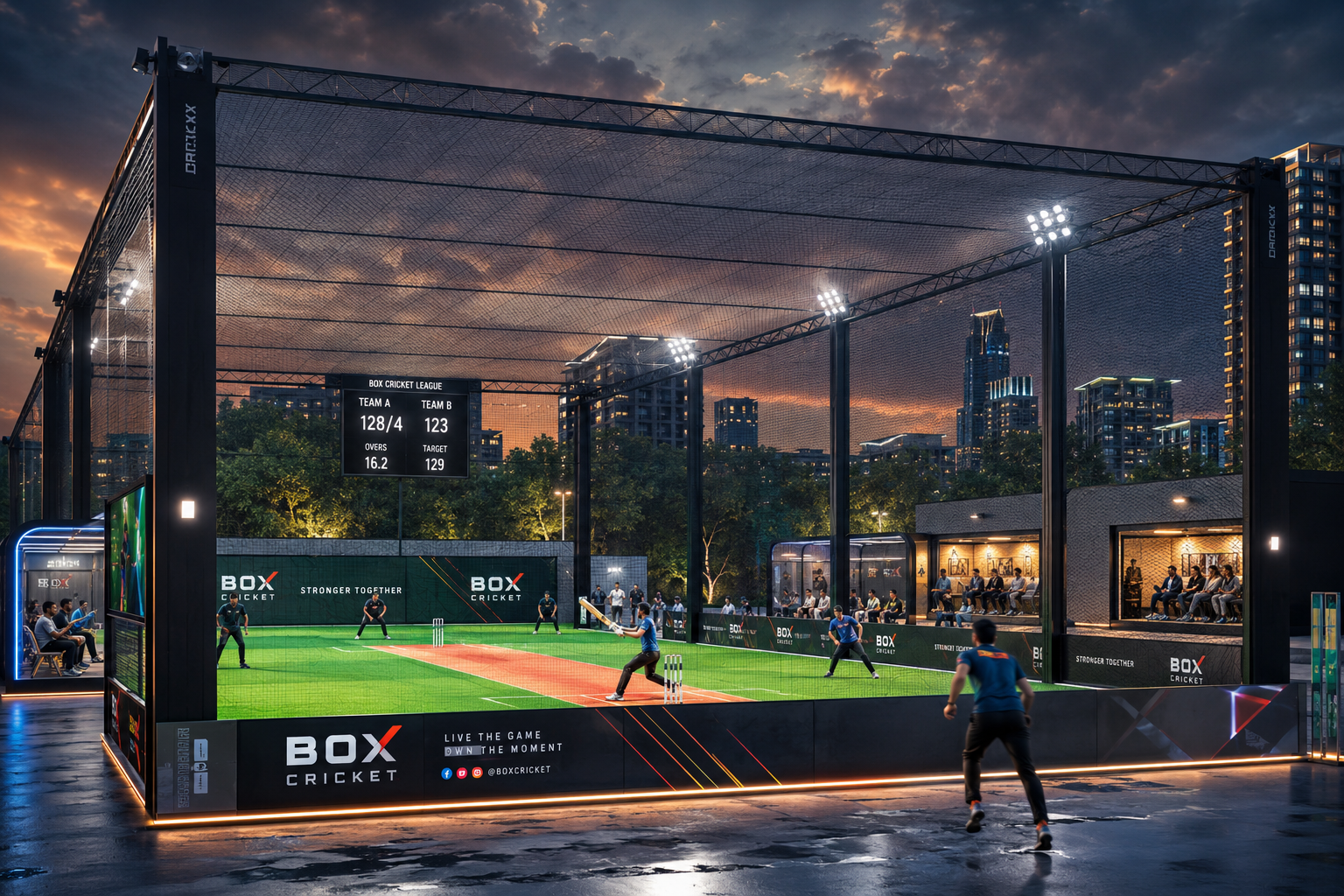
Introduction to Box Cricket Court Construction
Box cricket court construction has emerged as a practical way to create dedicated cricket facilities in places where conventional cricket grounds are difficult to develop. With limited urban land and growing demand for recreational sports, enclosed cricket courts allow schools, residential communities, sports academies, businesses, and commercial facilities to make better use of available space.
A box cricket court is generally designed as a compact, enclosed playing facility with artificial turf, protective netting, structural frames, lighting, and other supporting infrastructure. Its smaller playing area makes it suitable for short-format matches, casual games, training sessions, corporate activities, and organized recreational events.
However, building a durable box cricket court requires more than simply installing turf and nets. Site preparation, drainage, foundation work, structural design, flooring selection, lighting, safety arrangements, and finishing all influence the final quality of the facility.
This guide explains the major stages involved in box cricket court construction, including site planning, civil work, turf installation, net structures, lighting, cost considerations, maintenance, and common applications.
What Is a Box Cricket Court?
A box cricket court is a purpose-built enclosed cricket facility designed for playing a compact version of the game. Instead of the large open field required for conventional cricket, the playing area is surrounded by protective nets or fencing.
The enclosed arrangement keeps the ball inside the designated playing zone and helps maintain a controlled environment. Court dimensions can be adapted according to the available site, intended use, player capacity, and project requirements.
Typical features include:
- Artificial cricket turf
- Steel or galvanized structural framework
- Protective side and roof netting
- Concrete or prepared base
- Drainage arrangements for outdoor facilities
- LED sports lighting
- Entry and exit gates
- Boundary markings
- Safety padding where required
- Seating or spectator areas
Why Box Cricket Courts Are Becoming Popular
The demand for compact sports facilities has increased as available open land becomes more expensive and difficult to utilize in urban locations. Box cricket provides an alternative by allowing cricket activities to be organized within a relatively controlled and compact environment.
Efficient Use of Available Space
A properly designed court can convert an unused plot, commercial space, or institutional area into a functional recreational facility.
Suitable for Short Matches
Box cricket is particularly suitable for people who want to play cricket without committing several hours to a traditional match.
Community Recreation
Residential societies, schools, and clubs can use the facility for regular games, competitions, and community events.
Commercial Applications
Entrepreneurs can develop box cricket facilities for paid bookings, tournaments, coaching sessions, and group activities.
Extended Operating Hours
A suitable lighting system allows the facility to remain operational after sunset, subject to local conditions and applicable requirements.
Planning Before Box Cricket Court Construction
Good planning can significantly influence the performance, safety, and operating cost of a box cricket facility. Before starting construction, the site should be assessed carefully.
Site Inspection and Measurement
The available area should be measured to determine how the playing zone, structural supports, entrance, circulation space, and other facilities can be accommodated.
Important considerations include:
- Available plot dimensions
- Site access
- Existing ground level
- Soil conditions
- Nearby buildings and structures
- Electrical availability
- Water drainage
- Surrounding obstructions
- Intended court capacity
A professional site assessment helps identify potential construction challenges before work begins.
Court Layout and Space Planning
The layout should be prepared according to the available land and expected usage. The design may include the main playing area, safety clearance, net enclosure, entrance gate, player circulation space, spectator seating, changing facilities, and other amenities.
For commercial projects, additional areas may also be considered for reception, waiting zones, washrooms, storage, and equipment.
The final dimensions should be determined according to the project’s purpose rather than applying one fixed size to every site.
Step-by-Step Box Cricket Court Construction Process
1. Site Preparation
Construction begins with preparing the existing ground. Vegetation, debris, loose soil, and unwanted materials are removed from the site.
Depending on the condition of the land, the work may involve:
- Excavation
- Filling
- Level correction
- Soil compaction
- Removal of unsuitable material
- Preparation of construction levels
A properly prepared foundation helps prevent settlement and surface irregularities later.
2. Sub-Base and Foundation Work
The base system provides support to the playing surface and structural components. For outdoor projects, layers of suitable aggregates may be compacted to create a stable sub-base.
Depending on the design, the construction may include:
- Compacted soil
- Aggregate layers
- Stone dust
- Concrete elements
- Reinforcement
- Edge restraints
The exact construction specification should be determined after assessing the site and selecting the final flooring system.
3. Drainage Development
Water management is particularly important for outdoor box cricket facilities.
If rainwater remains on the playing surface, it can affect turf performance, damage the base, and interrupt court usage. Drainage planning should therefore be incorporated into the construction process rather than treated as an afterthought.
Possible drainage provisions include:
- Surface slopes
- Perimeter drains
- Drainage channels
- Subsurface drainage
- Collection points
- Suitable water outlets
The drainage design should account for local rainfall conditions and the surrounding site levels.
Artificial Turf Installation for Box Cricket Courts
Artificial cricket turf is one of the most commonly selected surfaces for box cricket facilities because it provides a consistent playing area and a recognizable cricket appearance
The selection of turf should consider factors such as:
- Turf pile height
- Fiber quality
- Density
- Backing construction
- Shock absorption
- Ball response
- UV resistance
- Drainage characteristics
- Expected playing intensity
The turf should be installed over a properly prepared base to minimize wrinkles, uneven areas, and premature deterioration.
Benefits of Artificial Cricket Turf
- Consistent playing surface
- Attractive appearance
- Reduced dependence on natural grass
- Suitable for frequent recreational use
- Easier routine maintenance
- Can be used in indoor and outdoor applications depending on the system
Box Cricket Court Netting and Structural Framework
The enclosure is a fundamental part of the facility. It keeps cricket balls within the playing area and creates a defined sports environment.
The structural system commonly consists of metal posts, horizontal supports, brackets, anchoring arrangements, and protective netting.
Important Structural Considerations
The framework should be designed according to:
- Court dimensions
- Net height
- Wind exposure
- Net weight
- Structural loading
- Foundation conditions
- Intended usage
- Indoor or outdoor location
For outdoor installations, corrosion protection is particularly important because the structure is exposed to weather conditions.
Cricket Net Selection
The quality and specifications of the net should match the expected usage. Important considerations include:
- Mesh size
- Net strength
- UV resistance
- Knotting or construction quality
- Abrasion resistance
- Installation method
The roof and side nets should be securely attached to the supporting framework so that gaps and loose sections are minimized.
Box Cricket Court Flooring Options
Although synthetic turf is widely associated with box cricket, the appropriate surface depends on the type of facility and its intended purpose.
Synthetic Cricket Turf
A popular choice for dedicated box cricket facilities, particularly outdoor and recreational courts.
PVC or Sports Flooring
Can be considered for certain indoor multi-purpose facilities where cricket is one of several activities.
Acrylic Surface
May be suitable for selected sports applications, although the final choice should depend on the desired ball response and playing format.
Concrete Base
Concrete can function as the structural base beneath the sports surface, but an exposed hard concrete playing surface may not provide the same comfort or playing characteristics as a dedicated sports flooring system.
Lighting for Box Cricket Courts
Lighting is an important component when a facility is intended to operate during evening hours.
LED sports lighting can provide broad and consistent illumination while supporting efficient energy use.
A lighting plan should consider:
- Number of fixtures
- Mounting height
- Light distribution
- Glare control
- Shadow reduction
- Electrical load
- Maintenance access
Lights should be positioned carefully so that players can track the ball without unnecessary glare.
For larger commercial facilities, a professional lighting layout can help achieve more uniform illumination across the playing area.
Safety Features in Box Cricket Court Construction
Player safety should be incorporated into the design from the beginning.
Potential safety provisions include:
- Properly tensioned netting
- Rounded or protected structural edges
- Safety padding around selected posts
- Non-slip playing surfaces
- Adequate clearance
- Secure entrance gates
- Appropriate lighting
- Clearly defined playing boundaries
The design should also provide sufficient movement space and minimize unnecessary collision points.
Additional Facilities for a Modern Box Cricket Court
A basic court can be expanded with supporting infrastructure depending on the project budget and intended audience.
Seating Area
Benches or spectator seating can make the facility more comfortable for visitors.
Changing Rooms
Useful for academies, clubs, and commercial sports facilities.
Washrooms
Important for facilities serving larger numbers of players and visitors.
Reception Area
Commercial facilities may require a reception or booking desk.
Scoreboard
A manual or electronic scoreboard can improve the match experience.
Equipment Storage
Dedicated storage can be provided for bats, balls, protective equipment, maintenance tools, and other sports accessories.
Indoor vs Outdoor Box Cricket Court Construction
The construction approach differs considerably between indoor and outdoor facilities.
| Feature | Indoor Box Cricket | Outdoor Box Cricket |
|---|---|---|
| Weather exposure | Low | High |
| Drainage requirement | Usually limited | Important |
| Roofing | Existing/building roof may be used | Optional or project-specific |
| Lighting | Essential | Essential for night use |
| Structural protection | Lower weather exposure | Corrosion/weather protection required |
| Flooring | Sports flooring/turf options | Synthetic turf commonly used |
| Maintenance | Controlled environment | More exposure to dust, rain and sunlight |
The choice should depend on available land, climate, budget, operating hours, and the intended use of the facility.
Factors Affecting Box Cricket Court Construction Cost
There is no single construction price applicable to every box cricket project. The total investment depends on the specifications selected and the condition of the site.
Major cost factors include:
1. Court Size
A larger playing area requires more turf, framework, netting, foundation work, and lighting.
2. Ground Condition
Uneven or weak soil may require additional excavation, filling, compaction, or foundation work.
3. Turf Specification
Turf quality, pile characteristics, backing, and installation requirements can influence the project budget.
4. Structural Framework
The quantity and specifications of steel members, posts, supports, and protective treatments affect the overall cost.
5. Netting
Net quality, mesh specification, height, roof coverage, and installation complexity contribute to the cost.
6. Lighting
The number, quality, mounting arrangement, and electrical infrastructure of LED fixtures can significantly change the project cost.
7. Additional Amenities
Changing rooms, seating, washrooms, scoreboards, roofing, signage, and other facilities increase the total project investment.
8. Location and Logistics
Transportation, labor availability, site accessibility, and local construction conditions can also affect the final quotation.
For an accurate estimate, the project should be assessed based on actual site dimensions and specifications.
Maintenance of a Box Cricket Court
Regular maintenance helps preserve the appearance, safety, and playing characteristics of the facility.
Artificial Turf Maintenance
Routine turf care may include:
- Removing leaves and debris
- Brushing the turf where required
- Cleaning spills
- Checking high-use areas
- Maintaining infill where applicable
- Inspecting seams and edges
Net Maintenance
The enclosure should be checked periodically for:
- Tears
- Loose sections
- Damaged attachment points
- Sagging
- Structural connection issues
Damaged netting should be repaired promptly.
Drainage Maintenance
Outdoor courts should have drainage channels and outlets inspected and cleaned regularly, particularly before and during the rainy season.
Lighting Maintenance
LED fixtures, wiring, mounting brackets, and electrical connections should be inspected periodically by qualified personnel.
Applications of Box Cricket Courts
Box cricket facilities can be developed for a wide range of users.
- Residential societies
- Schools
- Colleges and universities
- Cricket academies
- Sports clubs
- Corporate campuses
- Hotels and resorts
- Commercial sports centers
- Fitness and recreation facilities
- Community sports spaces
- Private recreational properties
The design can be customized according to the expected number of users and the available site.
Box Cricket Court Construction for Commercial Facilities
Commercial box cricket facilities require additional planning because the court must withstand frequent bookings and regular player traffic.
A commercial project may benefit from:
- Durable turf
- Strong structural framework
- Reliable lighting
- Efficient drainage
- Easy-maintenance surfaces
- Seating areas
- Changing facilities
- Booking/reception area
- Washrooms
- Equipment storage
- Safety provisions
The goal is to create a facility that remains functional and presentable under regular use.
How to Choose a Box Cricket Court Construction Company
Selecting an experienced construction company is an important part of the project.
Before finalizing a contractor, consider:
- Previous sports infrastructure projects
- Turf and flooring experience
- Structural fabrication capabilities
- Installation methodology
- Material specifications
- Site assessment process
- Project timeline
- Warranty and after-sales support
- Maintenance services
- Ability to provide turnkey execution
A professional contractor should be able to explain the proposed construction layers, materials, structural design, flooring system, drainage strategy, and installation process before work begins.
Conclusion
Box cricket court construction combines civil preparation, sports flooring, artificial turf, structural fabrication, net installation, lighting, drainage, and safety planning into a single sports infrastructure project.
The success of the facility depends heavily on selecting appropriate materials and designing every component according to the site and intended usage. A well-prepared base, quality turf, secure enclosure, effective drainage, suitable lighting, and regular maintenance can help create a reliable playing environment.
Whether the project is intended for a residential community, school, sports academy, corporate facility, or commercial sports center, professional planning can help maximize available space while creating an attractive and functional cricket destination.
Frequently Asked Questions About Box Cricket Court Construction
Q1. What is required to construct a box cricket court?
A typical project may require a prepared base, artificial cricket turf, structural framework, protective netting, drainage, lighting, entrance gates, and safety-related components.
Q2. What type of turf is used for box cricket?
Synthetic cricket turf is commonly used. The appropriate turf should be selected according to playing intensity, location, maintenance requirements, and the desired playing characteristics.
Q3. Does an outdoor box cricket court need drainage?
Yes. Proper drainage helps prevent standing water and protects the playing surface and underlying base during wet weather.
Q4. Can a box cricket court be built on a small plot?
Yes. One of the primary advantages of box cricket is its adaptability to relatively compact spaces. The layout should be developed according to the actual site dimensions.
Q5. Can box cricket courts be used at night?
Yes. Suitable LED sports lighting can allow evening and nighttime play while providing appropriate visibility.
Q6. How long does box cricket court construction take?
The timeline depends on site preparation, court size, structural work, flooring, weather, material availability, and project specifications. A site-specific schedule is more reliable than a fixed construction period.
Q7. Is artificial turf easy to maintain?
Artificial turf generally requires less routine maintenance than natural grass, but regular cleaning, brushing, inspection, and timely repairs are still important.
Q8. How much does box cricket court construction cost?
The cost varies according to court dimensions, turf specification, civil work, structural framework, netting, lighting, drainage, location, and additional amenities. A site inspection and detailed specification are recommended for an accurate quotation.