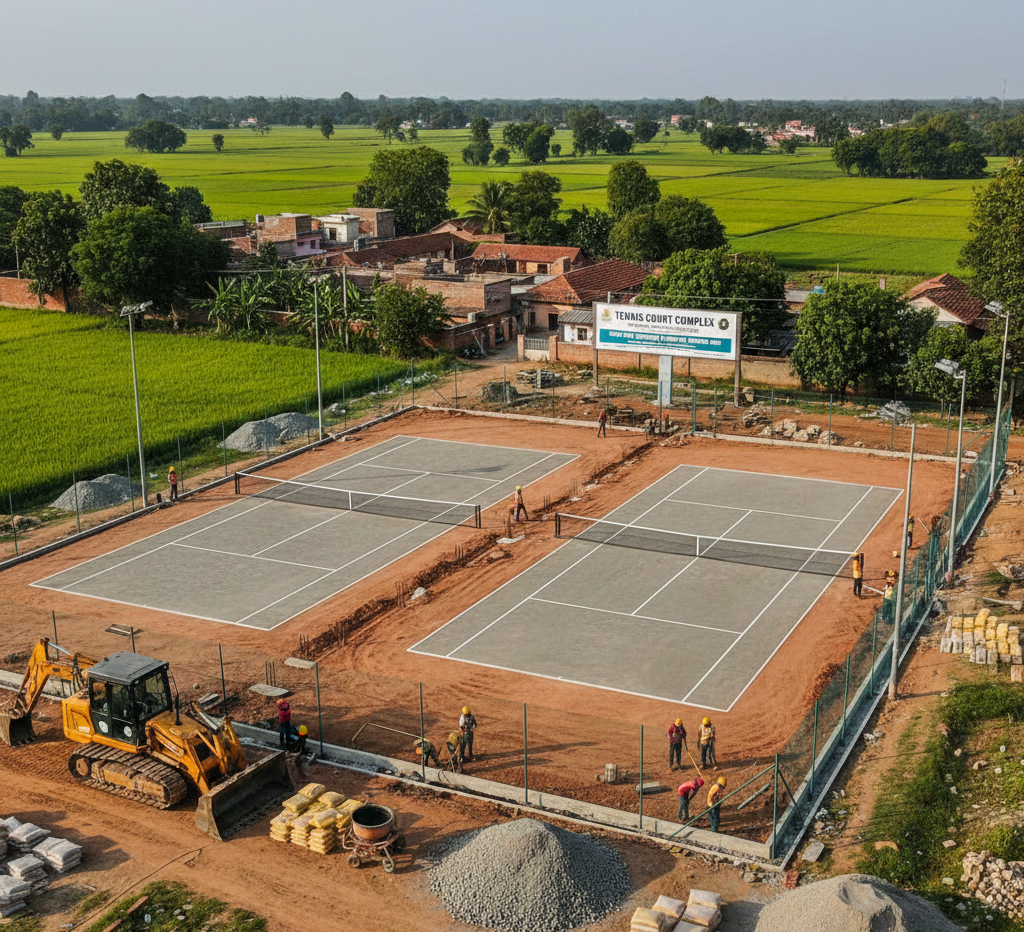
Introduction
Bihar is steadily developing its sports infrastructure as schools, colleges, universities, residential communities, private sports academies, and recreational clubs place greater emphasis on fitness and organised sporting activities. Tennis, known for its combination of speed, agility, endurance, and strategic gameplay, is gaining attention among sports enthusiasts and institutions looking to provide modern playing facilities. As a result, the demand for tennis court construction in Bihar is becoming increasingly relevant for organisations planning new sports infrastructure.
Building a professional tennis court requires much more than preparing a flat piece of land and installing a net. A durable court depends on detailed site assessment, appropriate foundation construction, quality sports flooring, accurate court dimensions, effective drainage, and professional installation. Every component influences the playing experience, safety, maintenance requirements, and long-term performance of the facility.
Sports Facility India offers sports facility construction and flooring solutions for projects with different space requirements, budgets, and intended uses. Whether you are planning a tennis court for a school in Patna, a sports academy in Muzaffarpur, a residential township in Gaya, or a private recreational facility elsewhere in Bihar, selecting the right construction approach is essential to achieving a functional and dependable sports surface.
This guide explains the key aspects of tennis court construction in Bihar, including flooring options, standard dimensions, construction stages, cost considerations, lighting, accessories, maintenance, and contractor selection.
Professional Tennis Court Construction Services in Bihar
A professionally constructed tennis court combines a structurally stable foundation with a suitable playing surface and carefully planned supporting facilities. The design must account for the available land, soil conditions, intended playing level, local weather exposure, and the expected frequency of use.
Professional tennis court construction services can cover the complete process, from initial planning to final inspection. Depending on the project, the scope may include:
- Site inspection and land suitability assessment
- Court layout design and dimensional planning
- Excavation, filling, and soil compaction
- Sub-base preparation and foundation construction
- Concrete or asphalt base installation
- Acrylic tennis court flooring and compatible surface systems
- Synthetic turf or other suitable surface options
- Court line marking and finishing
- Tennis net, net posts, and accessories installation
- Perimeter fencing and protective netting
- LED sports lighting installation
- Surface drainage and water management
- Final quality inspection and maintenance recommendations
A coordinated construction plan helps minimise avoidable errors, improves project management, and ensures that the foundation, flooring, and accessories work together as intended.
Why Is Professional Tennis Court Construction Important?
Investing in professional tennis court construction helps create a playing environment that supports consistent performance and long-term usability. Poor workmanship can result in uneven surfaces, premature cracks, water accumulation, fading markings, and expensive repairs.
1. Accurate Court Dimensions
Correct dimensions are essential for recreational tennis, professional coaching, and competitive matches. A standard tennis court is 78 feet long, with a playing width of 27 feet for singles and 36 feet for doubles.
In addition to the marked playing area, sufficient space must be provided around the court for player movement, safety, fencing, and access. Proper layout planning helps prevent space constraints and supports comfortable gameplay.
2. Strong Foundation and Structural Stability
The foundation is one of the most important elements of a tennis court. The construction team must assess the soil, existing ground levels, and drainage conditions before determining the appropriate base design.
Depending on the site and selected flooring system, construction may involve compacted aggregate layers followed by a concrete or asphalt base. Correct preparation helps reduce settlement, surface irregularities, and structural defects.
3. Effective Drainage for Bihar’s Weather
Bihar experiences hot summers and seasonal monsoon rainfall. Outdoor tennis courts must therefore be designed to manage rainwater effectively and reduce the risk of waterlogging.
A suitable drainage strategy may include carefully planned surface gradients, appropriate runoff arrangements, and additional drainage infrastructure where required. The final design should reflect the site’s elevation, soil characteristics, and the selected court surface.
4. Player Comfort and Safety
The right tennis court flooring can influence traction, ball bounce, movement, and playing comfort. Surface selection should be based on the intended users, playing frequency, and desired playing characteristics.
Professional installation also helps ensure that the court surface is even, the markings are accurate, and equipment is securely installed.
5. Long-Term Value
A well-planned court can serve schools, clubs, academies, and residential communities for many years when supported by suitable maintenance. Investing in appropriate materials and construction methods can help reduce avoidable repair costs and protect the overall project investment.
Types of Tennis Court Flooring Available in Bihar
Choosing the right tennis court surface is an important decision because different materials offer different playing characteristics, costs, installation requirements, and maintenance needs.
Acrylic Tennis Court Flooring
Acrylic tennis court flooring is a popular option for schools, colleges, tennis academies, sports clubs, and residential communities. It is generally applied over a properly prepared concrete or asphalt base using a compatible sports coating system.
Key advantages include:
- A professional and attractive playing surface
- Customisable colours and court markings
- Consistent playing characteristics when correctly installed
- Straightforward routine cleaning
- Options for different surface textures and playing speeds
- Suitability for many outdoor sports facilities
Acrylic flooring can be a practical choice for projects seeking a durable, clearly marked court. Its performance depends on the quality of the base, the selected coating system, installation conditions, and regular maintenance.
Synthetic Turf Tennis Courts
Synthetic turf tennis courts provide a grass-like appearance and may suit recreational facilities, private properties, selected schools, and sports clubs.
Potential benefits include an attractive finish and a different style of playing experience. However, synthetic turf does not perform identically to natural grass or acrylic hard courts. Its suitability depends on the turf specification, infill requirements, drainage design, and intended frequency of use.
Before installation, project owners should evaluate the expected ball response, player traction, maintenance requirements, and overall suitability for their intended tennis activities.
Clay Tennis Court Construction
Clay courts offer distinctive playing characteristics, often producing slower gameplay and a higher bounce than many hard-court systems. They may be suitable for specialised training facilities and players who prefer traditional clay-court tennis.
However, clay surfaces usually require more regular maintenance than acrylic courts. Depending on the system, maintenance may involve brushing, levelling, moisture management, and replenishing surface material.
Clay court construction is best considered where the owner has suitable maintenance resources and understands the requirements of the selected surface.
Cushioned Tennis Court Flooring
Cushioned tennis court systems incorporate resilient layers designed to provide a different level of playing comfort from conventional hard courts. They may be considered for sports academies, clubs, and facilities that prioritise player comfort.
The level of cushioning, ball response, and surface performance varies according to the selected system. A compatible base and professional installation are essential for achieving the intended result.
Concrete and Asphalt Tennis Court Bases
Concrete and asphalt are commonly used as structural foundations for suitable tennis court systems. They provide a base over which a compatible sports surface can be installed.
The choice between them depends on engineering requirements, ground conditions, drainage, local weather exposure, and the manufacturer’s specifications for the selected flooring. The structural base and finished playing surface should be planned as parts of one complete system.
Standard Tennis Court Dimensions and Space Requirements
Correct dimensions are necessary for a functional tennis court. According to standard tennis court measurements, the marked playing area has the following dimensions:
- Court length: 78 feet or 23.77 metres
- Singles court width: 27 feet or 8.23 metres
- Doubles court width: 36 feet or 10.97 metres
- Net height at the centre: 3 feet or approximately 0.914 metres
- Net height at the posts: 3 feet 6 inches or approximately 1.07 metres
The total land requirement is larger than the marked playing area. Additional space is needed behind the baselines and along the sidelines to accommodate movement, safety margins, fencing, and access.
The required footprint depends on the intended use and applicable facility specifications. Competitive facilities may require larger run-off areas than compact recreational projects. A site survey is recommended before finalising the design.
Step-by-Step Tennis Court Construction Process in Bihar
A structured construction process helps maintain quality, manage resources, and reduce the possibility of future defects.
Site Inspection and Planning
The project begins with an assessment of the proposed location. Contractors evaluate the land dimensions, soil condition, ground levels, accessibility, nearby structures, and existing drainage.
The intended use must also be established. A court for a private residence may have different requirements from a school facility, professional coaching centre, or sports complex.
Court Design and Orientation
The construction team prepares a layout that includes the marked court, surrounding safety areas, access points, fencing, lighting, and any spectator facilities.
A north-south orientation is often considered for outdoor tennis courts to reduce direct sunlight interference. However, the final alignment should reflect the available site and surrounding structures.
Excavation and Ground Preparation
The site is prepared through excavation, filling, levelling, and compaction as required. Unsuitable soil or unstable areas may require additional treatment before the foundation is installed.
The required preparation depends on the actual ground conditions rather than a universal construction specification.
Sub-Base and Foundation Construction
Suitable foundation layers are installed to support the selected court system. This may involve compacted aggregates and a concrete or asphalt base, depending on the engineering design.
The foundation should provide the required stability, surface regularity, and drainage characteristics. Poor base construction can affect the finished flooring and increase future repair requirements.
Drainage and Base Preparation
For outdoor courts, surface gradients and drainage arrangements are planned to direct water away from the playing area.
Before flooring installation, the base must meet the chosen system’s requirements for moisture condition, cleanliness, surface integrity, and levelness.
Sports Flooring Installation
The selected flooring system is installed according to its technical specifications. Acrylic courts may require compatible primers, resurfacing compounds, textured coatings, and finishing layers.
Synthetic turf, clay, and cushioned systems each have their own installation procedures. Materials should be applied under suitable conditions to achieve the required finish and performance.
Line Marking and Accessories
Accurate measurements are used to apply the tennis court markings. Net posts and nets are installed at the appropriate positions, while fencing and gates are fitted according to the approved layout.
All equipment should be checked for secure installation and safe positioning.
Lighting and Final Quality Inspection
If evening play is required, sports lighting should be planned to provide appropriate visibility and control glare. Electrical installations must meet relevant safety requirements.
Before handover, the completed facility should be checked for surface finish, markings, drainage, equipment, and general workmanship.
Tennis Court Construction Cost in Bihar
The cost of tennis court construction in Bihar varies according to the size of the project, flooring system, ground conditions, and additional facilities.
For preliminary budgeting, the following figures may be used as broad planning estimates rather than verified current market quotations:
- Basic outdoor hard court: approximately ₹12 lakh to ₹18 lakh
- Premium acrylic or selected synthetic surface project: approximately ₹20 lakh to ₹30 lakh
- Indoor tennis facility with lighting and additional amenities: ₹40 lakh or more, depending on the building and project scope
Actual costs may fall outside these ranges. An indoor facility, for example, may require a substantial building structure, roof, foundations, electrical systems, ventilation, and other infrastructure in addition to the tennis court itself.
The major factors affecting tennis court construction costs include:
1. Site preparation: Excavation, filling, soil improvement, and compaction requirements affect the initial civil work.
2. Foundation materials: The type and specification of concrete, asphalt, and sub-base layers influence structural costs.
3. Flooring selection: Acrylic, cushioned, synthetic turf, and clay systems have different material and installation expenses.
4. Drainage requirements: Additional drainage infrastructure may be necessary depending on the site and local rainfall exposure.
5. Fencing and accessories: Net posts, nets, gates, perimeter fencing, and protective netting increase the overall budget.
6. Lighting installation: LED sports lights, poles, wiring, and electrical work contribute to the project cost.
7. Additional amenities: Seating, landscaping, spectator areas, pathways, and changing rooms can increase the total investment.
8. Transportation and labour: Material availability, site access, and project location can influence installation costs.
For an accurate estimate, request a detailed quotation based on a site inspection. The quotation should identify civil work, foundation construction, flooring, accessories, lighting, taxes, warranty terms, and any excluded work.
Tennis Court Construction for Schools, Academies and Residential Projects
Professional tennis court construction can support a variety of sports and recreational projects throughout Bihar.
Schools and Colleges
Educational institutions can develop tennis courts to support physical education, extracurricular activities, student training, and inter-school competitions. Flooring selection should reflect the age of the players, expected usage, available budget, and maintenance resources.
Tennis Academies and Sports Training Centres
Tennis academies need functional playing surfaces, accurate court markings, secure fencing, and appropriate lighting where evening sessions are planned. The selected surface should support the academy’s training requirements and intended playing standards.
Residential Societies and Private Villas
Residential communities and private property owners can incorporate tennis courts into recreation areas and lifestyle amenities. Effective space planning is particularly important where land availability, neighbouring buildings, and access requirements must be balanced.
Sports Clubs, Hotels and Resorts
Hotels, resorts, and sports clubs may use tennis courts to provide recreational opportunities for members and guests. Surface quality, lighting, maintenance access, and the overall facility layout should be considered together.
Government and Institutional Sports Facilities
Institutional sports projects require careful planning, durability, and maintenance considerations. Court specifications should reflect the relevant project brief, tender requirements, and applicable technical guidelines.
Tennis Court Lighting, Fencing and Essential Accessories
A tennis court requires supporting infrastructure to provide a safe and practical playing environment.
Tennis Court Lighting
LED sports lighting can support evening training and recreational matches. Lighting design should account for court size, pole positions, illumination uniformity, glare control, and nearby residential properties.
Indoor facilities require suitable lighting distribution to reduce shadows and maintain clear visibility throughout the playing area.
Perimeter Fencing
Fencing helps keep tennis balls within the court area and provides a defined boundary. Fence height and specifications should be selected according to the facility layout, intended use, and relevant safety requirements.
Nets and Net Posts
The tennis net should be installed at the correct height and tension. Net posts must be securely positioned to maintain alignment and withstand normal use.
Seating and Spectator Areas
Schools, clubs, and academies may benefit from benches, shaded seating, and designated spectator areas. These features should be positioned to avoid interfering with player movement and court access.
How to Choose the Best Tennis Court Contractor in Bihar
Choosing an appropriate construction company is essential for achieving a dependable result. Before appointing a contractor, consider the following points:
- Experience: Review previous sports infrastructure projects and experience with tennis court flooring.
- Construction quality: Ask how the contractor prepares the ground, constructs the base, and manages drainage.
- Material specifications: Request product details for the proposed surface and supporting materials.
- Transparent pricing: Ensure the quotation explains the scope of work, inclusions, exclusions, and payment terms.
- Project supervision: Confirm how site progress, workmanship, and quality checks will be managed.
- Warranty conditions: Obtain written details of applicable material and workmanship warranties.
- Maintenance support: Ask about future repairs, cleaning recommendations, and resurfacing options.
- Technical compliance: Verify that the court dimensions, net arrangement, and surface specifications are appropriate for the intended playing level.
For competitive facilities, consult relevant International Tennis Federation guidance and any additional requirements applicable to the intended events. Any claim of certification or approval should be supported by appropriate documentation.
Tennis Court Maintenance and Long-Term Care
Regular maintenance helps protect the playing surface and preserve the original construction investment. Maintenance requirements vary according to the flooring material, usage frequency, weather exposure, and manufacturer’s recommendations.
Recommended maintenance practices include:
- Remove dust, leaves, and debris regularly.
- Clean the surface using suitable methods and approved products.
- Inspect the court for cracks, coating wear, and uneven areas.
- Check drainage arrangements, especially after heavy rainfall.
- Inspect the net, posts, fencing, gates, and lighting equipment.
- Repair surface defects before they become more extensive.
- Renew faded court markings when necessary.
- Arrange professional resurfacing when the condition of the playing surface requires it.
Acrylic courts may need periodic recoating, but the appropriate interval depends on the product system, traffic, climate, and maintenance history. Regular inspections are more reliable than following a fixed resurfacing schedule without considering the court’s actual condition.
Why Consider Sports Facility India for Tennis Court Construction in Bihar?
Developing a tennis court involves several connected activities, from civil work and surface preparation to flooring installation and accessories. A coordinated approach helps property owners understand the project scope and plan the different construction stages.
Sports Facility India provides sports facility construction and flooring solutions for projects with varying requirements. For a proposed tennis court in Bihar, the design and installation scope should be evaluated according to the site, selected flooring system, available budget, and intended use.
Before finalising a project, discuss the following details:
- Site assessment and recommended court layout
- Suitable flooring options for the intended application
- Foundation and drainage specifications
- Court accessories, fencing, and lighting requirements
- Estimated project timeline and construction stages
- Material specifications and quality checks
- Warranty terms and maintenance recommendations
- Detailed project pricing and exclusions
A clear scope of work and a site-specific quotation help establish realistic expectations and support better project coordination.
Conclusion
The demand for tennis court construction in Bihar reflects the growing importance of sports infrastructure, recreational facilities, and organised athletic training. From schools and universities to private villas, residential communities, sports academies, and clubs, professionally constructed tennis courts can provide valuable spaces for fitness, coaching, and recreation.
The success of a tennis court project depends on several essential factors, including accurate dimensions, a stable foundation, effective drainage, suitable flooring, secure accessories, and a practical maintenance plan. Selecting materials and construction methods according to the site and intended use helps reduce avoidable problems and improve the long-term value of the facility.
Sports Facility India can be considered for sports construction and flooring requirements based on your project’s scope and technical needs. Whether you are planning a new outdoor hard court, a cushioned playing surface, or a larger sports facility, start with a thorough site assessment and a clearly defined construction plan.
With the right planning, quality materials, professional installation, and consistent maintenance, a tennis court can become a lasting asset for its owners and users while contributing to the continued development of sports infrastructure across Bihar.
Frequently Asked Questions (FAQs) – Tennis Court Construction in Bihar
1. Who provides tennis court construction services in Bihar?
Sports construction companies offering tennis court services can assist with court planning, site preparation, foundation construction, sports flooring, line marking, fencing, lighting, and accessories. Review the contractor’s experience, technical proposal, and quotation before making a decision.
2. How much does tennis court construction cost in Bihar?
The cost depends on the flooring type, base construction, drainage, site conditions, fencing, lighting, and additional amenities. Basic outdoor court projects may be budgeted at approximately ₹12 lakh to ₹18 lakh, while premium projects may cost more. These figures are indicative only; obtain a current quotation for your site.
3. What is the standard size of a tennis court?
A standard tennis court measures 78 feet in length, 27 feet in width for singles, and 36 feet in width for doubles. Additional surrounding space is needed for player movement, access, and safety.
4. Which tennis court flooring is best for Bihar?
Acrylic hard court flooring is a common option for outdoor tennis facilities because it provides a defined playing surface and can be installed in different colour combinations. The final choice should account for budget, site drainage, playing requirements, and maintenance expectations.
5. How long does it take to construct a tennis court in Bihar?
Construction may take several weeks, depending on site conditions, weather, foundation requirements, flooring installation, and material availability. Projects involving substantial civil work or indoor building construction may take longer. The contractor should provide a schedule based on the actual scope.
6. Is drainage necessary for tennis court construction?
Yes. Effective drainage helps manage monsoon rainfall and reduce water accumulation around the court. Drainage design should be based on the ground levels, soil conditions, selected surface, and overall site layout.
7. Can tennis courts be constructed for schools and residential societies?
Yes. Courts can be planned for schools, colleges, residential townships, private villas, sports clubs, and academies. The design should reflect available land, anticipated usage, budget, and required safety areas.
8. Can an existing badminton court be converted into a tennis court?
Conversion is possible only if the site provides sufficient space and the existing base is suitable. A tennis court requires a substantially larger playing area than a standard badminton court, along with appropriate surrounding run-off space. A site inspection is necessary to determine feasibility.
9. What is the best base for an outdoor tennis court?
Concrete and asphalt are commonly used for suitable tennis court systems. The best option depends on soil conditions, engineering requirements, drainage, selected flooring, and the manufacturer’s specifications.
10. Are synthetic tennis courts suitable for schools and academies?
Synthetic surface systems may be suitable for selected schools and training facilities. The particular product should be assessed for traction, ball response, durability, maintenance needs, and suitability for the intended playing level.
11. Do tennis court construction companies provide maintenance services?
Some contractors offer maintenance, repairs, and resurfacing in addition to construction. Confirm the availability of these services and the applicable warranty conditions before entering into an agreement.
12. How can I obtain a quotation for tennis court construction in Bihar?
Prepare the project location, approximate land dimensions, preferred flooring, intended use, and required amenities. Arrange a site assessment where necessary and request a detailed quotation covering civil work, foundation, flooring, drainage, accessories, lighting, taxes, and exclusions.