Introduction
Badminton is one of the most popular sports in India, enjoyed by people of different age groups and skill levels. From school students and fitness enthusiasts to professional players, more people are taking an interest in the game. As a result, schools, colleges, sports academies, residential societies, and private clubs are investing in well-designed badminton facilities.
Building a badminton court involves more than simply preparing a flat surface and installing a net. The right flooring, accurate court measurements, proper lighting, ventilation, and sufficient playing space all contribute to a comfortable and safe playing experience. This is why choosing an experienced badminton court construction company in India is important when planning a new sports facility.
Professional badminton court builders understand the technical requirements involved in designing and constructing courts for different purposes. Whether you need a single court for a school, several courts for a sports academy, or a complete indoor badminton facility, an experienced contractor can help you select the right materials and manage the construction process.
In this guide, we will discuss the services provided by badminton court construction companies in India, available court flooring options, standard dimensions, construction costs, installation procedures, and important points to consider before hiring a contractor.
What Do Badminton Court Construction Companies in India Do?
Badminton court construction companies handle the planning, design, installation, and development of badminton facilities. Their services may cover everything from initial site inspection to final court markings and equipment installation.
Depending on the project, a contractor may provide complete construction services or take responsibility for specific requirements such as sports flooring, civil work, or court accessories.
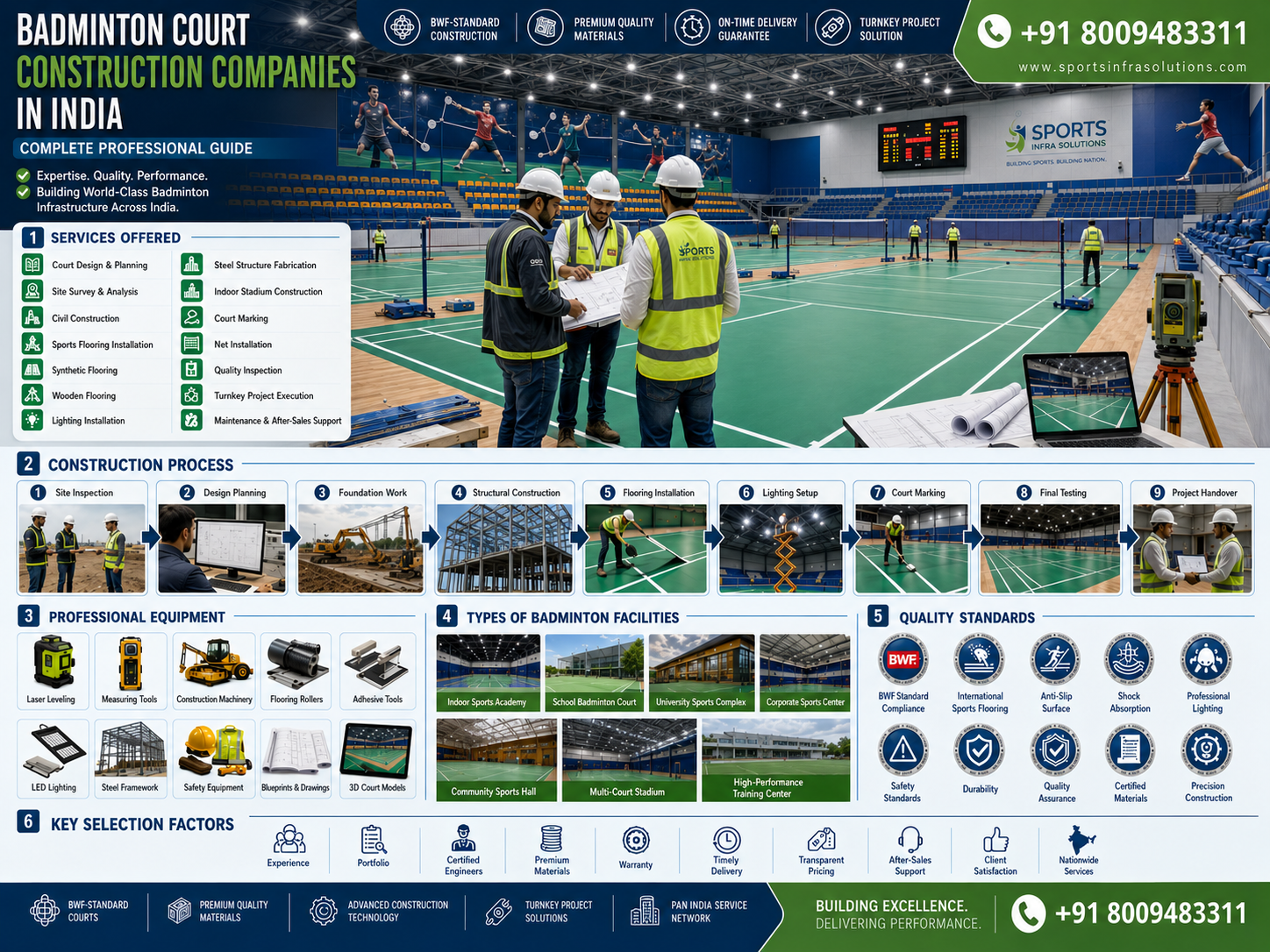
Some of the major services offered by professional badminton court builders include:
- Site inspection and planning: Checking the available space, ground condition, drainage, and overall project requirements before construction begins.
- Court design and layout: Preparing the court layout according to standard badminton dimensions and the intended use of the facility.
- Sports flooring installation: Supplying and installing suitable PVC, wooden, synthetic, or other sports flooring systems.
- Civil construction: Handling ground preparation, levelling, foundation work, and concrete installation.
- Lighting and ventilation: Planning suitable lighting and airflow arrangements, particularly for indoor badminton facilities.
- Equipment installation: Installing badminton nets, posts, court markings, and other necessary accessories.
- Repair and maintenance: Providing flooring repairs, surface inspections, line marking, and renovation services.
Hiring a specialist contractor makes it easier to manage these different requirements and maintain consistency throughout the project.
Services Offered by Professional Badminton Court Builders
1. Site Inspection and Project Consultation
The first step in any badminton court project is understanding the site and the client’s requirements. Before suggesting a construction method, professionals inspect the available area and check whether the location is suitable for the proposed facility.
For outdoor courts, particular attention is given to ground conditions, surface levelling, water drainage, and exposure to weather. For indoor projects, contractors also examine the existing flooring, roof structure, ceiling height, ventilation, and lighting arrangements.
Based on this assessment, the company can suggest a suitable court design, flooring material, construction method, and estimated project budget.
2. Badminton Court Design and Layout
A properly designed badminton court provides enough room for players to move freely and play comfortably. The layout must include the playing area, service lines, boundary markings, net position, and additional space around the court.
A standard badminton court is 13.40 metres long. The width is 6.10 metres for doubles matches and 5.18 metres for singles matches.
However, these measurements cover only the playing area. Additional space is needed around the court to allow players to move safely without coming into contact with walls, columns, or other obstacles.
For indoor badminton facilities, the design should also consider ceiling clearance, lighting positions, ventilation, and the location of structural supports. Proper planning at this stage helps prevent space-related problems after construction.
3. Badminton Court Flooring Installation
Flooring is one of the most important parts of badminton court construction. It directly affects how players move, maintain balance, change direction, and absorb impact while playing.
Different flooring systems are available depending on the type of facility, budget, and expected level of use.
Common options include:
- PVC sports flooring: A widely used choice for indoor badminton courts because of its cushioned construction, consistent playing surface, and relatively easy maintenance.
- Synthetic sports flooring: Available in different specifications for indoor sports applications, depending on performance and installation requirements.
- Wooden sports flooring: Often selected for premium indoor courts and competition facilities where shock absorption and playing performance are important.
- Acrylic sports flooring: Suitable for selected outdoor badminton courts when applied over a properly prepared base.
- Concrete base with sports coating: An economical option for certain recreational facilities, provided the final surface offers appropriate traction and safety.
The right flooring should be selected after considering player requirements, installation conditions, maintenance costs, and the expected lifespan of the facility.
4. Civil Work and Base Preparation
A badminton court needs a strong and properly levelled foundation to support the flooring system. If the base is uneven or affected by moisture, it can lead to surface damage and other problems over time.
Depending on the site, civil work may include excavation, ground levelling, foundation preparation, concrete work, drainage arrangements, and moisture protection.
For indoor courts, contractors first check the existing floor for strength, level differences, and moisture conditions before installing the selected sports flooring.
Proper coordination between civil construction and flooring installation is essential for achieving a stable and durable court.
5. Badminton Net, Posts, and Court Marking
Once the playing surface is ready, the next step is installing the required badminton equipment and court markings.
This includes positioning the net and posts correctly and marking the singles and doubles boundaries, service areas, and other playing lines.
As per standard badminton specifications, the net height is 1.55 metres at the posts and 1.524 metres at the centre. Court markings should be accurate, clearly visible, and consistent throughout the playing area.
Depending on the facility, additional equipment may include umpire chairs, player benches, protective padding, scoreboards, and storage facilities.
6. Indoor Lighting and Ventilation
Good lighting is essential for indoor badminton because players regularly look upward to follow the shuttlecock. If the lighting is too dim, uneven, or produces glare, it can make the game difficult and uncomfortable.
Professional contractors can help plan LED lighting systems with suitable placement and brightness distribution. Lighting should be arranged according to the ceiling height, number of courts, and intended use of the facility.
Ventilation is another important consideration. A busy badminton hall can become warm, particularly when several players are training at the same time. Proper airflow helps maintain comfortable conditions. Depending on the building size, mechanical ventilation or air-conditioning may also be required.
7. Court Maintenance, Repair, and Renovation
Regular maintenance helps keep a badminton court in good playing condition. Over time, flooring can experience wear due to frequent movement, dust, moisture, and everyday use.
Professional maintenance services may include:
- Inspection of the playing surface.
- Repair or replacement of damaged flooring sections.
- Renewal of court markings.
- Replacement of worn-out nets and posts.
- Cleaning and maintenance recommendations.
- Inspection of lighting and other installed equipment.
Addressing small problems early can prevent more expensive repairs and help extend the useful life of the court.
Types of Badminton Courts Constructed in India
Badminton courts are built in different designs depending on the available space, budget, and purpose of the facility. The most common options include indoor courts, outdoor courts, multi-court facilities, and modular courts.
Indoor Badminton Courts
Indoor badminton courts are commonly developed in schools, colleges, sports academies, clubs, and commercial sports centres.
One of their biggest advantages is that players can enjoy the game without being directly affected by rain or sunlight. Indoor facilities also make it easier to control lighting, ventilation, and other playing conditions.
These courts generally feature PVC or wooden sports flooring, suitable ceiling clearance, LED lighting, and proper ventilation.
For facilities offering regular coaching, training, or tournaments, indoor courts are often a practical choice.
Outdoor Badminton Courts
Outdoor badminton courts are suitable for residential societies, parks, schools, resorts, and recreational areas.
Compared with a complete indoor facility, an outdoor court may require less investment because it does not necessarily need a roof or enclosed building. However, the surface still needs proper preparation and drainage.
Acrylic sports flooring is one option for outdoor applications, provided the base and coating system are suitable for badminton.
It is also important to consider wind, sunlight, rainwater drainage, and surface temperature. Since wind can affect shuttlecock movement, outdoor courts are generally more appropriate for recreational games than high-level competitive matches.
Multi-Court Badminton Facilities
Sports academies and commercial badminton centres often require multiple courts within a single facility.
These projects need careful planning to ensure that every court has sufficient playing space, safe movement areas, and suitable lighting. Designers may also need to account for spectator seating, reception areas, changing rooms, washrooms, and circulation routes.
A properly planned multi-court facility can accommodate coaching programmes, tournaments, group training sessions, and paid court bookings.
Modular and Portable Badminton Courts
Modular badminton flooring is another option for selected indoor venues, particularly where flexibility is important.
These systems consist of flooring sections or panels that can be installed over a suitable existing base. Depending on the product, they may also be removed, relocated, or reconfigured when required.
Before selecting modular flooring, check its suitability for badminton, surface stability, grip, shock absorption, and overall playing performance.
Standard Badminton Court Dimensions and Space Requirements
Getting the measurements right is an important part of badminton court construction. The playing area must follow standard dimensions to ensure that the court is suitable for regular games and training.
The commonly used standard measurements are:
| Court specification | Standard measurement |
|---|---|
| Court length | 13.40 metres |
| Doubles court width | 6.10 metres |
| Singles court width | 5.18 metres |
| Net height at the posts | 1.55 metres |
| Net height at the centre | 1.524 metres |
| Short service line distance from the net | 1.98 metres |
These dimensions represent the actual playing area, not the complete space required for construction.
Additional clearance must be provided around the court so that players can move comfortably and safely. Indoor facilities also need adequate unobstructed height above the playing area.
If the court is being developed for tournaments or professional competitions, it is advisable to confirm the latest facility requirements with the relevant badminton governing body before finalising the design.
Choosing the Right Badminton Court Flooring
The flooring material you choose can make a noticeable difference to the playing experience and maintenance requirements of a badminton court.
There is no single flooring option that suits every facility. The best choice depends on whether the court is indoors or outdoors, how frequently it will be used, and the performance expected by players.
PVC Synthetic Sports Flooring
PVC sports flooring is a popular option for indoor badminton courts in schools, clubs, sports academies, and commercial facilities.
Quality sports-grade PVC flooring is designed to provide cushioning, traction, and a reasonably consistent surface for regular play. It is also available in different thicknesses and product specifications.
Before purchasing, check the material quality, wear layer, overall thickness, shock absorption, installation requirements, and manufacturer’s maintenance recommendations.
Wooden Sports Flooring
Wooden sports flooring is generally preferred for premium indoor badminton facilities and selected competition venues.
A properly designed wooden sports floor can provide good shock absorption and playing characteristics. However, it requires suitable subfloor preparation, moisture control, and regular maintenance.
Although the initial investment may be higher than some synthetic flooring options, it can be a worthwhile choice for facilities where playing performance is a priority.
Acrylic Sports Flooring
Acrylic flooring is commonly considered for outdoor badminton courts and certain recreational sports facilities.
It is applied over a prepared base and is available in different coating systems. When installed correctly, it can provide a durable and relatively easy-to-maintain surface.
The selection process should consider weather exposure, drainage, traction, surface consistency, and the intended level of play.
Concrete and Coated Surfaces
Concrete is often used as the base for badminton court construction, particularly in projects where budget is an important consideration.
However, an ordinary concrete surface should not automatically be treated as a suitable sports floor. A bare concrete surface can be too hard for regular badminton activities.
If this option is being considered, make sure that the final coating or sports surface provides appropriate grip and playing characteristics.
Badminton Court Construction Cost in India
The cost of building a badminton court in India depends on several factors, including flooring material, site conditions, civil work, building requirements, and additional facilities.
For initial budgeting, the following figures provide an indicative idea of possible construction costs.
| Court type | Indicative estimated cost |
|---|---|
| Basic concrete-base court | ₹2–4 lakh |
| Outdoor acrylic court | ₹4–7 lakh |
| Indoor synthetic flooring court | ₹6–10 lakh |
| Indoor wooden sports flooring court | ₹8–12 lakh or more |
Note: These figures are approximate planning estimates, not confirmed market rates or contractor quotations. Actual costs may vary depending on the location, material specifications, labour charges, and project requirements.
It is also important to understand what is included in the quoted amount. A price covering only the playing surface will be very different from the cost of developing a complete indoor badminton facility with roofing, structural work, lighting, and other infrastructure.
Factors That Influence Construction Cost
Several elements can affect the final badminton court construction budget.
1. Flooring material: PVC, wooden, acrylic, and other sports flooring systems have different material and installation costs.
2. Site preparation: Excavation, levelling, foundation work, concrete preparation, and drainage can increase the overall project cost.
3. Indoor building requirements: Structural steel, roofing, walls, ceiling height, and ventilation can account for a significant part of the investment.
4. Lighting and electrical work: The number of courts, LED lighting specifications, wiring, and electrical installations also affect the budget.
5. Equipment and amenities: Nets, posts, umpire chairs, benches, scoreboards, changing rooms, and washrooms add to the total expenditure.
6. Location and transportation: Labour availability, material transportation, site accessibility, and local construction rates vary across different parts of India.
Additional Expenses to Consider
Apart from the playing surface and basic construction, a badminton facility may require additional spending on lighting, electrical systems, ventilation, seating, accessories, transportation, taxes, and future maintenance.
When requesting quotations, ask contractors to provide a detailed cost breakdown. It should clearly mention the material brands, flooring specifications, civil work, installation charges, warranty coverage, and payment schedule.
This makes it easier to compare different proposals and understand the actual value offered by each company.
How to Choose the Best Badminton Court Construction Company in India
Choosing the right construction company is just as important as selecting the flooring material. A contractor with relevant experience can help you avoid common construction mistakes and make better decisions about the overall facility.
Here are a few things worth checking before finalising your contractor.
Check Relevant Project Experience
Start by looking at the company’s experience in badminton court construction. General construction experience is useful, but sports flooring and court development require additional technical knowledge.
Ask to see photographs, videos, and references from completed projects. If possible, visit an existing court developed by the company to check the actual workmanship.
Evaluate Flooring Quality
Do not select a flooring system based only on its price or appearance.
Ask the contractor for product specifications, technical details, installation procedures, and maintenance guidelines. Check whether the proposed material is suitable for the intended playing environment and expected usage.
Confirm Technical Standards
Make sure the contractor understands standard court dimensions, service lines, net height, and required safety clearances.
For professional or tournament-level facilities, discuss the applicable technical requirements before construction begins.
Request a Detailed Cost Breakdown
A professional quotation should clearly explain what the project includes.
Check the costs of materials, labour, civil work, flooring installation, lighting, accessories, and transportation. Also ask about items that are excluded from the quotation.
A detailed estimate helps avoid unexpected expenses during construction.
Review Warranty and After-Sales Support
Before signing an agreement, understand the warranty offered on the flooring material and installation work.
Ask whether the company provides maintenance services, repair support, and replacement assistance if problems occur after handover.
Reliable after-sales support can be particularly valuable for academies and commercial sports centres that use their courts regularly.
Assess Communication and Project Management
A good contractor should be able to explain the project clearly, including the construction schedule, material selection, site preparation, quality checks, and handover process.
Clear communication throughout the project helps avoid misunderstandings and keeps the work organised.
Benefits of Hiring Professional Badminton Court Construction Companies
Working with an experienced badminton court construction company offers several advantages, particularly when developing a facility for regular use.
Some important benefits include:
- Proper project planning: Professional guidance helps ensure that the available space, court dimensions, and site conditions are considered before work begins.
- Suitable flooring selection: Experienced contractors can recommend flooring systems according to the facility’s requirements and budget.
- Better player safety: Attention to surface quality, traction, court clearance, and equipment positioning helps create a safer playing environment.
- Coordinated construction: Civil work, flooring, lighting, and equipment installation can be managed as part of a planned process.
- Long-term value: Proper materials and installation can reduce the risk of premature surface damage and unnecessary repair expenses.
- Maintenance assistance: Professional contractors may also provide guidance and support for regular maintenance and future renovation.
The final results naturally depend on the contractor’s experience, the quality of materials, and the standard of work carried out at the site.
Latest Trends in Badminton Court Construction in India
The demand for better sports facilities is encouraging construction companies and facility owners to consider new materials, technologies, and management solutions.
Some developments worth considering include:
Advanced Sports Flooring Systems
Sports flooring manufacturers are introducing products designed to offer improved traction, cushioning, and durability.
Facility owners are also becoming more careful about comparing technical specifications instead of selecting products based only on colour or appearance.
Energy-Efficient LED Lighting
LED lighting is increasingly preferred for indoor badminton halls because of its energy efficiency and long service life compared with many older lighting systems.
A properly designed lighting arrangement can also help reduce glare and provide more uniform visibility across the playing area.
Multi-Sport Facilities
Schools, residential communities, and commercial sports operators are showing interest in facilities that can accommodate more than one sporting activity.
However, each sport has different surface requirements. Therefore, multi-sport facilities need careful planning to ensure that the selected flooring remains suitable for the intended activities.
Better Facility Management
Technology is also becoming a useful part of managing badminton centres.
Online court booking, digital access systems, electronic scoreboards, and facility management software can help commercial operators organise daily activities and improve the customer experience.
Focus on Durability and Maintenance
More facility owners are recognising that long-term performance depends on proper construction and regular maintenance.
Better drainage, moisture protection, suitable flooring specifications, and timely repairs can help reduce maintenance problems and protect the initial investment.
Who Needs Badminton Court Construction Services?
Badminton court construction services are useful for different types of organisations and property owners looking to develop or improve their sports infrastructure.
Some common examples include:
- Schools and colleges: For providing students with better opportunities to participate in sports and physical activities.
- Badminton academies: For creating dedicated courts for coaching, practice, and player development.
- Sports clubs: For upgrading existing facilities and improving playing conditions.
- Residential societies: For adding recreational sports facilities for residents.
- Hotels and resorts: For offering indoor or outdoor badminton as part of their recreational amenities.
- Fitness centres: For expanding their services with dedicated badminton facilities.
- Commercial sports operators: For developing pay-and-play badminton centres and multi-court facilities.
- Government institutions: For improving sports infrastructure and supporting local sporting activities.
Each project should be designed according to its users, available space, expected usage, and investment capacity.
Conclusion
With badminton becoming increasingly popular across India, the need for well-planned and properly constructed courts is growing. Schools, colleges, sports academies, residential communities, and commercial operators are all looking for reliable ways to develop quality badminton facilities.
Choosing the right badminton court construction company is an important part of this process. From the initial site inspection and civil work to flooring installation, court markings, lighting, and equipment fitting, every stage plays a role in the final quality of the facility.
Before selecting a contractor, take time to review their previous projects, flooring specifications, construction experience, pricing, warranty, and after-sales services. It is also important to choose materials that match the expected playing intensity and available maintenance budget.
Whether you are planning a single recreational court or a complete indoor badminton centre, proper planning and professional installation can help create a facility that remains useful and enjoyable for years.
If you are considering a new project or want to upgrade an existing court, explore professional badminton court construction services to learn about suitable flooring options and construction solutions.
Frequently Asked Questions (FAQs)
1. How much does it cost to build a badminton court in India?
The cost depends on the flooring type, site condition, civil work, and additional facilities. A basic court may cost a few lakh rupees, while a fully equipped indoor badminton facility can require a considerably higher investment. It is best to request an itemised quotation based on your actual project requirements.
2. Which flooring is best for a badminton court?
PVC synthetic sports flooring and engineered wooden flooring are commonly used for indoor badminton courts. Acrylic sports flooring can be considered for suitable outdoor applications. The right option depends on the playing level, available budget, location, and maintenance requirements.
3. How long does badminton court construction take?
The construction period depends on the project size, site preparation, material availability, and weather conditions. Installing flooring over an already prepared base generally takes less time than developing a complete indoor badminton facility. Your contractor should provide a project-specific timeline.
4. What are the standard dimensions of a badminton court?
A standard badminton court is 13.40 metres long. The width is 6.10 metres for doubles matches and 5.18 metres for singles matches. Additional clearance is required around the playing area to allow players to move safely.
5. Can a badminton court be constructed outdoors?
Yes. Outdoor badminton courts can be developed using suitable sports surfaces, including acrylic coatings installed over a properly prepared base. However, drainage, wind conditions, sunlight, and weather exposure should be considered during planning.
6. Do badminton court construction companies provide flooring installation?
Yes. Many specialist badminton court construction companies provide flooring supply and installation services. Depending on the contractor, the work may also include base preparation, court markings, equipment installation, and finishing.
7. What should I check before hiring a badminton court contractor?
Check the company’s experience, completed projects, flooring quality, technical knowledge, quotation details, warranty terms, and after-sales support. Make sure that the complete scope of work is clearly mentioned in the agreement.
8. Is a separate building required for an indoor badminton court?
Not necessarily. An existing hall may be suitable if it has enough floor space, adequate ceiling height, proper ventilation, suitable lighting, and a structurally safe building. A new building may be required if the existing space does not meet these conditions.
9. Are badminton court maintenance services necessary?
Yes. Regular cleaning, surface inspections, timely repairs, and equipment checks help maintain playing quality. Proper maintenance can also reduce the chances of major flooring damage and extend the court’s useful life.
10. How can I get a quotation for badminton court construction in India?
To receive an accurate quotation, share your project location, number of courts, indoor or outdoor requirements, preferred flooring type, available site dimensions, and approximate budget with the construction company.
Providing these details helps the contractor understand your requirements and prepare a more suitable project estimate.