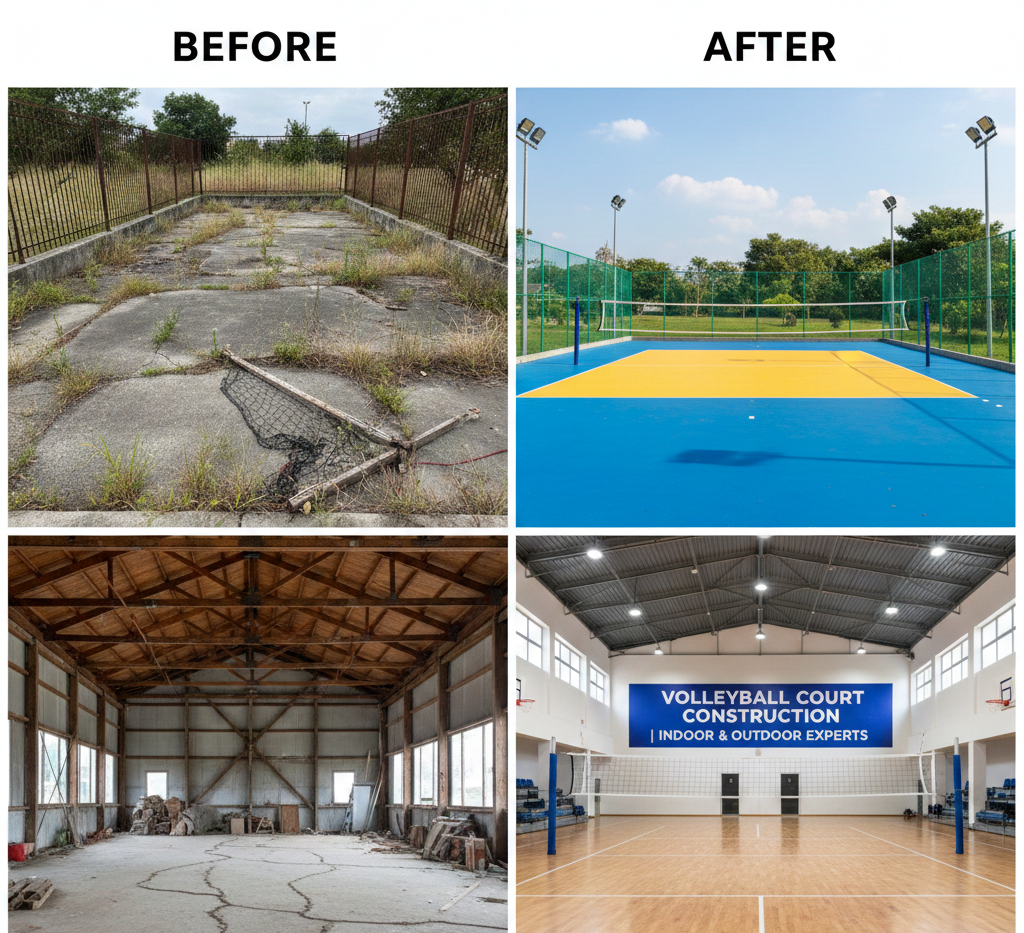
Volleyball is a popular sport played in schools, colleges, sports academies, clubs, stadiums, and residential communities. As interest in recreational and competitive sports continues to grow, the demand for professionally constructed volleyball courts is increasing across India. A well-designed court provides a safe playing environment, supports player development, and ensures consistent performance.
Volleyball court construction involves several important stages, including site selection, layout planning, base preparation, flooring installation, court marking, equipment setup, lighting, and maintenance. Choosing the right construction method and materials is essential for creating a durable, functional, and high-performance sports facility.
At Sports Facility India, volleyball court construction solutions can be planned according to available space, intended usage, site conditions, and project requirements. Whether you are developing an indoor volleyball court, an outdoor recreational facility, or a professional training venue, proper planning helps deliver a reliable playing surface.
This guide covers everything you need to know about volleyball court construction, including standard dimensions, court types, flooring materials, construction steps, equipment, maintenance, and estimated costs in India.
1. Planning and Site Selection for Volleyball Court Construction
Proper planning is the foundation of successful volleyball court construction. Before starting the project, the site should be evaluated to determine whether it can accommodate the playing area, safety zones, supporting facilities, and required equipment.
Important Site Selection Factors
- Available space: Select an area that accommodates the standard court dimensions and adequate clearance around the playing area.
- Ground condition: Ensure the site can support a stable, level base suitable for the selected flooring system.
- Court orientation: Consider sunlight direction and glare when planning an outdoor volleyball court.
- Drainage system: Provide effective drainage to prevent water accumulation and surface damage.
- Accessibility: Ensure convenient access for players, coaches, spectators, and maintenance personnel.
- Lighting and utilities: Plan electrical connections, lighting arrangements, and other essential services where required.
- Future expansion: Consider additional courts, spectator seating, changing rooms, and other facilities if needed.
The intended purpose of the facility also influences the design. School courts, residential community courts, sports academies, and tournament venues may require different flooring systems, safety provisions, and supporting infrastructure.
2. Standard Volleyball Court Dimensions
Following recognized volleyball court specifications helps create a playing area suitable for training, recreational games, and competitive matches.
The standard indoor volleyball court measures 18 metres in length and 9 metres in width. A centre line divides the court into two equal halves measuring 9 metres by 9 metres.
Standard Volleyball Court Specifications
- Court length: 18 metres
- Court width: 9 metres
- Each team’s court area: 9 metres × 9 metres
- Attack line: 3 metres from the centre line on each side
- Net height for men’s volleyball: 2.43 metres
- Net height for women’s volleyball: 2.24 metres
- Net width: Approximately 1 metre
- Free zone: At least 3 metres around the playing court under standard basic requirements
- Indoor free playing space: At least 7 metres high under standard basic requirements
Professional competitions may require larger free zones and greater overhead clearance depending on the applicable competition regulations. Always verify the latest FIVB requirements and event-specific specifications before construction.
Accurate measurements, clearly defined boundaries, and adequate clearance contribute to safe gameplay and help players move freely during matches.
3. Types of Volleyball Courts
Volleyball courts can be designed for indoor or outdoor use. The appropriate construction method depends on the environment, budget, expected usage, and performance requirements.
A. Indoor Volleyball Courts
Indoor volleyball courts are commonly constructed in schools, colleges, sports complexes, stadiums, and professional training centres.
Common flooring options include:
- Wooden sports flooring
- Synthetic vinyl sports flooring
- Polyurethane sports flooring
- Other approved indoor sports surface systems
Benefits of indoor volleyball courts:
- Greater control over weather conditions
- Consistent playing surface
- Better control of lighting and playing conditions
- Suitability for regular training and organized competitions
- Opportunities for multi-sport facility development
Indoor facilities should also include suitable ventilation, adequate ceiling clearance, and appropriate lighting to support player comfort and performance.
B. Outdoor Volleyball Courts
Outdoor volleyball courts are suitable for residential societies, schools, recreational parks, resorts, and sports clubs.
Common options include:
1. Outdoor sand volleyball courts
Sand courts are designed primarily for beach volleyball and recreational sand-based play. The sand should be appropriately selected, prepared, and maintained to provide suitable cushioning and safe movement.
2. Grass volleyball courts
Grass courts can be an economical option for casual games and recreational activities. They require regular mowing, irrigation where necessary, and surface checks to maintain safe playing conditions.
3. Synthetic outdoor courts
Synthetic sports surfaces can be considered for selected outdoor applications. The flooring system must be suitable for outdoor exposure, drainage requirements, intended sports use, and local weather conditions.
Choosing the right outdoor court type helps balance performance, installation costs, durability, and maintenance requirements.
4. Step-by-Step Volleyball Court Construction Process
A systematic construction process helps achieve accurate dimensions, a stable base, and a durable playing surface.
Site Inspection and Layout Planning
The project begins with a site survey to evaluate available space, soil conditions, ground levels, access, and drainage. The court layout is then prepared according to the intended use and applicable dimensions.
Ground Preparation and Levelling
For outdoor projects, the ground may require clearing, excavation, grading, and compaction. Indoor projects require inspection of the existing floor or structural base to determine whether repairs or additional preparation are necessary.Step 3: Base Construction
A suitable base is essential for long-term court performance. Depending on the design, the construction may involve a prepared subgrade, compacted aggregate, concrete base, or another engineered foundation.
The base should provide adequate stability, levelness, and drainage where applicable.
Flooring Installation
The selected flooring is installed after the base has been prepared and inspected. Installation requirements differ according to the surface system.
- Wooden flooring requires an appropriate sports floor assembly.
- Synthetic flooring requires a compatible, properly prepared substrate.
- Outdoor synthetic surfaces must be selected for the intended environmental conditions.
- Sand courts require suitable sand, appropriate depth, and effective drainage.
The flooring system should be selected according to the expected level of play, player safety requirements, budget, and maintenance needs.
Court Boundary Lines and Markings
The playing area is marked according to the applicable volleyball specifications. Standard boundary lines are generally 5 cm wide and should contrast clearly with the playing surface.
The centre line, attack lines, end lines, and sidelines must be accurately positioned. Marking materials should be compatible with the flooring and provide suitable traction.
Net Posts and Equipment Installation
Install the net, posts, antennae, and other required equipment. Posts must be securely anchored and positioned correctly, with protective padding where necessary.
Lighting and Safety Inspection
For indoor and evening-use outdoor courts, lighting should be designed to provide suitable, uniform illumination with minimal glare. Inspect the playing surface, equipment stability, boundary markings, clearances, and other safety provisions before opening the court.
Final Quality Check and Handover
The completed court should undergo a final inspection to verify dimensions, surface condition, equipment installation, and overall readiness. Any identified defects should be addressed before the facility is handed over for use.
5. Volleyball Court Flooring Options
Flooring selection is one of the most important decisions in volleyball court construction. The right surface supports player movement, traction, comfort, and consistent gameplay.
Wooden Sports Flooring
Wooden sports flooring is commonly used for indoor professional courts and established sports facilities. A properly designed sports floor can provide consistent playing characteristics and suitable shock absorption.
Synthetic Vinyl Flooring
Synthetic vinyl sports flooring is an option for indoor courts that require a uniform, easy-to-clean surface. Depending on the product specification, it may incorporate cushioning and wear-resistant layers.
Polyurethane Sports Flooring
Polyurethane flooring systems may be suitable for selected indoor or outdoor sports applications, provided the product is designed for the intended environment and playing requirements.
Sand Flooring
Sand is the primary playing surface for beach volleyball. The sand quality, depth, drainage, and maintenance programme should be carefully considered during construction.
The best volleyball court flooring depends on the application, performance requirements, subfloor conditions, budget, and expected maintenance. Flooring specifications should be checked against the requirements of the relevant sport and competition level.
6. Volleyball Court Equipment and Lighting
A complete volleyball court requires appropriate equipment and supporting facilities to ensure safe and effective use.
Net and Posts
The volleyball net should be installed at the appropriate height for the intended category of play. Posts should be stable, properly positioned, and protected with suitable padding where necessary.
Antennae
Antennae are attached to the net at the sidelines to help define the crossing space for the ball. They should be installed according to the applicable volleyball rules.
Court Lighting
Lighting requirements depend on whether the facility is intended for recreation, training, or competition. The lighting design should provide even illumination, minimize glare, and avoid distracting shadows.
Professional competition facilities may require higher illumination levels than recreational courts. A qualified lighting designer should determine the appropriate lux level for the intended use.
Additional Facilities
Depending on the project, additional features may include:
- Scoreboards
- Referee stands
- Team benches
- Spectator seating
- Perimeter fencing
- Changing rooms
- Storage areas
- First-aid facilities
These features can be incorporated during the planning stage to improve usability and support future facility requirements.
7. Volleyball Court Maintenance
Regular maintenance helps preserve the playing surface, protect equipment, and reduce avoidable repair costs.
Indoor Wooden Courts
Clean the surface according to the manufacturer’s instructions. Inspect for damage, moisture, worn finishes, loose components, and changes in playing characteristics. Use suitable maintenance products and avoid excessive moisture.
Indoor Synthetic Courts
Remove dust and debris regularly, clean with approved products, and inspect seams, surface wear, and damaged areas. Follow the flooring manufacturer’s cleaning recommendations.
Sand Courts
Rake and level the sand regularly, remove debris, check sand depth, and inspect the drainage system. Replace or replenish sand when necessary.
Grass Courts
Maintain appropriate grass height, inspect for uneven ground, manage weeds, and address drainage problems. The playing surface should remain sufficiently even for safe movement.
Outdoor Synthetic Courts
Remove leaves and debris, inspect the surface for damage, and check drainage after rainfall. Use cleaning methods recommended for the specific flooring system.
A planned inspection schedule helps identify problems early and extends the useful life of the facility.
8. Comparing Volleyball Court Types
The following comparison provides a general overview. Actual performance and costs depend on the product, construction quality, climate, and usage.
| Factor | Indoor Wooden | Indoor Synthetic | Outdoor Sand | Outdoor Grass | Outdoor Synthetic |
|---|---|---|---|---|---|
| Typical use | Indoor training and competition | Indoor recreational and training use | Beach volleyball | Casual recreation | Selected outdoor sports uses |
| Initial investment | Generally high | Varies by system | Varies by site and sand requirements | Often lower | Varies by system |
| Maintenance | Regular specialist care | Routine cleaning and inspections | Frequent levelling and cleaning | Regular groundskeeping | Cleaning and surface inspections |
| Weather exposure | Protected indoor environment | Primarily indoor use, unless specifically rated otherwise | Outdoor exposure | Outdoor exposure | Depends on product specification |
| Surface characteristics | Designed for indoor sports performance | Depends on cushioning and product design | Soft, sand-based playing surface | Natural grass | Depends on the selected system |
The ideal option should be selected after reviewing the project requirements, site conditions, available budget, and intended level of play.
9. Volleyball Court Construction Cost in India
The cost of volleyball court construction in India varies according to the court type, site condition, flooring system, and supporting infrastructure. A recreational outdoor sand court will generally have different cost requirements from a covered indoor facility with professional sports flooring.
Factors Affecting Construction Cost
- Site preparation and excavation
- Soil conditions and foundation requirements
- Concrete or other base construction
- Flooring material and thickness, where applicable
- Drainage and water management
- Net posts, nets, and accessories
- Lighting and electrical work
- Roofing and indoor building requirements
- Perimeter fencing and safety equipment
- Transportation, labour, and project location
For an accurate estimate, the site should be inspected and a detailed bill of quantities prepared. Any preliminary budget should clearly state whether it includes flooring, civil works, lighting, taxes, and other associated expenses.
Sports Facility India can be contacted to discuss project requirements and obtain a quotation tailored to the proposed volleyball court.
10. How to Choose a Volleyball Court Construction Company
Selecting an experienced contractor is important for achieving a reliable and functional sports facility. Before finalizing a volleyball court construction company, evaluate its technical capabilities and project execution process.
Consider the following factors:
- Experience with similar sports construction projects
- Knowledge of volleyball court dimensions and relevant standards
- Quality and suitability of proposed flooring materials
- Site survey and base preparation procedures
- Installation methods and quality-control practices
- Safety provisions and equipment specifications
- Project timeline and cost transparency
- Warranty terms and after-sales support
A professional construction partner should explain the available options, identify site-specific challenges, and recommend a suitable solution based on the project’s intended use.
11. Why Invest in Professional Volleyball Court Construction?
A professionally planned volleyball court provides more than a designated playing area. It creates an organized environment for sports participation, coaching, fitness, and competitive development.
The benefits include:
- A properly measured playing area
- A suitable surface for the intended level of play
- Improved facility usability and organization
- Appropriate equipment placement and safety provisions
- Better long-term maintenance planning
- Opportunities for schools, academies, clubs, and communities to expand sports activities
Investing in quality materials and proper construction methods can help reduce avoidable repairs and support the long-term performance of the facility.
Conclusion
Volleyball court construction requires careful planning, accurate measurements, appropriate flooring, a stable base, and suitable equipment. From outdoor sand courts to indoor wooden and synthetic sports surfaces, every project should be designed according to its intended use, site conditions, budget, and applicable standards.
Whether you are developing a school playground, residential sports facility, training academy, or professional indoor court, choosing the right construction approach is essential for creating a safe and durable playing environment.
Sports Facility India offers a starting point for discussing volleyball court construction requirements, flooring options, and project-specific solutions. Plan your court carefully to create a facility that supports recreational activities, player development, and long-term sports participation.
Frequently Asked Questions About Volleyball Court Construction
1. What is involved in volleyball court construction?
Volleyball court construction typically includes site inspection, layout planning, ground or subfloor preparation, base construction, flooring installation, court marking, equipment installation, and final quality checks. Lighting, drainage, fencing, and spectator facilities may also be included.
2. What are the standard dimensions of a volleyball court?
A standard volleyball court measures 18 metres long and 9 metres wide. The attack line is 3 metres from the centre line on each side. The required free zone and overhead clearance depend on the applicable rules and competition level.
3. What is the standard volleyball net height?
The standard net height is 2.43 metres for men’s volleyball and 2.24 metres for women’s volleyball. The net should be measured at the centre, with installation checked against the applicable rules.
4. Which flooring is best for a volleyball court?
Wooden sports flooring and suitable synthetic sports flooring are common choices for indoor courts. Sand is used for beach volleyball, while grass and selected outdoor-rated synthetic surfaces may be appropriate for recreational outdoor facilities.
5. How much space is required to build a volleyball court?
The playing court requires 18 metres by 9 metres. Additional space is necessary for free zones, access, equipment, and spectator facilities. Larger clearances may be required for professional competitions.
6. How much does volleyball court construction cost in India?
The total cost depends on the court type, site preparation, foundation, flooring, equipment, lighting, and additional facilities. A site assessment and detailed project quotation provide a more reliable estimate than a single standard price.
7. How long does it take to construct a volleyball court?
The timeline depends on the scope of work, site conditions, weather, flooring system, and availability of materials. A simple outdoor court may take considerably less time than a covered indoor facility requiring civil construction, roofing, electrical work, and sports flooring installation.
8. Can a volleyball court be used for multiple sports?
Yes. An indoor court may be designed for multiple sports, such as badminton or basketball, when the flooring, markings, equipment, and available clearances are suitable for each activity.
9. Is drainage necessary for an outdoor volleyball court?
Yes. Proper drainage helps prevent water accumulation, reduces damage to the base and playing surface, and supports safer use after rainfall. Drainage requirements depend on the soil and selected court construction system.
10. What safety measures should be included in volleyball court construction?
Important safety measures include a suitable playing surface, adequate free zones, stable net posts, protective padding where required, clear boundary markings, suitable lighting, and the removal of obstructions from the playing area.
11. Can volleyball courts be customized?
Yes. Courts can be customized according to available space, flooring preference, colour scheme, branding, lighting, fencing, seating, and other facility requirements, subject to applicable sports regulations.
12. How can I get a quotation for volleyball court construction?
Prepare the project location, proposed court type, available area, intended usage, preferred flooring, and any additional requirements. Share these details with Sports Facility India to discuss a suitable construction approach and request a project-specific quotation.