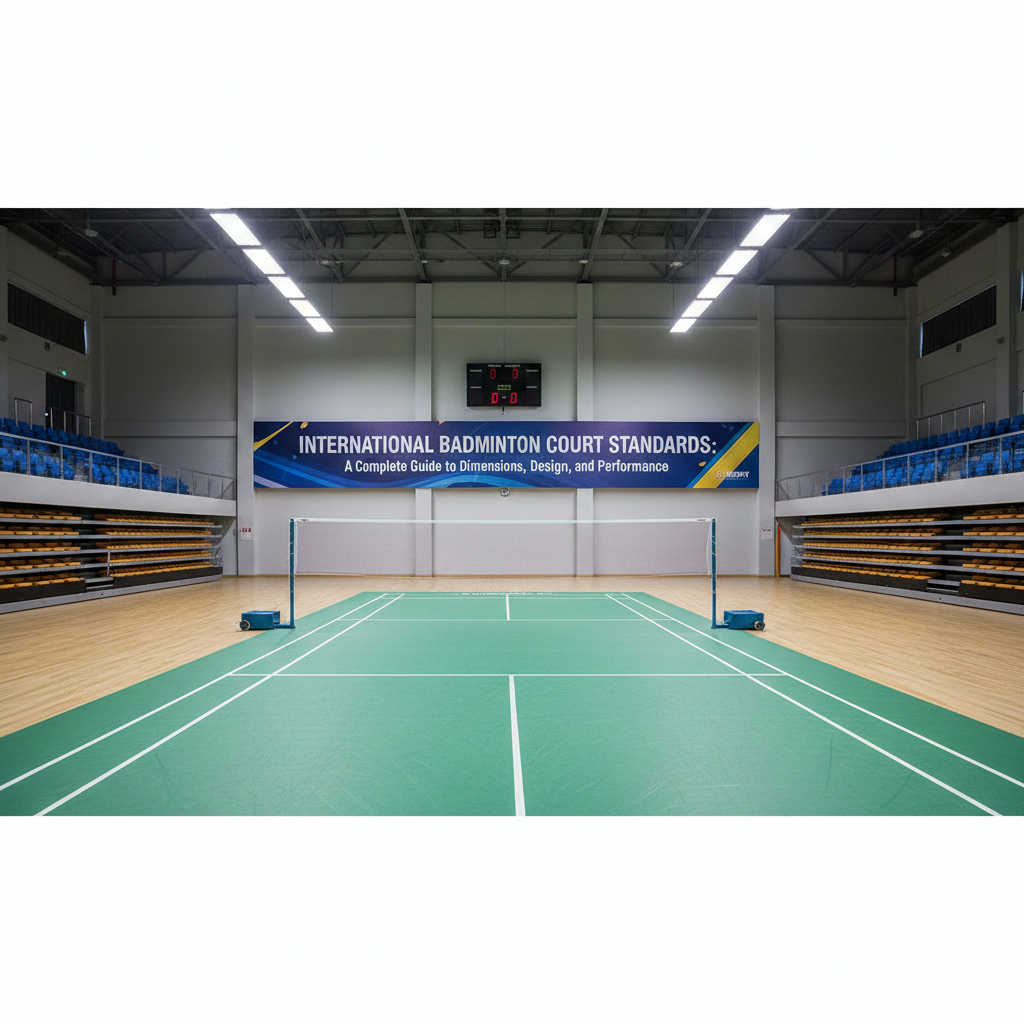
Badminton has become one of the most popular indoor sports worldwide, attracting players from schools, colleges, sports academies, residential communities, clubs, and professional sporting organizations. The game requires quick reflexes, controlled footwork, precise shot placement, and rapid changes in direction. To support these demands, a badminton court must be designed with accurate dimensions, suitable flooring, appropriate lighting, and sufficient space for safe player movement.
International badminton court standardsBadminton Court Flooring in Chhattisgarh: Complete Guide to Choosing the Right Sports Flooring provide a consistent framework for planning, constructing, and maintaining courts for recreational activities, professional training, and competitive events. The Badminton World Federation (BWF) establishes the official technical regulations governing court measurements, boundary markings, net dimensions, and other essential playing requirements.
For anyone planning a new badminton facility, understanding these specifications is an important first step. Proper court planning helps create a dependable playing environment, improves player comfort, and supports the long-term performance of the sports facility. Flooring selection, ceiling clearance, lighting arrangements, ventilation, and surrounding safety zones must also be considered when developing an indoor badminton court.
This comprehensive guide explains the major international badminton court requirements, including official measurements, flooring systems, net installation, lighting, safety clearances, construction considerations, and maintenance practices.
What Are International Badminton Court Standards?
International badminton court standards are technical requirements used to establish consistent playing conditions across different venues. These specifications help ensure that players experience the same court dimensions and essential playing arrangements regardless of where they compete.
The BWF regulations are particularly important for tournament venues and facilities seeking to host recognized competitions. However, schools, sports clubs, private academies, and community facilities can also benefit from following the relevant court design principles.
A properly planned badminton court includes several essential elements:
- Accurate singles and doubles court dimensions
- Clearly visible boundary and service lines
- Correct badminton net height and post positioning
- Suitable sports flooring with appropriate grip and cushioning
- Adequate ceiling height and unobstructed shuttle flight
- Uniform lighting with controlled glare
- Safe clearance around the playing area
- Appropriate ventilation and indoor environmental conditions
- Regular inspection and maintenance
Following these requirements during the design and construction stages can reduce costly modifications and help deliver a functional sports facility.
Standard International Badminton Court Dimensions
Court dimensions are among the most important parts of official badminton court specifications. The overall playing length remains the same for singles and doubles, while the width changes according to the format.
Official Badminton Court Measurements
| Court specification | Official measurement |
|---|---|
| Total court length | 13.40 metres |
| Doubles court width | 6.10 metres |
| Singles court width | 5.18 metres |
| Short service line | 1.98 metres from the net |
| Line width | 40 millimetres |
| Net height at the posts | 1.55 metres |
| Net height at the centre | 1.524 metres |
These measurements describe the playing court itself. The surrounding building footprint must be larger to accommodate safe movement, circulation, equipment, and any additional requirements imposed by the competition organizer.
Singles Badminton Court Dimensions
A singles badminton court measures 13.40 metres in length and 5.18 metres in width. The narrower playing area makes accurate boundary marking especially important.
During singles matches, the inner sidelines define the lateral playing boundaries. The full court length is used, with the applicable short and long service boundaries determining whether a serve is valid.
These dimensions should be established carefully before the flooring is installed or the court lines are applied. Small measurement errors can affect the usability of the court and create confusion during training or competition.
Doubles Badminton Court Dimensions
The standard doubles court has the same length as the singles court but a wider playing area of 6.10 metres. The outer sidelines determine the lateral boundaries during doubles rallies.
Doubles service rules also use a different long service boundary from singles. This distinction must be reflected accurately in the court markings.
Schools, academies, clubs, and commercial sports facilities should plan the layout according to the intended playing formats. Where a facility accommodates both singles and doubles, all relevant lines must be clearly visible and correctly positioned.
Badminton Court Line Marking Standards
Accurate line marking is essential for fair play and correct interpretation of the rules. According to the standard court specifications, badminton lines are 40 mm wide and should be clearly distinguishable from the surrounding surface.
Common court marking colours include white and yellow, although the choice should provide strong contrast against the selected flooring.
The principal court markings include:
- Singles and doubles sidelines
- Back boundary lines
- Short service lines
- Centre lines
- Long service lines for singles and doubles
All boundary lines are considered part of the area they define. Therefore, when the shuttlecock lands on a boundary line, it is treated as landing inside the relevant court boundary.
Professional line marking requires precise measurements, straight edges, and consistent line widths. For PVC sports flooring, markings may be incorporated through suitable installation methods or approved court-marking systems. For other flooring types, the marking method must be compatible with the surface material.
Badminton Net Height and Installation Requirements
The badminton net separates the two halves of the court and directly influences how players execute serves, clears, drops, and attacking shots.
The official net height is 1.55 metres at the posts and 1.524 metres at the centre. This difference creates the specified net profile across the playing area.
Badminton Net Specifications
The net should be made from fine, dark-coloured cord or a suitable approved material, with mesh that prevents the shuttlecock from passing through. Its upper edge must have white tape measuring approximately 75 mm in width, folded over the cord or cable as specified by the regulations.
Net posts must be positioned on the doubles sidelines, regardless of whether the match is singles or doubles. They should remain vertical, secure, and properly aligned.
During installation, the net must be tensioned appropriately so that the centre reaches the required height. Regular checks are necessary because loose fittings, damaged posts, or changes in tension can affect compliance.
For sports facility developers, selecting a durable net system and planning suitable post foundations or approved freestanding supports helps maintain consistent playing conditions.
International Badminton Court Flooring Standards
Badminton flooring plays a major role in player movement, comfort, and injury-risk management. Players repeatedly accelerate, stop, jump, land, and change direction, so the surface must support controlled movement without being excessively slippery or hard.
The appropriate flooring system depends on the facility’s purpose, budget, expected usage, subfloor condition, and competition requirements.
1. PVC and Vinyl Sports Flooring
PVC badminton court flooring is widely considered for indoor sports facilities because it is available in purpose-designed sports flooring systems, including cushioned constructions.
Depending on the product, these systems can provide a textured playing surface, controlled traction, impact absorption, and relatively straightforward maintenance.
PVC sports flooring is commonly selected for badminton academies, schools, indoor stadiums, clubs, and commercial sports centres. However, the performance of individual products varies, so buyers should examine the manufacturer’s technical specifications rather than relying on material type alone.
2. Wooden Sports Flooring
Purpose-designed wooden sports flooring is used in many indoor sports halls and professional venues. A properly engineered system can provide suitable resilience, controlled traction, and a consistent playing surface.
Performance depends on the complete floor construction, including the wood surface, supporting structure, shock-absorbing components, and subfloor preparation.
Wooden flooring requires suitable indoor environmental conditions and regular maintenance to preserve its performance.
3. Polyurethane Sports Flooring
Polyurethane, commonly known as PU, is another option for indoor sports surfaces. Depending on the system design, PU flooring can provide a durable, uniform finish and suitable playing characteristics.
The selected system must be specifically intended for badminton or the relevant indoor sporting application. Product testing and technical documentation should be reviewed before installation.
Important Flooring Performance Requirements
When choosing an international-standard badminton flooring system, consider the following factors:
- Shock absorption: Helps manage impact forces during jumping and landing.
- Traction: Supports controlled acceleration and directional changes.
- Surface consistency: Helps provide predictable footing throughout the court.
- Durability: Allows the surface to withstand repeated sporting activity.
- Low glare: Reduces distracting reflections under indoor lighting.
- Ease of maintenance: Supports regular cleaning and long-term facility management.
- Subfloor compatibility: Ensures the flooring system is installed on a suitable base.
Concrete and stone may be used as structural substrates beneath an appropriate sports flooring system, but a bare hard surface should not be treated as an equivalent substitute for a purpose-designed badminton playing surface.
Recommended Ceiling Height for Badminton Courts
Ceiling clearance is a critical consideration because badminton involves high clears, defensive lifts, and powerful overhead shots. A low roof or suspended obstruction can interrupt shuttle flight and restrict normal play.
A clear height of approximately 9 metres is commonly used as a planning reference for higher-level badminton facilities. More demanding competitions may require greater clearance, and some venues plan for 12 metres or more.
These figures should not be interpreted as universal approval thresholds for every tournament. The applicable BWF competition requirements and event-specific technical regulations must be checked when designing a venue for sanctioned events.
The ceiling design should account for lighting fixtures, beams, ventilation equipment, sprinklers, suspended signs, and other overhead installations. Measuring the distance to the lowest obstruction is more useful than considering only the overall building height.
Badminton Court Lighting Standards
Suitable lighting helps players follow the shuttlecock against the background, judge its trajectory, and respond quickly during rallies. Inadequate illumination can create dark areas, while poorly positioned lights can produce glare and interfere with visibility.
The appropriate lighting level depends on whether the court is used for recreation, routine training, high-performance practice, or competitive events.
Typical Lighting Planning Levels
| Facility use | Indicative illuminance |
|---|---|
| Recreational badminton | 200–300 lux |
| Regular training | 300–500 lux |
| Higher-level competition | 750–1,000 lux or more, as required |
These values are general planning references, not universal BWF-mandated thresholds. Final lighting design should follow the applicable competition specifications and relevant lighting standards.
Essential Indoor Court Lighting Considerations
Uniform illumination: Light should be distributed consistently across the playing area, avoiding excessively bright or dark patches.
Glare control: Fixtures should be positioned and shielded to reduce direct glare when players look upward to track the shuttle.
Colour rendering: Suitable colour rendering helps players distinguish the shuttle, court markings, and surrounding environment.
Energy efficiency: LED sports lighting can provide efficient illumination when properly designed and installed.
Maintenance access: Fixtures should be accessible for inspection, cleaning, and replacement without disrupting normal facility operations.
A professional lighting plan should consider mounting height, beam angles, fixture placement, reflectance, and measured illuminance across the court.
Court Clearance and Surrounding Safety Space
The playing court is only one part of a functional badminton facility. Sufficient free space around the boundaries is necessary for players to move safely during lunges, recovery steps, jumps, and defensive movements.
Side and rear clearances vary according to the venue’s intended use and the relevant competition requirements. For early-stage planning, designers may consider approximately 1.5–2 metres at the sides and 2–3 metres behind the baselines as preliminary space allowances, subject to confirmation against the applicable regulations.
For tournament venues, the required free area may be larger. The final design should also account for player benches, umpire chairs, officials, spectators, access routes, and emergency circulation.
Columns, walls, storage equipment, and other fixed objects should not intrude into the required playing or safety zones.
Indoor Environment and Ventilation Requirements
Badminton is sensitive to indoor environmental conditions. Air movement can alter shuttlecock flight, while moisture and condensation can affect the grip of the playing surface.
A well-planned indoor badminton facility should include suitable ventilation and temperature management without creating strong air currents across the court.
Environmental Factors to Consider
- Air circulation: Distribute fresh air without directing strong airflow across the playing area.
- Humidity management: Reduce the likelihood of condensation and moisture-related flooring problems.
- Temperature control: Maintain comfortable conditions for players and staff.
- Moisture protection: Prevent water ingress and investigate leaks promptly.
- Indoor cleanliness: Limit dust accumulation that could reduce surface traction.
Air-conditioning outlets, large fans, doors, and ventilation ducts should be considered during facility design. Where possible, airflow should be assessed under actual operating conditions before a venue is used for important matches.
International Badminton Court Construction Process
Building a badminton court to professional standards requires coordination between the designer, civil contractor, flooring supplier, electrical team, and sports equipment installer.
A systematic construction process helps reduce installation errors and improves the finished court’s usability.
Site Inspection and Layout Planning
The project begins with an assessment of the available building area, structural constraints, access, ceiling clearance, and intended number of courts.
Designers should determine whether the venue is intended for recreational play, coaching, regular competitions, or tournament use.
Subfloor Preparation
The underlying surface must be checked for flatness, strength, cracks, contamination, and moisture conditions. Any required repairs should be completed before the sports flooring is installed.
An unsuitable base can lead to unevenness, adhesive failure, or premature deterioration.
Flooring Selection
The flooring system should be chosen according to performance requirements, usage intensity, budget, maintenance needs, and manufacturer recommendations.
For competitive facilities, review available technical test reports and applicable sports certification or approval documentation.
Flooring Installation
Installation procedures vary by flooring type. PVC systems may require controlled adhesive application, accurate roll alignment, and suitable joint treatment. Wooden systems require their own engineered installation procedures, while PU systems must follow the specified preparation and curing process.
Court Marking and Net Installation
Court lines should be measured against the official playing dimensions. Net posts, net tension, and the centre and post heights should be checked before the court is handed over.
Lighting and Final Inspection
The completed facility should be inspected for flooring defects, marking accuracy, net measurements, lighting performance, overhead clearance, and surrounding hazards.
The project team should also provide maintenance instructions and documentation for the installed materials.
Maintenance of International Standard Badminton Courts
Regular maintenance helps preserve the playing characteristics and appearance of a badminton court. Even a well-designed facility can become unsafe or uncomfortable if dust, moisture, damaged joints, or deteriorating equipment are ignored.
Daily Maintenance
- Remove dust and debris using suitable cleaning equipment.
- Inspect the playing area for moisture, spills, or other slip hazards.
- Check the net, posts, and surrounding equipment.
- Use cleaning products approved for the installed flooring system.
Periodic Maintenance
- Examine the surface for wear, loose seams, or damage.
- Check that all court markings remain visible.
- Inspect lighting fixtures and measure illumination when required.
- Review subfloor or flooring issues if unevenness or movement develops.
- Repair or replace worn sports equipment as appropriate.
Cleaning products and maintenance techniques should be selected according to the flooring manufacturer’s instructions. Harsh chemicals, abrasive tools, and unsuitable cleaning methods can damage the surface or affect its grip.
Benefits of Following International Badminton Court Standards
Complying with the relevant technical specifications offers practical benefits to facility owners, players, coaches, and sports organizations.
Consistent Playing Conditions
Correct dimensions and line markings allow players to train and compete on a familiar court layout.
Improved Player Safety
Appropriate flooring, sufficient clearance, and proper equipment installation help reduce avoidable hazards.
Better Training Quality
A consistent playing environment allows coaches to develop footwork, positioning, serving accuracy, and match strategies.
Professional Facility Presentation
Well-finished flooring, clear markings, suitable lighting, and organized surroundings create a more professional sports environment.
Long-Term Facility Value
Choosing suitable materials and maintaining them correctly can reduce avoidable repairs and help protect the investment in the sports facility.
Greater Readiness for Competitive Events
A court designed around applicable BWF requirements is a stronger starting point for tournament planning. However, compliance with court dimensions alone does not automatically qualify a venue to host an officially sanctioned competition.
How to Choose an International Badminton Court Construction Company in India
Selecting an experienced sports construction contractor is important when developing an indoor badminton court. The right contractor should understand court measurements, sports flooring systems, subfloor preparation, lighting requirements, and the practical needs of players.
Before selecting a company, consider its experience with badminton facilities, the technical documentation available for its flooring products, installation procedures, project references, and after-sales support.
Ask for a detailed quotation that identifies the flooring system, preparation work, court markings, net equipment, lighting scope, and any civil or electrical work included in the project.
Sports Facility India can position its badminton court construction and flooring services around these project requirements, offering prospective customers a starting point for discussing court layouts, material options, installation planning, and facility-specific needs. Actual specifications and deliverables should be confirmed for each project.
For schools, colleges, sports academies, clubs, and commercial facilities, the objective should be to create a badminton court that combines suitable playing performance, reliable construction, manageable maintenance, and compliance with the requirements applicable to its intended use.
Conclusion
International badminton court standards establish the essential technical foundation for creating a safe, consistent, and functional playing environment. Accurate court dimensions, properly positioned net posts, clearly visible markings, suitable sports flooring, appropriate lighting, and sufficient ceiling clearance all contribute to the quality of the facility.
For new construction or renovation projects, these requirements should be considered from the initial design stage rather than after the flooring has been installed. Proper site inspection, professional installation, and routine maintenance can help preserve court performance over time.
Whether you are planning a school badminton court, a professional training academy, or a multi-court indoor sports complex, selecting appropriate materials and following the relevant technical regulations will help create a facility suited to its intended purpose. Always consult the latest BWF Laws of Badminton, applicable competition regulations, and product-specific technical guidance before finalizing a tournament-level court design.
Frequently Asked Questions About International Badminton Court Standards
1. What are the official international badminton court dimensions?
The official badminton court measures 13.40 metres in length. Its width is 6.10 metres for doubles and 5.18 metres for singles.
2. What is the standard badminton net height?
The net measures 1.55 metres at the posts and 1.524 metres at the centre.
3. What is the standard width of badminton court lines?
Badminton court lines are 40 mm wide. They should be clearly visible against the playing surface, and the lines form part of the boundaries they define.
4. Which flooring is best for an international-standard badminton court?
Purpose-designed PVC or vinyl sports flooring, engineered wooden sports flooring, and suitable PU systems may be considered. The best choice depends on the venue, performance requirements, installation conditions, and applicable competition regulations.
5. What is the recommended ceiling height for a badminton court?
Approximately 9 metres of clear height is a common planning reference for higher-level facilities. Some tournament venues require 12 metres or more. The actual requirement should be verified against the relevant competition regulations.
6. How much lighting is needed for an indoor badminton court?
General planning levels range from approximately 200–300 lux for recreational use to 750–1,000 lux or more for higher-level competition. The applicable lighting specification should be confirmed for the intended use.
7. How much space is required around a badminton court?
The required free space depends on the facility type and competition rules. Preliminary designs may allow approximately 1.5–2 metres at the sides and 2–3 metres behind the baselines, but tournament projects should follow the applicable requirements.
8. Are PVC badminton courts suitable for professional training?
Purpose-designed PVC sports flooring can be suitable for professional training when its traction, shock absorption, surface consistency, installation quality, and relevant technical approvals meet the project’s requirements.
9. Can an indoor badminton court be used for multiple sports?
Yes, a facility may be designed for multiple sports. However, the flooring must suit the intended activities, and additional court markings or equipment must not compromise badminton play or required clearances.
10. How often should a badminton court be maintained?
The playing surface should be cleaned regularly, often daily in frequently used facilities. Flooring condition, markings, nets, posts, and lighting should be inspected periodically according to usage and manufacturer recommendations.
11. Can a badminton court in India meet international standards?
Yes. A court in India can be designed around the relevant BWF technical requirements. The complete venue must also satisfy applicable competition, safety, building, and event-specific requirements before it can be considered suitable for a particular sanctioned event.
12. How can I plan a badminton court construction project?
Start by assessing the available space, intended number of courts, budget, clear ceiling height, subfloor condition, flooring requirements, lighting, and surrounding circulation. Consult an experienced sports facility contractor and verify the latest technical specifications before construction begins.