
Introduction
Badminton has become one of the fastest-growing sports worldwide. Schools, universities, sports academies, clubs, residential societies, fitness centers, hotels, and commercial sports facilities are increasingly investing in professional badminton courts to encourage healthy lifestyles and create modern recreational spaces.
However, constructing a badminton court is far more than simply laying a sports surface and drawing court lines. A high-quality badminton court requires technical planning, precise engineering, proper civil construction, advanced flooring systems, accurate court dimensions, professional lighting, effective ventilation, and strict adherence to international sports standards.
Whether you are planning to build a single practice court, a multi-court badminton academy, a tournament venue, or a premium indoor sports complex, choosing an experienced badminton court construction company ensures your facility delivers excellent playing performance, athlete safety, and long-term durability.
This comprehensive guide explains every stage of badminton court construction—from planning and site preparation to flooring selection, installation methods, equipment, lighting, maintenance, and cost considerations.
What is a Badminton Court Construction Service?
A badminton court construction service is a complete end-to-end solution for designing, engineering, constructing, and installing professional badminton playing facilities that comply with national and international standards.
Professional contractors manage every phase of the project, including:
- Site inspection and technical feasibility study
- Soil and ground evaluation
- Architectural planning
- Civil construction
- Foundation and base preparation
- Surface leveling
- Moisture control
- Flooring installation
- Court line marking
- Lighting design
- Sports equipment installation
- Safety inspections
- Quality testing
- Final project handover
Instead of treating flooring as an isolated task, experienced sports infrastructure specialists develop an integrated system in which every layer—from the foundation to the final playing surface—works together to maximize performance, safety, and longevity.
Why Professional Badminton Court Construction Matters
A professionally constructed badminton court provides much more than an attractive appearance. Every construction detail directly influences player comfort, game quality, and facility lifespan.
Professional construction helps achieve:
- Consistent ball bounce and shuttle visibility
- Excellent player grip and traction
- Reduced risk of slips and injuries
- Better shock absorption for joints
- Long-lasting surface durability
- Lower maintenance requirements
- Accurate BWF-compliant dimensions
- Proper drainage for outdoor courts
- Enhanced aesthetics
- Higher return on investment
Poor construction often results in uneven flooring, water accumulation, cracked surfaces, poor lighting, inaccurate court markings, and expensive repairs that could have been avoided with proper planning.
Applications of Professional Badminton Court Construction
Professional badminton courts are suitable for a wide range of facilities, including:
- International sports arenas
- Indoor stadiums
- Sports academies
- Schools
- Colleges
- Universities
- Community sports centers
- Residential townships
- Hotels and resorts
- Corporate campuses
- Fitness clubs
- Recreation centers
- Government sports complexes
- Private clubs
- Multi-sports facilities
- Commercial sports venues
Each project requires a customized design based on available space, expected usage, environmental conditions, and budget.
Types of Badminton Courts
Selecting the right type of badminton court is one of the most important decisions during project planning. The ideal court depends on the intended use, player level, climate, maintenance requirements, and available budget.
1. Indoor Badminton Courts
Indoor badminton courts are widely preferred for professional training, tournaments, schools, academies, and commercial sports complexes.
Key advantages include:
- Weather-independent gameplay
- Controlled lighting conditions
- Longer flooring lifespan
- Better athlete safety
- Consistent playing performance
- Reduced maintenance compared to outdoor courts
- Tournament-ready environment
Indoor courts can be constructed using sprung wooden flooring, PVC sports flooring, polyurethane (PU) systems, or other specialized sports flooring solutions.
2. Outdoor Badminton Courts
Outdoor badminton courts are generally built for recreational play in parks, residential communities, schools, and public sports areas.
They are designed to withstand:
- Rain
- UV exposure
- Heat
- Dust
- Temperature fluctuations
Outdoor courts typically use acrylic or weather-resistant synthetic sports flooring systems installed over a reinforced concrete or asphalt base with proper drainage.
3. Recreational Badminton Courts
Designed for casual play, these courts prioritize affordability, ease of maintenance, and durability. They are commonly installed in housing societies, clubs, schools, and community centers.
4. Professional Tournament Courts
Professional tournament courts are constructed to meet international standards and provide optimal playing conditions.
These courts feature:
- Premium sports flooring
- Precision leveling
- High-performance lighting
- Professional net systems
- Shock-absorbing subfloors
- Accurate line markings
- Controlled indoor environments
- Advanced safety features
BWF Standard Badminton Court Dimensions
Proper dimensions are essential for fair competition and player safety. Every professional badminton court should be laid out according to internationally recognized standards.
| Component | Standard Measurement |
|---|---|
| Court Length | 13.40 meters |
| Court Width (Doubles) | 6.10 meters |
| Court Width (Singles) | 5.18 meters |
| Net Height at Posts | 1.55 meters |
| Net Height at Center | 1.524 meters |
| Short Service Line | 1.98 meters from the net |
| Long Service Line (Doubles) | 0.76 meters inside the back boundary |
| Recommended Free Space Around Court | Minimum 2 meters on all sides |
| Recommended Ceiling Height | 9–12 meters or higher for competitive play |
Accurate measurements ensure a professional playing experience and prevent disputes during training or tournaments.
Planning Before Badminton Court Construction
Every successful badminton court begins with careful planning. Rushing into construction without technical evaluation often leads to higher costs, delays, and performance issues.
Key planning considerations include:
Site Selection
The site should provide:
- Stable soil conditions
- Easy accessibility
- Adequate drainage
- Utility availability
- Future expansion possibilities
Avoid locations prone to waterlogging or unstable ground.
Understanding User Requirements
Before construction begins, define:
- Number of courts
- Indoor or outdoor facility
- Recreational or professional use
- Daily player capacity
- Tournament requirements
- Budget
- Long-term maintenance expectations
This helps determine the appropriate construction method and flooring system.
Budget Planning
A realistic budget should include:
- Civil construction
- Flooring materials
- Sports lighting
- Net posts and accessories
- Seating (if required)
- Ventilation systems
- Electrical work
- Drainage
- Painting and finishing
- Safety equipment
- Annual maintenance
Considering these costs early reduces the risk of unexpected expenses.
Soil Testing and Ground Investigation
Professional contractors assess:
- Soil bearing capacity
- Moisture levels
- Ground stability
- Compaction quality
- Drainage characteristics
These findings guide the foundation design and help prevent settlement or structural issues.
Choosing the Ideal Location
The location of a badminton court has a direct impact on usability, maintenance, and overall playing quality.
Indoor Courts
Indoor facilities should have:
- Sufficient ceiling height
- Proper ventilation
- Controlled lighting
- Moisture-resistant construction
- Adequate emergency exits
- Comfortable spectator circulation
Outdoor Courts
Outdoor courts should be positioned to:
- Maximize natural drainage
- Minimize standing water
- Reduce wind interference where possible
- Avoid tree roots and falling debris
- Allow easy maintenance access
Proper orientation and surrounding landscape planning can also improve the user experience and extend the lifespan of the playing surface.
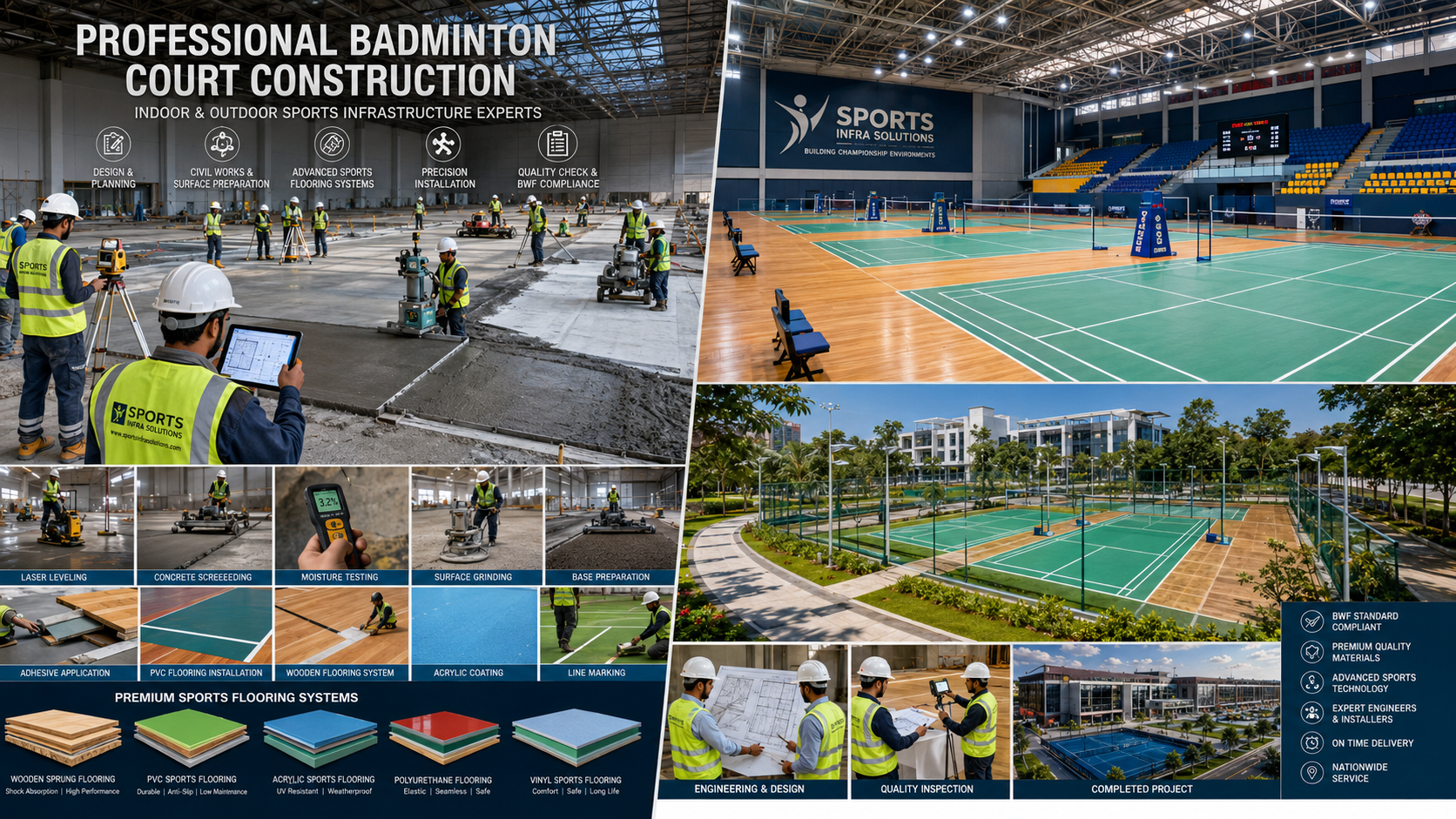
Complete Badminton Court Construction Process
A professional badminton court is built through a systematic process that combines civil engineering, sports flooring technology, and precision installation. Every stage must be completed with strict quality control to ensure the court delivers consistent playing performance, player safety, and long-term durability.
Step-by-Step Construction Process
Site Survey and Technical Assessment
Every successful project begins with a comprehensive site inspection.
Professional engineers evaluate:
- Existing ground conditions
- Soil strength and stability
- Site dimensions
- Accessibility for equipment and materials
- Drainage patterns
- Groundwater levels
- Electrical and utility availability
- Environmental conditions
- Future expansion possibilities
Based on this assessment, a customized construction plan, project timeline, and material specification are prepared.
Site Clearing and Preparation
Once the project is approved, the construction area is cleared and prepared.
Typical activities include:
- Removal of vegetation
- Excavation of unsuitable soil
- Demolition of old surfaces (if renovating)
- Removal of debris and waste
- Earth leveling
- Rough grading
- Boundary marking
- Initial compaction
Proper site preparation creates a stable foundation for all subsequent construction work.
Earthwork and Excavation
Excavation is carried out according to the approved engineering drawings.
The excavation depth depends on:
- Soil conditions
- Flooring system
- Indoor or outdoor application
- Load requirements
- Drainage design
Laser-guided equipment is often used to maintain precise elevations and slopes.
Subgrade Preparation
The subgrade is one of the most critical structural layers.
It supports every layer above it and must provide:
- Uniform bearing capacity
- Excellent stability
- Moisture resistance
- Proper compaction
- Minimal settlement
Compaction is generally performed using vibratory rollers until the required density is achieved.
Poor subgrade preparation frequently leads to cracks, uneven flooring, and costly repairs.
Drainage System Installation (Outdoor Courts)
Outdoor badminton courts require efficient drainage to prevent water accumulation.
A well-designed drainage system includes:
- Surface slope
- Side drains
- Catch pits
- Underground drainage pipes
- Rainwater outlets
- Edge channels
Effective drainage helps protect the foundation and increases the lifespan of the court.
Granular Sub-Base Construction
The granular sub-base distributes loads evenly and improves structural strength.
Common materials include:
- Crushed stone
- Graded aggregates
- Compacted gravel
- Stone dust
Each layer is compacted separately to achieve maximum density.
Concrete or Asphalt Base Construction
The structural base supports the sports flooring system.
Depending on project requirements, contractors generally use:
Reinforced Concrete Base
Advantages include:
- Excellent strength
- Long service life
- High dimensional stability
- Ideal for indoor courts
- Low structural movement
Asphalt Base
Advantages include:
- Faster construction
- Smooth finish
- Good flexibility
- Cost-effective for outdoor applications
The finished base must be perfectly level before sports flooring installation begins.
Moisture Testing
Moisture testing is essential before installing any sports flooring.
Engineers use specialized instruments to determine:
- Surface moisture
- Internal slab moisture
- Relative humidity
- Vapor emission
Excess moisture can cause:
- Adhesive failure
- Surface bubbling
- Delamination
- Flooring expansion
- Mold growth
Moisture issues should always be resolved before installation.
Surface Grinding and Leveling
The concrete base is mechanically prepared to ensure optimal adhesion.
Preparation includes:
- Diamond grinding
- Crack repair
- Joint filling
- Surface cleaning
- Vacuum dust removal
- Final leveling
A perfectly smooth substrate is essential for high-performance sports flooring.
Choosing the Right Badminton Court Flooring
Selecting the appropriate flooring system significantly influences player comfort, performance, maintenance, and operational costs.
1. Wooden Badminton Court Flooring
Wooden sprung flooring is widely regarded as the premium choice for professional indoor badminton facilities.
Advantages
- Superior shock absorption
- Natural playing feel
- Reduced stress on knees and ankles
- Excellent grip
- Professional tournament standards
- Long service life with proper maintenance
Best Applications
- International stadiums
- Sports academies
- Universities
- Professional clubs
- Championship venues
2. PVC Sports Flooring
PVC sports flooring has become a popular solution due to its balance of comfort, durability, and cost-effectiveness.
Features
- Multi-layer construction
- Comfortable playing surface
- Anti-slip finish
- Easy maintenance
- Fast installation
- Consistent performance
Suitable For
- Schools
- Community centers
- Indoor sports halls
- Multi-purpose courts
3. Polyurethane (PU) Sports Flooring
Polyurethane flooring offers seamless performance with excellent durability.
Benefits include:
- Flexible surface
- High abrasion resistance
- Good impact absorption
- Chemical resistance
- Long lifespan
- Attractive finish
PU flooring is commonly used in modern indoor sports complexes.
4. Vinyl Sports Flooring
Vinyl sports flooring provides a practical solution for facilities that host multiple sports.
Advantages include:
- Comfortable surface
- Easy cleaning
- Good traction
- Noise reduction
- Durable wear layer
- Quick installation
5. Acrylic Sports Flooring
Acrylic flooring is commonly used for outdoor badminton courts.
Major benefits include:
- UV resistance
- Weather resistance
- Color stability
- Slip-resistant texture
- Low maintenance
- Affordable lifecycle cost
Indoor vs Outdoor Badminton Court Construction
Indoor badminton courts emphasize controlled playing conditions.
Typical features include:
- Reinforced concrete foundation
- Wooden, PVC, PU, or vinyl flooring
- Professional LED lighting
- Ventilation systems
- Acoustic treatment
- High ceiling
- Climate control
- Professional seating arrangements
Indoor courts generally offer the highest level of playing performance.
Outdoor Court Construction
Outdoor badminton courts require surfaces designed to withstand environmental exposure.
Construction typically includes:
- Asphalt or concrete base
- Acrylic sports coating
- Proper drainage system
- UV-resistant materials
- Weatherproof line markings
- Protective fencing (if required)
These courts are suitable for schools, parks, residential societies, and recreational facilities.
Sports Lighting Design
Lighting plays a major role in player visibility and safety.
A professional lighting system should provide:
- Uniform illumination
- Minimal glare
- Shadow-free playing area
- Energy-efficient LED fixtures
- Proper mounting height
- Reliable electrical protection
For competitive venues, lighting should be designed to meet the standards of the intended level of play.
Ventilation and Indoor Air Quality
Proper ventilation enhances player comfort and preserves flooring materials.
A well-designed system helps:
- Control temperature
- Reduce humidity
- Improve air circulation
- Prevent condensation
- Maintain consistent playing conditions
Large indoor arenas often combine natural ventilation with mechanical HVAC systems for year-round comfort.
Court Markings
Accurate line marking is essential for fair gameplay.
Professional court markings should be:
- Dimensionally accurate
- High contrast
- Durable
- Non-slip
- Resistant to fading and wear
Laser-guided layout techniques are commonly used to ensure precise measurements.
Net Posts and Sports Equipment Installation
The final stage involves installing sports equipment and accessories.
Typical installations include:
- Professional net posts
- Competition-grade badminton nets
- Floor sockets
- Protective padding
- Umpire chairs
- Player benches
- Scoreboards
- Storage units
- Safety signage
Every component is checked for alignment, stability, and compliance with project specifications before handover.
Quality Testing Before Handover
Before the court is opened for use, contractors should perform a comprehensive inspection that includes:
- Surface levelness
- Floor adhesion
- Shock absorption
- Slip resistance
- Line accuracy
- Net height verification
- Lighting performance
- Drainage testing (outdoor courts)
- Equipment stability
- Overall finish and cleanliness
Only after all quality parameters are verified should the facility be handed over to the client.
Cost, Maintenance, Safety Features & Choosing the Right Contractor
Investing in a professionally constructed badminton court is a long-term decision that requires careful planning. Beyond the initial construction cost, factors such as flooring quality, maintenance, durability, energy efficiency, and future repair expenses significantly influence the total cost of ownership.
Whether you’re building a badminton court for a school, sports academy, residential community, corporate campus, hotel, or commercial sports complex, understanding these aspects helps you make informed decisions and maximize your return on investment.
Badminton Court Construction Cost
One of the first questions clients ask is:
“How much does badminton court construction cost?”
The answer depends on multiple factors rather than a single fixed price. Every project is unique, and the final investment varies according to the project scope, flooring system, location, infrastructure requirements, and finishing standards.
Professional contractors typically prepare a detailed estimate after evaluating the site, understanding the client’s objectives, and selecting the appropriate construction materials.
Factors That Affect Badminton Court Construction Cost
1. Court Size and Number of Courts
The total construction cost increases with the number of courts and the overall project size.
For example:
- Single badminton court
- Double court facility
- Four-court academy
- Six-court indoor stadium
- Multi-purpose sports complex
Larger facilities often benefit from economies of scale, reducing the average cost per court.
2. Indoor vs. Outdoor Construction
Indoor courts generally require additional infrastructure, including:
- Structural steel buildings
- Roofing systems
- Insulated walls
- Ventilation
- HVAC systems
- LED sports lighting
- Electrical installations
- Fire safety systems
- Spectator seating
Outdoor courts usually require fewer structural elements but need durable, weather-resistant flooring and efficient drainage systems.
3. Flooring Material
The flooring system has a major impact on project cost.
Premium options include:
Wooden Sports Flooring
Ideal for:
- International tournaments
- Professional academies
- Stadiums
Benefits:
- Superior athlete comfort
- Excellent shock absorption
- Long lifespan
- Premium playing experience
PVC Sports Flooring
Popular because of:
- Affordable installation
- Comfortable playing surface
- Easy maintenance
- Fast installation
- Good durability
Polyurethane (PU) Flooring
Preferred where seamless surfaces and long-term durability are required.
Acrylic Sports Flooring
Commonly selected for:
- Outdoor courts
- Schools
- Residential communities
- Public parks
4. Civil Construction Requirements
The condition of the existing site affects construction costs.
Additional civil work may include:
- Excavation
- Filling
- Compaction
- Reinforced concrete
- Retaining walls
- Drainage construction
- Foundation strengthening
- Soil stabilization
Poor site conditions generally increase construction time and budget.
5. Lighting System
Professional sports lighting should provide uniform illumination without glare.
Lighting costs depend on:
- Number of fixtures
- Ceiling height
- LED wattage
- Lighting controls
- Electrical infrastructure
- Backup power requirements
Energy-efficient LED systems reduce long-term operating expenses.
6. Ventilation and Air Conditioning
Indoor badminton courts require comfortable playing conditions.
Additional systems may include:
- Air circulation fans
- Industrial ventilation
- HVAC systems
- Air filtration
- Humidity control
These systems improve both player comfort and flooring longevity.
7. Sports Equipment
Professional badminton facilities typically include:
- Tournament-quality nets
- Heavy-duty net posts
- Umpire chairs
- Player benches
- Scoreboards
- Storage racks
- Protective wall padding
- Court divider curtains
Selecting durable equipment reduces replacement costs over time.
8. Location of the Project
Construction costs may vary depending on:
- Transportation distance
- Availability of materials
- Local labor costs
- Site accessibility
- Regional regulations
Projects in remote areas often involve higher logistics costs.
Why Quality Construction Saves Money
Some project owners focus only on reducing the initial construction cost. However, using inferior materials or skipping critical construction steps often leads to:
- Surface cracking
- Water damage
- Delamination
- Uneven flooring
- Frequent repairs
- Increased maintenance
- Shorter service life
- Safety hazards
Investing in quality materials and experienced installation teams generally results in lower lifetime costs.
Maintenance of a Badminton Court
Regular maintenance protects the court’s appearance, safety, and performance.
A preventive maintenance program is always more cost-effective than major repairs.
Daily Maintenance
Daily tasks include:
- Dust removal
- Dry mopping
- Surface cleaning
- Removal of debris
- Checking net tension
- Cleaning player areas
Maintaining a clean surface improves grip and reduces wear.
Weekly Maintenance
Weekly inspections should include:
- Line marking condition
- Surface damage
- Lighting performance
- Equipment stability
- Drainage inspection (outdoor courts)
Small issues can often be corrected before they become expensive problems.
Monthly Maintenance
A monthly maintenance schedule may include:
- Deep cleaning
- Joint inspection
- Moisture testing (where applicable)
- Hardware tightening
- Ventilation system servicing
- Safety equipment inspection
Keeping detailed maintenance records helps identify recurring issues.
Annual Maintenance
Annual maintenance generally includes:
- Professional surface inspection
- Floor refinishing (if required)
- Line repainting
- Structural assessment
- Lighting upgrades
- Drainage cleaning
- Preventive repairs
Routine servicing extends the life of the court and minimizes unexpected downtime.
Common Badminton Court Construction Mistakes
Avoiding common mistakes can significantly improve the quality and lifespan of the facility.
Poor Site Investigation
Ignoring soil conditions may result in:
- Uneven settlement
- Structural cracks
- Drainage problems
Incorrect Base Preparation
A weak base often causes:
- Surface movement
- Cracking
- Poor flooring performance
Choosing the Wrong Flooring
Installing flooring that does not match the intended use can reduce player comfort and increase maintenance costs.
For example:
- Outdoor flooring used indoors
- Indoor flooring exposed to weather
- Recreational flooring used for professional tournaments
Poor Drainage Design
Inadequate drainage can lead to:
- Water accumulation
- Surface damage
- Foundation deterioration
- Algae growth
- Slippery playing conditions
Inaccurate Court Markings
Incorrect dimensions can make the court unsuitable for official training or competitions.
Professional laser layout ensures precise measurements.
Low-Quality Materials
Using low-grade materials may reduce the initial budget but often increases repair costs and shortens the facility’s lifespan.
Essential Safety Features
A modern badminton court should prioritize player safety.
Important features include:
- Shock-absorbing flooring
- Anti-slip playing surface
- Rounded corners where appropriate
- Protective wall padding
- Adequate run-off space
- Non-glare LED lighting
- Proper ventilation
- Emergency exits
- Fire safety equipment
- First-aid facilities
- Clearly marked access routes
A safe environment enhances the playing experience and helps reduce the risk of injuries.
How to Choose the Right Badminton Court Construction Company
Selecting the right contractor is one of the most important decisions in the project.
Look for a company that offers:
Industry Experience
Choose a contractor with proven experience in sports infrastructure and badminton court construction.
Technical Expertise
A reliable contractor should have expertise in:
- Civil engineering
- Sports flooring systems
- Structural design
- Lighting
- Drainage
- Quality assurance
High-Quality Materials
Ensure the company uses durable, certified materials suitable for the intended application.
Skilled Installation Team
Experienced technicians ensure:
- Accurate leveling
- Professional flooring installation
- Proper line marking
- Secure equipment installation
Transparent Project Management
A professional contractor should provide:
- Detailed project planning
- Construction schedule
- Material specifications
- Cost estimates
- Regular progress updates
- Quality inspections
After-Sales Support
Long-term support is essential.
Look for services such as:
- Maintenance guidance
- Repair assistance
- Surface refurbishment
- Equipment replacement
- Technical inspections
Reliable after-sales service helps protect your investment for years to come.
Return on Investment
A professionally built badminton court can generate long-term value through:
- Sports academy memberships
- Coaching programs
- Tournament hosting
- Court rental income
- School and university partnerships
- Community sports events
- Corporate wellness initiatives
- Increased property value
With proper maintenance and effective management, a badminton court can remain a productive asset for many years.
Benefits of Investing in a Badminton Court, ROI, FAQs & Conclusion
A professionally constructed badminton court is more than a sports facility—it is a long-term investment that promotes fitness, supports community engagement, creates business opportunities, and enhances the value of educational, commercial, and recreational properties. Whether your goal is to establish a sports academy, develop a multi-sports complex, or provide recreational amenities for residents or employees, a high-quality badminton court offers lasting benefits.
Benefits of Professional Badminton Court Construction
1. Enhanced Player Performance
A professionally designed court provides:
- Uniform playing surface
- Excellent grip and traction
- Consistent shuttle movement
- Accurate court dimensions
- Better footwork support
- Reduced fatigue during long matches
High-performance flooring helps athletes train effectively while minimizing the risk of injuries.
2. Improved Player Safety
Safety is a priority in every sports facility.
Professional badminton courts feature:
- Shock-absorbing flooring
- Anti-slip surfaces
- Smooth joints
- Proper lighting
- Adequate run-off areas
- Securely installed sports equipment
These features significantly reduce the chances of slips, falls, and joint-related injuries.
3. Long Service Life
Premium construction materials and expert installation ensure exceptional durability.
With routine maintenance, a professionally built badminton court can deliver excellent performance for many years while requiring fewer major repairs.
4. Low Maintenance Costs
High-quality sports flooring systems are designed for easy cleaning and long-term reliability.
Routine maintenance generally includes:
- Surface cleaning
- Dust removal
- Periodic inspections
- Minor repairs
- Equipment checks
Preventive maintenance minimizes unexpected repair expenses.
5. Attractive Appearance
Modern badminton courts enhance the overall appearance of any sports facility.
Professional flooring systems provide:
- Vibrant colors
- Sharp court markings
- Seamless finishes
- Professional aesthetics
- Premium branding opportunities
An attractive court creates a positive impression for players, visitors, and event organizers.
Commercial Opportunities
A badminton court can become a valuable revenue-generating asset.
Potential income sources include:
- Court rentals
- Monthly memberships
- Coaching programs
- Professional training camps
- School partnerships
- Corporate tournaments
- District and state competitions
- National-level events
- Summer sports camps
- Equipment sales
- Sponsorship opportunities
Well-managed sports facilities often achieve consistent occupancy throughout the year.
Who Can Benefit from Badminton Court Construction?
Professional badminton courts are ideal for:
- Schools and educational institutions
- Colleges and universities
- Sports academies
- Stadium developers
- Government sports departments
- Residential societies
- Hotels and resorts
- Fitness centers
- Corporate offices
- Clubs and recreation centers
- Industrial townships
- Commercial sports complexes
Every project can be customized to meet the specific needs of the client.
Why Choose a Professional Badminton Court Construction Company?
An experienced contractor provides much more than flooring installation.
Professional services typically include:
- Site survey and planning
- Civil engineering
- Foundation preparation
- Sports flooring installation
- Court marking
- Sports lighting design
- Equipment installation
- Quality inspections
- Maintenance guidance
- Technical support
- Warranty assistance
Working with experienced professionals ensures the court meets performance expectations and remains reliable over the long term.
Return on Investment
Investing in a badminton court can deliver excellent long-term returns.
Major benefits include:
- Increased property value
- Higher facility utilization
- Revenue from coaching and memberships
- Income through court bookings
- Tournament hosting opportunities
- Improved customer satisfaction
- Stronger brand reputation
- Community engagement
- Promotion of healthy lifestyles
A professionally maintained badminton court can become a profitable and valuable asset for educational institutions, clubs, sports academies, and commercial facilities.
Frequently Asked Questions
1. How long does badminton court construction take?
Construction time depends on project size, flooring type, weather conditions, and site preparation. A single indoor court generally takes several weeks, while larger multi-court facilities require more time.
2. Which flooring is best for a badminton court?
The ideal flooring depends on the intended use.
- Wooden sprung flooring for professional tournaments
- PVC sports flooring for schools and academies
- Polyurethane flooring for premium indoor facilities
- Acrylic flooring for outdoor courts
3. Can badminton courts be constructed outdoors?
Yes. Outdoor badminton courts are commonly built using weather-resistant acrylic sports flooring installed over a properly prepared concrete or asphalt base.
4. What is the standard size of a badminton court?
A standard doubles badminton court measures:
- Length: 13.40 meters
- Width: 6.10 meters
A standard singles court uses the same length but has a playing width of 5.18 meters.
5. How often should a badminton court be maintained?
Daily cleaning, weekly inspections, monthly preventive maintenance, and annual professional servicing help maximize the court’s lifespan and maintain playing quality.
6. Is synthetic flooring suitable for badminton?
Yes. High-quality PVC, polyurethane, and acrylic sports flooring systems provide excellent grip, durability, and player comfort when professionally installed.
7. What lighting is recommended for indoor badminton courts?
Energy-efficient LED sports lighting with uniform illumination and minimal glare is recommended to improve visibility and reduce energy consumption.
8. Why is proper drainage important for outdoor courts?
An effective drainage system prevents water accumulation, protects the foundation, reduces maintenance requirements, and extends the life of the sports surface.
9. Can existing courts be renovated?
Yes. Professional contractors can repair, resurface, upgrade flooring systems, replace sports equipment, improve lighting, and restore existing badminton courts to modern standards.
10. How do I choose the right badminton court contractor?
Choose a contractor with:
- Proven sports infrastructure experience
- Qualified engineering team
- Premium construction materials
- Strong project portfolio
- Transparent pricing
- Reliable after-sales support
- Comprehensive warranty
Final Thoughts
A badminton court is not simply a place to play—it is an investment in health, performance, education, and community development. A professionally constructed court delivers superior playing conditions, enhanced safety, long-term durability, and greater financial value.
From careful planning and site preparation to advanced flooring installation, lighting design, equipment fitting, and ongoing maintenance, every stage contributes to creating a world-class sports facility. By partnering with an experienced badminton court construction company, you can ensure that your project meets international standards while providing an exceptional experience for players of all skill levels.
Whether you are building a badminton court for a school, university, sports academy, residential community, commercial sports complex, hotel, or corporate campus, investing in quality construction today will provide lasting value for years to come.