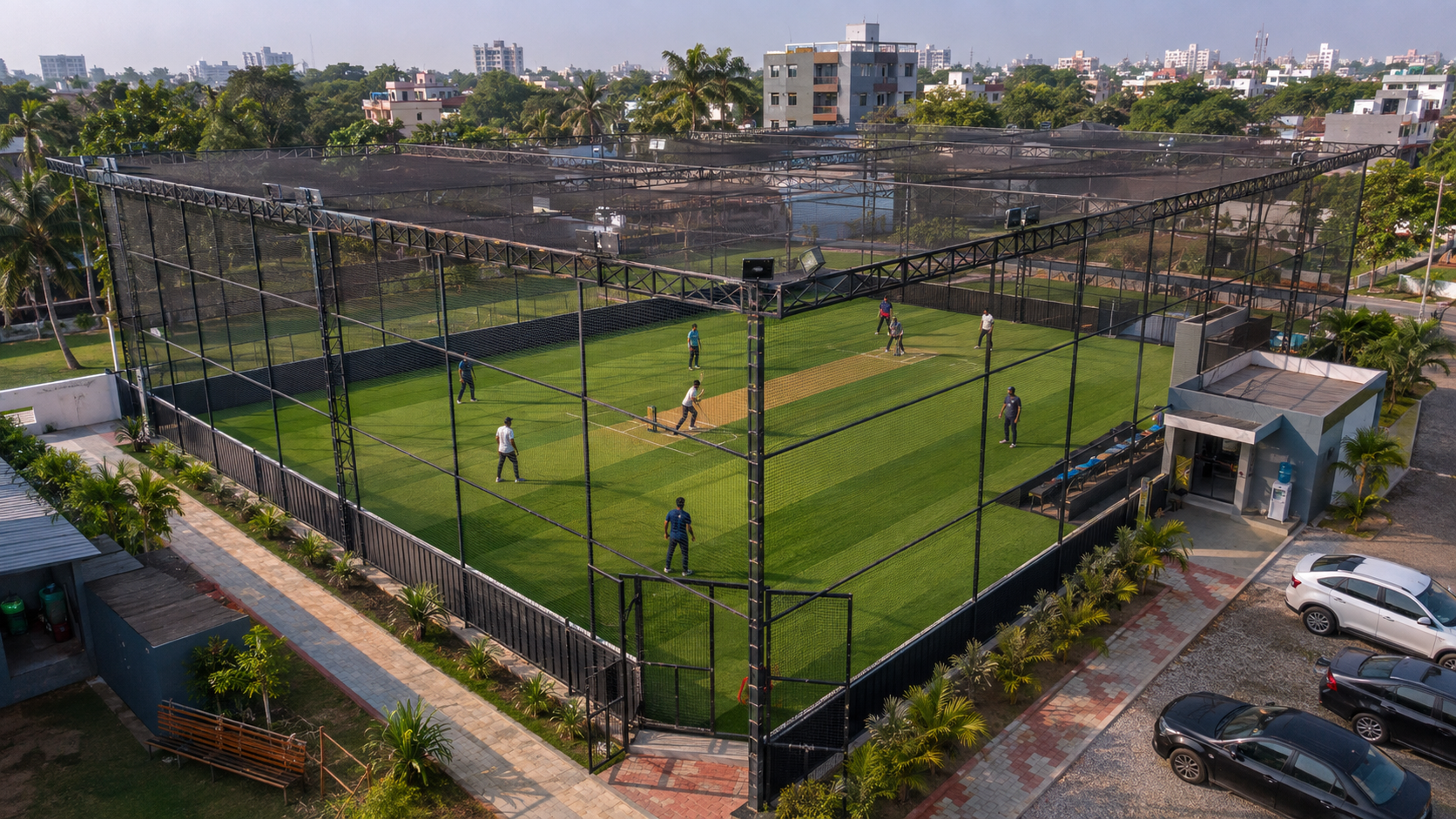
Tamil Nadu has always had a strong connection with cricket. From school grounds and local tournaments to professional academies and corporate cricket leagues, the sport continues to attract players across age groups. As cities become more crowded and available open land becomes increasingly expensive, traditional large cricket grounds are not always practical for recreational and commercial use.
This is where 360 degree box cricket turf construction in Tamil Nadu is becoming an attractive solution.
A professionally designed 360 degree box cricket facility can transform a relatively compact piece of land into a modern sports destination. It can be developed for casual cricket, coaching, corporate events, tournaments, academies, residential communities, or as a revenue-generating sports business.
However, successful construction requires more than installing artificial grass and surrounding it with nets. The quality of the foundation, drainage, turf, steel structure, safety netting, lighting, playing dimensions, and overall site planning directly affects the performance and operating life of the facility.
This guide explains the complete process of 360 degree box cricket turf construction in Tamil Nadu, including planning, site selection, design, materials, construction stages, approximate cost, maintenance, business opportunities, and important factors to consider before starting the project.
What Is a 360 Degree Box Cricket Turf?
A 360 degree box cricket turf is an enclosed cricket facility designed to provide an immersive playing environment where the ball remains within a controlled playing area. The court is generally surrounded by high-strength protective netting, steel framework, or a combination of rebound walls and mesh systems.
Unlike a conventional open cricket ground, box cricket is designed specifically for shorter-format recreational games. The compact layout encourages faster gameplay and allows players to participate without requiring a large conventional cricket field.
The 360 degree concept can provide greater interaction with the surrounding playing structure, making the facility suitable for fast-paced matches, practice sessions, entertainment cricket, and organized competitions.
Depending on the project requirements, a facility may include:
- Artificial cricket turf
- Dedicated cricket pitch
- Steel perimeter framework
- Side and overhead safety netting
- LED floodlights
- Ball-stop systems
- Player seating
- Changing rooms
- Washrooms
- Reception or booking counter
- Digital scoreboard
- Drinking-water facilities
- Parking
- Cafeteria or refreshment area
The final design should be determined by the available land, target customers, expected daily usage, and business model.
Why Build a Box Cricket Turf in Tamil Nadu?
Tamil Nadu offers several favorable conditions for developing modern recreational sports facilities. Major cities such as Chennai, Coimbatore, Madurai, Salem, Tiruchirappalli, Tirunelveli, and Hosur have growing residential and commercial areas where organized sports facilities can serve a large local customer base.
Strong Cricket Demand
Cricket is one of the most popular recreational sports in the state. Local cricket clubs, schools, colleges, companies, residential communities, and amateur teams create demand for convenient playing spaces.
A professionally constructed box cricket facility can provide an alternative for people who want to play cricket without travelling to a large stadium or conventional cricket ground.
Limited Urban Land
Finding a large open ground in a densely populated city can be difficult and expensive. Box cricket solves part of this problem by using a compact, controlled playing environment.
The exact land requirement depends on the playing format and facility design, but a properly planned facility can provide substantial recreational value without requiring a full-size cricket ground.
Evening and Weekend Demand
Working professionals and students often prefer playing after work, college, or school. This makes evening lighting an important component of a commercial turf.
With appropriate LED floodlights, the facility can operate beyond normal daylight hours and potentially generate bookings during evening peak periods.
Corporate Sports Activities
Tamil Nadu has significant IT, manufacturing, automobile, education, and commercial activity. Companies increasingly organize employee engagement programs, sports days, inter-company competitions, and team-building activities.
A box cricket facility can therefore create an additional revenue stream through corporate packages and organized events.
Site Selection for 360 Degree Box Cricket Construction
Choosing the right location can be as important as selecting the turf itself.
A facility located in an area with poor accessibility may struggle to achieve regular bookings even if the construction quality is excellent.
Before purchasing or leasing land, evaluate:
- Road connectivity
- Nearby residential communities
- Schools and colleges
- Corporate offices
- Existing sports facilities
- Parking availability
- Electricity connection
- Water availability
- Drainage conditions
- Local competition
- Visibility from the main road
- Accessibility during evening hours
For commercial projects, conducting a basic market survey before construction can help determine the preferred playing format, customer profile, booking rates, and expected demand.
Land Size and Layout Planning
There is no single universal land size for every 360 degree box cricket facility. The required area depends on the playing dimensions, safety clearance, net height, circulation space, amenities, and number of facilities being developed.
A professional layout should account for more than the playing surface.
The site plan may include:
- Playing area
- Safety clearance
- Steel framework
- Side and overhead netting
- Entry and exit gates
- Player waiting area
- Spectator seating
- Reception
- Washrooms
- Changing facilities
- Equipment storage
- Parking
- Electrical and lighting areas
For commercial developments, it is advisable to leave sufficient space for maintenance access and future expansion.
Soil Testing and Foundation Preparation
The foundation is one of the most important parts of box cricket turf construction.
A weak or poorly prepared base can eventually result in settlement, surface irregularities, drainage problems, turf movement, or premature deterioration.
The construction team should first inspect the existing ground conditions and determine the appropriate foundation system.
Typical preparation may involve:
- Site clearing
- Removal of unsuitable soil
- Excavation
- Soil compaction
- Grading
- Sub-base installation
- Aggregate layering
- Final leveling
- Concrete or asphalt base construction where required
The exact foundation specification should be determined according to soil conditions, drainage requirements, expected usage, and the selected sports flooring system.
Drainage Planning for Tamil Nadu’s Climate
Drainage should never be treated as an afterthought.
Tamil Nadu experiences periods of heavy rainfall, particularly during monsoon seasons. If rainwater remains trapped below or around the artificial turf, it can create unpleasant odors, algae growth, surface deterioration, and operational downtime.
A suitable drainage design may include:
- Surface slope
- Perimeter drainage channels
- Perforated drainage pipes
- Filter layers
- Aggregate drainage beds
- Collection chambers
- Proper discharge arrangements
The drainage design should be prepared according to the site’s natural levels and local rainfall conditions.
For coastal locations and areas with poor soil permeability, additional attention may be required to ensure rapid removal of excess water.
Artificial Cricket Turf Selection
The artificial turf is the primary playing surface, so selecting the right product is critical.
For cricket facilities, turf should be selected based on:
- Yarn quality
- Fiber density
- Pile height
- UV resistance
- Stitch rate
- Backing quality
- Infill requirements
- Wear resistance
- Drainage performance
- Expected playing hours
A good cricket turf should provide predictable ball behavior while remaining comfortable for players.
For a commercial facility with high daily usage, choosing an inexpensive turf simply to reduce initial investment can become costly over time because frequent repairs or replacement may affect revenue.
Cricket Pitch Construction
The cricket pitch requires special attention because it directly influences ball bounce and gameplay.
Depending on the facility’s objectives, the pitch can be constructed using a dedicated cricket carpet or synthetic cricket surface installed over a properly engineered base.
The pitch should be:
- Evenly leveled
- Firm and stable
- Properly aligned
- Free from visible depressions
- Correctly bonded
- Suitable for the intended ball type
The playing surface should be tested after installation to identify uneven bounce, loose sections, wrinkles, or other defects.
Steel Structure and Protective Netting
The enclosure is a defining feature of box cricket.
A strong galvanized steel or appropriately protected structural framework should be designed to support the perimeter and overhead netting.
The structure should be capable of handling:
- Wind loads
- Repeated ball impact
- Long-term outdoor exposure
- Lighting fixtures
- Safety netting
- Routine maintenance requirements
Protective netting should have appropriate strength and mesh characteristics for the facility.
All poles, joints, connections, anchor points, and gates should be installed securely. Sharp edges or exposed structural components should be avoided in areas accessible to players.
For outdoor facilities, corrosion protection is particularly important because prolonged exposure to moisture can affect unprotected steel components.
Lighting for Night-Time Box Cricket
Lighting can significantly increase the commercial value of a turf.
Many customers prefer cricket sessions between evening and late-night hours. Poor illumination, however, can create shadows, glare, and difficulty tracking the ball.
A professional lighting system should provide:
- Uniform illumination
- Reduced glare
- Minimal shadow areas
- Proper fixture positioning
- Energy efficiency
- Reliable electrical protection
LED sports floodlights are commonly preferred because they provide strong illumination with relatively efficient energy consumption.
The lighting design should be prepared around the actual playing area rather than simply installing a few high-powered lights.
Additional Facilities That Improve Customer Experience
A commercial box cricket facility can become more attractive by providing supporting amenities.
Depending on budget and available space, consider:
Player Seating
Benches or covered seating areas allow players to rest between matches.
Changing Rooms
Changing facilities are particularly useful for academies, corporate events, and tournament operations.
Washrooms
Clean, accessible washrooms should be considered essential for commercial facilities.
Reception Area
A reception desk can handle customer registration, bookings, payments, and equipment distribution.
Digital Scoreboard
A scoreboard can make matches more engaging and can also provide branding opportunities.
Refreshment Area
A small café or beverage counter can generate additional revenue while improving the overall customer experience.
Step-by-Step 360 Degree Box Cricket Turf Construction Process
A typical project can be divided into the following stages:
Step 1: Site Survey
The site is measured and evaluated for soil condition, levels, access, drainage, electricity, and available construction space.
Step 2: Design and Planning
The playing area, structure, amenities, entry points, lighting, drainage, and circulation zones are planned.
Step 3: Ground Preparation
Vegetation, debris, loose soil, and unsuitable material are removed.
Foundation and Sub-Base
The ground is compacted and prepared with the required aggregate and base layers.
Drainage Installation
Drainage channels and underground systems are installed according to the approved site design.
Surface Construction
The final sports base is prepared and leveled to provide a stable foundation for the turf.
Turf Installation
Synthetic cricket turf is laid, aligned, joined, secured, and finished with the appropriate infill where required.
Steel Framework
Perimeter posts, structural members, gates, and support components are installed.
Safety Netting
Side and overhead protective nets are fitted and tensioned correctly.
Lighting Installation
Floodlights, electrical cabling, control systems, and protective equipment are installed.
Amenities
Seating, washrooms, reception, signage, scoreboard, and other facilities are completed.
Final Quality Inspection
The facility is checked for turf alignment, drainage, structural stability, net tension, lighting, safety, and overall playing conditions.
360 Degree Box Cricket Turf Construction Cost in Tamil Nadu
The cost of constructing a box cricket facility varies considerably from project to project. Land cost is usually separate from construction expenditure and can have a major impact on the overall investment.
Indicative construction components may include:
| Construction Component | Approximate Cost Range |
|---|---|
| Site preparation and civil work | ₹4–10 lakh |
| Base and drainage system | ₹4–10 lakh |
| Artificial cricket turf | ₹8–20 lakh |
| Steel framework and netting | ₹5–15 lakh |
| LED sports lighting | ₹3–10 lakh |
| Electrical installation | ₹1–4 lakh |
| Player amenities | ₹3–10 lakh |
| Seating, signage and accessories | ₹1–5 lakh |
A professionally developed facility may therefore require an approximate investment of ₹30 lakh to ₹70 lakh or more, depending on size, structural design, turf specification, lighting, amenities, site condition, and finishing standards.
Smaller facilities may cost less, while premium commercial projects with stronger structures, larger playing areas, extensive amenities, covered roofing, premium flooring, or advanced lighting can exceed these ranges.
A detailed site-specific quotation is always preferable to relying on a fixed per-square-foot price.
How to Reduce Construction Cost Without Sacrificing Quality
Cost control does not necessarily mean choosing the cheapest materials.
A better approach is to prioritize spending on components that directly affect safety, durability, and gameplay.
You can control the project budget by:
- Selecting an efficient site layout
- Avoiding unnecessary structural complexity
- Choosing turf according to actual usage
- Planning drainage correctly from the beginning
- Using energy-efficient LED lighting
- Phasing non-essential amenities
- Comparing multiple technical quotations
- Choosing durable materials with suitable warranties
- Planning future expansion during the initial design
The objective should be value engineering, rather than simply reducing the initial construction price.
Maintenance of a Box Cricket Turf
Regular maintenance protects the investment and keeps the playing surface attractive.
A maintenance program should include:
- Routine brushing
- Removal of leaves and debris
- Checking turf seams
- Monitoring infill levels
- Cleaning high-use areas
- Inspecting drainage
- Checking safety netting
- Tightening structural connections where required
- Inspecting LED fixtures
- Repairing damaged turf promptly
High-traffic areas around the batting crease, bowling area, entry points, and corners may require more frequent attention.
Drainage channels should also be inspected before and during the monsoon season to reduce the possibility of water accumulation.
Business and Revenue Opportunities
A 360 degree box cricket facility can operate as more than an hourly rental ground.
Potential revenue models include:
Hourly Turf Bookings
Teams can book the facility for fixed time slots.
Membership Plans
Regular players can be offered monthly, quarterly, or annual membership packages.
Cricket Coaching
The turf can be partnered with cricket coaches or academies for structured training programs.
Corporate Cricket
Companies can rent the facility for employee tournaments and team-building events.
Tournament Hosting
Weekend leagues and seasonal tournaments can generate higher utilization.
Sponsorship
Local businesses can sponsor leagues, tournaments, scoreboards, or advertising spaces.
Events
Depending on the facility design and local regulations, sports-related events and community programs can create additional income opportunities.
The most successful commercial turfs generally focus on maintaining strong occupancy rather than depending exclusively on high hourly prices.
How to Choose a 360 Degree Box Cricket Turf Contractor
Selecting an experienced construction company is important because multiple technical disciplines are involved in the project.
Before appointing a contractor, ask for:
- Previous box cricket projects
- Material specifications
- Turf technical details
- Structural specifications
- Drainage design
- Lighting details
- Construction timeline
- Warranty information
- Maintenance recommendations
- Itemized quotation
- Project photographs or references
Do not compare contractors only on the lowest quotation. A cheaper project can become expensive if poor drainage, low-quality turf, inadequate steel sections, or weak netting leads to repeated repairs.
Is a 360 Degree Box Cricket Turf a Good Investment in Tamil Nadu?
The answer depends on location, investment size, competition, operating costs, and utilization.
A well-located facility near residential communities, educational institutions, offices, or commercial hubs can have strong demand. However, profitability should be calculated using realistic assumptions rather than optimistic booking projections.
Before investing, estimate:
- Monthly rental or land cost
- Construction investment
- Electricity expenses
- Staff salaries
- Maintenance costs
- Marketing expenditure
- Taxes and permissions
- Expected hourly booking rate
- Peak and off-peak occupancy
- Seasonal demand
- Loan or financing costs
A proper feasibility study can help determine the expected break-even period and return on investment.
Frequently Asked Questions
1. What is a 360 degree box cricket turf?
A 360 degree box cricket turf is an enclosed recreational cricket facility surrounded by protective structures and netting. It is designed for compact, fast-paced cricket games and can be used for casual matches, coaching, tournaments, and corporate events.
2. How much does box cricket turf construction cost in Tamil Nadu?
A typical commercial project may cost approximately ₹30 lakh to ₹70 lakh or more, excluding land. The actual price depends on the site, playing area, foundation, turf quality, steel structure, netting, lighting, drainage, and amenities.
3. What turf is best for box cricket?
A high-quality synthetic cricket turf designed for sports applications is generally suitable. The selection should consider yarn quality, density, UV resistance, durability, drainage, infill requirements, and expected playing hours.
4. How long does construction take?
A standard project may take approximately 3 to 8 weeks, depending on site preparation, weather, facility size, structural work, material availability, lighting, and amenities.
5. Can a box cricket turf be constructed outdoors in Tamil Nadu?
Yes. Outdoor facilities can be designed for Tamil Nadu’s climatic conditions. UV-resistant materials, effective drainage, corrosion-protected steel structures, and suitable safety netting are important for long-term performance.
6. Is drainage necessary for an outdoor box cricket turf?
Yes. Proper drainage is essential, particularly in locations that experience heavy seasonal rainfall. A well-designed drainage system helps prevent water accumulation and reduces downtime.
7. Can the facility operate at night?
Yes. LED sports floodlights can be installed to provide suitable illumination for evening and night matches. Lighting should be designed to minimize glare and shadows.
8. Can a box cricket turf be used for coaching?
Yes. Box cricket facilities can support cricket coaching, practice sessions, fitness drills, and small-group training programs when the layout and playing surface are designed appropriately.
9. Which cities in Tamil Nadu are suitable for box cricket facilities?
Chennai, Coimbatore, Madurai, Tiruchirappalli, Salem, Tirunelveli, Hosur, and other growing urban and suburban areas can offer potential markets. The actual suitability depends on local demand, land availability, competition, accessibility, and customer demographics.
10. What is the most important factor in box cricket construction?
There is no single factor. Foundation quality, drainage, turf performance, structural safety, netting, lighting, and professional installation all contribute to the final quality of the facility.
Conclusion
360 degree box cricket turf construction in Tamil Nadu represents an opportunity to create a modern, compact, and commercially viable sports facility in areas where traditional cricket grounds may not be practical.
The success of the project begins with proper planning. Selecting the right location, understanding the target market, designing an efficient layout, preparing a strong base, installing an effective drainage system, choosing suitable synthetic turf, and constructing a secure steel and netting system are all essential steps.
For commercial facilities, the project should also be planned around customer experience. Good lighting, clean amenities, convenient booking, player seating, parking, and professional maintenance can make a significant difference to repeat business.
Tamil Nadu’s strong cricket culture, growing cities, expanding residential communities, educational institutions, and corporate sector provide several potential markets for professionally designed box cricket facilities.
Whether the objective is to develop a commercial box cricket business, cricket academy, residential sports facility, school turf, corporate sports centre, or community recreation space, a well-engineered 360 degree box cricket turf can provide long-term value when construction quality and business planning are given equal importance.
The best approach is not to treat the turf as simply an artificial grass installation. It should be developed as a complete sports infrastructure project—with a reliable foundation, safe enclosure, effective drainage, quality playing surface, professional lighting, comfortable amenities, and a sustainable operating model.
With the right combination of engineering, sports flooring expertise, location planning, customer-focused design, and ongoing maintenance, a 360 degree box cricket facility can become a popular sporting destination and a valuable addition to Tamil Nadu’s rapidly developing recreational sports infrastructure.