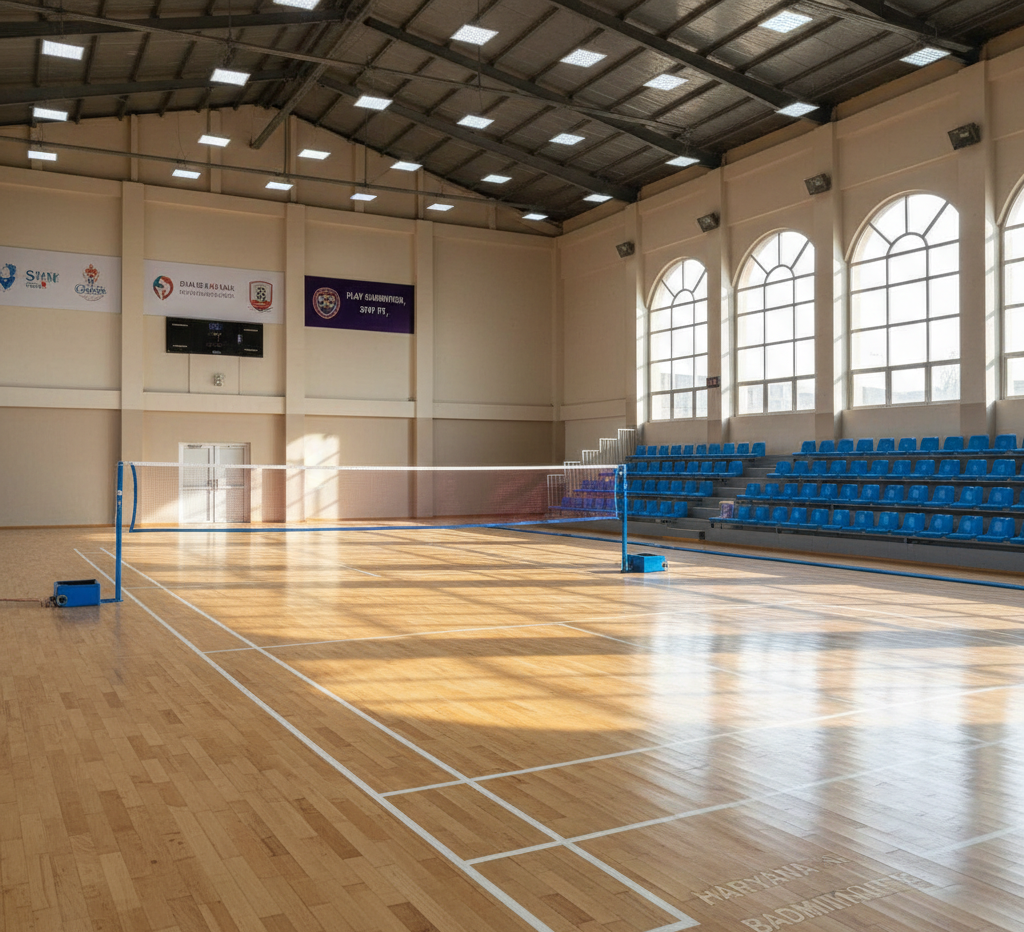
Haryana has established itself as an important centre for sports development in India, with growing participation in badminton across schools, colleges, universities, sports academies, private clubs, and government-supported training facilities. As the demand for professional indoor sports infrastructure continues to increase, the need for durable, safe, and performance-oriented wooden badminton flooring in Haryana is becoming increasingly important. A well-designed wooden badminton court provides players with a stable playing surface, effective shock absorption, controlled grip, and the comfort required for regular training and competitive matches.
From Gurugram and Faridabad to Sonipat, Panipat, Rohtak, Hisar, Karnal, Ambala, and other districts, sports facility owners are investing in modern indoor courts to support beginners, recreational players, professional athletes, and competitive badminton programmes. Wooden sports flooring is an excellent option for facilities that require a premium indoor playing surface capable of handling frequent use while maintaining consistent playing characteristics.
Our wooden badminton court flooring solutions are designed around the specific requirements of each project, including the condition of the existing floor, expected playing intensity, available installation space, environmental conditions, and overall budget. Whether you are developing a new badminton academy, upgrading a school gymnasium, constructing a multipurpose indoor stadium, or renovating an existing sports hall, selecting the right flooring system can significantly influence player comfort, court usability, and long-term maintenance requirements.
Why Choose Wooden Badminton Flooring in Haryana?
Badminton involves rapid acceleration, sudden stops, jumping, lunging, and frequent changes in direction. These movements place considerable demands on the playing surface. An ordinary hard floor may not provide the cushioning, grip, and resilience required for intensive badminton training. A professionally engineered wooden badminton court addresses these needs through a combination of sports-grade timber, a suitable subfloor structure, and a protective playing finish.
1. Effective Shock Absorption and Player Comfort
Shock absorption is one of the most important characteristics of a professional badminton court. During training and competition, players repeatedly land from jumps and make quick lateral movements. A properly designed sprung wooden flooring system helps absorb some of the impact generated by these movements, improving comfort during extended playing sessions.
The level of cushioning depends on the complete flooring assembly, including the timber surface, resilient pads, supporting framework, and subfloor. A suitable system can help reduce excessive impact loading while providing the stability required for confident movement. This makes wooden badminton flooring a practical choice for sports academies, schools, colleges, and professional indoor training facilities across Haryana.
2. Reliable Grip and Controlled Footwork
Badminton players need a surface that allows quick movement without excessive slipping or unwanted resistance. The flooring finish and surface texture play an important role in achieving this balance.
Sports-grade wooden flooring can provide controlled traction for forward movement, lateral steps, lunges, and rapid recovery movements. The final finish should be selected specifically for indoor badminton rather than ordinary residential or commercial flooring.
Consistent surface conditions also help players develop confidence in their footwork. Proper cleaning, dust management, and periodic inspection are essential to maintain suitable grip throughout the court’s service life.
3. Durability for High-Intensity Sports Activities
Indoor badminton facilities often operate for several hours each day. Training sessions, coaching programmes, recreational games, and tournaments can expose the floor to substantial repeated use.
High-quality timber, a properly designed supporting structure, suitable protective coatings, and professional installation contribute to the durability of a wooden badminton court. Regular maintenance can help preserve the appearance and playing characteristics of the surface over time.
For facilities in Haryana, choosing a flooring system according to the expected number of players, daily operating hours, and maintenance budget is particularly important.
4. Professional Appearance and Premium Finish
Wooden badminton flooring gives indoor sports halls a clean, professional appearance. Natural timber tones, carefully finished surfaces, and clearly defined court markings create an organised playing environment suitable for coaching, competitions, and recreational sports.
Different timber finishes and court layouts can be considered according to the venue’s design requirements. Academy branding, selected colour schemes, and suitable lighting can also be incorporated into the broader sports facility design.
5. Suitable for Training and Competitive Play
A professionally installed wooden court can support regular badminton coaching, player development, club competitions, and other indoor sporting activities. Facilities intending to host sanctioned tournaments should ensure that the complete court system complies with the applicable Badminton World Federation (BWF) requirements and the relevant competition specifications.
Compliance depends on the flooring system and the complete playing environment, not simply on whether the surface is made from wood.
Types of Wooden Badminton Court Flooring Available in Haryana
Different indoor facilities have different performance expectations and financial constraints. The most appropriate flooring solution depends on the venue, the supporting floor, environmental conditions, and the level of sports activity.
1. Solid Hardwood Sports Flooring
Solid hardwood flooring uses timber planks as the visible playing surface. Maple and beech are commonly associated with professional indoor sports flooring, while other timber species may be considered depending on availability, engineering characteristics, and project specifications.
Key features include:
- Natural timber appearance and a premium finish.
- A durable playing surface when properly installed and maintained.
- Compatibility with suitable sprung subfloor systems.
- The possibility of sanding and refinishing, depending on the construction and remaining timber thickness.
- Suitability for selected sports academies, clubs, and indoor stadiums.
Solid hardwood requires careful control of moisture and environmental conditions. The timber species, plank dimensions, installation method, protective finish, and subfloor design should be evaluated together before choosing a system.
2. Engineered Wooden Sports Flooring
Engineered wooden sports flooring uses multiple bonded layers designed to improve dimensional stability. Its construction can help manage the movement associated with changes in temperature and humidity when the system is correctly manufactured and installed.
This option may be suitable for indoor facilities in Gurugram, Faridabad, Sonipat, Rohtak, Karnal, and other Haryana locations where seasonal environmental changes must be considered.
Important advantages include:
- A layered construction designed for improved stability.
- Reduced dimensional movement compared with some solid-wood constructions, depending on the product.
- Compatibility with selected sports subfloor systems.
- A range of surface finishes and installation configurations.
- Potentially lower maintenance requirements for certain engineered products.
Product specifications should be checked carefully because not every engineered wood product is designed for sports use. The selected flooring should be intended for athletic applications and tested against the performance requirements of the project.
3. Sprung Wooden Badminton Flooring
Sprung wooden flooring incorporates a resilient supporting structure beneath the timber surface. This construction is designed to provide controlled deflection and energy absorption during player movement.
Depending on the system, the supporting assembly may include resilient rubber pads, timber battens or sleepers, structural panels, and other specified components.
A sprung floor can be an appropriate solution for facilities prioritising player comfort and regular training. However, its performance depends on the entire assembly, including the spacing of the supports, structural rigidity, load distribution, and the quality of installation.
4. Wooden Subfloor with a Synthetic Sports Surface
Some facilities prefer a hybrid flooring system that combines a resilient or wooden supporting structure with a synthetic sports surface. Depending on the selected product, this arrangement may provide cushioning, simplified maintenance, or a different balance of installation cost and playing characteristics.
This option can be considered for schools, multipurpose halls, recreational centres, and indoor sports facilities with limited budgets. The finished system should be assessed for badminton-specific traction, impact performance, surface consistency, and suitability for the intended activities.
Technical Features of Wooden Badminton Flooring
A high-performance badminton court requires more than an attractive timber surface. Each component must work together to deliver stability, comfort, durability, and safe movement.
Important technical considerations include:
- Shock absorption: The complete floor assembly should provide impact performance appropriate to the intended level of play.
- Vertical deformation: Controlled movement under load helps balance cushioning with stability.
- Surface friction: The finish should provide suitable traction for badminton footwork.
- Structural strength: The supporting framework must accommodate expected player loads and other relevant service loads.
- Moisture protection: Appropriate moisture testing and, where required, a properly specified moisture-control system help protect the installation.
- Surface levelling: The subfloor must meet the flooring manufacturer’s requirements for flatness and stability.
- Protective coating: A sports-specific finish helps protect the timber and supports consistent maintenance.
- Court markings: Lines must be accurate, clearly visible, and compatible with the selected playing surface.
- Dimensional stability: Materials and installation methods should account for anticipated temperature and humidity changes.
- Noise management: The supporting structure can be designed to help manage impact noise and sound transmission where required.
Performance values should be established from the actual flooring specification and applicable test reports. Claims about shock absorption, deformation, or compliance should not be assumed to apply equally to every wooden flooring product.
Complete Wooden Badminton Court Installation Services in Haryana
Successful installation begins with proper planning. Even high-quality timber may develop problems if it is installed over an unsuitable base or exposed to excessive moisture. A structured installation process helps improve the finished court’s reliability and service life.
Site Inspection and Project Assessment
The installation process begins with an evaluation of the proposed venue. The team should assess the available floor area, existing concrete or other subfloor, surface levels, signs of dampness, access conditions, ventilation, and intended use.
The number of courts, movement clearance, equipment requirements, and lighting arrangements should also be considered. This assessment helps determine whether the existing base can be retained or requires repair.
Subfloor Preparation
The supporting floor must be structurally sound, stable, and sufficiently level for the selected system. Cracks, uneven areas, contamination, and moisture-related issues should be addressed before the installation proceeds.
Where required, moisture testing and suitable moisture-control measures should be completed according to the flooring manufacturer’s instructions. Installing timber over an unsuitable base can lead to movement, distortion, or premature deterioration.
Installation of the Supporting Structure
For a sprung wooden court, the specified resilient components and supporting framework are installed according to the approved layout. Their spacing, alignment, and load-bearing characteristics must match the system design.
The supporting structure should be inspected before the upper flooring layers are installed. Correct alignment helps ensure that the finished playing surface remains stable and consistent.
Wooden Flooring Installation
Sports-grade timber planks or engineered flooring panels are installed using the recommended fixing or assembly method. Installation allowances must account for the product’s expected dimensional movement and the environmental conditions within the building.
The timber should be stored and conditioned as required by the manufacturer. Correct material handling and installation procedures help reduce the risk of gaps, excessive movement, and other avoidable defects.
Sanding, Finishing, and Protective Coating
Where the selected system requires site finishing, the timber surface is prepared and sanded to achieve the specified finish. Suitable sports-floor coatings are then applied according to the manufacturer’s application and curing instructions.
The surface should not be opened for play until the coating has cured adequately. The finish must be selected for sports use, with appropriate traction and durability rather than a slippery decorative gloss.
Court Marking and Equipment Installation
Court lines are laid out according to the applicable badminton court dimensions. Posts, nets, and other equipment are installed in their designated positions, and the playing area is checked for clearance and usability.
For competition venues, the complete layout should be reviewed against the relevant event requirements before the court is commissioned.
Final Inspection and Handover
Before the court is opened, the installation should be checked for surface consistency, stability, visible defects, line accuracy, and compliance with the agreed specifications.
The facility operator should also receive appropriate guidance on cleaning, preventive maintenance, environmental control, and the recommended inspection schedule.
Wooden Badminton Flooring for Different Facilities in Haryana
Our proposed flooring solutions can be tailored to a variety of indoor sports environments.
Sports academies: A carefully specified sprung wooden court can support intensive coaching sessions, player development, and structured training programmes.
Schools and colleges: Wooden sports flooring can provide a professional playing environment for physical education, extracurricular sports, and inter-college competitions.
Universities and government sports complexes: Large indoor venues may require multiple courts, organised circulation areas, suitable lighting, and durable flooring systems designed around high usage levels.
Private clubs and residential communities: Premium wooden flooring can enhance the quality of indoor recreational facilities while supporting regular badminton sessions.
Corporate gyms and employee recreation centres: A properly planned indoor court can provide a dedicated area for sports and fitness activities.
Hotels, resorts, and multipurpose halls: Selected flooring systems can accommodate badminton and other approved indoor activities when their performance specifications are appropriate for the intended use.
For multipurpose venues, the compatibility of the flooring with movable equipment, other sports, and event configurations should be reviewed before finalising the design.
Wooden Badminton Flooring Across Haryana
We aim to support indoor sports flooring projects across Haryana, with solutions planned according to local site conditions and project requirements.
- Gurugram: Corporate sports centres, private badminton academies, premium clubs, and institutional facilities.
- Faridabad: Schools, colleges, indoor stadiums, and community sports centres.
- Sonipat: Sports training facilities, educational campuses, and badminton academies.
- Panipat: Private clubs, indoor halls, and institutional sports facilities.
- Rohtak: University sports centres, coaching facilities, and indoor courts.
- Hisar: Training academies, educational institutions, and sports complexes.
- Karnal: School sports halls, private academies, and recreational venues.
- Ambala: Indoor badminton courts, community facilities, and institutional projects.
- Bahadurgarh and Rewari: Schools, residential sports facilities, and private training centres.
- Yamunanagar and Kurukshetra: Educational campuses, indoor stadiums, and academy projects.
- Sirsa, Jind, Kaithal, Palwal, Bhiwani, and Mahendragarh: New court construction, flooring upgrades, and maintenance projects, subject to site assessment and service availability.
Whether the project is located in an urban centre or a smaller district, the selection process should focus on the actual venue conditions rather than relying on a standard flooring specification for every location.
Why Professional Installation Matters
The performance of wooden badminton flooring depends on material quality, subfloor construction, installation accuracy, and ongoing care. Choosing an experienced sports flooring contractor can help ensure that these elements are considered together.
Sports-Specific Material Selection
Materials should be selected for their suitability for athletic use, including timber quality, structural components, resilient supports, and protective finishes. Relevant product documentation and test results should be reviewed before the project is approved.
Climate and Moisture Planning
Haryana experiences seasonal temperature changes, dry periods, and varying indoor moisture conditions. Although indoor environments differ from site to site, timber flooring should be designed with suitable expansion allowances, moisture management, ventilation, and environmental monitoring.
Skilled Installation
Correct subfloor preparation, alignment, fixing, finishing, and court marking are essential for achieving a reliable result. Installation should follow the manufacturer’s instructions and the agreed technical specification.
Maintenance and After-Sales Support
A maintenance plan helps facility owners protect their investment. Depending on the flooring system and available service arrangements, support may include inspections, repairs, surface refinishing, recoating, and replacement of damaged components.
Custom Court Planning
Each facility can be assessed for the number of courts, playing clearances, timber finish, supporting structure, equipment, and branding requirements. This approach helps align the flooring specification with the facility’s operating needs and available budget.
Maintenance Tips for Wooden Badminton Flooring
Routine care helps preserve the court’s appearance and playing characteristics.
- Remove dust daily: Use a clean, dry microfiber mop or an approved dust-control system.
- Clean with suitable products: Use only cleaners recommended for the installed sports-floor finish.
- Avoid excessive water: Standing water and inappropriate wet-cleaning methods can damage timber and its supporting layers.
- Maintain indoor conditions: Provide suitable ventilation and follow the manufacturer’s recommended temperature and relative-humidity range.
- Control footwear and dust: Encourage players to use clean, non-marking indoor sports shoes.
- Inspect the surface regularly: Look for damaged coatings, loose boards, unusual movement, gaps, and areas with inconsistent traction.
- Prevent equipment damage: Use suitable protective measures when moving heavy equipment and avoid dragging furniture across the court.
- Schedule professional maintenance: Recoating, sanding, or refinishing should be performed when required by the condition of the surface, not solely according to a fixed calendar.
The frequency of refinishing depends on the timber thickness, coating system, usage intensity, and maintenance history. Promptly addressing moisture problems and surface defects can help prevent more expensive repairs.
Wooden Badminton Flooring Cost in Haryana
The cost of wooden badminton court flooring varies according to the selected materials, supporting structure, installation complexity, and condition of the existing venue. A site-specific quotation is more reliable than applying a single price to every project.
Factors affecting the overall budget include:
- Type and grade of timber or engineered wood.
- Sprung or non-sprung floor construction.
- Thickness and specification of the flooring layers.
- Subfloor levelling, repairs, and moisture-control requirements.
- Sports coating, court markings, and finishing work.
- Number of courts and total installation area.
- Badminton posts, nets, and other accessories.
- Transportation, site access, and installation conditions.
- Maintenance arrangements and any additional facility requirements.
When comparing quotations, check whether each proposal includes the same components, preparation work, taxes, equipment, finishing, warranty terms, and post-installation support. A lower initial price may not represent the best long-term value if important structural or maintenance provisions are excluded.
Get a Quotation for Wooden Badminton Flooring in Haryana
Planning a new indoor badminton court or upgrading an existing sports hall requires the right balance of performance, safety, durability, and cost. A professionally specified wooden badminton flooring system can provide an attractive and functional playing surface for academies, schools, colleges, clubs, and indoor sports complexes throughout Haryana.
We can help assess your project requirements, identify suitable flooring options, and prepare a proposal based on the venue’s dimensions, intended use, existing subfloor, and budget.
To request a project assessment and quotation, visit Sports Facility. You can also explore badminton court dimensions and planning information when preparing your facility layout.
Share your project location, approximate court area, number of courts, preferred flooring type, and installation timeline to help establish the appropriate scope of work.
Build a better indoor badminton facility with wooden sports flooring designed around your performance requirements and long-term operational needs.
Wooden Badminton Flooring in Haryana – Frequently Asked Questions
1. What is wooden badminton flooring?
Wooden badminton flooring is an indoor sports surface made using solid timber or engineered wood, often installed over a specially designed supporting structure. Depending on the system, it can provide controlled traction, resilience, and impact performance suitable for badminton.
2. Is wooden flooring suitable for badminton courts in Haryana?
Yes. Wooden sports flooring can be suitable for indoor badminton courts throughout Haryana when the system is selected and installed according to the site’s conditions. Moisture management, ventilation, subfloor quality, and appropriate expansion allowances are important considerations.
3. Which wood is suitable for badminton court flooring?
Maple and beech are commonly used for professional indoor sports floors. Other timber options may be considered according to their properties and the system’s specifications. The final selection should be based on sports performance, durability, availability, and project requirements.
4. What is the total thickness of wooden badminton flooring?
The overall thickness varies considerably between systems. A basic surface layer and a complete sprung flooring assembly have different construction requirements. The total thickness should be confirmed from the selected manufacturer’s drawings and technical specifications rather than assuming one standard measurement.
5. Does wooden badminton flooring help reduce player impact?
A suitably engineered sprung wooden floor can absorb a portion of the impact generated during play. Actual performance depends on the timber surface, resilient supports, subfloor assembly, and tested characteristics of the complete system.
6. Can wooden badminton flooring be installed over an existing concrete floor?
Yes, in many cases. The concrete base must be structurally sound, adequately level, and suitable for the selected installation. Moisture testing and necessary repairs should be completed before the new flooring is installed.
7. Is wooden flooring appropriate for badminton tournaments?
Wooden sports flooring can be used for competitive badminton, provided the complete court and playing environment meet the applicable event requirements. Tournament organisers should verify the relevant BWF requirements and any additional venue specifications.
8. How long does wooden badminton flooring last?
Service life depends on the timber, supporting structure, usage intensity, installation quality, environmental conditions, and maintenance. A well-maintained system can provide many years of use, but no fixed lifespan can be guaranteed for every installation.
9. How should wooden badminton courts be cleaned?
Daily dry dust removal, prompt treatment of spills, and periodic cleaning with approved sports-floor products are recommended. Excessive water, unsuitable chemicals, and products that leave slippery residues should be avoided.
10. Can wooden badminton flooring be customised?
Yes. Depending on the selected system, customisation can include timber finish, court layout, line colours, academy branding, logos, and the number of courts. Structural and playing-performance requirements should take priority over decorative choices.
11. Is wooden flooring suitable for multipurpose indoor halls?
It can be suitable for selected multipurpose halls, provided the flooring system is compatible with the intended activities and equipment. Heavy loads, movable sports equipment, and non-sport events may require additional protection or a different flooring specification.
12. What determines the cost of wooden badminton flooring in Haryana?
The main factors include timber type, flooring construction, total area, base preparation, installation complexity, protective coating, court markings, equipment, and transport. A detailed site assessment helps establish a more accurate project estimate.
13. Do wooden badminton courts require periodic polishing?
The protective finish may require maintenance, recoating, or refinishing as the surface wears. The timing depends on the coating manufacturer’s recommendations and the actual condition of the court.
14. Which Haryana cities can be considered for installation services?
Potential project locations include Gurugram, Faridabad, Sonipat, Panipat, Rohtak, Hisar, Karnal, Ambala, Rewari, Bahadurgarh, Kurukshetra, Yamunanagar, and other districts, subject to confirmation of service availability and site requirements.
15. How can I request a wooden badminton flooring quotation?
Prepare the project location, approximate floor dimensions, number of courts, preferred flooring system, existing subfloor details, and target installation date. Submit these details through the Sports Facility website to request a project discussion and quotation.