Introduction
Badminton has become one of the fastest-growing indoor sports in India, and Panipat is rapidly emerging as a preferred destination for modern sports infrastructure. Schools, colleges, sports academies, fitness centers, residential societies, hotels, and corporate campuses are increasingly investing in professionally designed badminton courts to promote sports, wellness, and competitive training.
However, constructing a professional badminton court requires much more than painting lines on a floor. A high-quality badminton court involves careful planning, proper civil work, premium sports flooring, accurate dimensions, shock-absorbing systems, professional lighting, ventilation, and compliance with international standards.
Whether you’re planning to build a single badminton court, a multi-court indoor academy, or a commercial sports facility in Panipat, this comprehensive guide covers everything you need to know—including flooring options, construction process, costs, dimensions, maintenance, and expert tips for 2026.
Why Invest in a Badminton Court in Panipat?
Panipat has witnessed significant growth in sports infrastructure due to:
- Rising interest in badminton among youth
- Government sports initiatives
- Growing number of private sports academies
- Increasing residential townships
- Demand from schools and universities
- Corporate wellness programs
- Commercial indoor sports complexes
A professionally built badminton court not only improves sports participation but also becomes a long-term revenue-generating asset.
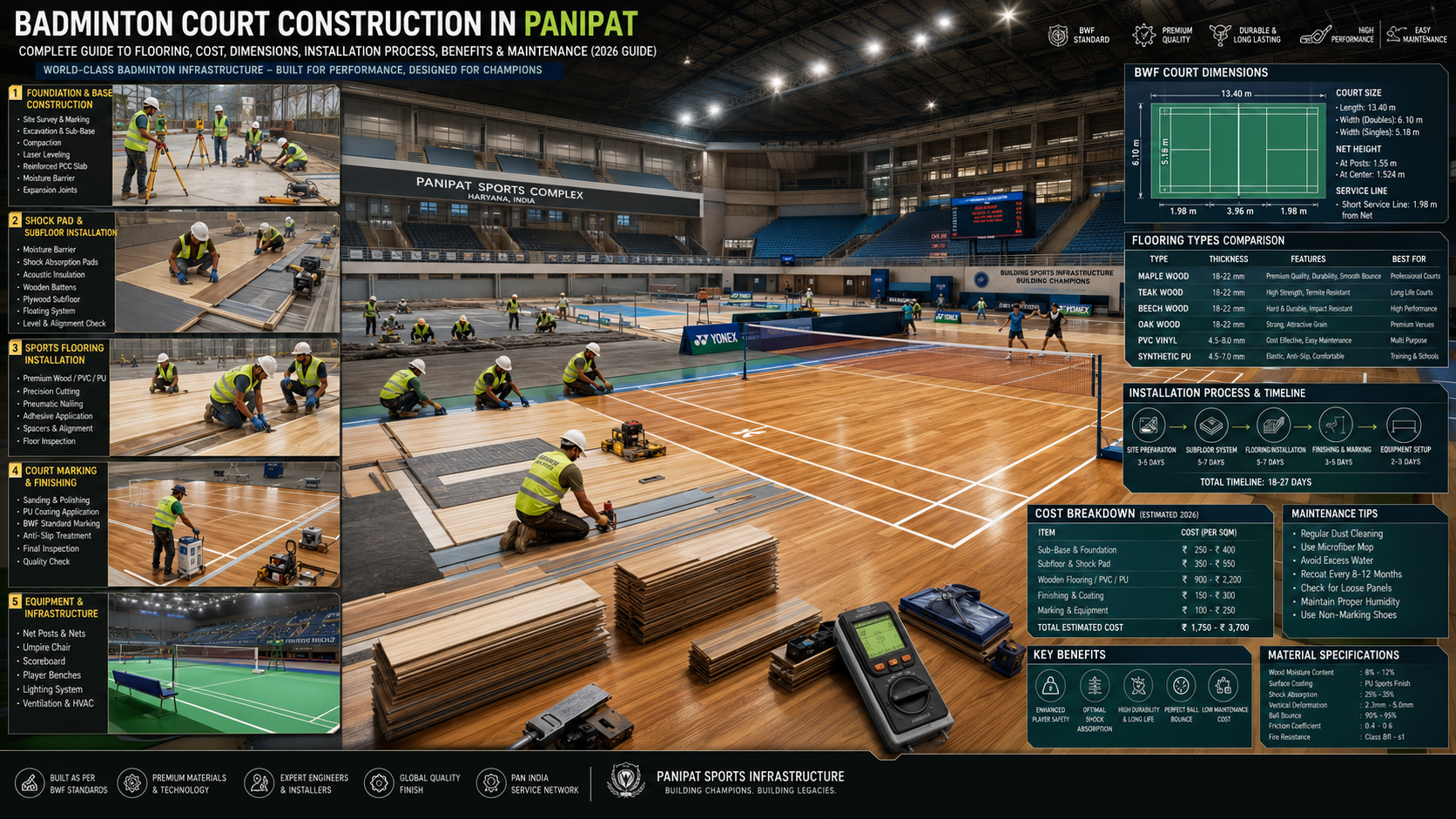
Official Badminton Court Dimensions (BWF Standards)
A professional badminton court must follow international specifications established by the Badminton World Federation (BWF).
| Dimension | Measurement |
|---|---|
| Court Length | 13.40 meters (44 ft) |
| Doubles Width | 6.10 meters (20 ft) |
| Singles Width | 5.18 meters (17 ft) |
| Net Height at Posts | 1.55 meters |
| Net Height at Center | 1.524 meters |
| Recommended Ceiling Height | 9–12 meters |
| Line Width | 40 mm |
These dimensions are the accepted standard for competitive badminton facilities.
Space Required for Construction
Apart from the playing area, sufficient safety clearance should be provided.
Recommended space:
- Length: 17–18 meters
- Width: 9–10 meters
- Total Area: 1,500–2,000 sq. ft. per court
Additional space may be required for:
- Walkways
- Seating
- Coaching area
- Storage
- Emergency exits
Types of Badminton Court Flooring
Choosing the correct flooring determines player safety, comfort, and performance.
1. Wooden Sports Flooring
The preferred flooring for professional tournaments.
Features:
- Excellent shock absorption
- Natural ball bounce
- Premium appearance
- Long lifespan
- Comfortable for joints
Common wood species include:
- Maple
- Teak
- Oak
- Beech
Best For:
- Academies
- Professional clubs
- Indoor stadiums
2. PVC Vinyl Sports Flooring
One of the most popular choices today.
Advantages:
- Affordable
- Comfortable
- Anti-slip
- Easy maintenance
- Available in multiple thicknesses
Suitable For:
- Schools
- Colleges
- Community centers
- Indoor clubs
3. Synthetic PU Flooring
Polyurethane flooring offers:
- High durability
- Excellent cushioning
- Seamless finish
- Chemical resistance
- Premium appearance
Ideal For:
- High-performance facilities
- Sports complexes
- Commercial indoor arenas
4. Acrylic Flooring (Outdoor)
Outdoor badminton courts often use acrylic coatings because they are:
- UV resistant
- Weather resistant
- Durable
- Easy to maintain
Ideal For:
- Parks
- Schools
- Residential societies
Step-by-Step Badminton Court Construction Process
Step 1: Site Inspection
Engineers evaluate:
- Soil condition
- Drainage
- Moisture levels
- Space availability
- Utility access
Proper site planning prevents future structural issues.
Base Preparation
The foundation must be:
- Level
- Crack-free
- Moisture resistant
- Strong enough for sports flooring
Most projects use reinforced concrete with proper curing.
Moisture Protection
Moisture barriers help prevent:
- Floor expansion
- Warping
- Mold growth
- Surface damage
Shock Absorption System
Professional courts use resilient systems that reduce impact on:
- Knees
- Ankles
- Lower back
- Hip joints
This improves player safety and comfort.
Flooring Installation
Depending on the chosen material:
- Wooden planks are fixed over a resilient subfloor.
- PVC flooring is bonded using sports-grade adhesive.
- PU flooring is poured and cured in layers.
- Acrylic systems are coated over concrete.
Court Marking
Professional line markings are applied according to BWF standards using durable sports-grade paint.
Lighting Installation
Proper LED sports lighting ensures:
- Uniform brightness
- No glare
- Better shuttle visibility
- Reduced eye strain
Recommended lighting:
- 500–1000 lux for training
- 750–1500 lux for tournaments
Net Installation
Professional badminton posts are installed securely, maintaining the required net height.
Final Inspection
The completed court undergoes checks for:
- Levelness
- Surface friction
- Shock absorption
- Dimensions
- Lighting
- Safety compliance
Estimated Badminton Court Construction Cost in Panipat (2026)
Construction costs vary depending on flooring type, building structure, and project size.
Approximate investment ranges:
| Type | Estimated Cost |
|---|---|
| Outdoor Acrylic Court | ₹3–8 lakh |
| Indoor PVC Court | ₹15–30 lakh |
| Wooden Indoor Court | ₹25–60 lakh |
| Premium Multi-Court Academy | ₹80 lakh–₹1 crore+ |
Actual costs depend on civil work, roofing, lighting, HVAC, seating, and amenities.
Benefits of Professional Badminton Court Construction
A professionally designed court offers:
- Better player safety
- Enhanced performance
- Reduced injury risk
- Longer flooring lifespan
- Lower maintenance costs
- Higher property value
- Better aesthetics
- Increased commercial revenue
- Tournament readiness
Essential Equipment
A complete badminton facility should include:
- Professional net system
- Badminton poles
- Umpire chair
- LED lighting
- Player benches
- Storage racks
- Scoreboard
- Fire safety equipment
- Drinking water
- Changing rooms
- Washrooms
Maintenance Tips
Proper maintenance extends the life of the court.
Daily:
- Dust removal
- Surface cleaning
- Check for spills
Weekly:
- Inspect markings
- Clean lighting fixtures
- Check nets
Monthly:
- Inspect flooring joints
- Check moisture
- Tighten hardware
Annually:
- Professional inspection
- Recoating (if applicable)
- Repair damaged areas
Common Mistakes to Avoid
Avoid these common construction errors:
- Incorrect dimensions
- Poor-quality flooring
- Uneven concrete base
- Inadequate moisture protection
- Low-quality adhesives
- Poor lighting
- Insufficient ceiling height
- Lack of expansion joints
- Improper ventilation
Indoor vs Outdoor Badminton Courts
| Feature | Indoor | Outdoor |
|---|---|---|
| Weather Protection | Excellent | Limited |
| Playing Experience | Professional | Recreational |
| Maintenance | Moderate | Higher |
| Wind Impact | None | High |
| Lifespan | Longer | Depends on exposure |
| Tournament Suitable | Yes | Generally No |
Why Hire Professional Court Builders?
Experienced contractors ensure:
- Accurate BWF-compliant dimensions
- Premium flooring installation
- High-quality materials
- Faster execution
- Manufacturer warranties
- Proper drainage and moisture control
- Long-term durability
Frequently Asked Questions (FAQs)
What is the standard size of a badminton court?
The official court measures 13.40 m × 6.10 m for doubles and 13.40 m × 5.18 m for singles.
Which flooring is best?
Wooden flooring is preferred for professional facilities, while PVC and PU flooring are popular for academies and schools.
How long does construction take?
A single indoor court typically takes 3–8 weeks, depending on civil work and flooring.
What is the ideal ceiling height?
A clear height of 9–12 meters is recommended for uninterrupted play.
How often should the floor be maintained?
Routine cleaning should be done daily, with periodic inspections and professional maintenance scheduled annually.
Conclusion
Constructing a badminton court in Panipat is a valuable investment for schools, academies, residential societies, sports clubs, and commercial sports facilities. A well-designed court built with quality materials and installed according to international standards delivers superior player safety, consistent performance, and long-term durability.
Whether you choose hardwood, PVC, PU, or acrylic flooring, partnering with experienced sports infrastructure professionals ensures precise construction, compliance with BWF standards, and a facility that serves athletes for years to come. With growing demand for quality sports infrastructure in Panipat, a professionally built badminton court can become both a community asset and a sustainable business opportunity.