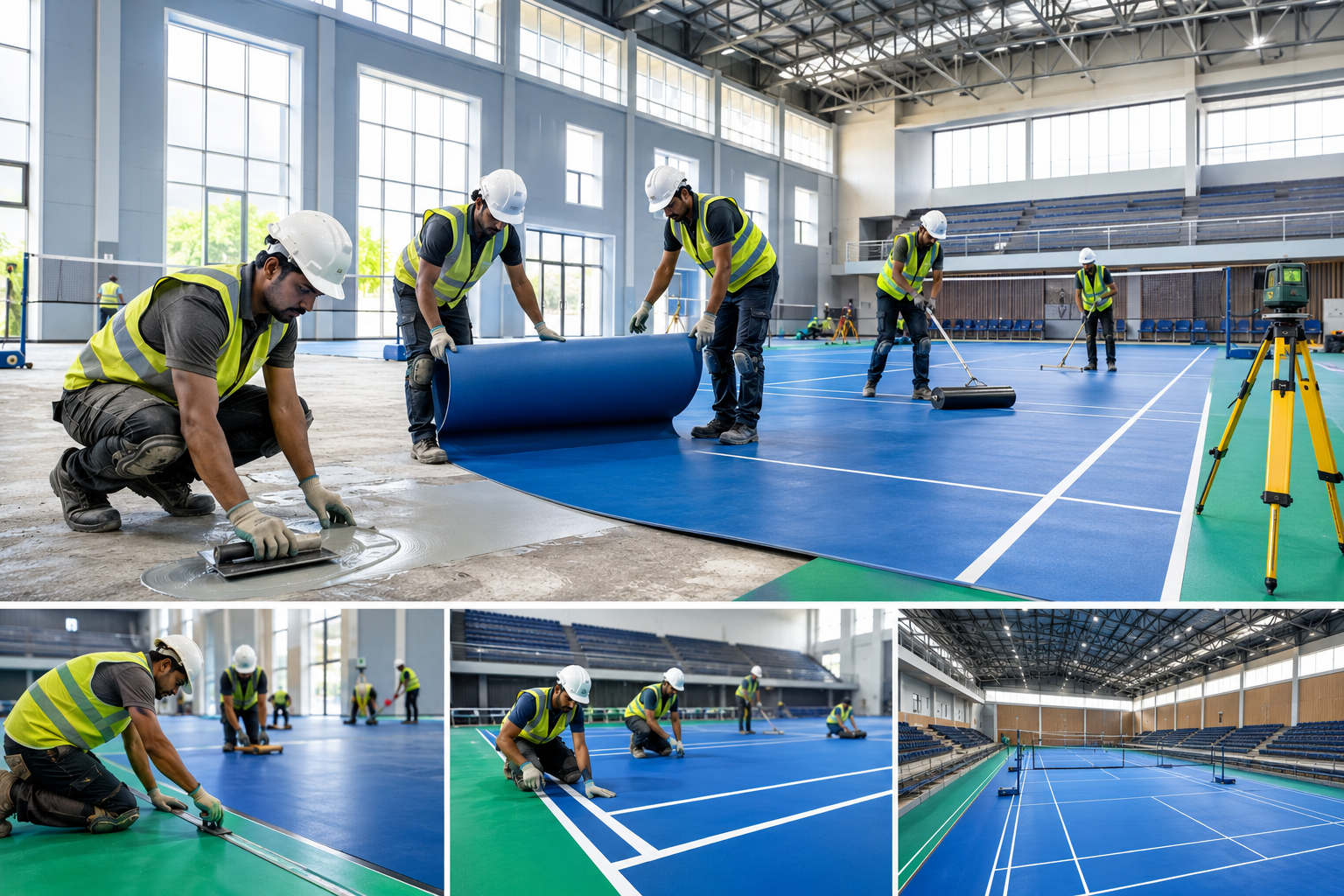
Badminton is becoming increasingly popular in Jamshedpur, with more schools, colleges, sports clubs, residential societies, and fitness centres making space for the sport. As interest in professional coaching and recreational activities grows, the need for well-built badminton courts is also increasing. Whether it is a school planning a new sports facility, an academy preparing for professional training, or a residential society looking to add a recreational amenity, having a properly designed badminton court can make a significant difference.
However, constructing a badminton court involves much more than preparing a flat surface and installing a net. The foundation, flooring, lighting, ventilation, court dimensions, and surrounding clearance all need careful attention. Even a small mistake in floor levelling or court marking can affect the playing experience and create safety concerns for players.
Modern badminton facilities use different flooring options, including synthetic PVC, polyurethane (PU), acrylic, and wooden sprung flooring. Each option has its own advantages in terms of comfort, durability, maintenance, and playing performance. The right choice depends on the intended use of the court, available budget, and expected number of players.
For institutions and organisations planning to develop a sports facility, professional construction is a worthwhile investment. A properly constructed court provides a comfortable playing environment, supports regular coaching, and can accommodate recreational matches and competitive events.
If you are planning badminton court construction in Jamshedpur, this guide will help you understand the important aspects of the project, from selecting the flooring material and checking court dimensions to construction methods, estimated costs, and regular maintenance.
Why Is Badminton Court Construction in Jamshedpur Becoming Popular?
Badminton is enjoyed by people of different age groups, from schoolchildren and college students to working professionals and experienced athletes. Its growing popularity has encouraged many organisations in Jamshedpur to improve their sports facilities.
There are several reasons behind the increasing demand for professionally constructed badminton courts.
Growing Interest in Sports and Fitness
People are becoming more conscious of their health and physical fitness. Badminton is a convenient way to stay active because it improves stamina, coordination, flexibility, and overall fitness. This has encouraged residential communities, fitness centres, and sports clubs to provide dedicated badminton facilities.
Increasing Demand from Schools and Colleges
Educational institutions are giving greater importance to sports and extracurricular activities. A dedicated badminton court allows students to participate in regular practice, inter-school competitions, and coaching programmes. It also gives institutions an opportunity to develop young sporting talent.
Development of Badminton Academies
Professional coaching requires a suitable playing environment. Badminton academies need courts with proper dimensions, reliable flooring, adequate lighting, and enough space for players to move comfortably. A professionally constructed facility helps coaches conduct training sessions more effectively.
Better Facilities in Residential Societies
Many modern residential projects are including sports facilities as part of their lifestyle amenities. Badminton courts are particularly useful because they can be enjoyed by children, adults, and senior residents. They also encourage people within a community to spend more time participating in physical activities.
Opportunities for Indoor Sports Throughout the Year
Jamshedpur experiences seasonal rainfall and changing weather conditions. An indoor badminton court allows players to continue their activities without worrying about rain, wind, or excessive sunlight. Proper ventilation and lighting further improve the indoor playing environment.
Long-Term Value for Property Owners
A well-maintained badminton court can become an attractive feature of a school, club, hotel, residential complex, or commercial property. Depending on the business model, it can also generate revenue through coaching programmes, hourly bookings, tournaments, and sports events.
Types of Badminton Courts and Flooring Options
Choosing the right flooring is one of the most important decisions when planning a badminton court. The surface should provide sufficient grip, comfortable foot movement, and suitable shock absorption.
Different flooring materials are available, and each is designed for particular requirements.
1. Wooden Badminton Courts
Wooden badminton flooring is commonly used in professional indoor sports facilities where player comfort and performance are major priorities. Unlike ordinary wooden flooring, sports-grade wooden systems are designed with a specialised subfloor that provides controlled cushioning.
Important features:
-
High-quality hardwood or engineered timber surface.
-
Sprung subfloor construction for shock absorption.
-
Comfortable movement and foot support.
-
Consistent playing characteristics.
-
Premium appearance suitable for professional facilities.
-
Suitable for indoor stadiums and sports academies.
Why choose wooden flooring?
Wooden sprung flooring helps reduce the impact experienced by players during jumping, landing, and rapid changes in direction. It is particularly suitable for facilities that host regular training sessions and competitive matches.
However, it requires proper cleaning, periodic refinishing, and humidity control. The initial installation cost is also generally higher than synthetic flooring.
2. Synthetic PVC Badminton Flooring
Synthetic PVC flooring is one of the most widely used options for indoor badminton courts. It is available in different thicknesses, colours, and surface finishes.
The flooring usually consists of multiple layers designed to provide a combination of grip, cushioning, and durability.
Key features:
-
Cushioned sports surface.
-
Anti-slip texture.
-
Consistent playing experience.
-
Multiple colour combinations.
-
Easy day-to-day cleaning.
-
Suitable for schools, academies, and clubs.
Advantages:
PVC sports flooring offers a practical balance between cost and performance. It is suitable for facilities that experience regular player movement and require a relatively easy-to-maintain surface.
The quality of the flooring, its thickness, subfloor preparation, and installation method all influence its performance and lifespan.
3. Polyurethane (PU) Badminton Flooring
PU flooring is another option used in sports facilities that require a seamless synthetic surface. It is generally installed through a specialised coating process over a properly prepared base.
Main characteristics:
-
Seamless surface finish.
-
Good surface grip.
-
Customisable colours.
-
Cushioned systems available.
-
Easy cleaning.
-
Suitable for selected indoor sports applications.
Benefits of PU flooring:
PU systems can provide a smooth and visually appealing playing surface. Depending on the system specification, they can also offer useful cushioning and resistance to regular wear.
The complete flooring specification should be selected carefully to ensure it is appropriate for badminton rather than simply using a general-purpose PU coating.
4. Acrylic Badminton Court Flooring
Acrylic flooring is generally used for outdoor sports courts and selected multipurpose sports surfaces. It is applied over a properly prepared concrete or asphalt base.
Features include:
-
Weather-resistant coating systems.
-
Bright and attractive colours.
-
Good surface texture.
-
Relatively simple maintenance.
-
Customisable court markings.
-
Suitable for outdoor recreational facilities.
Acrylic courts are more exposed to weather conditions than indoor synthetic courts. Wind, sunlight, and rain can also affect badminton gameplay, so this flooring is generally more appropriate for recreational use than professional indoor badminton facilities.
5. Modular Sports Flooring
Modular flooring uses interlocking tiles that fit together to create a sports surface. It is useful for community facilities, temporary sports installations, and multipurpose areas.
Advantages:
-
Quick installation.
-
Individual tile replacement.
-
Easy transportation.
-
Reusable flooring system.
-
Suitable for selected outdoor applications.
-
Minimal installation downtime.
Before choosing modular flooring, check whether the specific tile system is designed and tested for badminton. Not every interlocking sports tile provides the playing characteristics required for competitive badminton.
Standard Badminton Court Dimensions as per BWF
Correct measurements are essential for building a badminton court. The Badminton World Federation (BWF) specifies the official court dimensions used in competitive badminton.
The standard court is rectangular, with different width measurements for singles and doubles matches.
Official Badminton Court Measurements
| Specification | Standard measurement |
|---|---|
| Court length | 13.40 metres |
| Singles court width | 5.18 metres |
| Doubles court width | 6.10 metres |
| Net height at posts | 1.55 metres |
| Net height at centre | 1.524 metres |
| Net post position | On the doubles sidelines |
The actual playing area is not the only space that needs to be considered. Players require additional clearance around the court for safe movement.
When planning an indoor badminton facility, consider:
-
Sufficient space behind the baselines.
-
Adequate clearance along both sidelines.
-
Appropriate ceiling height.
-
Uniform lighting without glare.
-
Good ventilation and air circulation.
-
Safe access for players and spectators.
-
Proper positioning of net posts and equipment.
For competitive facilities, the available space and playing conditions should be checked against the applicable BWF competition requirements. A general-purpose indoor court may have different clearance and ceiling requirements from a tournament venue.
Step-by-Step Process of Badminton Court Construction in Jamshedpur
Constructing a badminton court requires coordination between civil engineers, flooring specialists, electricians, and installation professionals. Following a planned process helps avoid unnecessary delays and reduces the possibility of future problems.
1. Site Inspection and Planning
The first step is to inspect the proposed site and understand its construction requirements.
The available area, existing floor condition, soil quality, drainage, and accessibility are evaluated before the design is finalised.
The planning stage generally includes:
-
Measuring the available space.
-
Checking soil and ground conditions.
-
Assessing existing flooring levels.
-
Reviewing drainage arrangements.
-
Planning the court layout.
-
Evaluating lighting and ventilation.
-
Identifying electrical and utility requirements.
-
Preparing the estimated project budget.
Proper planning is particularly important when several badminton courts are being developed within the same building.
2. Ground Preparation and Civil Construction
The foundation provides support to the complete badminton flooring system. If the base is uneven or develops cracks, the finished sports surface may also experience problems.
For a new outdoor facility, ground preparation may involve excavation, filling, compaction, and concrete construction.
For an indoor facility, the existing RCC floor may be suitable after proper inspection and surface preparation.
Common activities include:
-
Site cleaning and excavation, where required.
-
Soil compaction.
-
Granular sub-base preparation.
-
Reinforced concrete construction, where specified.
-
Surface levelling.
-
Crack inspection and repairs.
-
Moisture protection.
-
Proper curing of concrete.
The foundation should be sufficiently level and stable before sports flooring installation begins.
3. Moisture Protection and Surface Preparation
Moisture is an important consideration in Jamshedpur because seasonal rainfall and humidity can affect sports flooring.
Before installation, the contractor should check the moisture condition of the concrete base and identify possible sources of water penetration.
Depending on the site, the preparation work may include:
-
Damp-proof membrane installation.
-
Waterproofing treatment.
-
Moisture testing.
-
Crack filling.
-
Application of suitable primers.
-
Removal of dust and loose material.
This stage helps prevent adhesive failure, flooring damage, and other moisture-related problems.
4. Sports Flooring Installation
Once the foundation is ready, the selected flooring system is installed.
The installation method varies depending on whether the project uses PVC, PU, wooden, or modular flooring.
For synthetic PVC flooring, the process generally involves:
-
Cleaning and preparing the base.
-
Applying the recommended adhesive.
-
Positioning the flooring rolls.
-
Allowing the material to settle.
-
Welding or finishing the seams where required.
-
Completing the edges and joints.
-
Checking the finished surface.
Wooden flooring requires a different installation method involving a suitable subfloor and sprung support system.
Professional installation is important because incorrect bonding, uneven joints, or poor surface preparation can affect the playing experience.
5. Badminton Court Marking
After the flooring installation is completed, the court lines are marked according to official badminton measurements.
The lines must be clear, straight, and consistent throughout the playing area.
The marking work includes:
-
Singles sidelines.
-
Doubles sidelines.
-
Baselines.
-
Short service lines.
-
Long service lines for doubles.
-
Centre lines.
The contractor should use accurate measuring equipment to ensure that the markings follow the required dimensions.
6. Lighting and Ventilation Installation
Good lighting is essential for badminton because players constantly track a fast-moving shuttlecock.
Poorly positioned lights can create glare and make it difficult to follow the shuttle during play.
A professional lighting arrangement should provide:
-
Uniform illumination.
-
Reduced glare.
-
Proper fixture positioning.
-
Energy-efficient LED lights.
-
Suitable electrical protection.
-
Easy maintenance access.
Ventilation should also be planned carefully. Excessive air movement across the playing area can affect shuttlecock flight, so fans and air-conditioning outlets should be positioned appropriately.
7. Installation of Badminton Equipment
The final stage involves installing the equipment required for playing and operating the facility.
Typical accessories include:
-
Badminton net.
-
Heavy-duty net posts.
-
Net tensioning arrangements.
-
Protective post padding.
-
Player benches.
-
Scoreboards.
-
Spectator seating.
-
Safety equipment.
-
Storage facilities.
Once the equipment is installed, the contractor should inspect the entire facility before handing it over to the client.
Estimated Cost of Badminton Court Construction in Jamshedpur
The cost of building a badminton court depends on the flooring material, condition of the site, civil work, available infrastructure, and additional facilities.
A project involving only synthetic flooring over an existing indoor concrete floor will cost considerably less than a complete facility requiring a new foundation, roofing, lighting, and ventilation.
Approximate Sports Flooring Rates
The following figures are indicative planning estimates and should not be treated as confirmed local quotations.
| Flooring type | Approximate rate |
|---|---|
| Synthetic PVC flooring | ₹90–₹150 per sq. ft. |
| PU sports flooring | ₹100–₹160 per sq. ft. |
| Wooden sports flooring | ₹250–₹400 per sq. ft. |
| Modular sports flooring | ₹120–₹200 per sq. ft. |
Actual rates vary according to product specifications, thickness, subfloor requirements, installation charges, and supplier pricing.
What Is the Total Cost of One Badminton Court?
A basic indoor badminton court project may require an estimated investment of ₹6 lakh to ₹12 lakh, depending on the scope of work.
However, this range is not a fixed turnkey price. A project requiring a complete steel structure, roofing, civil foundation, electrical installation, and additional amenities may cost substantially more.
Factors That Affect Construction Costs
Flooring selection: Wooden flooring generally requires a higher initial investment than basic synthetic flooring.
Civil work: Excavation, RCC construction, levelling, and waterproofing add to the overall budget.
Building structure: New indoor facilities require roofing, steel structures, and suitable ceiling arrangements.
Lighting: The number and specification of LED sports lights influence electrical installation costs.
Ventilation: Exhaust systems, air circulation arrangements, and air-conditioning requirements affect the project budget.
Accessories: Nets, posts, seating, scoreboards, and safety equipment are additional expenses.
Number of courts: Developing multiple courts together can change the overall project economics and infrastructure requirements.
For an accurate quotation, it is advisable to obtain a site inspection and a detailed bill of quantities before starting construction.
Maintenance Tips for a Long-Lasting Badminton Court
Regular maintenance keeps the playing surface in good condition and reduces the chances of expensive repairs. The maintenance routine depends on the type of flooring installed and the amount of daily use.
Daily Maintenance
A few simple steps can help maintain the court’s cleanliness and safety.
-
Sweep or vacuum the playing surface.
-
Remove dust and loose particles.
-
Wipe spills immediately.
-
Keep the floor dry before players enter.
-
Check the net and posts.
-
Inspect the flooring for visible damage.
-
Ensure the lighting system is working properly.
Avoid using harsh chemicals or cleaning equipment that may damage the flooring.
Weekly and Monthly Maintenance
Periodic inspection helps identify problems before they become serious.
Recommended activities include:
-
Checking flooring seams and joints.
-
Inspecting court markings.
-
Cleaning difficult stains.
-
Checking net tension.
-
Inspecting protective padding.
-
Cleaning ventilation equipment.
-
Checking lights and electrical fittings.
-
Examining drainage arrangements in outdoor areas.
Always follow the flooring manufacturer’s cleaning recommendations.
Long-Term Maintenance
Every sports flooring system needs occasional professional attention.
Depending on the material and usage, long-term maintenance may include:
-
Recoating synthetic surfaces.
-
Replacing damaged PVC sections.
-
Refinishing wooden flooring.
-
Repairing loose flooring joints.
-
Repainting faded court lines.
-
Checking the foundation for cracks.
-
Inspecting waterproofing systems.
-
Servicing lighting and ventilation equipment.
A planned maintenance programme helps preserve the court’s appearance and playing characteristics over time.
Common Challenges in Badminton Court Construction in Jamshedpur
Although badminton court construction may appear straightforward, several technical issues can affect the quality of the finished facility.
1. Moisture and Humidity
Rainfall and humidity can create problems if the foundation and flooring are not properly protected.
Moisture may affect flooring adhesives, wooden surfaces, and concrete bases.
To reduce these risks, contractors should use suitable waterproofing systems, moisture barriers, and proper drainage arrangements.
2. Uneven Flooring
An uneven base can cause problems during flooring installation and affect player movement.
Laser levelling, proper concrete preparation, and surface inspection help achieve the required finish.
3. Inadequate Ceiling Height
Badminton requires sufficient vertical clearance because the shuttlecock frequently travels high above the players.
The building should be designed with appropriate ceiling height and without unnecessary obstructions such as low beams, hanging lights, or exposed equipment.
4. Poor Lighting Arrangement
Improper lighting can create shadows and glare, making it difficult for players to follow the shuttlecock.
Using suitable LED fixtures and carefully planning their positions can improve visibility.
5. Incorrect Court Dimensions
Even small measurement errors can affect the usability of a badminton court.
All markings, net positions, and court dimensions should be checked before the facility is opened.
6. Incomplete Budget Planning
Some projects consider only flooring costs and overlook foundation work, electrical installation, equipment, and future maintenance.
A complete project estimate should include all essential construction and operational expenses.
Where Can Badminton Courts Be Used?
Professionally constructed badminton courts are suitable for a wide range of facilities in Jamshedpur.
Common applications include:
-
Schools and educational institutions.
-
Colleges and universities.
-
Professional badminton academies.
-
Indoor sports stadiums.
-
Government sports facilities.
-
Residential societies.
-
Apartment clubhouses.
-
Corporate campuses.
-
Hotels and resorts.
-
Fitness and wellness centres.
-
Community recreation centres.
-
Multipurpose sports complexes.
Each facility has different requirements. For example, a school may prioritise durability and easy maintenance, while a professional academy may require advanced flooring, better lighting, and additional training space.
Why Hire a Professional Badminton Court Construction Company?
Choosing the right contractor is just as important as choosing the flooring material. A reliable sports construction company understands the technical requirements of badminton facilities and can coordinate different stages of the project.
An experienced contractor can assist with:
-
Site inspection and feasibility assessment.
-
Court layout and design.
-
Civil construction and RCC foundation.
-
Moisture protection and waterproofing.
-
Synthetic PVC and PU flooring installation.
-
Wooden sports flooring installation.
-
Modular flooring solutions.
-
Accurate badminton court markings.
-
LED sports lighting.
-
Ventilation planning.
-
Sports equipment installation.
-
Final quality inspection.
-
Maintenance and after-sales support.
Before finalising a contractor, check previous project experience, flooring specifications, installation methods, product warranties, and the quality of completed work.
It is also useful to request a written quotation that clearly separates material costs, labour charges, civil work, equipment, and other expenses.
Conclusion
Building a good badminton court requires proper planning, suitable materials, and attention to construction details. With growing interest in sports and fitness, the demand for badminton court construction in Jamshedpur is creating opportunities for schools, colleges, sports academies, residential societies, and commercial establishments to develop better sporting facilities.
From selecting the right flooring to preparing a stable foundation, installing proper lighting, and marking the court accurately, every stage contributes to the quality of the finished facility.
Synthetic PVC and PU flooring are practical choices for many indoor courts, while wooden sprung flooring is worth considering for professional training and competition venues. The final decision should always depend on the intended use, available budget, and expected level of play.
Whether you are planning a single badminton court or a complete sports complex, investing in professional design and construction can help create a facility that remains safe, attractive, and functional for years.
With the right construction partner and a well-planned maintenance schedule, your badminton court can become a valuable sports facility for the Jamshedpur community.
Frequently Asked Questions (FAQs)
1. What is the cost of constructing a badminton court in Jamshedpur?
The estimated cost of a basic indoor badminton court project can range from ₹6 lakh to ₹12 lakh. The actual amount depends on flooring selection, civil construction, lighting, equipment, and building requirements.
2. Which flooring is most suitable for badminton courts?
Synthetic PVC flooring is a popular choice for schools, clubs, and badminton academies because of its cushioning, grip, and maintenance convenience. PU flooring and wooden sprung flooring are also suitable depending on the project requirements.
3. What is the standard size of a badminton court?
A standard badminton court is 13.40 metres long. Its width is 6.10 metres for doubles and 5.18 metres for singles.
4. How much space is required to construct a badminton court?
The playing area measures 13.40 metres by 6.10 metres for doubles. Additional space is needed around the court for player movement, safety clearance, and access. Tournament facilities may require larger surrounding clearances.
5. How long does badminton court construction take?
A basic project involving flooring installation over an existing prepared surface may take considerably less time than a complete facility. Most projects can take approximately 2–6 weeks, although major civil and structural construction may require longer.
6. Is PVC flooring suitable for professional badminton courts?
Yes, specialised sports-grade PVC flooring is widely used in indoor badminton facilities. However, the flooring should have suitable sports performance characteristics and be installed according to the manufacturer’s specifications.
7. Can badminton courts be constructed outdoors?
Yes, outdoor badminton courts can be constructed using suitable acrylic or modular sports flooring systems. However, outdoor play is affected by wind, rain, sunlight, and temperature, making indoor courts more suitable for competitive badminton.
8. What ceiling height is required for an indoor badminton court?
The required ceiling clearance depends on the level of play and the applicable competition requirements. Recreational facilities and professional tournament venues may have different requirements, so the building height should be finalised during the design stage.
9. How should a badminton court be maintained?
Regular sweeping, dust removal, immediate cleaning of spills, and periodic inspection are essential. Wooden flooring may need refinishing, while synthetic flooring should be cleaned and repaired according to the manufacturer’s instructions.
10. Can an existing indoor hall be converted into a badminton court?
Yes. An existing hall can often be converted into a badminton facility if it has sufficient space, ceiling clearance, a suitable floor base, and appropriate lighting and ventilation. A professional site inspection is recommended before beginning the work.
11. Which organisations need professional badminton court construction services?
Schools, colleges, universities, sports academies, residential societies, hotels, clubs, corporate campuses, and government sports departments can all benefit from professionally constructed badminton courts.
12. What should I check before hiring a badminton court contractor?
Check the contractor’s previous projects, flooring quality, technical specifications, installation experience, quotation details, warranty terms, and after-sales service. A proper site assessment and written project proposal can help you make a better decision.