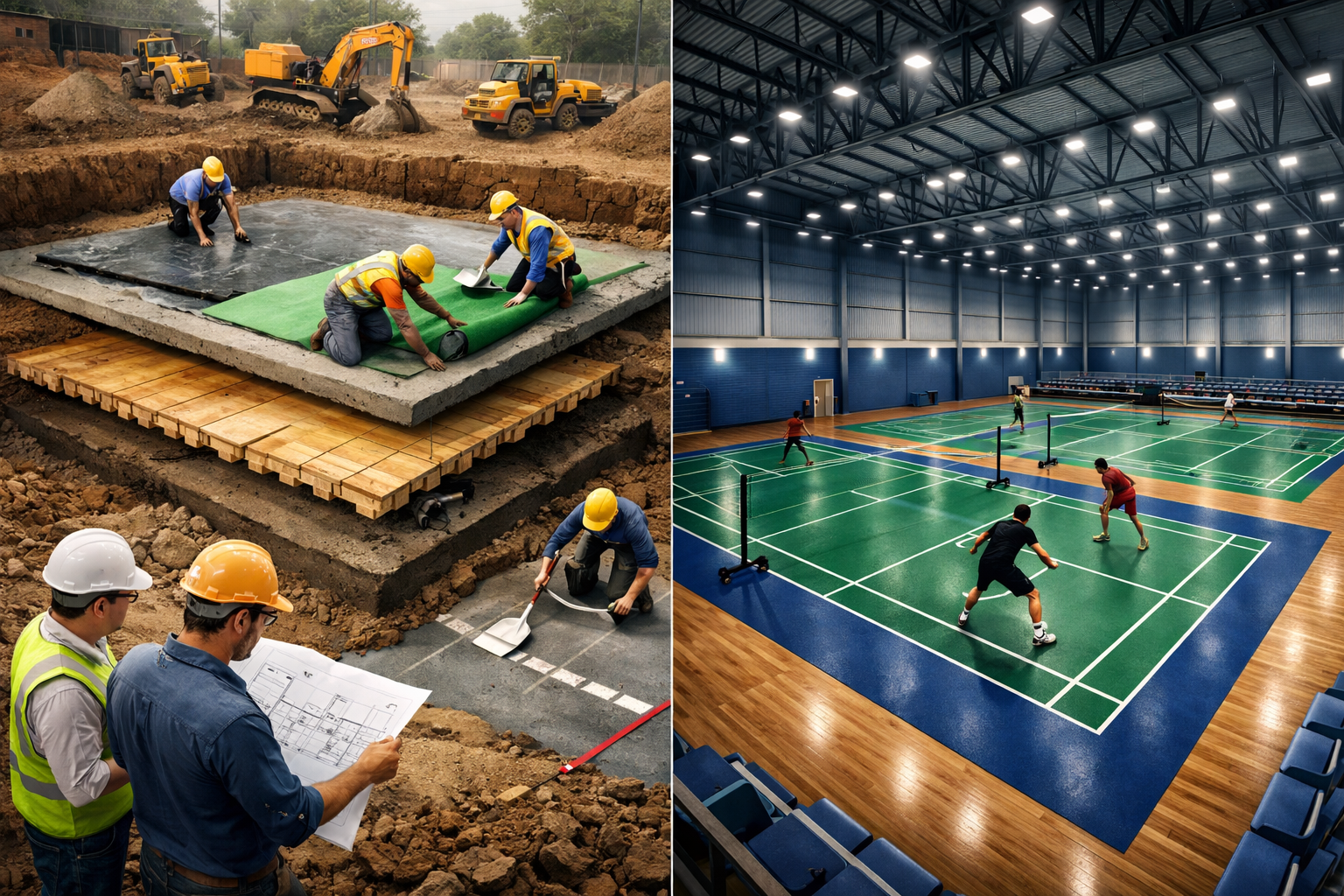
Badminton is now one of India’s fastest-growing indoor sports, with increasing demand from schools, colleges, sports academies, residential societies, fitness centres, clubs, and commercial sports facilities. As more people invest in professional sports infrastructure, choosing an experienced badminton court builder in India has become essential for achieving the right combination of playing performance, player safety, durability, and professional appearance.
Building a badminton court involves much more than installing a playing surface and marking lines. A properly engineered facility requires accurate space planning, a stable base, suitable sports flooring, professional lighting, controlled airflow, quality equipment, and precise installation. Every component must work together to create a comfortable and reliable playing environment.
Whether you are developing a single indoor badminton court or a multi-court sports complex, the choice of construction partner can directly influence the performance and lifetime of the facility. An experienced badminton court builder understands the technical requirements of sports flooring, court dimensions, subfloor preparation, cushioning, line marking, lighting, drainage, and finishing.
This comprehensive guide explains the complete process of badminton court construction in India, including court dimensions, flooring options, construction stages, cost factors, maintenance requirements, and how to select the right badminton court construction company.
What Does a Badminton Court Builder Do?
A professional badminton court builder in India manages the planning, construction, flooring, installation, and finishing of a badminton playing facility.
Depending on the project, the scope may include:
- Site inspection and measurement
- Court layout and space planning
- Civil foundation and base preparation
- Indoor sports flooring installation
- Wooden, PVC, PU, or synthetic flooring systems
- Court line marking
- Badminton net and post installation
- LED sports lighting
- Ventilation and airflow planning
- Safety padding and wall protection
- Player seating and accessories
- Quality inspection and final handover
- Maintenance and resurfacing support
A professional builder should also understand the requirements of recreational, training, academy, and tournament-level facilities.
The objective is to create a court that provides consistent bounce, suitable grip, controlled shock absorption, accurate dimensions, excellent visibility, and long-term durability.
Why Choose a Professional Badminton Court Builder in India?
Badminton involves frequent jumping, sudden changes in direction, lunges, rapid acceleration, and repetitive footwork. Therefore, the playing surface needs to provide an appropriate balance between traction and cushioning.
An improperly constructed court may develop problems such as:
- Uneven flooring
- Poor surface grip
- Excessive hardness
- Inadequate shock absorption
- Moisture-related damage
- Peeling or cracking
- Incorrect court markings
- Glare from unsuitable lighting
- Poor ventilation
- Premature flooring failure
Working with an experienced badminton court builder helps reduce these risks by addressing the complete facility rather than treating flooring as an isolated component.
Professional construction also helps ensure that the court is designed according to its intended use, expected player traffic, available space, and project budget.
Standard Badminton Court Dimensions in India
Correct dimensions are one of the most important parts of badminton court construction.
According to standard badminton court measurements:
- Court length: 13.40 metres
- Doubles court width: 6.10 metres
- Singles court width: 5.18 metres
- Net height at the centre: 1.524 metres
- Net height at the posts: 1.55 metres
The actual playing court is not the only space that should be considered during construction.
Additional clearance around the court is necessary for:
- Player movement
- Safety
- Spectator circulation
- Equipment placement
- Maintenance
- Seating
- Access pathways
For a multi-court facility, the badminton court builder should carefully plan the spacing between courts to prevent players from interfering with neighbouring games.
Space Required for a Badminton Court
A common mistake in sports facility planning is allocating only the official court dimensions.
A professional badminton facility requires additional space around the playing area. The required overall footprint depends on the type of facility, number of courts, ceiling height, spectator requirements, circulation space, and safety provisions.
For indoor facilities, the planning stage should consider:
- Playing area
- Run-off space
- Court-to-court clearance
- Side access
- Rear clearance
- Net-post area
- Player seating
- Lighting zones
- Ventilation equipment
- Storage
- Reception or spectator areas where applicable
A skilled badminton court builder can prepare an efficient layout that maximizes usable space without compromising player safety.
Types of Badminton Courts Built in India
1. Indoor Badminton Courts
Indoor badminton courts are the preferred choice for academies, schools, clubs, stadiums, and commercial sports facilities.
They provide better control over:
- Lighting
- Temperature
- Air movement
- Flooring conditions
- Weather exposure
- Playing environment
Indoor construction also provides greater flexibility when selecting premium flooring systems.
2. Outdoor Badminton Courts
Outdoor courts require materials that can withstand:
- Sunlight
- Rain
- Temperature fluctuations
- Dust
- Moisture
- Heavy recreational use
Acrylic and other weather-resistant sports surface systems are commonly considered for outdoor applications.
However, wind can significantly affect shuttlecock movement, which is why professional competitive badminton is generally played indoors.
3. Multi-Court Badminton Facilities
Commercial academies and sports complexes often require multiple courts under one roof.
A multi-court project requires detailed planning for:
- Court orientation
- Player circulation
- Lighting
- Ceiling height
- Airflow
- Spectator movement
- Equipment storage
- Emergency access
- Acoustic control
An experienced badminton court builder can integrate these requirements into one coordinated facility design.
Badminton Court Flooring Options
Flooring is one of the most critical investments in badminton court construction. The correct surface can influence player comfort, movement, traction, shock absorption, and maintenance requirements.
Wooden Badminton Court Flooring
Wooden flooring is widely associated with premium indoor sports facilities.
A properly designed wooden sports floor can provide:
- Excellent shock absorption
- Comfortable foot response
- Professional appearance
- Controlled playing characteristics
- High-quality performance
Sprung wooden systems are particularly useful where impact reduction is a major consideration.
The subfloor, suspension system, timber quality, surface treatment, and installation method all influence final performance.
PVC Vinyl Sports Flooring
PVC sports flooring is a popular option for indoor badminton courts.
Its advantages may include:
- Good cushioning
- Consistent surface finish
- Low maintenance
- Easy cleaning
- Professional appearance
- Suitable traction
PVC systems are available in different constructions and performance levels, so the product should be selected according to the intended use of the court.
PU Sports Flooring
Polyurethane sports flooring can provide a seamless and durable surface when correctly installed.
It may be suitable for facilities requiring:
- High wear resistance
- Seamless finish
- Shock-absorbing construction
- Easy maintenance
- Long service life
The quality of the base preparation and installation process is particularly important for PU flooring.
Acrylic Sports Flooring
Acrylic systems are commonly used for outdoor sports surfaces.
A properly engineered acrylic badminton surface can offer:
- Weather resistance
- UV resistance
- Good traction
- Attractive appearance
- Relatively simple maintenance
The system should be selected according to site conditions, drainage, usage, and environmental exposure.
Badminton Court Construction Process
A professional badminton court builder in India generally follows a systematic construction process.
Site Inspection
The project begins with an assessment of the proposed location.
The builder evaluates:
- Available dimensions
- Existing flooring
- Soil and structural conditions
- Moisture levels
- Drainage
- Ceiling height
- Electrical requirements
- Access for materials
- Environmental conditions
This information helps determine the appropriate construction methodology.
Court Design and Layout
The next stage involves preparing the court layout.
The design should establish:
- Court dimensions
- Court orientation
- Safety clearance
- Flooring specification
- Lighting positions
- Net locations
- Player circulation
- Seating requirements
For multi-court facilities, the layout must be carefully coordinated to maximize capacity while maintaining safe movement.
Base Preparation
The playing surface is only as reliable as the base underneath it.
Depending on the project, the base may involve:
- Reinforced concrete
- Cementitious screed
- Asphalt
- Engineered wooden subfloor
- Other approved structural systems
The surface should be sufficiently stable, level, clean, and suitable for the selected sports flooring system.
Moisture testing is also important for indoor flooring installations where excessive moisture could damage adhesives or flooring materials.
Surface Correction and Leveling
Before flooring installation, irregularities in the base should be corrected.
The builder may perform:
- Grinding
- Leveling
- Crack treatment
- Surface cleaning
- Joint treatment
- Moisture control
- Primer application
Precision at this stage helps prevent problems from appearing after the final flooring is installed.
Sports Flooring Installation
The selected flooring system is installed according to its technical specifications.
Depending on the material, installation can involve multiple layers such as:
- Primer
- Cushioning layer
- Sports surface
- Protective coating
- Finishing layer
The exact system varies according to the flooring type and manufacturer specifications.
Court Line Marking
Precise line marking is essential.
Court markings should be:
- Straight
- Clearly visible
- Correctly positioned
- Consistent in width
- Durable
- Suitable for the selected flooring
Professional installation equipment and measurement techniques help achieve accurate markings.
Lighting Installation
Lighting must be planned specifically for badminton.
Players frequently track a fast-moving shuttlecock against the ceiling, making glare and uneven illumination particularly problematic.
A professional lighting design should focus on:
- Uniform illumination
- Low glare
- Appropriate mounting height
- Good colour rendering
- Minimal shadows
- Efficient energy consumption
LED sports lighting is widely used in modern badminton facilities.
Net and Equipment Installation
The final installation stage includes badminton equipment such as:
- Net posts
- Badminton nets
- Umpire chairs
- Player benches
- Scoreboards
- Safety padding
- Storage equipment
All equipment should be securely installed and positioned without interfering with player movement.
Badminton Court Ceiling Height
Ceiling height is an important consideration that is sometimes overlooked during facility planning.
Badminton requires significant vertical clearance because players frequently hit high clears and lifts. Low ceilings can interfere with gameplay and reduce the suitability of a venue for serious training or competitive use.
The appropriate clear height depends on the intended level of play, facility design, lighting arrangement, structural services, and applicable standards.
A professional badminton court builder should evaluate the clear playing height, rather than simply measuring the total building height.
Lighting Requirements for Badminton Courts
Badminton lighting needs special attention because the shuttlecock can move rapidly through the player’s field of vision.
Poor lighting can cause:
- Glare
- Visual discomfort
- Difficulty tracking the shuttle
- Uneven illumination
- Shadows
- Reduced playing quality
Modern badminton facilities generally use carefully positioned LED fixtures designed to provide consistent illumination across the playing area.
Lighting should be planned together with the ceiling structure rather than added after flooring construction.
Ventilation and Airflow
Air movement is another critical factor in badminton.
Excessive airflow can affect shuttlecock flight and make gameplay inconsistent. At the same time, an indoor sports facility needs sufficient ventilation to maintain comfort and air quality.
Therefore, ventilation should be engineered carefully.
Possible systems include:
- Mechanical ventilation
- Exhaust systems
- HVAC
- Controlled air circulation
- Natural ventilation where appropriate
The objective is to maintain a comfortable indoor environment without creating unnecessary air movement directly across the court.
Badminton Court Construction for Different Facilities
Schools and Colleges
Educational institutions require durable courts capable of handling frequent use.
A suitable system should balance:
- Safety
- Durability
- Maintenance
- Budget
- Student usage
Badminton Academies
Academies generally need higher-performance flooring because players may train for several hours each day.
The flooring, lighting, ventilation, and court layout should therefore be designed for intensive use.
Residential Societies
Residential developments increasingly include badminton courts as lifestyle and fitness amenities.
The design should focus on:
- Space efficiency
- Noise control
- Durability
- Easy maintenance
- User safety
Sports Clubs and Fitness Centres
Clubs and fitness centres can use professional badminton facilities to attract members and increase sports participation.
Premium flooring, attractive interiors, efficient lighting, and comfortable player areas can significantly improve the user experience.
Professional Sports Complexes
Large sports complexes may require several courts, spectator facilities, professional lighting, changing rooms, storage, and event infrastructure.
These projects require detailed coordination between civil, flooring, electrical, HVAC, and sports equipment teams.
Badminton Court Construction Cost in India
The cost of badminton court construction varies significantly from project to project. There is no single fixed price because several components influence the final investment.
Major cost factors include:
- Court size and number of courts
- Indoor or outdoor construction
- Existing floor condition
- Civil foundation requirements
- Flooring material
- Cushioning system
- Lighting
- Ceiling structure
- Ventilation
- Electrical work
- Badminton equipment
- Safety systems
- Spectator facilities
- Building construction, if required
A basic recreational court can have a very different budget from a fully equipped commercial badminton academy.
For an accurate estimate, a badminton court builder should inspect the site and prepare a detailed specification-based quotation rather than providing a generic per-court price.
How to Select the Best Badminton Court Builder in India
Choosing the right contractor is one of the most important decisions in the project.
Before finalizing a company, evaluate:
Experience
Check whether the contractor has experience with badminton courts and sports flooring projects.
Flooring Expertise
Ask about the flooring systems they install and their suitability for your intended level of play.
Project Portfolio
Review completed sports facilities rather than relying only on product brochures.
Technical Support
A professional builder should be able to explain base preparation, flooring layers, lighting, ventilation, and maintenance requirements.
Material Quality
Confirm the specifications and performance characteristics of the proposed materials.
Installation Team
Experienced installation technicians can make a significant difference to final flooring performance.
After-Sales Support
Maintenance, repair, resurfacing, and technical support can become important over the life of the facility.
Maintenance of a Badminton Court
Regular maintenance protects the investment and helps preserve playing performance.
Recommended practices include:
- Clean the floor regularly
- Use suitable sports-floor cleaning products
- Prevent dirt and grit from accumulating
- Avoid dragging heavy equipment
- Inspect flooring periodically
- Repair damaged areas promptly
- Check court markings
- Inspect nets and posts
- Maintain lighting systems
- Control moisture in indoor facilities
The maintenance procedure should always follow the flooring manufacturer’s recommendations.
Modern Trends in Badminton Court Construction
The Indian sports infrastructure industry is moving toward more performance-focused and technologically advanced facilities.
Current trends include:
Advanced Cushioning Systems
Modern sports flooring increasingly incorporates engineered cushioning to improve comfort and impact management.
Energy-Efficient LED Lighting
LED systems can provide efficient and consistent illumination while reducing energy consumption.
Modular Flooring
Modular and prefabricated flooring solutions can simplify installation and future replacement.
Smart Sports Facilities
Digital scoreboards, video systems, player analysis tools, and facility management technologies are becoming more common.
Sustainable Construction
Energy-efficient lighting, durable materials, responsible material selection, and efficient facility design are increasingly important in new sports projects.
Why Invest in a Professionally Built Badminton Court?
A professionally constructed court provides benefits beyond aesthetics.
It can help deliver:
- Better player safety
- Consistent playing conditions
- Improved comfort
- Reduced flooring problems
- Lower long-term maintenance
- Better facility appearance
- Greater user satisfaction
- Longer service life
For commercial facilities, quality construction can also contribute to better customer retention and a stronger reputation.
Badminton Court Builder in India – Complete Project Support
A reliable badminton court construction company should ideally provide complete project support from initial planning through final installation.
This can include:
Site Survey → Design → Base Preparation → Flooring → Line Marking → Lighting → Equipment → Quality Inspection → Handover → Maintenance
Using one experienced team for multiple components can simplify project coordination and reduce the possibility of compatibility issues between different contractors.
Frequently Asked Questions About Badminton Court Builders in India
1. What does a badminton court builder in India provide?
A badminton court builder can provide services ranging from site assessment and court planning to base construction, sports flooring, line marking, lighting, equipment installation, and final inspection.
2. Which flooring is best for a badminton court?
For indoor professional and training facilities, engineered wooden sports flooring and high-quality synthetic sports flooring systems are commonly considered. The best choice depends on usage, budget, building conditions, and performance requirements.
3. How much space is required for a badminton court?
The official court measures 13.40 m long and 6.10 m wide for doubles play, but additional clearance is required around the court for safe player movement and facility circulation.
4. Is wooden flooring suitable for badminton?
Yes. Properly engineered wooden sports flooring can provide excellent cushioning and a premium playing experience, making it suitable for high-performance indoor facilities.
5. Can badminton courts be constructed outdoors?
Yes. Outdoor courts can be constructed using weather-resistant sports surface systems. However, environmental conditions such as sunlight, rain, wind, and temperature must be considered.
6. How long does badminton court construction take?
The project duration depends on the existing site, civil work, flooring system, number of courts, building requirements, lighting, and finishing work. A site-specific schedule should be prepared before construction begins.
7. What is the cost of a badminton court in India?
There is no universal price. Construction costs vary according to flooring, civil work, indoor structure, lighting, ventilation, equipment, and project specifications. A professional site inspection provides a more reliable estimate.
8. Why is professional flooring installation important?
Professional installation helps ensure a level surface, correct cushioning, reliable adhesion, accurate finishing, and long-term durability.
9. What type of lighting is suitable for badminton?
Uniform, low-glare LED sports lighting is generally preferred for badminton facilities because players need clear visibility of the shuttlecock throughout the rally.
10. How can I choose a reliable badminton court builder?
Look for proven sports infrastructure experience, quality flooring systems, technical expertise, completed projects, professional installation teams, transparent specifications, and dependable after-sales support.
Conclusion
Choosing an experienced badminton court builder in India is the foundation of a successful sports facility. A high-quality badminton court requires careful planning, accurate dimensions, a stable base, performance-oriented flooring, appropriate lighting, controlled ventilation, professional equipment installation, and regular maintenance.
Whether the project is for a school, college, badminton academy, residential society, fitness centre, sports club, or large commercial sports complex, every detail should be planned around the intended level of use.
The right construction approach can create a court that is safer, more comfortable, visually appealing, durable, and capable of supporting years of intensive play. Instead of focusing only on the initial construction price, facility owners should evaluate flooring quality, installation expertise, long-term maintenance, performance, and overall lifecycle value.
With professional design and execution, a badminton court becomes more than a sports surface. It becomes a reliable sports infrastructure investment that supports training, fitness, competition, recreation, and community engagement for years to come.