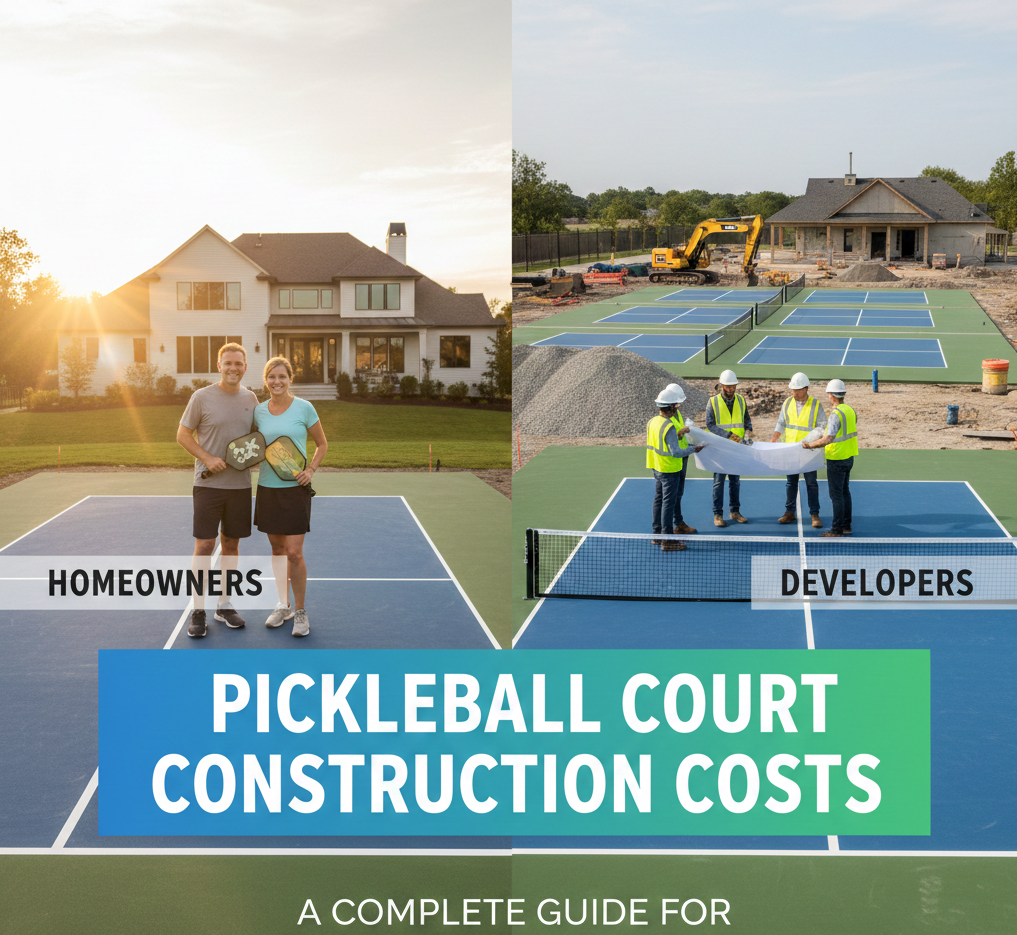
introduction
Pickleball is gaining remarkable popularity across India. What was once considered a niche recreational activity is now attracting homeowners, schools, residential communities, sports academies, fitness clubs, resorts, and commercial sports facility developers.
As demand for pickleball facilities continues to grow, one question comes up repeatedly: How much does it cost to build a pickleball court in India?
There is no single answer because the total investment depends on the condition of the site, type of foundation, sports surface, fencing, drainage, lighting, equipment, number of courts, and additional facilities. A basic court created by converting an existing sports surface can cost considerably less than a new premium court built from an undeveloped site.
This guide explains the major factors that determine pickleball court construction costs, helping homeowners and developers understand where their money goes and how to plan a realistic budget.
What Is the Average Cost of a Pickleball Court in India?
The cost of a pickleball court can vary significantly depending on the scope of construction.
As a general planning reference, an existing court conversion may require an investment of approximately ₹1.5 lakh to ₹5 lakh or more, while a new outdoor court can commonly fall in the range of ₹4 lakh to ₹8 lakh or more for basic construction.
A premium outdoor court with better civil work, sports surfacing, fencing, drainage, lighting, and accessories may reach ₹8 lakh to ₹15 lakh or more per court.
Commercial facilities with multiple courts can require a much larger investment because they often include additional infrastructure such as parking, reception areas, changing rooms, spectator seating, landscaping, electrical systems, toilets, and other amenities.
These numbers should be considered indicative rather than fixed prices. A professional site assessment is necessary to determine the actual cost.
Why Does Pickleball Court Construction Cost Vary?
Two pickleball courts with the same playing dimensions can have completely different construction costs.
For example, imagine two projects:
The first court is being constructed on a level site where a suitable concrete base already exists. The owner only needs surface preparation, sports coating, line marking and a net.
The second project is being developed on undeveloped land. It requires excavation, soil compaction, a new concrete foundation, drainage, fencing, electrical work, lighting and landscaping.
Both are pickleball courts, but their construction budgets will be very different.
The major cost factors include:
- Site preparation
- Court foundation
- Sports flooring
- Drainage
- Fencing
- Lighting
- Net and equipment
- Number of courts
- Location
- Labour and transportation
- Additional amenities
Understanding each component makes it easier to estimate the overall investment.
1. Site Preparation and Groundwork
Before the actual court is constructed, the site needs to be prepared properly.
A professional contractor should inspect the land for slope, soil condition, drainage, existing structures, vegetation and accessibility.
Depending on the property, site work may involve:
- Clearing vegetation and debris
- Excavation
- Filling low areas
- Soil stabilization
- Grading
- Leveling
- Compaction
- Sub-base preparation
- Drainage work
A flat, accessible site with good soil conditions can be less expensive to prepare. Difficult terrain may require additional machinery, materials and labour.
This is why a site inspection is one of the most important steps before preparing a final pickleball court quotation.
2. Court Foundation and Base Construction
The foundation is one of the most important parts of a pickleball court.
A sports surface may look attractive after installation, but its performance and durability depend heavily on what lies underneath it.
Outdoor courts are commonly constructed over suitable concrete or asphalt bases. The appropriate option depends on soil conditions, project requirements, drainage, climate and engineering considerations.
Foundation costs may be influenced by:
- Soil conditions
- Base thickness
- Reinforcement
- Concrete or asphalt specification
- Ground preparation
- Expansion and control joints
- Site accessibility
- Number of courts
A properly engineered base helps reduce problems such as settlement, unevenness and cracking.
Trying to save money by reducing essential foundation work can result in higher repair and resurfacing costs later.
3. Pickleball Court Surface Cost
The sports surface directly influences the playing experience.
For outdoor pickleball courts, acrylic sports surfacing is a popular choice because it can provide a consistent playing surface when installed over a suitable foundation.
Depending on the project, other sports flooring systems may also be considered.
The final surface cost can depend on:
- Surface preparation
- Number of coating layers
- Material quality
- Cushioning requirements
- Color selection
- Crack treatment
- Line marking
- Application process
A recreational residential court may have different surface requirements from a high-use sports academy or tournament facility.
Therefore, the cheapest available surface is not necessarily the most economical option over the long term.
4. Pickleball Court Fencing
Fencing is an important addition to many outdoor pickleball courts.
It helps keep balls within the playing area, separates the court from nearby spaces and improves overall safety.
Common options include:
- Chain-link fencing
- Galvanized steel fencing
- PVC-coated fencing
- Powder-coated fencing
- Sports-grade fencing
The cost depends on fence height, mesh specification, support posts, gates, foundations and finish.
A commercial facility may require stronger fencing and additional gates compared with a private backyard court.
5. Pickleball Court Lighting
If the court will be used after sunset, lighting becomes an important part of the project.
Modern LED sports lighting can provide efficient illumination while supporting longer playing hours.
A lighting system may include:
- LED sports fixtures
- Lighting poles
- Pole foundations
- Electrical cables
- Distribution panels
- Control systems
- Installation
The cost depends on the number of courts and the required lighting design.
For commercial facilities, lighting should be planned carefully to reduce glare and provide suitable visibility throughout the playing area.
6. Drainage Costs
Outdoor pickleball courts must be designed to handle rainwater effectively.
Standing water can interfere with play and may contribute to premature deterioration of the surface.
Depending on the property, drainage solutions can include:
- Court slope
- Peripheral drains
- Surface channels
- Catch pits
- Underground drainage pipes
- Stormwater connections
Drainage requirements are particularly important in regions that experience significant seasonal rainfall.
Including drainage during initial construction is usually better than trying to correct water-related problems after the court is completed.
7. Net, Posts and Court Accessories
The pickleball net is an essential component of the court.
A standard installation typically includes suitable net posts and a regulation-height net.
Depending on the facility, additional equipment can include:
- Scoreboards
- Player benches
- Equipment storage
- Ball baskets
- Shade structures
- Wind screens
- Referee chairs
- Spectator seating
A private court may need only basic equipment, while a commercial pickleball club may require a much more comprehensive setup.
Pickleball Court Dimensions
The standard pickleball playing area measures:
| Court Feature | Standard Dimension |
|---|---|
| Court Length | 44 ft / 13.41 m |
| Court Width | 20 ft / 6.10 m |
| Non-Volley Zone | 7 ft from the net |
| Net Height at Centre | 34 in / approx. 0.86 m |
| Net Height at Posts | 36 in / approx. 0.91 m |
The actual land requirement should be larger than the playing rectangle because players need space outside the lines for movement and safety.
For facilities with several courts, additional space is also required for walkways, seating, fencing, landscaping and circulation.
Residential Pickleball Court Construction
Homeowners who have sufficient outdoor space may choose to build a private pickleball court.
A residential project generally has fewer infrastructure requirements than a commercial facility.
The budget may include:
- Site preparation
- Court foundation
- Sports surface
- Court markings
- Net and posts
- Fencing
- Optional lighting
- Landscaping
- Seating
A homeowner can control the overall investment by selecting the surface specification, fencing style, lighting and additional amenities according to personal requirements.
For example, a private court intended for occasional family recreation may not need the same specification as a court used daily for professional training.
Commercial Pickleball Court Construction
The economics of a commercial pickleball facility are different.
Sports clubs, resorts, academies and recreational centres may construct several courts together to create a dedicated pickleball venue.
A commercial development may require:
- Multiple courts
- Professional sports surfacing
- Fencing
- LED lighting
- Drainage
- Reception area
- Toilets
- Changing rooms
- Player seating
- Spectator areas
- Parking
- Landscaping
- Security
- Storage
- Staff facilities
The total investment therefore depends on the entire facility rather than just the cost of the playing courts.
Is It Cheaper to Build Multiple Pickleball Courts?
In many cases, yes.
Developing several courts as part of one project can create economies of scale because some infrastructure can be shared.
For example, a multi-court facility may use common:
- Drainage systems
- Electrical infrastructure
- Access pathways
- Parking
- Reception
- Changing facilities
- Landscaping
- Security systems
Although the total project cost is higher, the cost per court can sometimes become more efficient compared with constructing completely independent courts.
This is one reason commercial developers should evaluate the project as a complete sports facility.
Converting an Existing Tennis Court Into Pickleball Courts
Conversion is another option worth considering.
An existing tennis court may have sufficient area to accommodate multiple pickleball layouts, depending on the required clearances and facility design.
Conversion work may include:
- Existing surface inspection
- Repairs
- Resurfacing
- Pickleball line marking
- Net installation
- Fence modifications
- Lighting modifications
If the existing foundation is in good condition, conversion can eliminate a significant portion of the civil construction work.
This can make conversion attractive for schools, residential communities, clubs and recreational facilities that already have unused sports courts.
Indoor vs Outdoor Pickleball Court Costs
Indoor courts generally require a larger overall investment than outdoor courts.
An outdoor court primarily requires the playing area and associated infrastructure. An indoor facility may require an entire building or the conversion of an existing structure.
Indoor construction can involve:
- Structural framework
- Roofing
- Flooring
- Insulation
- Ventilation
- Electrical systems
- Sports lighting
- Acoustic treatment
- Fire safety
- Changing rooms
- Toilets
However, indoor facilities can offer advantages such as protection from rain, controlled playing conditions and extended year-round operation.
For commercial developers, the decision between indoor and outdoor construction should therefore consider both construction costs and the expected business model.
How Location Affects Construction Cost
Location can have a noticeable effect on pickleball court construction costs.
Projects in major cities may face higher labour rates, transportation costs and contractor charges. However, material and skilled labour availability may be better.
Projects in smaller cities or semi-urban areas may benefit from lower labour costs but can sometimes involve higher transportation expenses or limited access to specialized contractors.
Other location-specific factors include:
- Soil conditions
- Weather
- Rainfall
- Material availability
- Site accessibility
- Local labour rates
- Electricity connection requirements
- Land development requirements
For an accurate estimate, the project location should always be included when requesting a quotation.
Pickleball Court Maintenance
A properly constructed court still requires regular maintenance.
Routine maintenance can include:
- Sweeping
- Dust removal
- Surface cleaning
- Crack inspection
- Minor repairs
- Line maintenance
- Fence inspection
- Net maintenance
- Lighting checks
- Periodic resurfacing
The maintenance frequency depends on usage, weather exposure, surface quality and installation standards.
Regular maintenance can help preserve the appearance and playing characteristics of the court and potentially extend the useful life of the sports surface.
How to Control Pickleball Court Construction Costs
There are several ways to manage the project budget without compromising essential construction quality.
Start With a Site Assessment
Understanding the site before construction begins helps identify potential additional expenses.
Choose the Right Surface
Select a surface according to the intended level of play rather than simply choosing the most expensive option.
Consider Court Conversion
If a suitable existing sports surface is available, conversion may reduce civil construction costs.
Build Multiple Courts Together
Commercial developers can investigate shared infrastructure to improve project efficiency.
Plan Drainage Before Construction
Early drainage planning can prevent expensive modifications later.
Separate Essential and Optional Features
Lighting, premium fencing, landscaping, spectator seating and decorative features can be planned according to budget and business requirements.
What Should You Ask a Pickleball Court Contractor?
Before accepting a quotation, ask the contractor for a clear description of what is included.
The quotation should ideally identify:
- Site preparation
- Foundation specification
- Sports surface system
- Surface preparation
- Court markings
- Net and posts
- Fencing
- Drainage
- Lighting
- Electrical work
- Transportation
- Labour
- Warranty
- Maintenance recommendations
- Taxes and applicable charges
Do not compare contractors solely on the final price.
A lower quotation may exclude important work that another contractor has included. Comparing the complete scope of work provides a much better basis for selecting a contractor.
Is Building a Pickleball Court a Good Investment?
For commercial developers, the investment potential depends on location, customer demand, operating costs, pricing strategy and facility utilization.
A pickleball venue can potentially serve multiple customer groups, including:
- Recreational players
- Sports academies
- Schools
- Corporate groups
- Fitness communities
- Sports clubs
- Tournament organizers
- Residential communities
However, construction should be preceded by proper market research and financial planning.
For homeowners, the value may be less about direct financial return and more about creating a dedicated recreational facility for family and community use.
Final Thoughts
Pickleball court construction costs in India depend on the complete scope of the project. A simple conversion of an existing sports surface can require a relatively small investment, while a new premium court can involve substantial expenditure on civil construction, sports surfacing, drainage, fencing and lighting.
For commercial developments, the budget can increase considerably when multiple courts and supporting amenities are included.
The most effective way to control costs is to plan the project carefully from the beginning. Evaluate the site, determine the intended use, select an appropriate surface, plan drainage and lighting, and obtain a detailed quotation that clearly identifies every component.
Whether you are a homeowner planning a private court or a developer creating a multi-court sports facility, professional planning can help you build a pickleball court that delivers durability, safety and a consistent playing experience.
Frequently Asked Questions
How much does a pickleball court cost in India?
The cost depends on the project scope. A basic new outdoor court may start around ₹4 lakh–₹8 lakh, while premium courts can cost ₹8 lakh–₹15 lakh or more. Existing-court conversions may cost less.
What is the standard size of a pickleball court?
The standard playing area is 20 feet wide by 44 feet long, equivalent to approximately 6.10 metres by 13.41 metres.
What is the best surface for an outdoor pickleball court?
A properly installed acrylic sports surface over a suitable concrete or asphalt foundation is a common solution for outdoor pickleball courts. The ideal specification depends on the site and intended usage.
Can a tennis court be converted into pickleball courts?
Yes. A tennis court can often accommodate multiple pickleball courts, subject to available space, safety clearances and the condition of the existing surface.
Is fencing required around a pickleball court?
Fencing is not mandatory for every private court, but it is commonly installed because it helps contain balls and improves safety.
Does a pickleball court require drainage?
Outdoor courts should have appropriate water-management provisions. Proper grading and drainage help prevent standing water and protect the playing surface.
Are indoor pickleball courts more expensive?
Generally, yes. Indoor projects can involve building construction, roofing, lighting, ventilation, insulation and other infrastructure in addition to the sports flooring.
How long does it take to construct a pickleball court?
The timeline depends on site preparation, foundation work, curing, surface installation, weather and project size. A court conversion can be significantly quicker than constructing a new court from undeveloped land.
How can I reduce pickleball court construction costs?
Consider converting an existing suitable court, planning several courts together, selecting an appropriate surface specification and separating essential construction requirements from optional amenities.
How do I get an accurate pickleball court construction quotation?
Provide the contractor with the project location, number of courts, site dimensions, existing surface condition, preferred surface, fencing, lighting and drainage requirements. A site inspection can then be used to prepare a more accurate estimate.