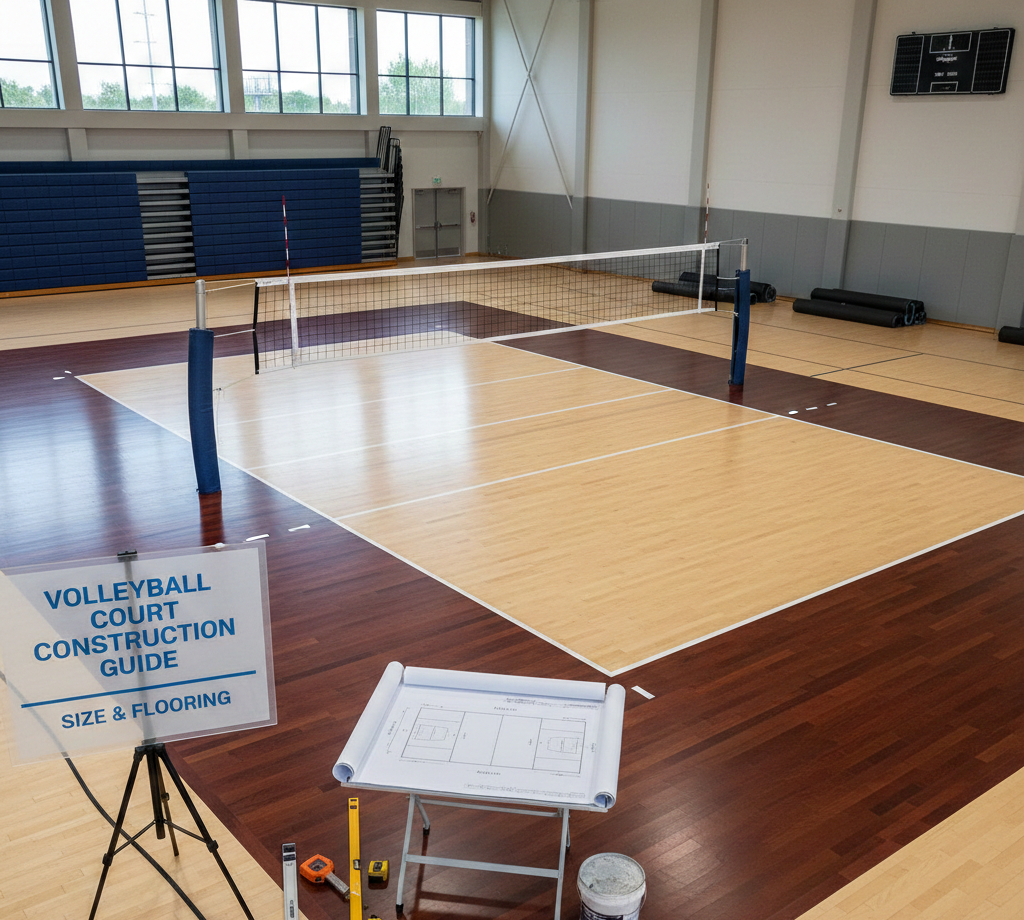
Volleyball is a popular sport that promotes physical fitness, teamwork, coordination, and athletic performance. With the growing demand for sports infrastructure in schools, colleges, residential societies, sports academies, clubs, and stadiums, the need for professionally constructed volleyball courts is increasing across India. A properly designed volleyball court provides a safe playing environment, supports consistent performance, and offers long-term durability.
Building a volleyball court requires careful planning, accurate dimensions, suitable flooring materials, a strong foundation, and proper installation of sports equipment. Whether you are planning an indoor volleyball court for professional training or an outdoor court for recreational activities, selecting the right construction method is essential.
Sports Facility India offers volleyball court construction solutions tailored to different project requirements, available spaces, usage levels, and budgets. This guide covers standard volleyball court dimensions, flooring options, construction procedures, estimated costs, maintenance requirements, and important factors to consider before starting your project.
1. Standard Volleyball Court Dimensions
Understanding the correct volleyball court dimensions is the first step toward successful court construction. According to Fédération Internationale de Volleyball (FIVB) regulations, a standard indoor volleyball playing court measures 18 metres in length and 9 metres in width.
The court is divided into two equal halves by a centre line, with each team occupying a 9 × 9 metre playing area.
Official Volleyball Court Measurements
- Court length: 18 metres
- Court width: 9 metres
- Each team’s playing area: 9 × 9 metres
- Attack line: 3 metres from the centre line on each side
- Boundary line width: 5 cm
- Net height for men: 2.43 metres
- Net height for women: 2.24 metres
- Net width: Approximately 1 metre
- Net length: Approximately 9.5–10 metres
- Free playing zone: At least 3 metres around the court for standard play
- Indoor free playing space height: At least 7 metres for general international play, with greater clearance required for higher-level competitions
The free zone and overhead clearance should be planned according to the intended level of competition and applicable regulations. Higher-level events may require larger safety areas and additional unobstructed ceiling height.
Correct measurements help ensure accurate court markings, sufficient player movement, and a professional playing environment.
2. Volleyball Court Flooring Options
Choosing the right flooring material is an important part of volleyball court construction. The surface should provide suitable grip, shock absorption, stability, and durability while supporting the movements involved in jumping, landing, and quick directional changes.
The ideal flooring depends on whether the court will be installed indoors or outdoors.
A. Indoor Volleyball Court Flooring
Indoor volleyball courts require a consistent, resilient playing surface that supports athletic movement and helps reduce impact stress.
1. Wooden Sports Flooring
Wooden sports flooring, particularly purpose-designed maple flooring systems, is a premium choice for competitive indoor volleyball courts.
Key benefits include:
- Good shock absorption when installed over a suitable sports subfloor.
- Consistent surface response for jumping and landing.
- Professional appearance suitable for sports halls and competition venues.
- Long service life with appropriate cleaning and periodic refinishing.
Wooden flooring generally requires a higher initial investment and regular maintenance.
2. PVC and Vinyl Sports Flooring
PVC or vinyl sports flooring is a practical solution for schools, sports academies, clubs, and multipurpose indoor halls.
Advantages include:
- Cushioned surfaces designed for indoor sports.
- Consistent grip when the correct sports-grade material is selected.
- Easy cleaning and routine maintenance.
- Multiple colours and surface designs.
- Compatibility with suitable prepared subfloors.
The performance of synthetic flooring depends on its construction, cushioning system, installation quality, and suitability for volleyball.
3. Polyurethane Sports Flooring
Polyurethane sports flooring provides a seamless synthetic surface that can be suitable for selected indoor sports facilities.
Its potential benefits include:
- A uniform playing surface.
- Good durability with a correctly specified system.
- Customisable colours and court markings.
- Suitability for certain multipurpose sports halls.
The selected system should be designed specifically for indoor sports use, rather than general-purpose flooring.
B. Outdoor Volleyball Court Flooring
Outdoor courts must be designed to withstand weather exposure, temperature changes, moisture, and regular use.
1. Beach Volleyball Sand Flooring
Sand is the standard playing surface for beach volleyball. A properly constructed sand court provides a softer landing surface and supports the sliding and diving movements associated with the sport.
Important considerations include:
- Clean, suitable sand with an appropriate grain size.
- A consistent playing depth in accordance with the applicable competition requirements.
- Effective drainage and sub-base preparation.
- Removal of stones, debris, and other foreign materials.
- Regular raking and levelling.
Competition-grade beach volleyball courts generally require a minimum sand depth of 40 cm, with the exact specification determined by the relevant rules.
2. Natural Grass Flooring
Natural grass can be used for recreational volleyball courts in parks, resorts, residential communities, and open sports areas.
Its benefits include a natural appearance and relatively low initial surface installation costs. However, grass courts require mowing, irrigation, drainage, and ongoing maintenance. Surface consistency can also change with weather and usage.
3. Artificial Turf Flooring
Artificial turf can be considered for recreational outdoor volleyball areas and selected multipurpose sports spaces.
Potential advantages include:
- A consistent appearance throughout the year.
- Reduced mowing and irrigation requirements.
- Resistance to many forms of routine outdoor wear.
- Options for suitable backing and cushioning systems.
Artificial turf should not automatically be treated as equivalent to a regulation beach volleyball surface or a specialist indoor volleyball floor. Material selection must match the intended sport and level of play.
3. Step-by-Step Volleyball Court Construction Process
Professional volleyball court construction involves several stages, from initial site assessment to final inspection. Each stage contributes to the safety, performance, and lifespan of the completed facility.
Site Inspection and Planning
The first stage involves assessing the available space, ground conditions, drainage, access, and intended court usage.
The planning process should establish:
- Required court dimensions and free zones.
- Indoor or outdoor construction requirements.
- Flooring preferences and project budget.
- Lighting, ventilation, and equipment requirements.
- Future maintenance and accessibility needs.
Ground Preparation and Levelling
The construction area must be cleared of vegetation, debris, loose materials, and obstructions. The ground should then be prepared and levelled according to the selected court system.
For outdoor projects, proper grading and drainage are especially important to prevent water accumulation and surface deterioration.
Foundation and Subfloor Construction
A stable foundation supports the playing surface and helps maintain consistent court performance.
Indoor courts may require a properly engineered concrete base, moisture protection, and a specialist sports-flooring subfloor. Outdoor courts may require compacted granular layers, drainage systems, or other foundations appropriate to the selected surface.
The foundation specification should be determined by site conditions, structural requirements, and the flooring manufacturer’s installation guidelines.
Flooring Installation
After the base has been inspected and prepared, the selected flooring system is installed.
- Wooden flooring requires a suitable subfloor and sports-flooring installation system.
- PVC and vinyl flooring require a clean, dry, smooth, and appropriately prepared base.
- Polyurethane flooring requires the specified substrate preparation and coating procedure.
- Sand courts require suitable sand placement, levelling, and drainage.
- Grass and artificial turf courts require the correct sub-base and surface installation.
Correct installation helps minimise surface irregularities and supports long-term performance.
Court Marking and Net Installation
Court markings must be measured accurately and applied using suitable materials for the selected flooring.
The net should be installed at the correct height using secure posts positioned outside the sidelines. Antennae and other equipment should be fitted where required by the intended playing standard.
For indoor volleyball, net height is generally 2.43 metres for men’s play and 2.24 metres for women’s play.
Lighting and Safety Arrangements
Indoor courts require suitable lighting, adequate overhead clearance, and appropriate ventilation. Outdoor courts should have safe access, effective drainage, and suitable lighting if evening play is planned.
Safety provisions may include padding on posts, protected structural elements, non-slip surfaces, and adequate clearance around the playing area.
Final Inspection and Handover
Before the court is opened for use, the completed facility should be checked for:
- Correct court dimensions and line placement.
- Surface uniformity and installation quality.
- Secure net posts and sports equipment.
- Adequate drainage where applicable.
- Safe playing zones and unobstructed overhead space.
- Compliance with the relevant project specifications.
A final inspection helps confirm that the facility is ready for its intended recreational, training, or competitive use.
4. Volleyball Court Construction Cost in India
The cost of volleyball court construction depends on the selected flooring, site conditions, foundation requirements, equipment, and additional facilities.
Indoor courts generally require a larger investment because they may include structural construction, roofing, lighting, ventilation, and specialist sports flooring. Outdoor courts may be less expensive when the site is already suitable, although drainage and foundation work can significantly affect the budget.
Factors Affecting Construction Cost
- Court size and total project area.
- Indoor or outdoor location.
- Type and quality of flooring material.
- Ground preparation and foundation requirements.
- Drainage and moisture protection.
- Net posts, nets, antennae, and other accessories.
- Sports lighting and electrical work.
- Roofing and structural requirements.
- Labour, transportation, and project location.
- Number of courts being constructed.
How to estimate your project: Request a site-specific quotation that separates civil work, foundation, flooring, equipment, lighting, and other optional features. This approach provides a clearer understanding of the total investment.
Any indicative construction price should be treated as a preliminary estimate until the site, specifications, and scope of work have been assessed.
5. Essential Features of a Professional Volleyball Court
A well-planned volleyball court should provide a safe, practical, and durable environment for players.
Accurate Court Dimensions
Correct measurements help maintain fair play and support compliance with the applicable sporting regulations.
Quality Sports Flooring
The flooring should offer appropriate traction, shock absorption, stability, and durability for the intended level of play.
Effective Drainage
Outdoor courts require appropriate drainage to reduce standing water and protect the playing surface and foundation.
Proper Lighting
Adequate, evenly distributed lighting improves visibility and supports safe play, especially in indoor halls and courts used after sunset.
Safe Playing Zones
Sufficient free space around the court helps reduce collisions with walls, equipment, and other obstacles.
Durable Equipment
Quality net systems, secure posts, suitable boundary markings, and protective padding contribute to a safer playing environment.
6. Volleyball Court Maintenance Guidelines
Regular maintenance helps preserve the court surface, reduce avoidable repair costs, and maintain consistent playing conditions.
Wooden Volleyball Flooring
- Remove dust and dirt using suitable cleaning equipment.
- Use approved sports-flooring cleaning products.
- Inspect the surface for damage, wear, and moisture issues.
- Arrange professional recoating or refinishing when required.
PVC, Vinyl, and Polyurethane Flooring
- Sweep or vacuum the surface regularly.
- Use a damp mop and manufacturer-approved cleaner.
- Avoid abrasive tools and harsh chemicals.
- Inspect seams, joints, and surface damage.
- Repair damaged areas promptly.
Sand Volleyball Courts
- Rake and level the sand regularly.
- Remove stones, litter, and other debris.
- Monitor sand depth and surface consistency.
- Check drainage after heavy rainfall.
- Replenish sand when necessary.
Grass and Artificial Turf Courts
- Mow and irrigate natural grass as required.
- Monitor drainage and ground conditions.
- Remove debris from artificial turf.
- Brush the turf where recommended by the manufacturer.
- Inspect seams, backing, and any cushioning layer.
A planned maintenance schedule can help extend the useful life of the court and keep it suitable for regular play.
7. Choosing the Right Volleyball Court for Your Facility
Selecting the right court design depends on the intended users, available space, climate, maintenance capacity, and budget.
| Court Type | Best Suited For | Main Considerations |
|---|---|---|
| Indoor wooden court | Professional competitions and sports halls | Premium investment and regular maintenance |
| Indoor PVC or vinyl court | Schools, academies, clubs, and multipurpose halls | Sports-grade cushioning and subfloor quality |
| Polyurethane court | Selected indoor sports facilities | System specification and installation quality |
| Beach volleyball sand court | Beach sports, resorts, and specialist training | Sand quality, depth, and drainage |
| Natural grass court | Parks and recreational facilities | Irrigation, mowing, and weather conditions |
| Artificial turf court | Selected outdoor recreational facilities | Turf suitability, drainage, and cushioning |
Before finalising the design, consider the frequency of use, expected player level, maintenance resources, and whether the court will be dedicated to volleyball or shared with other sports.
8. Why Choose Sports Facility India for Volleyball Court Construction?
Sports Facility India provides sports facility planning and construction solutions for projects with different space, usage, and budget requirements.
When planning a volleyball court, professional support can help coordinate site preparation, flooring selection, court dimensions, markings, equipment installation, and final inspection.
Key considerations include:
- Customised planning based on the available site.
- Flooring recommendations based on the intended application.
- Attention to court measurements and layout.
- Coordination of foundation and surface installation.
- Suitable net systems and sports accessories.
- Practical maintenance guidance for long-term use.
Whether you are developing a school sports ground, a residential sports area, an indoor training centre, or a dedicated sports academy, choosing the right construction specifications is essential for a successful project.
Contact Sports Facility India to discuss your volleyball court construction requirements and obtain a quotation based on your project scope.
Conclusion
A successful volleyball court construction project combines accurate dimensions, a suitable foundation, quality sports flooring, secure equipment, and effective safety planning. Selecting the right surface for indoor or outdoor use is equally important for player comfort, durability, and maintenance.
From wooden and synthetic indoor courts to outdoor sand, grass, and artificial turf surfaces, each option offers different benefits depending on the intended application.
With careful planning, professional installation, and regular maintenance, a volleyball court can provide a reliable playing environment for schools, colleges, sports academies, clubs, residential communities, and recreational facilities.
For a customised volleyball court construction solution, Sports Facility India can help you plan a facility according to your site conditions, requirements, and budget.
Frequently Asked Questions About Volleyball Court Construction
1. What is the standard size of a volleyball court?
A standard indoor volleyball court measures 18 metres long and 9 metres wide. The court is divided into two equal 9 × 9 metre halves by the centre line.
2. What is the official volleyball net height?
The standard net height is 2.43 metres for men’s volleyball and 2.24 metres for women’s volleyball. Different age groups and recreational formats may use adjusted heights.
3. Which flooring is best for an indoor volleyball court?
Purpose-designed wooden sports flooring is a common premium choice for competitive indoor volleyball. PVC, vinyl, and polyurethane sports flooring systems can also be suitable when specified for volleyball and installed over an appropriate base.
4. Which surface is best for outdoor volleyball?
Sand is the standard surface for beach volleyball. Natural grass and selected artificial turf systems can be considered for recreational outdoor courts, depending on the intended use and safety requirements.
5. How much space is required to construct a volleyball court?
The playing area measures 18 × 9 metres, equivalent to 162 square metres. Additional space is required around the court for safe player movement, access, equipment, and any applicable competition requirements.
6. How much does volleyball court construction cost in India?
The cost varies according to the flooring system, foundation, site preparation, drainage, equipment, lighting, and structural work. A site-specific quotation is the most reliable way to establish the project budget.
7. How long does it take to construct a volleyball court?
The timeline depends on the site condition, foundation work, flooring material, weather, and project scope. Outdoor surface projects may take less time than complete indoor facilities requiring structural construction and specialist flooring.
8. Can a volleyball court be used for multiple sports?
Yes. A suitable indoor or outdoor facility can sometimes accommodate multiple sports. However, the flooring, dimensions, equipment, and markings should be planned for the intended activities.
9. What foundation is required for a volleyball court?
Indoor synthetic and wooden courts typically require a stable, level, properly prepared subfloor. Outdoor courts may require compacted aggregate, suitable drainage, and a foundation designed for the selected surface and site conditions.
10. How can I maintain volleyball court flooring?
Maintenance depends on the surface. Wooden floors require appropriate cleaning and periodic refinishing, synthetic floors need routine cleaning and inspection, sand courts require levelling and debris removal, and grass or artificial turf requires surface-specific care.
11. Is drainage necessary for an outdoor volleyball court?
Yes. Proper drainage is important for outdoor courts because standing water can affect playability, damage the surface, and weaken the underlying construction over time.
12. How can I get a quotation for volleyball court construction?
Contact Sports Facility India with your project location, available site dimensions, preferred court type, flooring requirements, and expected usage. These details help establish a suitable design and project-specific estimate.