
Introduction to Badminton Court Construction in India
Badminton has become one of the fastest-growing indoor sports across India, enjoyed by children, students, athletes, and fitness enthusiasts alike. From school tournaments to international championships, badminton continues to gain popularity due to its accessibility, health benefits, and competitive appeal. The success of Indian badminton champions such as P.V. Sindhu, Saina Nehwal, and Kidambi Srikanth has further encouraged the development of professional badminton facilities throughout the country.
Today, institutions such as schools, colleges, sports academies, indoor stadiums, residential societies, and private clubs are investing in high-quality badminton court construction. A professionally built badminton court improves gameplay, enhances player safety, and ensures long-term durability.
Badminton court construction is not simply about drawing lines on a surface. It involves precise measurements, durable flooring, proper lighting, ventilation planning, and adherence to international guidelines. Whether you plan to build a badminton court in Delhi, Mumbai, Hyderabad, Bengaluru, Chennai, Lucknow, Jaipur, or any other city in India, understanding proper construction methods is essential.
This comprehensive guide explains badminton court construction details, including official dimensions, flooring types, installation methods, cost estimates, and important design considerations.
Standard Badminton Court Dimensions (As per BWF Guidelines)
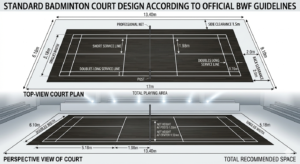
The Badminton World Federation (BWF) defines official court dimensions used worldwide. Following these measurements ensures uniform gameplay and allows courts to be used for professional tournaments.
Official Badminton Court Measurements
- Total Court Length: 13.40 meters (44 feet)
- Court Width (Doubles): 6.10 meters (20 feet)
- Court Width (Singles): 5.18 meters (17 feet)
- Short Service Line Distance: 1.98 meters from the net
- Long Service Line (Doubles): 0.76 meters inside baseline
- Net Height at Posts: 1.55 meters
- Net Height at Center: 1.524 meters
Recommended Space Around Court
Apart from the playing area, additional clearance space is required for player movement and safety.
- Side Clearance: Minimum 1.5 meters
- Back Clearance: Minimum 2 meters
- Total Recommended Space: 17m × 9m per court
Following these dimensions ensures that the badminton court meets international standards and provides enough room for professional-level gameplay.
Types of Badminton Court Flooring in India
Selecting the correct flooring is one of the most critical decisions in badminton court construction. The right surface improves performance, reduces injuries, and increases court life.
Below are the most widely used badminton flooring options in India.
1. Wooden Badminton Court Flooring
Wooden flooring is considered the premium choice for indoor badminton courts. It is widely used in professional academies, indoor stadiums, and tournament venues.
Key Features
- Made using hardwood materials such as maple or teak
- Excellent shock absorption
- Smooth shuttle movement
- Comfortable for professional athletes
- Long lifespan with proper maintenance
Best Suitable For
- Indoor badminton academies
- Professional sports complexes
- Tournament stadiums
- International-level training facilities
Approximate Cost in India
₹8 lakh to ₹12 lakh per badminton court
Wooden badminton courts are preferred when performance quality and player safety are top priorities.
2. Synthetic Badminton Court Flooring (PU/PVC)
Synthetic badminton flooring has become extremely popular due to its durability, comfort, and affordability. It is widely used in educational institutions and sports clubs.
Key Features
- Multi-layer cushioned surface
- Anti-slip finish
- High durability
- Low maintenance
- Consistent bounce performance
Best Suitable For
- Schools and colleges
- Indoor sports halls
- Community clubs
- Coaching academies
Approximate Cost in India
₹6 lakh to ₹10 lakh per badminton court
Synthetic flooring offers a balance between performance and budget, making it one of the most recommended options.
3. Acrylic Badminton Court Flooring (Outdoor)
Acrylic flooring is commonly used for outdoor badminton courts due to its weather-resistant properties.
Key Features
- UV-resistant coating
- Water-resistant surface
- Suitable for outdoor environments
- Low maintenance
- Durable finish
Best Suitable For
- Residential societies
- Parks and recreational zones
- Outdoor sports areas
- Government projects
Approximate Cost in India
₹4 lakh to ₹7 lakh per badminton court
Acrylic badminton courts are highly suitable for outdoor locations across India.
4. Concrete Badminton Court Surface
Concrete badminton courts are the most economical option and are commonly seen in public spaces and rural areas.
Key Features
- Budget-friendly
- Easy to construct
- Can be upgraded with synthetic coating
- Strong base foundation
Best Suitable For
- Village playgrounds
- Public grounds
- Budget projects
- Temporary sports areas
Approximate Cost in India
₹2 lakh to ₹4 lakh per badminton court
Concrete surfaces are basic but effective for entry-level sports facilities.
Indoor vs Outdoor Badminton Court Construction
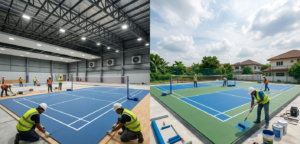
Understanding the difference between indoor and outdoor courts helps determine the right design and budget.
Indoor Badminton Court Construction
- Roofing structure
- False ceiling installation
- Professional lighting system
- Wooden or synthetic flooring
- Controlled ventilation
Advantages of Indoor Courts
- Weather-independent gameplay
- Longer flooring lifespan
- Suitable for tournaments
- Professional playing conditions
Approximate Cost in India
₹10 lakh to ₹15 lakh per badminton court
Indoor badminton courts are ideal for professional use and competitive training.
Outdoor Badminton Court Construction
- Acrylic or synthetic flooring
- Drainage system
- UV-protected surface
- Weather-resistant materials
Advantages of Outdoor Courts
- Cost-effective installation
- Suitable for community use
- Requires less structural investment
Approximate Cost in India
₹4 lakh to ₹8 lakh per badminton court
Outdoor courts are widely used in residential areas and recreational parks.
Step-by-Step Badminton Court Construction Process
Constructing a badminton court involves multiple stages that ensure accuracy, durability, and safety.
Step 1: Site Inspection and Planning
The construction process begins with evaluating the available land and identifying suitable space for the court.
Important Tasks
- Soil testing
- Space measurement
- Drainage planning
- Orientation selection
- Safety clearance setup
This stage helps avoid structural issues later in the project.
Step 2: Ground Preparation
Proper ground preparation ensures the stability of the court structure.
Key Activities
- Land leveling
- Surface compacting
- Base grading
- Concrete foundation pouring
The base thickness depends on the flooring material chosen.
Step 3: Base Construction
A strong base is required to support flooring layers.
Base Materials
- Cement concrete
- Reinforced base layers
- Waterproofing materials
A stable base improves court lifespan and prevents cracks.
Step 4: Flooring Installation
This step involves placing the selected flooring material over the prepared base.
Flooring Installation Methods
- Wooden plank installation
- Synthetic roll placement
- Acrylic layer coating
- Surface finishing
Each flooring type requires specialized installation techniques.
Step 5: Court Marking and Line Painting
Court lines are marked precisely according to official badminton dimensions.
Line Features
- Anti-slip paint
- Standard white marking
- Accurate measurement tools
Proper marking ensures correct gameplay boundaries.
Step 6: Net and Post Installation
The net setup must follow official height standards.
Installation Details
- Metal posts fixed securely
- Adjustable net tension
- Correct center height alignment
High-quality materials improve durability.
Step 7: Lighting Installation (Indoor Courts)
Lighting plays a major role in indoor badminton court performance.
Lighting Requirements
- LED non-glare lights
- Uniform illumination
- Energy-efficient fixtures
Proper lighting reduces shadows and improves visibility.
Step 8: Ventilation and Interiors
Indoor courts require ventilation to maintain air quality and temperature.
Ventilation Options
- Natural airflow design
- Exhaust systems
- Air-conditioning installation
Good ventilation prevents humidity damage.
Step 9: Final Inspection and Testing
After completion, the court undergoes quality inspection.
Final Checks
- Surface smoothness
- Line accuracy
- Net height verification
- Lighting performance
This ensures the court is safe and ready for use.
Badminton Court Construction Cost in India
The total cost of building a badminton court varies based on location, materials, and customization.
Below is an approximate cost breakdown.
Indoor Badminton Court Cost
| Flooring Type | Estimated Cost | Suitable Use |
|---|---|---|
| Wooden Flooring | ₹8 – ₹12 Lakhs | Professional Courts |
| Synthetic Flooring | ₹6 – ₹10 Lakhs | Schools & Clubs |
Outdoor Badminton Court Cost
| Flooring Type | Estimated Cost | Suitable Use |
|---|---|---|
| Acrylic Flooring | ₹4 – ₹7 Lakhs | Residential Areas |
| Concrete Court | ₹2 – ₹4 Lakhs | Budget Projects |
Additional Cost Factors
Apart from flooring, several other elements influence total project cost.
Lighting Installation
₹50,000 to ₹2,00,000
Seating Arrangements
₹1 lakh to ₹5 lakh
Air Conditioning System
₹3 lakh to ₹8 lakh
Roofing Structure
₹3 lakh to ₹10 lakh
Total project cost varies depending on specifications and project size.
Key Factors to Consider Before Building a Badminton Court
Planning ahead helps prevent costly mistakes.
Important Considerations
- Available land size
- Climate conditions
- Usage frequency
- Budget allocation
- Player skill level
- Maintenance requirements
Choosing the right materials ensures long-term performance.
Benefits of Professional Badminton Court Construction
A professionally built badminton court offers multiple advantages.
Major Benefits
✔ Improved player safety
✔ Reduced injury risk
✔ Longer flooring lifespan
✔ Professional gameplay quality
✔ Higher property value
✔ Better sports infrastructure
Professional installation enhances overall performance.
Maintenance Tips for Badminton Courts
Regular maintenance extends the life of the court.
Maintenance Guidelines
- Clean surface daily
- Repair cracks immediately
- Maintain proper humidity
- Inspect lighting regularly
- Replace worn-out nets
Proper maintenance reduces long-term repair costs.
Badminton court construction in India
Indoor badminton court construction Delhi
Badminton court builders Mumbai
Synthetic badminton flooring installation Hyderabad
Badminton court contractors Bengaluru
Outdoor badminton court construction Chennai
Badminton court installation Lucknow
Badminton court builders Jaipur
Badminton court construction services Kolkata
Professional badminton court flooring India
Using location-based keywords improves search engine visibility.
Applications of Badminton Court Construction
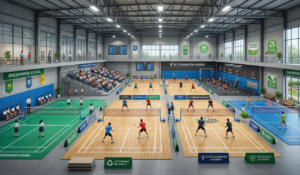
Badminton courts are used across multiple sectors.
Common Applications
- Schools and colleges
- Sports academies
- Residential societies
- Indoor stadiums
- Commercial sports complexes
- Community recreation centers
These facilities promote fitness and sports participation.
Future Trends in Badminton Court Construction
Modern badminton courts are evolving with technology.
Emerging Trends
- Shock-absorbing flooring systems
- LED smart lighting
- Eco-friendly materials
- Modular court designs
- Multi-sport flooring solutions
These innovations improve durability and sustainability.
Conclusion
Badminton court construction requires careful planning, professional design, and high-quality materials to ensure durability and safety. From selecting the correct flooring type to following official court dimensions, every stage plays a vital role in creating a functional and long-lasting facility.
Whether you are building a badminton court for a school, sports academy, residential society, or indoor stadium, investing in professional construction ensures long-term performance and user satisfaction. With the increasing popularity of badminton across India, high-quality court construction has become an essential part of modern sports infrastructure.
A well-designed badminton court not only promotes physical fitness but also supports athletic development and encourages community participation. By choosing reliable materials, proper flooring systems, and expert installation methods, you can create a professional badminton facility that meets international standards and serves players for many years.
(FAQs)
1. What is the standard size of a badminton court?
The standard badminton court size, as per international guidelines, is 13.40 meters (44 feet) in length and 6.10 meters (20 feet) in width for doubles matches. For singles matches, the width is 5.18 meters (17 feet). These official measurements are followed in professional badminton court construction across India.
2. What is the minimum space required to build a badminton court?
The minimum space required for badminton court construction is approximately 17 meters × 9 meters, including safety clearance around the playing area. This additional space ensures safe movement for players during matches and training sessions.
3. How much does it cost to build a badminton court in India?
The cost of badminton court construction in India typically ranges between:
- ₹2 lakh – ₹4 lakh for a basic concrete court
- ₹4 lakh – ₹7 lakh for an outdoor acrylic court
- ₹6 lakh – ₹10 lakh for synthetic indoor flooring
- ₹8 lakh – ₹12 lakh for wooden indoor flooring
- ₹10 lakh – ₹15 lakh for complete indoor badminton courts
The final cost depends on flooring type, location, and additional features.
4. Which flooring is best for badminton court construction?
The best flooring depends on usage and budget:
- Wooden flooring – Best for professional and tournament-level courts
- Synthetic (PU/PVC) flooring – Ideal for schools and academies
- Acrylic flooring – Suitable for outdoor badminton courts
- Concrete flooring – Budget-friendly basic option
Synthetic flooring is currently the most popular choice for badminton courts in India.
5. What is the difference between indoor and outdoor badminton courts?
Indoor badminton courts are built inside enclosed structures with controlled lighting and ventilation, while outdoor courts are exposed to weather conditions and require UV-resistant flooring.
Indoor courts provide better gameplay quality, while outdoor courts are more economical to construct.
6. How long does it take to construct a badminton court?
The average time required for badminton court construction is:
- Outdoor Court: 7 to 15 days
- Indoor Court: 20 to 30 days
The duration may vary depending on flooring type, site condition, and project size.
7. What base is required for badminton court flooring?
A levelled concrete base is required for most badminton court flooring systems. The base must be strong, smooth, and properly cured before installing wooden, synthetic, or acrylic flooring.
A well-prepared base increases the lifespan of the court.
8. Which badminton court flooring is suitable for outdoor use?
Acrylic flooring is the most suitable option for outdoor badminton court construction. It is resistant to sunlight, rain, and temperature changes, making it ideal for outdoor sports areas in Indian climates.
9. What lighting is required for indoor badminton courts?
Indoor badminton courts require LED non-glare lighting systems that provide uniform brightness across the playing surface. Proper lighting improves visibility and reduces eye strain during gameplay.
Typical lighting installation costs range between ₹50,000 and ₹2,00,000.
10. What is the lifespan of a badminton court?
The lifespan of a badminton court depends on the flooring type and maintenance quality:
- Wooden flooring: 15–25 years
- Synthetic flooring: 8–15 years
- Acrylic flooring: 5–10 years
- Concrete flooring: 10–20 years
Regular maintenance significantly increases durability.
11. Is synthetic flooring better than wooden flooring?
Synthetic flooring is more cost-effective and easier to maintain, making it ideal for schools and training centers. Wooden flooring provides superior performance and shock absorption, making it suitable for professional-level badminton courts.
The choice depends on budget and usage requirements.
12. What materials are used in badminton court construction?
Common materials used include:
- Cement and concrete
- Hardwood or synthetic flooring
- Acrylic coatings
- Anti-skid surface materials
- Steel net posts
- LED lighting fixtures
High-quality materials ensure durability and safety.
13. Can a badminton court be constructed on existing land?
Yes, badminton courts can be constructed on existing land if the ground is properly levelled and prepared. Site inspection and soil assessment are necessary before construction begins.
This helps prevent surface cracks and uneven flooring.
14. How do you maintain a badminton court?
Regular maintenance includes:
- Cleaning the court surface
- Repairing cracks immediately
- Maintaining proper humidity levels
- Checking lighting and nets
- Repainting court lines when needed
Proper maintenance improves safety and extends court lifespan.
15. What is the ideal location for badminton court construction?
Badminton courts can be constructed in various locations such as:
- Schools and colleges
- Sports academies
- Residential societies
- Indoor stadiums
- Community sports centers
Selecting a location with sufficient space and proper ventilation is essential.
16. Do badminton courts require drainage systems?
Yes, outdoor badminton courts require proper drainage systems to prevent water accumulation during rainfall. Efficient drainage ensures longer flooring life and prevents surface damage.
17. Can badminton courts be customized for multi-sport use?
Yes, badminton courts can be designed as multi-purpose sports courts that also support games such as volleyball, basketball, or futsal. Multi-sport flooring systems are becoming popular in modern sports facilities.
18. What are the benefits of professional badminton court construction?
Professional badminton court construction offers:
- Enhanced player safety
- Improved gameplay quality
- Long-term durability
- Reduced maintenance costs
- Compliance with international standards
Professionally constructed courts provide better performance and reliability.
19. How thick should the concrete base be for badminton courts?
The recommended concrete base thickness for badminton courts is generally 100 mm to 150 mm, depending on soil condition and flooring type. A thicker base provides greater stability and prevents cracks.
20. Why is badminton court construction becoming popular in India?
Badminton court construction is increasing across India due to:
- Rising interest in indoor sports
- Growth of badminton academies
- Increased awareness of fitness
- Government sports initiatives
- Demand from schools and residential projects
The sport’s popularity continues to drive infrastructure development nationwide.