Introduction
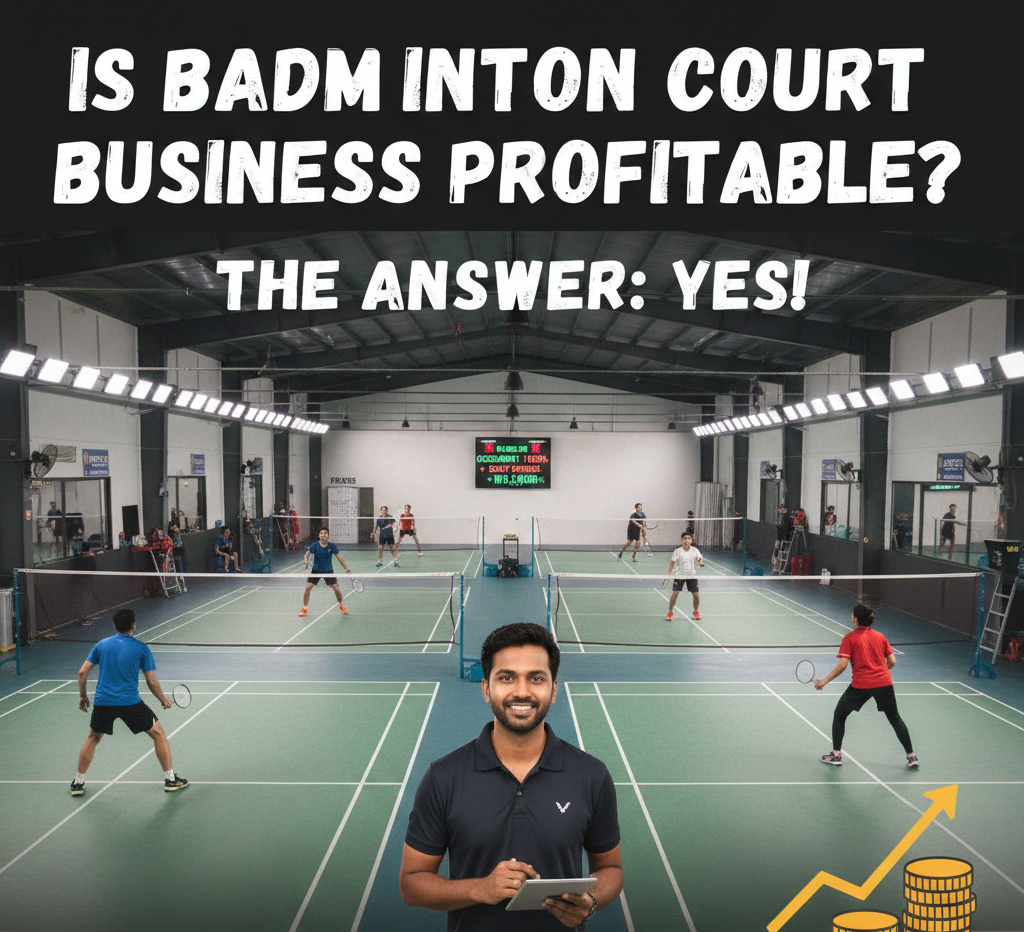
The popularity of badminton in India has grown significantly over the years, creating new opportunities for entrepreneurs and sports infrastructure investors. The success of Indian badminton players such as P. V. Sindhu, Saina Nehwal, and Kidambi Srikanth has encouraged more people to participate in the sport for fitness, recreation, and professional training.
As a result, the demand for well-designed badminton courts is increasing across schools, colleges, residential societies, sports clubs, fitness centres, and private academies. This growing interest has made badminton court development an attractive business opportunity for investors looking to enter the sports and recreation industry.
But is a badminton court business profitable in India? The answer depends on several factors, including the initial investment, location, court construction quality, hourly rental rates, coaching services, occupancy levels, and day-to-day management.
In this guide, we will explore the cost of building a badminton court, potential revenue sources, operating expenses, profitability factors, and practical strategies to develop a sustainable badminton court business.
Why Is the Badminton Court Business Growing in India?
Badminton court businesses are gaining attention because of increasing sports participation, fitness awareness, and demand for organised recreational facilities. Several factors are contributing to this growth.
1. Increasing Popularity of Badminton
Badminton is played by people of different age groups, from school students and working professionals to fitness enthusiasts and competitive athletes. Its accessibility and indoor playing options make it a popular choice for regular exercise and recreation.
2. Growing Demand for Indoor Sports Facilities
Urban areas and developing cities are seeing increased interest in indoor sports facilities. Schools, residential communities, private clubs, and sports academies are investing in dedicated badminton courts to meet the needs of local players.
3. Opportunities for Private Sports Entrepreneurs
Entrepreneurs can establish independent badminton centres, coaching academies, or multi-court sports facilities. A well-planned facility can generate income through court bookings, training programmes, memberships, and sports-related services.
4. Demand for Professional Coaching
Parents and aspiring athletes increasingly seek structured badminton training for children and young players. Coaching programmes can provide a recurring revenue source for facilities that partner with qualified coaches.
How Much Investment Is Required to Start a Badminton Court Business?
The investment required to start a badminton court business in India varies according to the number of courts, flooring system, building structure, land availability, lighting, and additional amenities.
1. Badminton Court Construction Cost
The following figures are illustrative estimates for preliminary planning, not verified market quotations. Actual costs depend on the project specifications and location.
| Type of Badminton Court | Flooring Option | Indicative Flooring and Court Setup Cost |
|---|---|---|
| Indoor wooden court | Sports-grade wooden flooring | ₹8–12 lakh |
| Indoor synthetic court | PVC or synthetic sports flooring | ₹6–10 lakh |
| Outdoor acrylic court | Acrylic sports surface | ₹4–7 lakh |
| Basic outdoor court | Concrete base with suitable finish | ₹2–4 lakh |
These estimates may exclude land, building construction, roofing, major civil work, electrical infrastructure, and other site-specific expenses. Obtain an itemised quotation before finalising your investment.
2. Additional Infrastructure Expenses
Apart from the court surface, a badminton facility may require:
- Sports lighting: Appropriate illumination for safe and comfortable play.
- Net posts and nets: Essential court equipment and accessories.
- Electrical installation: Wiring, switches, distribution panels, and related work.
- Seating and waiting areas: Space for players, parents, and spectators.
- Ventilation or air-conditioning: Depending on the building design and climate.
- Changing rooms and washrooms: Useful amenities for a commercial facility.
- Booking and payment systems: Tools to manage reservations and customer payments.
3. Land and Building Requirements
Land and building costs can represent a substantial portion of the total investment. Renting an existing suitable indoor space may reduce the initial capital requirement compared with purchasing land and constructing a new sports facility.
Before choosing a property, assess the available playing area, ceiling height, ventilation, accessibility, parking, electricity supply, and suitability of the floor base.
4. Working Capital and Operating Expenses
A badminton court business also needs sufficient funds to cover recurring expenses, including:
- Staff salaries and coaching payments
- Electricity and water bills
- Cleaning and maintenance
- Rent or property-related expenses
- Marketing and booking platform charges
- Equipment replacement and repairs
Keeping a working capital reserve can help the business manage the initial months while building a regular customer base.
How Does a Badminton Court Business Generate Revenue?
A successful badminton facility should not depend entirely on hourly court rentals. Combining multiple income sources can help improve utilisation and create more predictable cash flow.
1. Hourly Badminton Court Rentals
Hourly bookings are one of the main revenue sources for commercial badminton centres. Players can reserve courts individually or as groups for recreational games and practice sessions.
Rental rates depend on the city, neighbourhood, court quality, facility amenities, and time of day. For preliminary planning, a rate of ₹250–₹800 per hour may be considered as an illustrative range, but local competitor research is necessary to determine a realistic price.
Peak evening and weekend slots may attract stronger demand, while discounted off-peak bookings can help improve daytime utilisation.
2. Monthly and Annual Memberships
Membership programmes encourage repeat visits and can support more consistent revenue.
Facilities may offer:
- Monthly court access packages
- Prepaid booking hours
- Off-peak membership plans
- Family or group packages
- Annual membership benefits
Membership pricing should be based on expected usage, available court hours, and operating costs rather than simply offering large discounts.
3. Badminton Coaching and Training Programmes
Coaching is another potential income stream for a badminton court business. Facilities can work with qualified coaches to provide beginner lessons, children’s batches, intermediate training, advanced practice, and individual sessions.
Revenue arrangements may include fixed court rental fees, coach-led programme fees, or an agreed revenue-sharing model.
Clear scheduling is essential to ensure coaching sessions do not prevent profitable public bookings during peak hours.
4. Tournaments and Corporate Events
Local competitions, school championships, weekend leagues, and corporate badminton events can attract new customers and increase facility visibility.
Potential revenue sources include registration fees, sponsorships, event partnerships, and refreshments. Event profitability will depend on participation, staffing requirements, prizes, and other organisational costs.
5. Sports Equipment and Refreshments
A facility may also earn additional income by selling shuttlecocks, grips, rackets, sports accessories, bottled water, and refreshments.
These services can improve customer convenience while creating supplementary revenue opportunities.
Is a Single Badminton Court Profitable? Example Profitability Analysis
A single badminton court can generate income, but its profitability depends on how frequently it is booked and how much it costs to operate. The following example demonstrates how to estimate monthly revenue.
Illustrative Monthly Revenue Calculation
Assume a facility charges ₹400 per hour and is available for 10 bookable hours per day over 30 days.
| Business Metric | Example Assumption |
|---|---|
| Court rental rate | ₹400 per hour |
| Available hours per day | 10 hours |
| Operating days per month | 30 days |
| Total available hours | 300 hours |
| Average booking utilisation | 50% |
| Paid booking hours | 150 hours |
| Estimated monthly rental revenue | ₹60,000 |
The calculation is:
Monthly rental revenue = Hourly rate × Paid booking hours
In this example, ₹400 × 150 hours equals ₹60,000 in monthly court rental revenue.
Coaching, memberships, tournaments, and equipment sales could generate additional income if these services are offered and attract sufficient demand.
Understanding Monthly Profit
Revenue is not the same as profit. The business must deduct all applicable operating expenses, rent, coach payments, maintenance, marketing, taxes, and other costs.
For example, if the court generates ₹60,000 in rental revenue and incurs ₹35,000 in monthly operating expenses, the remaining ₹25,000 is an illustrative operating surplus before any excluded expenses, financing costs, taxes, depreciation, or recovery of the initial investment.
This example is not a guarantee of earnings. Actual results may be higher or lower depending on utilisation, pricing, rent, and the revenue earned from additional services.
How Long Does It Take to Recover the Investment?
The payback period depends on the total project investment and the cash flow available to recover it.
Estimated payback period = Initial investment ÷ Average monthly cash available for investment recovery
For example, an initial investment of ₹12 lakh and an average monthly cash surplus of ₹50,000 would imply a simple payback period of 24 months. This calculation is illustrative and assumes the monthly surplus remains consistent; actual payback may take longer.
A realistic business plan should include conservative, expected, and optimistic booking scenarios before committing funds.
Key Factors That Affect Badminton Court Business Profitability
1. Location and Target Customers
Location influences both customer demand and operating expenses. A facility near residential neighbourhoods, schools, colleges, offices, or existing sports communities may have a stronger opportunity to attract regular players.
However, a high-rent location is not necessarily more profitable. Compare local demand, competitor pricing, transport access, parking, and rental costs before selecting a site.
2. Flooring Quality and Court Construction
The flooring system affects playing comfort, traction, maintenance, and the overall customer experience. Indoor badminton facilities may consider sports-grade PVC, synthetic, or wooden flooring according to their budget and intended usage.
Professional installation, a properly prepared subfloor, appropriate lighting, and accurate court markings can help reduce maintenance problems and support long-term use.
3. Court Utilisation and Booking Management
The number of paid hours booked is one of the most important drivers of rental income. A court that remains empty during large parts of the day may struggle to cover fixed expenses.
Online booking, advance reservations, recurring group slots, corporate tie-ups, and off-peak offers can help improve utilisation.
4. Coaching and Membership Strategy
Regular coaching batches and memberships can encourage repeat visits and provide additional revenue. Pricing should account for court availability, coach compensation, customer demand, and the opportunity cost of reserving court time.
5. Marketing and Customer Retention
A facility can promote its services through local search listings, social media, referral programmes, introductory offers, and partnerships with schools and companies.
Consistent service quality, convenient booking, clean courts, and responsive customer support are equally important for retaining players.
6. Maintenance and Operational Efficiency
Routine cleaning, inspection of flooring and court markings, net replacement, lighting checks, and timely repairs can help maintain a safe playing environment.
Tracking electricity usage, staff costs, booking patterns, and maintenance expenses also helps identify areas where operating efficiency can improve.
Practical Strategies to Increase Badminton Court Business Profits
Business owners can improve their chances of success by combining effective pricing, consistent customer service, and disciplined financial planning.
- Introduce flexible booking packages: Offer hourly rentals, prepaid hours, group bookings, and off-peak rates.
- Develop coaching partnerships: Create beginner and advanced training programmes with qualified coaches.
- Build a local customer community: Organise leagues, friendly matches, and weekend tournaments.
- Use digital booking tools: Simplify court reservations, payments, cancellations, and reminders.
- Partner with schools and corporates: Explore recurring bookings, coaching sessions, and organised sporting events.
- Choose flooring suited to the project: Consider durability, player comfort, maintenance needs, and the expected level of use.
- Monitor financial performance: Review revenue per court, booking utilisation, customer retention, and monthly expenses.
- Maintain a reserve fund: Prepare for unexpected repairs, seasonal demand changes, and slower booking periods.
What Is the Future of the Badminton Court Business in India?
The future potential of the badminton court business is linked to sports participation, fitness awareness, organised coaching, and the development of community sports infrastructure.
Indoor badminton centres can serve recreational players, aspiring athletes, schools, residential communities, and corporate groups. Facilities that combine court rentals with coaching, memberships, and organised events may be better positioned to diversify their income.
Digital reservations, cashless payments, customer relationship tools, and energy-efficient lighting can also support more efficient operations.
Nevertheless, demand varies between locations. Entrepreneurs should validate local interest, assess competing facilities, and prepare a detailed financial forecast before investing in a new court.
Why Choose Sports Facility India for Badminton Court Development?
Planning a commercial badminton court requires careful attention to the site, playing dimensions, flooring, lighting, and long-term maintenance requirements.
Sports Facility India provides badminton court solutions covering project planning, court construction, sports flooring, installation, and related infrastructure, according to project requirements.
Whether you are planning a single court, a school sports facility, or a multi-court badminton academy, professional guidance can help you evaluate suitable construction and flooring options.
Before starting your project, discuss your available space, location, budget, expected number of courts, and intended customer base to develop a solution aligned with your business objectives.
Explore badminton court solutions: https://www.sports-facility.in/badminton-court.php
Conclusion: Is Badminton Court Business Profitable in India?
Yes, a badminton court business can be profitable in India when it is supported by sufficient local demand, appropriate investment, competitive pricing, effective court utilisation, and efficient management.
Hourly rentals can provide the foundation of the business, while coaching programmes, memberships, tournaments, and supplementary services may create additional revenue opportunities.
However, profitability is not automatic. Land and building expenses, rent, construction quality, staffing, electricity, competition, and customer demand all influence the final financial outcome.
The best approach is to prepare a detailed business plan, calculate the total project cost, estimate realistic monthly bookings, and evaluate the expected cash flow before investing. With careful planning and a focus on customer experience, a badminton facility can become a sustainable sports business while encouraging fitness and participation in the game.
Frequently Asked Questions (FAQs)
1. Is a badminton court business profitable in India?
A badminton court business can be profitable when local demand is sufficient and operating costs are controlled. Court rentals, coaching, memberships, and tournaments can contribute to revenue, but actual profitability depends on utilisation, pricing, investment, and expenses.
2. How much does it cost to start a badminton court business?
The cost depends on whether you are developing an indoor or outdoor court, the flooring system, the building structure, land or rental expenses, lighting, and amenities. A complete commercial facility may cost substantially more than the basic court setup alone.
3. How much can a badminton court earn per month?
Monthly earnings depend on the hourly rate and the number of paid booking hours. For example, 150 paid hours at ₹400 per hour would generate ₹60,000 in monthly court rental revenue, excluding coaching and other services.
4. What are the main revenue sources for a badminton court business?
The main revenue sources include hourly court rentals, memberships, coaching programmes, tournaments, corporate events, sports equipment sales, and refreshments.
5. How many badminton courts should I build to start a business?
The ideal number depends on the available budget, property size, expected demand, and operating model. Starting with one or a few courts may limit initial investment, while a multi-court facility can accommodate more simultaneous bookings and coaching sessions.
6. Which flooring is suitable for a commercial badminton court?
Sports-grade PVC, synthetic, and wooden flooring systems are potential options for indoor courts. The choice should depend on the intended use, budget, playing characteristics, subfloor condition, maintenance requirements, and relevant sports specifications.
7. How can I increase badminton court bookings?
Improve visibility through local search listings and social media, offer convenient online booking, build school and corporate partnerships, introduce coaching programmes, and encourage repeat visits through memberships and customer referral offers.
8. Is an indoor badminton court better than an outdoor court for business?
Indoor courts generally offer greater protection from rain, wind, and other weather conditions, which can support more consistent scheduling. Outdoor courts may require a lower initial investment in some situations, but weather and local conditions can affect availability and customer demand.
9. How do I calculate the ROI of a badminton court business?
Estimate the total project investment, forecast revenue and operating expenses, and calculate the cash surplus available to recover the investment. A simple payback estimate divides the initial investment by the average monthly cash surplus, while a complete ROI analysis should also account for financing, taxes, depreciation, and ongoing capital expenses.
10. What are the biggest risks in the badminton court business?
Common risks include insufficient bookings, high rent, unexpected construction costs, competition, seasonal demand changes, equipment repairs, and poor cash flow. Market research, conservative financial projections, effective marketing, and a working capital reserve can help manage these risks.
11. Can badminton coaching improve business profitability?
Yes. Coaching can generate additional income and encourage regular attendance. However, the programme must attract enough students to cover coach payments and the cost of court hours allocated to training.
12. How can I plan a badminton court project with Sports Facility India?
You can discuss your project requirements, available space, location, budget, court type, and flooring preferences with Sports Facility India to explore suitable badminton court construction and flooring solutions.