Introduction
Bhopal, the capital of Madhya Pradesh, is witnessing steady development in sports infrastructure, fitness facilities, educational institutions, and modern residential communities. As interest in tennis continues to grow among young athletes, fitness enthusiasts, and recreational players, the demand for tennis court construction in Bhopal is increasing. Schools, colleges, sports academies, private clubs, hotels, residential townships, and government sports facilities are investing in professionally designed tennis courts to encourage an active lifestyle and provide better training opportunities.
Constructing a high-quality tennis court involves much more than preparing a flat surface and drawing playing lines. It requires careful site evaluation, ground preparation, structural planning, drainage design, selection of suitable tennis court flooring, and professional installation. Every element contributes to the court’s playing characteristics, durability, safety, and maintenance requirements.
Sports Facility India provides tennis court construction solutions designed around the requirements of different projects, from private residential courts to institutional sports complexes. Whether you are planning a new tennis court, upgrading an existing playing surface, or developing a complete sports facility, choosing the right construction approach helps create a dependable playing environment for years to come.
If you are searching for a reliable tennis court construction company in Bhopal, understanding the construction process, flooring options, cost factors, and essential design requirements can help you make an informed investment.
Professional Tennis Court Construction Services in Bhopal
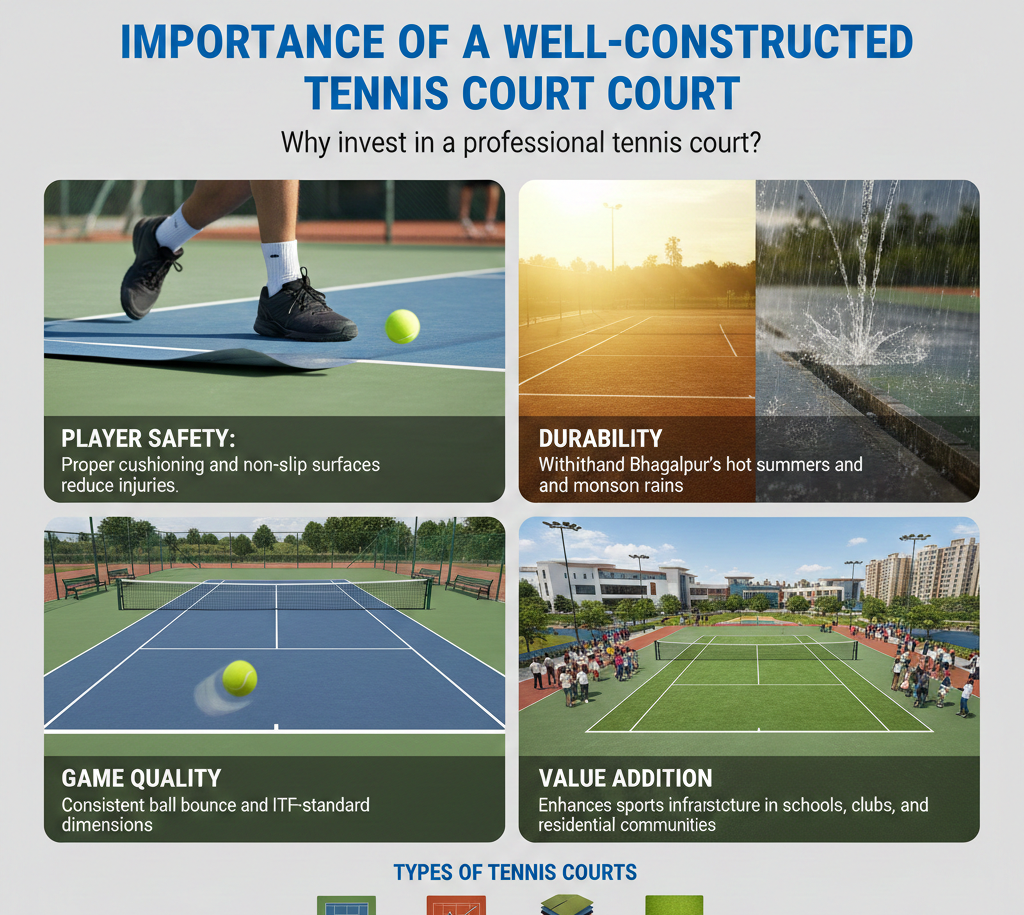
A professionally constructed tennis court combines accurate dimensions, a stable foundation, suitable sports flooring, effective drainage, and appropriate safety features. These components must work together to deliver consistent ball bounce, comfortable player movement, and reliable performance under regular use.
Sports Facility India offers comprehensive tennis court construction solutions that can be planned according to the available site, project budget, intended usage, and maintenance expectations. Each project requires an individual assessment because soil conditions, site elevation, weather exposure, and the selected playing surface influence the construction method.
Professional tennis court construction services may include:
- Site inspection and feasibility assessment
- Tennis court layout planning and orientation
- Ground excavation and soil preparation
- Sub-base development and compaction
- Concrete or asphalt base construction
- Acrylic, synthetic turf, or other suitable surface installation
- Tennis court line marking
- Net posts and tennis net installation
- Perimeter fencing and protective netting
- Sports lighting and electrical arrangements
- Drainage planning and finishing work
- Final inspection and maintenance guidance
A coordinated construction process helps reduce installation errors, avoid unnecessary rework, and maintain quality throughout the project.
Why Invest in Professional Tennis Court Construction in Bhopal?
A tennis court is a long-term sports infrastructure investment. Poor construction practices can lead to uneven surfaces, premature cracking, standing water, inconsistent ball bounce, and expensive repairs. Working with experienced tennis court contractors helps address these risks during the planning and construction stages.
1. Accurate Court Dimensions and Layout
Correct court dimensions are essential for recreational play, coaching sessions, and competitive tennis. A standard tennis court measures 23.77 metres in length, with a width of 8.23 metres for singles and 10.97 metres for doubles. Additional space is required around the playing area for player movement, fencing, access, and safety.
Professional planning considers both the marked playing area and the surrounding run-off zones. This helps ensure that players have sufficient space to move comfortably without unnecessary obstructions.
2. Strong Foundation and Surface Stability
The foundation determines how well the tennis court performs over time. Ground conditions must be evaluated before selecting the appropriate construction method. Excavation, soil compaction, sub-base preparation, and base installation should be completed according to the site’s engineering requirements.
A properly prepared base supports the sports surface, helps reduce settlement-related problems, and contributes to consistent playing conditions.
3. Effective Drainage for Monsoon Conditions
Bhopal experiences seasonal rainfall, making drainage an important consideration for outdoor tennis court construction. Poor water management can cause water accumulation, surface deterioration, and interruptions to playing schedules.
A suitable drainage plan may include carefully designed surface gradients, appropriate runoff arrangements, and drainage systems based on the site conditions. The objective is to move water away from the playing area while protecting the foundation and surrounding facilities.
4. Better Player Comfort and Safety
The right tennis court flooring can influence traction, movement, ball response, and playing comfort. Surface selection should reflect the age and skill level of the players, the frequency of use, and the type of tennis activities planned.
Professional installation also helps ensure that the surface is even, markings are accurate, and accessories are fitted securely.
5. Reduced Long-Term Maintenance
Quality materials and proper installation can help minimise avoidable repair expenses. Although every court requires regular inspection and maintenance, a well-planned construction project can improve service life and reduce the likelihood of recurring surface problems.
Types of Tennis Court Flooring Available in Bhopal
Selecting the appropriate tennis court surface is one of the most important decisions in a construction project. Different flooring systems offer different playing characteristics, installation requirements, costs, and maintenance needs.
Acrylic Tennis Court Flooring
Acrylic tennis court flooring is a popular choice for schools, sports clubs, residential communities, and tennis academies. It is generally installed over a suitable concrete or asphalt base using a compatible sports surface coating system.
Key advantages include:
- A clean, professional playing appearance
- Customisable surface colours
- Clearly defined playing lines
- Relatively straightforward routine maintenance
- Options for different surface textures and playing characteristics
- Suitability for many outdoor and selected indoor applications
The performance of an acrylic court depends on the complete system, including the base condition, coating specification, installation quality, and maintenance practices. Cushion-backed acrylic systems may also be considered when additional surface comfort is required.
Synthetic Turf Tennis Courts
Synthetic turf tennis courts offer a grass-like appearance and can be suitable for selected recreational facilities, residential developments, and sports clubs. Their playing characteristics differ from those of conventional acrylic hard courts.
Potential benefits include an attractive finish, surface drainage when the complete system is designed appropriately, and a different style of ball response.
Before choosing synthetic turf, project owners should assess the intended playing experience, infill requirements, cleaning needs, and suitability for regular tennis training. The turf specification and base design should be selected according to the project’s performance expectations.
Clay Tennis Courts
Clay courts are valued for their distinctive playing characteristics, including slower ball speed and higher bounce compared with many hard-court systems. They can support specialised coaching and players who prefer traditional clay-court tennis.
However, clay surfaces generally require more frequent upkeep than many acrylic courts. Maintenance can include moisture management, brushing, levelling, and periodic replenishment of surface material.
Their suitability depends on available maintenance resources, local weather conditions, and the intended use of the facility.
Cushioned Tennis Court Systems
Cushioned tennis court flooring incorporates a resilient layer within a compatible sports surface system. It may be considered for tennis academies, sports clubs, and facilities where player comfort is an important design priority.
The amount of cushioning and the resulting playing characteristics depend on the selected product and system specification. Proper installation over a stable base is essential for reliable performance.
Concrete and Asphalt Court Bases
Concrete and asphalt are commonly used as structural bases for suitable tennis court systems. They should not be treated as interchangeable with every finished sports surface.
The choice depends on soil conditions, engineering design, climate exposure, construction methods, and the selected flooring system. A finished court may require additional sports-specific coatings or surface treatments to achieve the intended playing characteristics.
Step-by-Step Tennis Court Construction Process
A systematic construction process helps maintain consistency, manage project costs, and reduce the risk of future defects.
Site Inspection and Feasibility Assessment
The project begins with an assessment of the proposed location. Contractors review available land, access for construction equipment, ground levels, soil conditions, surrounding structures, and existing drainage arrangements.
The assessment also considers whether the site is intended for a private court, a school, a sports academy, a club, or a larger sports complex.
Court Design and Planning
After evaluating the site, the construction team prepares a layout based on the intended use and available space. Planning covers court dimensions, run-off areas, orientation, fencing, entry points, lighting positions, and any spectator facilities.
North-south alignment is often considered for outdoor tennis courts to reduce direct sunlight interference during play, although the final orientation must account for site constraints.
Excavation and Ground Preparation
The ground is prepared to provide a stable foundation. Depending on the site, this may involve excavation, removal of unsuitable material, filling, levelling, and compaction.
The required depth and composition of the foundation layers should be determined through an appropriate site assessment and engineering design rather than applying the same specification to every project.
Sub-Base and Structural Base Installation
A suitable sub-base is installed and compacted to provide structural support. The base may consist of engineered aggregate layers followed by concrete or asphalt, depending on the selected court system.
Proper workmanship at this stage is crucial because irregularities in the foundation can affect the finished surface and may contribute to cracking or unevenness.
Drainage and Surface Preparation
The court base is prepared to manage water effectively. For outdoor installations, surface gradients and drainage arrangements should be designed to suit the site and applicable construction requirements.
Before flooring installation, the base must meet the selected system’s requirements for cleanliness, levelness, moisture condition, and surface integrity.
Tennis Court Flooring Installation
The selected flooring system is installed according to the manufacturer’s technical specifications. For acrylic systems, this may involve compatible primers, resurfacing materials, acrylic coatings, and textured finishing layers.
Other surfaces require their own installation procedures. Applying the correct materials under suitable environmental conditions helps achieve the intended finish and performance.
Court Marking and Equipment Installation
Playing lines are measured and applied accurately after the surface reaches the appropriate installation stage. Net posts, nets, fencing, gates, and other accessories are fitted according to the approved design.
The installation team also checks that equipment does not create unnecessary hazards around the playing area.
Lighting and Final Inspection
Where night play is required, lighting is designed to provide suitable visibility while controlling glare and uneven illumination. Electrical equipment should be selected and installed according to the project’s requirements and applicable safety standards.
The final inspection reviews surface finish, dimensions, markings, drainage, accessories, and overall site cleanliness before handover.
Tennis Court Construction Cost in Bhopal
The cost of tennis court construction in Bhopal depends on the project specification rather than a single fixed market rate. A recreational court with basic amenities may require a different investment from a cushioned sports court with professional lighting, fencing, and spectator facilities.
An indicative budget of ₹12 lakh to ₹40 lakh or more may be used for preliminary planning, but this is not a verified current quotation or a guaranteed price range for every project. Actual costs can fall outside this range depending on site conditions, construction scope, materials, and local pricing.
The principal factors affecting tennis court construction costs include:
- Court size and available land: The playing area, safety margins, and access requirements influence the overall footprint.
- Ground conditions: Excavation, soil improvement, filling, and compaction may increase costs where the site requires additional work.
- Foundation specification: The design, materials, and thickness of base layers influence structural costs.
- Flooring selection: Acrylic, cushioned, synthetic turf, and clay systems have different material and maintenance requirements.
- Drainage infrastructure: Surface gradients and additional drainage arrangements may be needed depending on the site.
- Fencing and accessories: Perimeter fencing, gates, net posts, nets, and protective netting add to the project budget.
- Sports lighting: Poles, fixtures, electrical connections, and installation requirements affect the final estimate.
- Additional amenities: Seating, landscaping, changing rooms, pathways, and other facilities increase the overall scope.
- Transportation and labour: Material availability, site access, and project location can affect installation expenses.
For an accurate estimate, request a site-specific quotation that separates civil work, base construction, flooring, accessories, lighting, taxes, and any exclusions. Comparing quotations on the basis of the same technical specifications makes it easier to evaluate overall value.
Tennis Court Construction for Different Applications in Bhopal
Professional tennis court construction can support a wide range of projects across Bhopal and nearby areas.
Schools and Colleges
Educational institutions can use professionally planned tennis courts to support physical education, extracurricular activities, coaching programmes, and inter-school competitions. Surface selection should account for student safety, usage frequency, and maintenance capacity.
Tennis Academies and Sports Training Centres
Training facilities may require durable surfaces, consistent playing conditions, secure fencing, suitable lighting, and sufficient run-off space. Depending on the training programme, specialised surface systems can be evaluated for their playing characteristics.
Residential Societies and Private Villas
Residential communities and private property owners can incorporate tennis courts into lifestyle and recreation facilities. Good planning considers available space, neighbouring properties, lighting impact, access, drainage, and long-term upkeep.
Sports Clubs, Hotels, and Resorts
Clubs and hospitality facilities may use tennis courts to improve guest amenities and provide opportunities for recreational play, coaching, and organised activities. A well-maintained court can contribute to the overall appeal of the property.
Government and Institutional Sports Projects
Public sports facilities require practical designs that account for regular usage, durability, accessibility, and maintenance planning. Project specifications should be developed in line with the relevant tender requirements and applicable technical standards.
How to Choose the Right Tennis Court Construction Company in Bhopal
Selecting a dependable tennis court contractor is essential for controlling project quality and avoiding unnecessary expenses.
Before finalising a service provider, consider the following factors:
- Relevant experience: Review completed tennis court projects and ask about experience with similar site conditions and surface systems.
- Construction methodology: Confirm that the contractor explains ground preparation, foundation layers, drainage, and flooring installation.
- Material specifications: Request product details and technical documentation for the proposed sports surface.
- Transparent quotation: Ensure the estimate identifies the work included, material specifications, payment stages, and exclusions.
- Project supervision: Understand how quality checks, site coordination, and installation progress will be managed.
- Warranty terms: Obtain written details of applicable product and workmanship warranties.
- Maintenance guidance: Ask about cleaning, inspections, resurfacing, and the availability of repair services.
- Compliance requirements: Verify that court dimensions, surface specifications, and equipment arrangements are appropriate for the intended use.
For competitive facilities, the project team should also verify relevant International Tennis Federation (ITF) guidance and any event-specific requirements. Claims of certification or approval should be supported by appropriate documentation.
Essential Design Considerations for Tennis Courts in Bhopal
Bhopal’s seasonal weather conditions make thoughtful planning particularly important for outdoor courts.
Drainage and rainfall management: The court should be designed to prevent avoidable water accumulation and protect the base from moisture-related damage.
Heat and sunlight exposure: Surface colour, material selection, shade provisions in spectator areas, and the placement of nearby structures should be evaluated in the context of local conditions.
Surface durability: Materials should be selected according to the expected frequency of play and the environmental exposure of the court.
Lighting and visibility: Lighting arrangements should provide suitable visibility for evening use while reducing glare for players and nearby residents.
Space and player movement: The layout should include adequate space beyond the marked playing area, with safe access routes and appropriately positioned fencing.
Future maintenance: Access for cleaning, surface repairs, equipment replacement, and drainage inspections should be considered during the design stage.
These considerations help create a court that is practical to operate and suitable for its intended users.
Tennis Court Maintenance and Resurfacing Services
Regular maintenance helps preserve playing quality and protect the original construction investment. The maintenance schedule should be based on the flooring type, intensity of use, weather exposure, and manufacturer’s recommendations.
Recommended maintenance activities include:
- Removing leaves, dust, and other debris from the playing surface.
- Cleaning the court using methods and products suitable for the installed flooring system.
- Inspecting cracks, surface wear, coating damage, and uneven areas.
- Checking drainage outlets and water flow after rainfall.
- Inspecting net posts, nets, fencing, gates, and lighting equipment.
- Repainting faded lines or repairing damaged surface markings when required.
- Arranging professional repairs and resurfacing when the surface condition warrants it.
Resurfacing intervals vary significantly. They should not be based on a universal timeline alone; instead, the decision should consider the surface manufacturer’s guidance, actual wear, and the condition of the underlying base.
Addressing small defects early can help prevent more extensive repairs and keep the facility suitable for regular play.
Why Consider Sports Facility India for Tennis Court Construction in Bhopal?
Planning a tennis court involves coordinating several technical elements, including civil construction, surface selection, drainage, accessories, and finishing. A coordinated service approach can help simplify project management and ensure that the different components are considered together.
Sports Facility India provides sports facility construction and flooring solutions for projects with different space, usage, and budget requirements. For a tennis court project in Bhopal, the proposed scope can be evaluated according to the site conditions, intended playing level, selected flooring system, and required amenities.
Project owners should discuss the following points before proceeding:
- The complete scope of construction and installation.
- Recommended flooring options for the intended application.
- Base preparation and drainage requirements.
- Estimated project duration and construction stages.
- Material specifications and quality checks.
- Warranty conditions and post-installation support.
- A detailed, site-specific cost estimate.
A clearly defined project scope helps establish realistic expectations and supports better coordination from initial planning through final handover.
Conclusion
The demand for tennis court construction in Bhopal reflects the growing importance of sports, fitness, and recreational infrastructure across educational institutions, residential developments, sports clubs, and training facilities. A well-designed tennis court can provide a valuable space for learning, exercise, coaching, and organised competition.
However, the quality of the finished facility depends on much more than the appearance of its playing surface. Proper site assessment, stable foundation construction, effective drainage, appropriate flooring selection, accurate line marking, and safe accessories all contribute to long-term performance.
Sports Facility India can be considered for tennis court construction and sports flooring requirements based on your project’s scope and technical needs. Whether you are developing a school tennis court, a private residential facility, a sports academy, or a larger recreation complex, begin with a clear design, a realistic budget, and a detailed construction specification.
By choosing suitable materials, qualified installation support, and a practical maintenance plan, property owners and institutions can develop a durable tennis facility that supports players of different skill levels and contributes to Bhopal’s expanding sports infrastructure.
Frequently Asked Questions (FAQs) – Tennis Court Construction in Bhopal
1. Who provides tennis court construction services in Bhopal?
Sports construction companies offering tennis court services can assist with site evaluation, court planning, foundation work, sports flooring, line marking, fencing, lighting, and accessories. Before appointing a contractor, review its relevant experience, proposed specifications, and project quotation.
2. How much does it cost to build a tennis court in Bhopal?
The cost depends on the court surface, site preparation, foundation design, drainage, fencing, lighting, and additional amenities. An indicative planning budget may be around ₹12 lakh to ₹40 lakh or more, but a site inspection and detailed quotation are necessary to establish the actual project cost.
3. What is the standard size of a tennis court?
A standard tennis court is 23.77 metres long. Its playing width is 8.23 metres for singles and 10.97 metres for doubles. Additional space must be provided around the court for safe player movement and access.
4. Which tennis court flooring is best for Bhopal’s climate?
Acrylic hard courts are a common option for outdoor tennis facilities because they offer a durable, clearly marked playing surface when installed over a suitable base. Synthetic turf and other systems may also be considered depending on the intended playing experience, drainage design, budget, and maintenance requirements.
5. How long does tennis court construction take in Bhopal?
The construction timeline depends on site preparation, foundation work, weather, material availability, and the selected flooring system. A straightforward project may take several weeks, while sites requiring substantial civil work or additional facilities may take longer. The contractor should provide a project-specific schedule.
6. Is drainage necessary for outdoor tennis court construction?
Yes. Effective drainage is essential for managing rainfall, limiting water accumulation, and protecting the court foundation. The drainage design should reflect the site elevation, soil conditions, surface system, and local rainfall patterns.
7. Can tennis court contractors build courts for schools and residential societies?
Yes. Tennis courts can be designed for schools, colleges, sports academies, residential communities, private villas, clubs, and institutional projects. The design should be adapted to the available land, player requirements, budget, and anticipated frequency of use.
8. Can an existing tennis court be renovated?
Yes. Depending on its condition, an existing court may be repaired, resurfaced, have its line markings renewed, or receive improvements to drainage, fencing, and lighting. A professional inspection is recommended to determine whether the base remains suitable or requires more extensive work.
9. Are acrylic tennis courts suitable for regular coaching?
Acrylic courts are widely used in tennis clubs and training facilities. The appropriate coating system should be selected according to the intended playing characteristics, frequency of use, and condition of the base. Regular cleaning and timely repairs help maintain the playing surface.
10. What accessories are required for a tennis court?
Typical accessories include tennis net posts, a tennis net, court markings, and suitable perimeter fencing. Depending on the project, additional features may include LED sports lighting, player seating, protective netting, access gates, and spectator areas.
11. Do tennis court construction companies provide maintenance services?
Some contractors provide maintenance, repairs, and resurfacing in addition to construction. Confirm the available services, warranty coverage, maintenance recommendations, and applicable charges before signing the agreement.
12. How can I get a quotation for tennis court construction in Bhopal?
Prepare the site location, approximate land dimensions, preferred flooring type, intended use, and required amenities. Share these details with the contractor and arrange a site assessment where necessary. A detailed quotation should specify the construction scope, materials, drainage, accessories, estimated timeline, and exclusions.