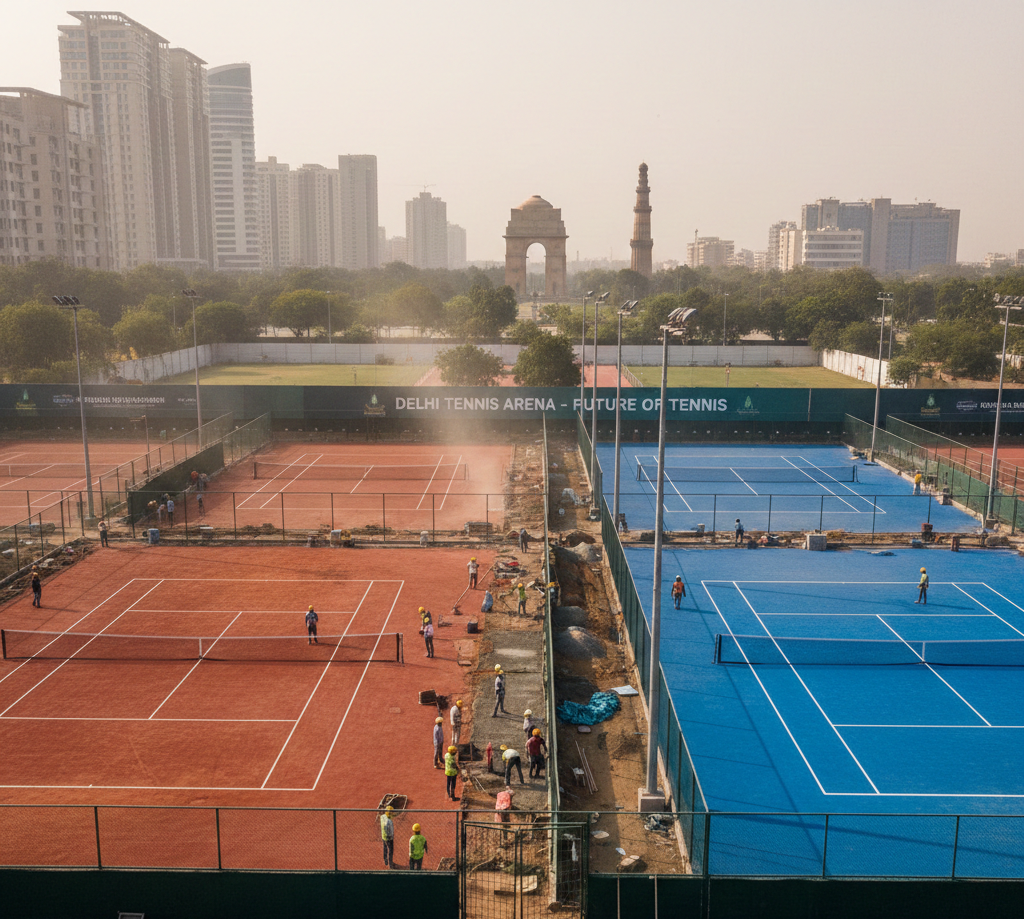
Introduction
Delhi is witnessing growing interest in tennis as schools, educational institutions, sports academies, residential communities, fitness clubs, and private property owners continue to invest in modern sports facilities. As awareness of outdoor fitness and professional sports training increases, the demand for tennis court construction in Delhi is creating new opportunities for sports infrastructure development.
Constructing a tennis court involves much more than preparing a flat surface and installing a net. A successful project requires careful site planning, appropriate foundation design, effective drainage, durable sports flooring, accurate court markings, and properly installed accessories. Each component contributes to the court’s playing quality, safety, and long-term performance.
Sports Facility India provides tennis court construction solutions designed around the requirements of schools, colleges, residential societies, sports academies, private clubs, and commercial sports facilities. From initial consultation and site assessment to base preparation, sports surface installation, line marking, and finishing, every stage should be planned according to the project’s intended use, available space, and budget.
Whether you are planning a tennis court for recreational activities, regular coaching, competitive practice, or a larger sports complex, selecting the right construction approach can help you develop a dependable playing facility that serves players for years.
If you are looking for professional tennis court construction in Delhi, understanding the available surfaces, construction methods, installation process, and project costs is an important first step.
Why Choose Professional Tennis Court Construction in Delhi?
A tennis court must provide consistent ball bounce, suitable traction, comfortable movement, and sufficient space for players to compete safely. Poor drainage, uneven foundations, incorrect markings, or unsuitable surface materials can affect performance and increase maintenance expenses.
Professional tennis court contractors assess these requirements before construction begins. They coordinate the civil work, surface system, court dimensions, fencing, lighting, and other essential features to create a functional sports facility.
1. Accurate Court Dimensions and Layout
Correct measurements are essential for recreational and competitive tennis. A standard tennis court measures 23.77 metres in length, with a width of 8.23 metres for singles and 10.97 metres for doubles. Additional space is necessary around the playing area for safe movement, fencing, access, and maintenance.
Professional planning helps ensure that the court layout suits the available site while providing adequate playing and run-off space. Where competition-level facilities are intended, the design should be checked against the applicable International Tennis Federation (ITF) guidance and event requirements.
2. Strong Foundation and Surface Stability
The foundation supports the entire tennis court. Depending on the site conditions and selected surface, construction may involve a properly designed granular base, asphalt, concrete, or another engineered system.
Correct compaction, level control, material selection, and curing are essential to reduce the risk of settlement, cracking, and surface irregularities. A suitable foundation also supports more consistent ball bounce and improves the durability of the finished court.
3. Effective Drainage for Delhi’s Climate
Delhi experiences hot summers, seasonal monsoon rainfall, and cooler winter conditions. These variations make drainage and material selection particularly important for outdoor tennis court projects.
A well-planned court incorporates appropriate gradients, drainage channels where required, and suitable surface materials. Water should be directed away from the playing area without creating puddles or undermining the foundation.
4. Improved Player Safety and Comfort
The right tennis surface helps players accelerate, change direction, and stop with greater confidence. Surface texture, traction, cushioning, and maintenance all influence the playing experience.
Professional installation helps minimize avoidable surface irregularities and ensures that the selected flooring system is appropriate for its intended use.
5. Reduced Long-Term Maintenance
Quality construction can reduce recurring problems associated with poor drainage, premature surface deterioration, and inadequate preparation. Choosing durable materials and establishing a regular maintenance schedule helps protect the investment over time.
Types of Tennis Court Surfaces Available in Delhi
Selecting the right playing surface is one of the most important decisions in tennis court construction. The ideal option depends on the available budget, player experience, expected usage, maintenance capacity, and desired style of play.
1. Acrylic Tennis Court Flooring
Acrylic tennis court flooring is a popular choice for schools, sports clubs, academies, residential communities, and outdoor sports complexes.
These systems are generally installed over a suitable asphalt or concrete base using compatible primers, resurfacing materials, and acrylic sports coatings. Depending on the system, additional cushioning layers may be incorporated to provide a more comfortable playing experience.
Key advantages include:
- A clean, professional sports-court appearance.
- Customizable playing-area and surrounding-area colours.
- Consistent playing characteristics when correctly installed.
- Options for cushioned and non-cushioned systems.
- Straightforward routine cleaning and periodic resurfacing.
Acrylic courts are particularly suitable for facilities that need a durable, relatively low-maintenance surface for regular tennis practice and recreational matches.
2. Synthetic Turf Tennis Courts
Synthetic turf offers an alternative for property owners who prefer a grass-like appearance. It may be considered for residential projects, recreational facilities, and selected club applications.
The playing characteristics depend on the turf construction, pile properties, infill system where applicable, and quality of the underlying base. Synthetic turf should be selected specifically for tennis rather than assuming that every artificial grass product is suitable for the sport.
Advantages can include an attractive appearance, reduced mowing requirements compared with natural grass, and flexibility in recreational facility design.
Proper installation, drainage, brushing, debris removal, and periodic inspection remain important for maintaining performance.
3. Clay Tennis Courts
Clay courts are associated with slower gameplay and longer rallies. They can be useful for players who want to develop patience, movement, and tactical consistency.
Clay court construction requires suitable surface materials, a carefully prepared foundation, effective drainage, and a maintenance plan. Depending on the clay system, regular watering, brushing, levelling, and surface replenishment may be necessary.
This option is worth considering for dedicated tennis clubs and training facilities that have the resources to maintain the playing surface consistently.
4. Concrete and Asphalt-Based Tennis Courts
Concrete and asphalt are commonly used as foundation systems for hard courts. When properly designed and prepared, they can provide a stable base for an appropriate sports coating.
The final playing surface should not be selected solely on the basis of the base material. Surface finishing, texture, cushioning requirements, drainage, joint treatment, and compatibility with the coating system all influence the final result.
For Delhi projects, the base must be designed with consideration for soil conditions, weather exposure, and the expected intensity of use.
5. Cushioned Tennis Court Systems
Cushioned acrylic systems incorporate additional elastic layers beneath the playing surface. These systems may be suitable for clubs, academies, and facilities that prioritize playing comfort.
The amount of cushioning and the playing characteristics vary by product. The selected system should match the intended level of use and the manufacturer’s installation requirements.
Tennis Court Construction Process in Delhi
A systematic construction process helps maintain quality, control project costs, and reduce the likelihood of future repairs.
Step 1: Site Inspection and Feasibility Assessment
The project begins with an assessment of the proposed location. Contractors examine the available area, access routes, soil conditions, existing levels, drainage patterns, and nearby structures.
The inspection also considers the intended users, number of courts, lighting requirements, fencing, and any applicable site restrictions.
This information helps establish a realistic construction plan and identify potential challenges before work begins.
Step 2: Court Design and Planning
The next stage involves preparing a court layout based on the available land and project objectives. Planning should include the playing dimensions, surrounding safety areas, entrance locations, fencing, lighting positions, and drainage arrangements.
Court orientation should also be considered to help reduce direct sun glare during play. A north-south orientation is often preferred where site conditions permit, although the final layout depends on the property’s shape and other constraints.
Step 3: Excavation and Ground Preparation
Once the layout is approved, the site is cleared and prepared for construction. Excavation, grading, soil stabilization, and compaction are completed as required by the site assessment and engineering design.
Unstable or unsuitable soil may require additional treatment. Proper ground preparation is important because defects beneath the court can eventually affect the finished surface.
Step 4: Foundation and Drainage Construction
The foundation is constructed according to the selected sports surface and site requirements. This may involve compacted granular layers followed by asphalt or concrete, or another suitable engineered arrangement.
Drainage slopes and outlets are incorporated into the design. Concrete and asphalt work must be completed to the required tolerances, with suitable curing or setting time before subsequent layers are installed.
Step 5: Sports Surface Installation
After the base has been inspected and confirmed suitable, the selected sports surface is installed.
For acrylic courts, this may involve cleaning and preparing the base, repairing minor imperfections, applying compatible coatings, and installing the specified texture and cushioning layers.
For synthetic turf or clay systems, the installation procedure differs according to the chosen product and construction specification.
The surface should be installed under appropriate weather and substrate conditions and in accordance with the manufacturer’s technical guidance.
Step 6: Court Marking and Net Installation
Accurate line marking is essential for correct gameplay. The singles and doubles boundaries, service lines, and centre service line must be positioned correctly.
Suitable sports-court marking materials should be compatible with the playing surface. The net, posts, and supporting fittings must also be installed at the correct positions and heights.
For a standard tennis court, the net height is 1.07 metres at the posts and 0.914 metres at the centre.
Step 7: Fencing, Lighting, and Additional Facilities
Fencing helps keep balls within the court area and separates the playing zone from surrounding spaces. Its height, gate placement, and construction should be selected according to the location and intended use.
LED sports lighting can support evening practice and improve facility utilization. Lighting should be designed to provide appropriate illumination while limiting glare and excessive light spill.
Other additions may include player seating, benches, shaded waiting areas, equipment storage, walkways, landscaping, and accessible entry points.
Step 8: Final Inspection and Handover
Before the facility is opened, the completed court should be inspected for surface consistency, line accuracy, drainage performance, net installation, and finishing quality.
The handover process should include relevant maintenance instructions, product information, and recommendations for cleaning and periodic inspection.
Tennis Court Construction Cost in Delhi
The cost of tennis court construction in Delhi depends on the site, selected surface, civil work, equipment, and overall project specifications. A reliable quotation should be based on a site assessment and a clearly defined scope of work.
The following factors have a major influence on the total investment.
1. Court Surface Selection
Acrylic, cushioned acrylic, synthetic turf, and clay courts have different material, installation, and maintenance requirements. The chosen surface affects both initial expenditure and long-term operating costs.
2. Site Conditions and Civil Work
Projects on level, well-prepared ground may require less preparation than sites with uneven terrain, weak soil, existing obstructions, or drainage problems.
Excavation, filling, soil stabilization, retaining structures, and access improvements can increase the overall budget.
3. Foundation Specifications
The cost of a concrete or asphalt base depends on engineering requirements, material quantities, thickness, reinforcement where needed, and site accessibility.
The foundation should be designed for the selected sports surface rather than chosen solely to minimize initial expenditure.
4. Fencing and Lighting
Perimeter fencing, gates, LED floodlights, electrical cabling, poles, and control equipment can form a significant part of the project budget.
The number of lighting fixtures and the required illumination level depend on whether the court is intended for recreational play, coaching, or competitive use.
5. Accessories and Additional Amenities
Seating, shade structures, landscaping, walkways, player facilities, and equipment storage can increase project costs but may improve the overall experience for users.
6. Location and Project Scale
Transportation, labour availability, site access, project scheduling, and the number of courts can affect the quotation. Multi-court facilities may require a different construction strategy from a single private court.
For this reason, it is better to request an itemized quotation than rely on a general online estimate. The quotation should identify the base construction, sports surface, line marking, fencing, lighting, accessories, and any excluded work.
Benefits of Building a Tennis Court in Delhi
Encourages Sports and Physical Fitness
A dedicated tennis court provides an accessible space for exercise, skill development, and recreational activities. It can encourage people of different age groups to participate in regular physical activity.
Supports Schools and Educational Institutions
Schools and colleges can use tennis courts for physical education, extracurricular activities, coaching, and inter-school sporting events. A well-planned facility can also support structured player development.
Creates Opportunities for Sports Academies
Training academies need suitable courts for regular coaching, drills, practice matches, and player assessment. Selecting the appropriate surface and supporting infrastructure helps create a better training environment.
Adds Value to Residential and Club Facilities
Tennis courts can enhance the recreational amenities offered by residential societies, private clubs, hotels, and premium residential developments. Their value depends on how well the facility is designed, maintained, and integrated into the property.
Supports Commercial Sports Operations
Depending on local demand and operating costs, tennis courts can support coaching programmes, membership facilities, court bookings, and organized sporting events.
A realistic business plan should account for maintenance, staffing, utilities, equipment replacement, and expected court usage before estimating potential returns.
How to Choose the Best Tennis Court Construction Company in Delhi
Selecting the right contractor is an important part of ensuring construction quality and long-term performance.
Review previous projects: Ask to see completed tennis courts and, where possible, inspect the surface quality, line markings, drainage, and finishing.
Check technical expertise: Choose a company that understands foundation construction, sports surface installation, drainage, fencing, and lighting rather than focusing only on the visible flooring.
Evaluate material specifications: Request details about the proposed surface system, product quality, installation method, and maintenance requirements.
Confirm design standards: Ensure that the layout, court dimensions, net height, and safety areas are appropriate for the intended level of play and relevant tennis guidelines.
Request an itemized quotation: Compare the scope of work, material specifications, construction stages, completion schedule, and exclusions before making a decision.
Discuss warranties and maintenance: Understand what is covered by the warranty, how surface repairs are handled, and whether resurfacing or maintenance services are available.
Prioritize communication: A reliable contractor should explain the construction sequence, expected site requirements, payment milestones, and factors that may affect the schedule.
For projects across Delhi and the wider National Capital Region, these checks can help property owners identify a contractor suited to their specific requirements.
Tennis Court Construction Solutions by Sports Facility India
Sports Facility India offers sports infrastructure solutions for organizations and property owners planning new tennis facilities. Project requirements can differ considerably between a private residence, school, sports academy, residential society, and commercial sports complex.
A project-specific approach should consider the available site, preferred playing surface, expected number of users, budget, and future maintenance requirements.
Services may include site assessment, court layout planning, foundation preparation, sports flooring installation, court marking, net and post installation, fencing, lighting coordination, and finishing work, depending on the agreed project scope.
The objective is to develop a functional and durable tennis court with an appropriate playing surface and supporting infrastructure. Careful planning before construction can help reduce avoidable changes, improve coordination, and establish realistic expectations for the completed facility.
If you are planning tennis court construction in Delhi, contact Sports Facility India to discuss your site, preferred surface, intended usage, and project requirements.
Growing Demand for Tennis Court Construction in Delhi NCR
Interest in tennis is creating opportunities for new sports facilities throughout Delhi and neighbouring NCR locations, including Gurugram, Noida, Faridabad, and Ghaziabad.
Educational institutions may require courts for sports programmes, while private academies need surfaces suited to repeated training sessions. Residential communities and clubs may prioritize recreational use, accessibility, and manageable maintenance requirements.
Commercial sports facilities often need a balance between durability, player experience, lighting, and efficient use of available space.
Although every project has different priorities, successful tennis court development begins with the same essentials: a suitable site, an engineered foundation, effective drainage, a surface matched to its intended use, and professional finishing.
As investment in sports infrastructure continues, well-designed tennis courts can provide valuable spaces for learning, fitness, recreation, and competitive development.
Conclusion
Professional tennis court construction in Delhi requires coordinated planning, quality materials, reliable civil work, and the right sports surface. From acrylic hard courts and cushioned systems to synthetic turf and clay courts, each option offers different playing characteristics, costs, and maintenance requirements.
The best construction solution is one that matches the project’s purpose while accounting for site conditions, weather exposure, drainage, safety, and long-term operating costs.
Whether you are developing a tennis court for a school, sports academy, residential society, private property, or commercial facility, working with an experienced sports infrastructure contractor can help you make informed decisions throughout the project.
Sports Facility India can be approached to discuss tennis court construction requirements in Delhi and explore suitable solutions for your location, budget, and intended use.
Frequently Asked Questions About Tennis Court Construction in Delhi
1. Who provides tennis court construction services in Delhi?
Sports infrastructure contractors provide tennis court planning and construction services for schools, colleges, sports academies, clubs, residential societies, and private properties. Before selecting a company, review its relevant experience, proposed materials, completed projects, and maintenance support.
2. What is the cost of tennis court construction in Delhi?
The cost depends on the court surface, foundation, ground conditions, drainage, fencing, lighting, accessories, and site accessibility. An accurate quotation generally requires a site inspection and a detailed project specification.
3. How much space is required to build a tennis court?
A standard tennis court measures 23.77 metres long, with a playing width of 8.23 metres for singles and 10.97 metres for doubles. Additional space is required beyond the playing lines for player movement, fencing, and safe access. The complete site requirement depends on the design and intended level of play.
4. Which surface is best for a tennis court in Delhi?
Acrylic hard courts are a common choice for schools, clubs, and outdoor sports facilities because they offer customizable finishes and relatively straightforward maintenance. Cushioned acrylic, synthetic turf, and clay may be suitable for other requirements. The final selection should consider budget, playing style, drainage, and maintenance capacity.
5. How long does tennis court construction take?
The construction period depends on site preparation, foundation work, surface selection, weather, curing or setting requirements, and the installation of accessories. A straightforward project may take several weeks, while sites requiring extensive civil work or additional facilities may take longer. The contractor should provide a project-specific schedule.
6. Can tennis courts be constructed at schools and residential societies?
Yes. Tennis courts can be planned for schools, colleges, housing societies, private clubs, and residential properties. The design should consider the available space, user requirements, access, safety areas, lighting, and maintenance arrangements.
7. Is acrylic flooring suitable for outdoor tennis courts?
Yes, a suitable outdoor acrylic sports-court system can be installed over a properly prepared asphalt or concrete base. Correct drainage, substrate preparation, product selection, and installation conditions are essential for long-term performance.
8. Are tennis courts suitable for Delhi’s hot summers and monsoon season?
Tennis courts can be designed for Delhi’s seasonal conditions by selecting suitable materials, preparing a stable foundation, and incorporating effective drainage. Outdoor surface performance also depends on installation quality, exposure, maintenance, and the manufacturer’s recommendations.
9. What are the standard tennis court dimensions?
The standard playing area is 23.77 metres long. The width is 8.23 metres for singles and 10.97 metres for doubles. The net is 1.07 metres high at the posts and 0.914 metres high at the centre. Additional space around the court is needed for safe movement and access.
10. Do tennis court construction companies install fencing and sports lighting?
Many sports infrastructure contractors can provide fencing, gates, LED lighting, net posts, and related accessories as part of a complete project. Confirm that these items are included in the quotation and that the lighting design meets the intended usage requirements.
11. How can tennis court maintenance costs be reduced?
Use appropriate cleaning methods, remove debris regularly, maintain drainage outlets, inspect the surface for cracks or damage, and address small defects promptly. Periodic maintenance and resurfacing should follow the requirements of the installed court system.
12. Can an existing tennis court be resurfaced in Delhi?
Yes. Existing courts may be eligible for resurfacing if the underlying foundation is sufficiently stable. The contractor should inspect cracks, drainage, surface wear, and structural defects before recommending repairs or a new surface system.
13. Can tennis courts be customized according to a client’s requirements?
Yes. Customization may include playing-surface colours, cushioning systems, fencing, lighting, seating, access gates, and branding. Custom features should be planned without compromising court dimensions, playing characteristics, or safety.
14. What should I check before hiring a tennis court contractor in Delhi?
Review completed projects, material specifications, construction methods, court dimensions, drainage plans, itemized pricing, project timelines, warranty terms, and maintenance support. A detailed written scope of work helps clarify responsibilities and reduce misunderstandings.
15. Does Sports Facility India provide tennis court construction solutions in Delhi NCR?
Sports Facility India can be contacted to discuss tennis court construction requirements in Delhi and nearby NCR areas. Share the project location, available space, preferred surface, and intended use to help establish the appropriate scope of work and quotation.