Introduction
Badminton has become one of the most widely played indoor sports in India, enjoyed by students, working professionals, and competitive athletes alike. In urban regions like Navi Mumbai, where infrastructure development is rapidly expanding, the demand for high-quality sports facilities has increased significantly.
Among all indoor sports facilities, badminton courts are the most preferred due to their compact space requirements, low maintenance, and high usability throughout the year. As a result, badminton court construction in Navi Mumbai has become a growing trend across schools, residential complexes, sports academies, gyms, and commercial sports centers.
Modern badminton courts are no longer basic cemented spaces. They now follow international standards with advanced flooring systems, precision lighting, shock-absorbing bases, and high-performance materials designed for safety and professional gameplay.
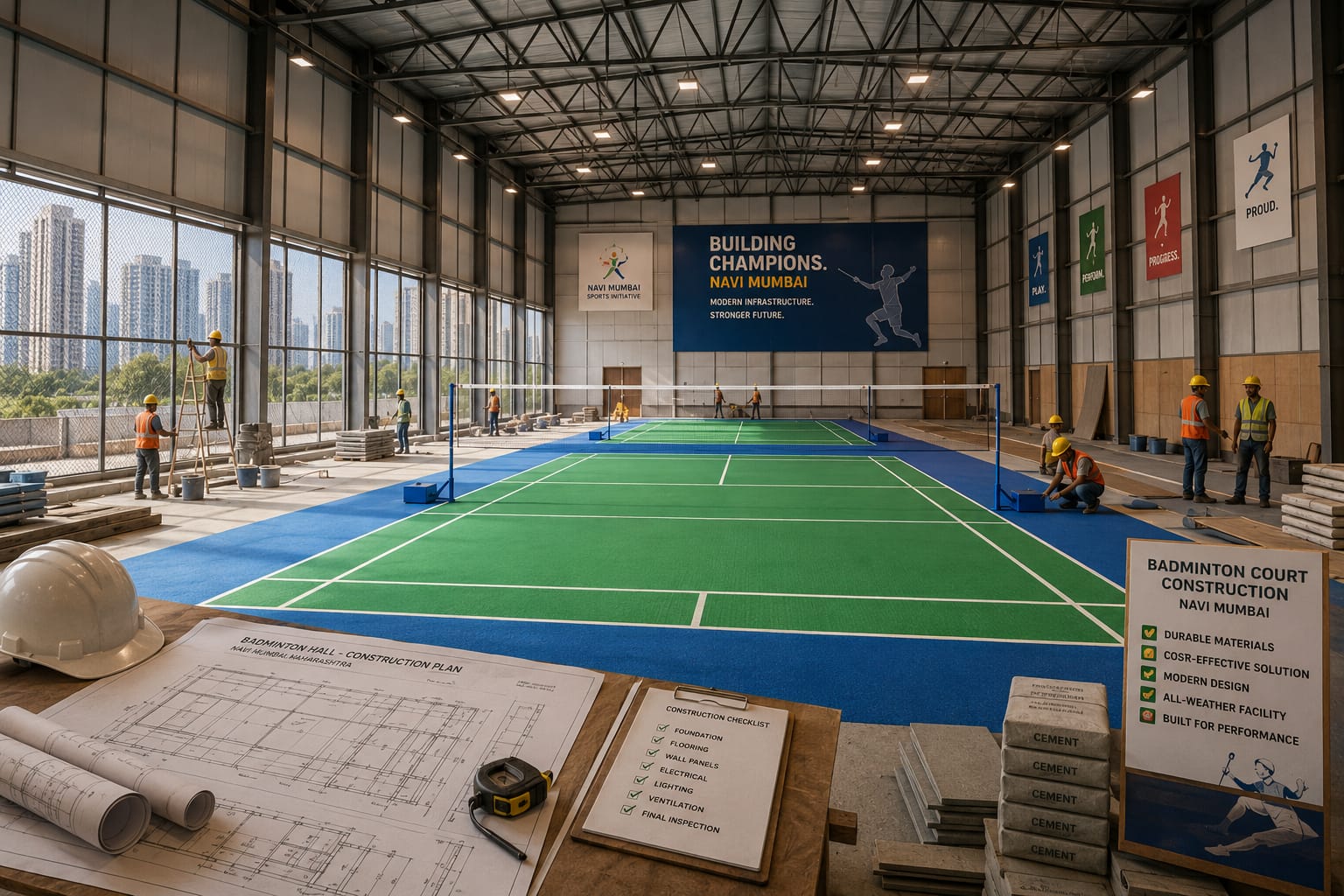
This guide explains everything about badminton court construction in Navi Mumbai, including types of courts, technical specifications, construction steps, cost breakdown, maintenance, benefits, and frequently asked questions.
Why Badminton Court Construction is Increasing in Navi Mumbai
Navi Mumbai is one of India’s fastest-growing planned cities with a strong focus on lifestyle, fitness, and infrastructure development. Several factors are driving the growth of badminton court projects:
1. Rapid Urban Sports Development
The city is witnessing continuous development of residential townships, schools, and commercial complexes that include indoor sports facilities as standard amenities.
2. Growing Fitness Awareness
Badminton is a high-intensity sport that improves stamina, reflexes, and overall fitness, making it popular among youth and working professionals.
3. Demand for Indoor Sports Facilities
Due to unpredictable weather conditions, indoor sports infrastructure is preferred, ensuring year-round play without interruption.
4. Rise of Coaching Academies
Professional badminton coaching centers are expanding across Navi Mumbai, requiring high-quality courts that meet training standards.
5. Space-Efficient Sport
Unlike football or cricket grounds, badminton courts require limited space, making them ideal for urban construction projects.
Types of Badminton Courts in Navi Mumbai
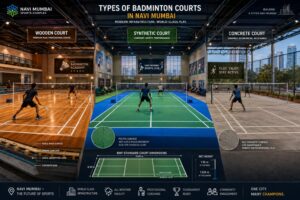
Choosing the right court type is one of the most important decisions in the construction process. Each surface offers different benefits based on usage, budget, and performance requirements.
1. Wooden Badminton Courts
Wooden flooring systems are widely used in professional indoor stadiums and academies.
Key Features:
- Hardwood or engineered wood surface
- Shock-absorbing understructure (sprung system)
- High-quality bounce and grip performance
Advantages:
- Best playing experience
- Reduces injury risk
- International-level standard
Limitations:
- Expensive installation
- Sensitive to humidity and moisture
- Requires regular maintenance and polishing
2. Synthetic Badminton Courts (PVC/PU)
Synthetic courts are the most widely used option in India today due to their affordability and durability.
Key Features:
- PVC or polyurethane flooring layer
- Installed over RCC or asphalt base
- Anti-slip cushioned surface
Advantages:
- Cost-effective solution
- Low maintenance requirements
- Suitable for schools, gyms, and clubs
- Weather-resistant (indoor environments)
Limitations:
- Moderate lifespan compared to wood
- Needs professional installation for best results
3. Cement or Concrete Badminton Courts
These are basic-level courts often used for recreational or budget-friendly setups.
Key Features:
- RCC or cement concrete base
- No cushioning layer
Advantages:
- Lowest construction cost
- Simple installation process
- Suitable for outdoor use
Limitations:
- Hard surface increases injury risk
- Not suitable for professional play
- Poor shock absorption
Standard Badminton Court Dimensions (BWF Guidelines)
A professional badminton court must strictly follow Badminton World Federation (BWF) standards:
- Court Length: 13.40 meters
- Court Width (Doubles): 6.10 meters
- Court Width (Singles): 5.18 meters
- Net Height: 1.55 meters at posts, 1.524 meters at center
- Safety Clearance: Minimum 2 meters around all sides
- Ceiling Height (Indoor): Minimum 7.5 meters (9–12 meters recommended)
Accurate markings and proper spacing are essential for fair gameplay and tournament eligibility.
Step-by-Step Process of Badminton Court Construction in Navi Mumbai
Step 1: Site Evaluation and Planning
- Analyze available space
- Check ceiling height (for indoor courts)
- Ensure ventilation and lighting feasibility
- Decide court orientation
Step 2: Base Preparation
- Excavation and leveling of surface
- Installation of RCC slab (100–125 mm thickness)
- Moisture-proof treatment for indoor courts
Subfloor or Base Layer Installation
- Wooden spring system for professional courts
- Cement smoothing for synthetic flooring
- Surface leveling for uniform play
Flooring Installation
- PVC or PU synthetic mat installation
- Hardwood plank fitting for wooden courts
- Strong adhesive bonding and alignment
Court Marking
- Accurate BWF standard marking
- Use of non-slip, durable sports paint
- Clear boundary definition for singles and doubles
Lighting and Accessories
- LED lighting system for indoor visibility
- Badminton nets and poles installation
- Optional seating, fencing, and scoreboard systems
Cost of Badminton Court Construction in Navi Mumbai
Construction cost depends on material selection, location, and project size.
Estimated Cost Breakdown:
- Synthetic PVC Court: ₹350 – ₹600 per sq. ft
- Wooden Court System: ₹500 – ₹800 per sq. ft
- Concrete Court: ₹150 – ₹250 per sq. ft
Total Project Cost Range:
- Basic Court Setup: ₹5 – ₹8 lakhs
- Standard Indoor Synthetic Court: ₹8 – ₹15 lakhs
- Professional Wooden Court: ₹20 – ₹25 lakhs
Factors affecting cost:
- Flooring type
- Structural design
- Indoor vs outdoor construction
- Lighting system quality
- Additional facilities
Maintenance of Badminton Courts
Proper maintenance ensures long-lasting performance and player safety.
Synthetic Courts:
- Regular cleaning using soft mops
- Avoid sharp objects on surface
- Use mild cleaning agents
Wooden Courts:
- Maintain humidity levels
- Regular polishing every 1–2 years
- Avoid water exposure
General Maintenance:
- Inspect nets and poles regularly
- Maintain LED lighting systems
- Check flooring wear and tear
Common Challenges in Navi Mumbai Court Construction
1. Climate and Humidity
High humidity can damage wooden flooring if moisture control is not properly managed.
2. Limited Urban Space
Space constraints in residential and commercial projects can restrict full-size court design.
3. Poor Installation Practices
Incorrect base preparation leads to uneven bounce and reduced court lifespan.
4. Budget Management Issues
Many projects underestimate long-term maintenance and operational costs.
5. Lack of Technical Expertise
Improper flooring installation reduces performance and safety.
Benefits of Building Badminton Courts in Navi Mumbai
- Encourages sports and fitness culture
- Supports professional training academies
- Generates commercial rental income
- Enhances property value in residential projects
- Promotes healthy lifestyle among youth
- Suitable for schools, clubs, and societies
Future of Badminton Infrastructure in Navi Mumbai
With increasing government support and private investment in sports infrastructure, Navi Mumbai is becoming a major hub for indoor sports development. The demand for badminton courts is expected to grow further due to:
- Expansion of residential townships
- Growth of sports academies
- Corporate wellness initiatives
- Rising interest in competitive badminton
Frequently Asked Questions (FAQs)
1. What is the standard size of a badminton court?
A standard court measures 13.40 meters in length and 6.10 meters in width for doubles play.
2. What is the cost of badminton court construction in Navi Mumbai?
The cost typically ranges from ₹5 lakhs to ₹25 lakhs depending on flooring type and design.
3. Which flooring is best for badminton courts?
Wooden flooring is best for professional use, while synthetic flooring is ideal for schools and clubs.
4. How long does it take to build a badminton court?
Construction usually takes 4 to 8 weeks depending on site conditions and materials.
5. Can badminton courts be used for other sports?
Yes, with multi-sport markings, courts can also be used for pickleball or volleyball.
6. What is the lifespan of a badminton court?
- Wooden courts: 15–20 years
- Synthetic courts: 7–10 years
- Concrete courts: 20+ years
7. Is indoor or outdoor badminton court better?
Indoor courts are preferred due to better surface control and weather protection.
Conclusion
Badminton court construction in Navi Mumbai is growing rapidly due to increasing demand for indoor sports facilities, fitness awareness, and professional training centers. Whether it is a residential society, school, gym, or sports academy, investing in a well-designed badminton court ensures long-term value, better community engagement, and improved sports culture.
A successful project depends on proper planning, high-quality materials, accurate execution, and adherence to international standards. With the right approach, Navi Mumbai can continue developing as one of India’s leading hubs for modern sports infrastructure.