In today’s health-conscious world, jogging tracks have become an essential part of modern infrastructure in schools, residential societies, corporate campuses, sports complexes, fitness centers, and public parks. A well-designed jogging track provides a dedicated space for walking, jogging, and running while promoting a healthy and active lifestyle.
However, constructing a high-quality jogging track requires more than simply preparing a running surface. It involves professional site planning, civil engineering, foundation development, drainage management, sports flooring installation, and infrastructure integration.
A professionally constructed jogging track combines durable materials, proper ground preparation, efficient drainage, and suitable surface systems to deliver long-term performance, user comfort, and safety. Whether it is a small residential jogging track or a full-scale athletic running facility, every construction element plays an important role in ensuring durability and functionality.
Overview of Jogging Track Construction & Infrastructure
Jogging track construction is a specialized infrastructure development process that involves designing and building a dedicated running and walking pathway using suitable foundation materials and performance-oriented surface systems.
The construction process includes several important stages, starting with site inspection and excavation, followed by subgrade preparation, foundation construction, drainage installation, surface application, and final finishing.
Overview of Jogging Track Construction (image) Overview of Jogging Track Construction
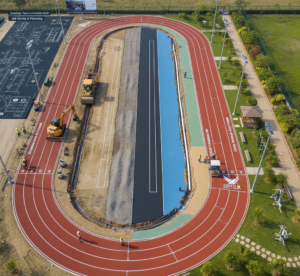
A properly designed jogging track infrastructure should be capable of handling:
- Regular pedestrian and running activity.
- Continuous exposure to sunlight, rain, and changing weather conditions.
- Surface wear, impact, and repeated foot traffic.
- Effective stormwater drainage and moisture management.
- Long-term structural stability and minimal maintenance.
- Safe and comfortable movement for users of different age groups.
Combining civil construction techniques with modern sports flooring technology helps create jogging tracks that are functional, attractive, and durable.
Key Stages of Jogging Track Construction
A successful jogging track project requires systematic execution and quality control at every construction stage. Below are the major steps involved in developing a durable jogging track.
1. Site Survey, Inspection & Infrastructure Planning
The first stage of jogging track construction involves a detailed site survey and feasibility assessment.
Construction engineers inspect the available land to understand its physical condition and determine the most suitable track layout.
Important factors evaluated during this stage include:
- Existing ground levels and topography.
- Soil condition and bearing capacity.
- Natural water flow and drainage requirements.
- Available construction area and surrounding infrastructure.
- Accessibility, pedestrian movement, and safety requirements.
Based on the survey, engineers prepare a detailed construction and layout plan covering:
- Track length, width, and overall dimensions.
- Straight sections and curve geometry.
- Lane divisions and running zones.
- Foundation specifications and surface material selection.
- Drainage routes and stormwater management.
- Lighting, landscaping, and peripheral facilities.
Proper planning ensures efficient land utilization, construction accuracy, and long-term operational performance.
2. Excavation & Ground Preparation
Once the layout is approved, excavation and ground preparation work begins.
The existing ground is excavated according to the approved design and required foundation depth. The excavation depth generally depends on soil conditions, track specifications, and the selected surface system.
The major activities include:
- Removing vegetation, roots, topsoil, and construction debris.
- Excavating the ground to the specified formation level.
- Leveling and grading the construction area.
- Compacting the natural soil using mechanical equipment.
- Applying soil stabilization where necessary.
For weak or moisture-sensitive soil, additional stabilization using suitable materials or geotechnical solutions may be required.
Proper subgrade preparation provides a stable foundation and minimizes the possibility of surface settlement, cracking, and structural deformation.
3. Foundation & Base Layer Construction
The foundation system is one of the most important components of jogging track infrastructure. It provides the structural support required to maintain surface stability and distribute loads evenly.
Depending on the selected track design, the foundation may consist of multiple compacted layers.
| Foundation Layer | Common Materials | Main Function |
|---|---|---|
| Subgrade | Compacted natural soil | Provides ground support |
| Granular Sub-base | Crushed stone and gravel | Improves drainage and load distribution |
| Base Course | WMM or WBM | Provides structural strength |
| Binding Layer | Fine aggregates or suitable binder | Creates a stable base |
| Surface Base | Asphalt or concrete | Provides a suitable substrate for finishing |
Each layer is placed, compacted, and leveled according to the engineering specifications.
The required cross-slope is incorporated into the foundation design to facilitate effective water runoff. The exact slope depends on the surface system and project specifications.
A properly constructed foundation prevents uneven settlement and improves the overall lifespan of the jogging track.
4. Drainage System & Water Management
An efficient drainage system is essential for maintaining the quality and usability of an outdoor jogging track.
Water accumulation can damage the foundation, weaken surface adhesion, and create slippery running conditions. Therefore, drainage infrastructure should be incorporated during the initial construction stage.
Common drainage components include:
- Perimeter drainage channels.
- Surface water collection points.
- Catch basins and inspection chambers.
- Underground PVC or RCC drainage pipes.
- Suitable outlets for stormwater discharge.
- Permeable drainage layers where required.
The track surface and foundation should be designed to direct rainwater toward designated collection points.
An effective drainage network protects the foundation, reduces maintenance requirements, and helps maintain safe running conditions throughout the year.
5. Jogging Track Surface Installation & Finishing
The surface material directly influences the comfort, durability, grip, and overall running experience.
Different surface systems are available depending on the project budget, usage requirements, and performance expectations.
| Surface Type | Material | Suitable Applications |
|---|---|---|
| PU Synthetic Surface | Polyurethane-based multilayer system | Sports facilities and premium running tracks |
| Acrylic Surface | Textured acrylic resin coating | Schools, parks, and residential societies |
| EPDM Rubber Surface | EPDM granules with suitable binder | Recreational and community jogging tracks |
| Rubberized Flooring | Recycled or virgin rubber materials | Fitness zones and walking pathways |
| Asphalt Surface | Bituminous pavement | Public parks and outdoor pathways |
| Natural Soil / Red Earth | Compacted natural materials | Traditional park jogging tracks |
The installation process depends on the selected system and may include:
- Surface cleaning and preparation.
- Primer application where required.
- Base coating or cushioning layer installation.
- Application of EPDM or PU finishing layers.
- Surface texturing and leveling.
- Final curing and quality inspection.
The selected surface should provide suitable slip resistance, weather resistance, durability, and user comfort.
6. Lane Marking, Signage & Track Identification
Line marking and signage help improve the organization, accessibility, and usability of jogging tracks.
For multi-lane tracks and designated running zones, clear markings are installed according to the approved layout.
Common finishing elements include:
- Lane division markings.
- Start and finish line identification.
- Distance indicators.
- Directional arrows and safety signage.
- Track branding and facility identification.
Suitable marking materials should offer good adhesion, visibility, and resistance to UV exposure and regular wear.
7. Lighting & Electrical Infrastructure
Proper lighting improves the usability and safety of jogging tracks during early mornings, evenings, and low-light conditions.
A well-planned electrical infrastructure may include:
- Energy-efficient LED lighting poles.
- Solar-powered lighting systems.
- Underground or protected electrical cabling.
- Weather-resistant electrical fixtures.
- Automated timers and lighting controls.
- Emergency lighting provisions where required.
Lighting positions should be planned to minimize dark spots, glare, and shadows along the running pathway.
Modern jogging track projects can also incorporate solar energy systems and smart lighting controls to improve energy efficiency.
8. Landscaping & Peripheral Infrastructure Development
Landscaping and surrounding infrastructure enhance the appearance and functionality of a jogging track.
A properly developed outdoor fitness environment encourages regular physical activity and provides users with a comfortable recreational space.
Additional infrastructure may include:
- Green belts, trees, and decorative plants.
- Seating benches and resting areas.
- Drinking water stations.
- Outdoor gym and fitness equipment.
- Gazebos and shaded structures.
- Walking pathways and connecting trails.
- Waste bins and information signage.
- Safety fencing and boundary development.
Native plants and sustainable landscaping solutions can further reduce water consumption and maintenance requirements.
Essential Infrastructure Components of a Jogging Track
A complete jogging track project involves multiple interconnected construction and infrastructure systems.
| Infrastructure Component | Purpose |
|---|---|
| Ground Preparation | Creates a stable construction platform |
| Foundation System | Provides structural strength and stability |
| Drainage Network | Prevents water accumulation and foundation damage |
| Sports Flooring System | Improves comfort, grip, and running performance |
| Electrical Infrastructure | Provides lighting and operational safety |
| Lane Marking & Signage | Improves track organization and navigation |
| Landscaping | Enhances aesthetics and environmental quality |
| Safety Infrastructure | Includes fencing, curbing, and protective features |
| Peripheral Amenities | Provides seating, hydration, and fitness facilities |
Integrating these elements during the planning and construction stages ensures a complete, functional, and sustainable jogging track facility.
Quality Testing & Inspection in Jogging Track Construction
Quality control is essential to ensure that the completed jogging track meets the required engineering and performance specifications.
Various tests and inspections are conducted during different construction stages.
Important quality checks include:
- Soil Compaction Test: Evaluates the density and stability of the prepared subgrade.
- CBR Test: Determines the load-bearing capacity of the soil.
- Plate Load Test: Assesses the bearing characteristics of the prepared foundation where specified.
- Aggregate Quality Test: Checks the suitability of materials used in the base layers.
- Drainage Flow Test: Verifies effective water movement through the drainage system.
- Level & Slope Verification: Ensures correct surface grading and water runoff.
- Surface Adhesion Test: Evaluates bonding between the substrate and synthetic flooring.
- Slip Resistance Test: Checks surface traction and safety.
- Shock Absorption Test: Evaluates impact attenuation for suitable synthetic sports surfaces.
For professional athletic facilities, testing and installation should follow the relevant project specifications and applicable sports surface standards.
Cost of Jogging Track Construction & Infrastructure in India
The cost of constructing a jogging track depends on several factors, including track dimensions, soil conditions, foundation requirements, surface materials, drainage arrangements, and additional infrastructure.
The following figures are indicative preliminary estimates and should not be treated as fixed market rates.
| Track Category | Typical Application | Approximate Cost |
|---|---|---|
| Mini Jogging Track (100–150 m) | Residential societies and schools | ₹1,50,000–₹3,00,000 |
| Standard Jogging Track (200 m) | Colleges and recreational complexes | ₹3,50,000–₹5,50,000 |
| 400 m Running Track | Sports grounds and public facilities | ₹6,00,000–₹12,00,000 |
Actual project costs can vary considerably depending on the track width, total surface area, selected flooring system, and construction specifications.
Additional facilities such as LED lighting, landscaping, fencing, seating arrangements, and outdoor gym equipment may increase the overall project budget.
For accurate costing, a detailed site survey, quantity estimation, and material specification are recommended.
Approximate Jogging Track Surface Material Costs
| Surface Type | Indicative Cost per Sq. Metre |
|---|---|
| PVC / Interlocking Tiles | ₹400–₹900 |
| PU Synthetic Flooring | ₹900–₹2,500 |
| Rubberized Surface | ₹1,500–₹3,000 |
Note: These are indicative estimates only. Actual rates depend on material quality, thickness, installation requirements, location, and project scale. They may not include civil foundation, drainage, or electrical work.
Benefits of Professionally Constructed Jogging Tracks
Investing in professionally designed jogging track infrastructure offers several long-term advantages.
- Enhanced Durability: Quality foundation materials and proper construction techniques improve the service life of the facility.
- Improved User Safety: Suitable surface textures, proper drainage, and adequate lighting help reduce common safety risks.
- Better Running Comfort: Specialized rubber and synthetic surfaces can provide improved cushioning and impact absorption.
- Low Maintenance Requirements: Proper installation and drainage reduce the need for frequent repairs.
- Improved Aesthetic Appeal: Well-designed tracks enhance the overall appearance of schools, residential communities, and public spaces.
- Increased Property Value: Recreational infrastructure can improve the attractiveness of residential and commercial developments.
- Sustainable Development: Recycled materials, solar lighting, and water-efficient landscaping support environmentally responsible construction.
Common Mistakes to Avoid During Jogging Track Construction
Even a well-planned project can experience performance issues if essential construction practices are overlooked.
Common mistakes include:
- Inadequate Subgrade Compaction: Can result in settlement, cracks, and uneven surfaces.
- Improper Drainage Planning: Causes waterlogging and premature surface deterioration.
- Incorrect Surface Material Selection: May reduce comfort, durability, and suitability for the intended application.
- Poor Foundation Preparation: Can lead to structural instability and surface failure.
- Inadequate Surface Slope: Prevents efficient rainwater runoff.
- Low-Quality Installation: Can result in peeling, poor adhesion, and premature wear.
- Insufficient Lighting: Creates visibility and safety problems during low-light conditions.
- Skipping Quality Inspections: Increases the risk of construction defects and costly repairs.
To avoid these issues, project owners should work with experienced sports infrastructure contractors who understand civil engineering, sports flooring systems, and outdoor facility development.
Sustainable & Eco-Friendly Jogging Track Construction Practices
Modern jogging track infrastructure increasingly focuses on sustainability, resource efficiency, and environmentally responsible construction.
Some effective sustainable construction practices include:
- Using recycled rubber granules in suitable synthetic flooring systems.
- Selecting low-VOC and environmentally responsible binders where available.
- Installing permeable surfaces and drainage systems where site conditions permit.
- Incorporating solar-powered LED lighting.
- Using native plants and drought-resistant landscaping.
- Implementing rainwater harvesting and stormwater management.
- Selecting durable materials that reduce replacement frequency and construction waste.
These measures help create environmentally responsible jogging facilities while supporting long-term operational efficiency.
Conclusion: Building Durable & High-Performance Jogging Track Infrastructure
A successful jogging track construction and infrastructure project requires the right combination of engineering expertise, quality construction materials, advanced sports flooring solutions, and systematic project execution.
From site inspection and foundation development to drainage installation, synthetic surfacing, lighting, and landscaping, every component contributes to the overall performance and durability of the facility.
Whether developing a jogging track for a school, residential society, corporate campus, sports complex, or public park, professional planning and quality construction practices are essential for creating a safe, comfortable, and long-lasting fitness environment.
Visit Sports Facility to explore sports infrastructure solutions and professional facility development services.
Frequently Asked Questions (FAQs) – Jogging Track Construction & Infrastructure
1. What is jogging track construction and infrastructure?
Jogging track construction and infrastructure refers to the complete process of planning, designing, and developing dedicated running and walking tracks. It includes site preparation, excavation, foundation construction, drainage, sports flooring, lighting, safety features, and peripheral amenities.
2. What are the main components of jogging track infrastructure?
The major components include:
- Compacted soil and sub-base preparation.
- Granular foundation and base course.
- PU, EPDM, acrylic, or rubberized surface systems.
- Stormwater drainage arrangements.
- Electrical and lighting infrastructure.
- Lane markings and directional signage.
- Landscaping, fencing, and seating facilities.
3. What are the different stages of jogging track construction?
The typical construction process involves:
- Site survey and feasibility assessment.
- Layout design and project planning.
- Excavation and ground preparation.
- Subgrade compaction and stabilization.
- Foundation and base course construction.
- Drainage system installation.
- Sports flooring and surface application.
- Line marking and finishing.
- Lighting and landscaping installation.
- Final quality inspection and handover.
4. Which materials are commonly used for jogging track construction?
Commonly used materials include:
- Crushed stone and aggregates for foundation layers.
- WMM and WBM for base construction.
- Asphalt and concrete for structural surfaces.
- Polyurethane (PU) for synthetic sports flooring.
- EPDM rubber granules for cushioned surfaces.
- Acrylic coatings for recreational running pathways.
- PVC and interlocking rubber tiles for modular flooring applications.
The material selection depends on the project requirements, budget, climatic conditions, and expected usage.
5. Why is drainage important in jogging track infrastructure?
Drainage prevents rainwater accumulation and protects the foundation and surface layers from moisture-related damage. A properly designed drainage system also helps maintain surface grip, reduces maintenance requirements, and improves track usability during rainy weather.
6. What are the standard dimensions of a jogging track?
Jogging track dimensions vary according to the available land and intended application.
Typical planning considerations include:
- Width: Approximately 1.2–2.5 metres for recreational jogging pathways, depending on expected traffic.
- Length: Common recreational loops range from 100 to 400 metres.
- Clearance: Adequate space should be provided along the track edges for safe movement and maintenance.
A professional athletic track requires a different dimensional design and should follow the relevant sporting standards.
7. Can a jogging track be constructed over an existing concrete or asphalt surface?
Yes. Synthetic and modular jogging track surfaces can often be installed over existing concrete or asphalt, provided the substrate is structurally sound, sufficiently level, clean, dry, and free from significant cracks or drainage defects.
Surface preparation, crack repairs, and suitable primers may be required before installation.
8. How much time is required to construct a jogging track?
The construction duration depends on the track size, foundation requirements, weather conditions, and selected surface system.
Indicative project durations include:
- Small residential jogging track: 3–7 days.
- Medium-sized jogging track: 7–15 days.
- Large athletic track: 2–4 weeks or longer.
These estimates assume suitable site conditions and timely material availability. They may vary depending on the scope of civil and infrastructure work.
9. What is the cost of jogging track construction in India?
Jogging track construction costs depend on the surface material, track dimensions, foundation design, drainage system, and additional infrastructure.
Indicative surface costs include:
- PVC or interlocking tiles: ₹400–₹900 per sq. metre.
- PU synthetic flooring: ₹900–₹2,500 per sq. metre.
- Rubberized surfaces: ₹1,500–₹3,000 per sq. metre.
Civil work, drainage, lighting, and landscaping may be charged separately depending on the project scope.
10. How can jogging tracks be maintained?
Regular maintenance helps preserve the quality and performance of jogging tracks.
Recommended activities include:
- Sweeping and cleaning the running surface.
- Removing leaves, dust, and debris.
- Inspecting surfaces for cracks, peeling, and worn areas.
- Checking drainage channels and outlets.
- Repairing damaged flooring and markings.
- Inspecting lighting fixtures and electrical connections.
- Conducting periodic surface condition assessments.
11. What safety features should be included in jogging track construction?
Important safety provisions include:
- Slip-resistant running surfaces.
- Proper surface gradients and drainage.
- Adequate lighting.
- Safe entry and exit points.
- Clearly visible directional signage.
- Suitable edge protection and curbing.
- Emergency access provisions where required.
- Adequate separation from vehicular movement.
12. Can additional fitness facilities be integrated into jogging track infrastructure?
Yes. Modern jogging track projects can incorporate several recreational and fitness facilities, including:
- Outdoor gym equipment.
- Walking and cycling pathways.
- Drinking water stations.
- Resting benches and shaded seating.
- Fitness instruction boards.
- Distance markers and digital counters.
- Children’s play areas.
- Green spaces and landscaped zones.
13. Who is responsible for designing and constructing jogging tracks?
Jogging track projects are generally handled by specialized sports infrastructure contractors, civil engineers, architects, and sports flooring professionals.
An experienced contractor can coordinate site preparation, foundation construction, drainage, surface installation, and additional infrastructure to ensure a complete facility.
14. How long does a professionally constructed jogging track last?
The lifespan depends on the flooring material, installation quality, foundation condition, weather exposure, and maintenance practices.
Indicative service-life expectations are:
- PVC / Interlocking Tiles: 8–10 years.
- PU / EPDM Synthetic Surfaces: 10–12 years.
- Rubberized Asphalt Surfaces: 12–15 years.
These are general estimates rather than guaranteed lifespans. Regular maintenance and timely repairs can help extend the useful life of a jogging track.
15. What factors should be considered before starting a jogging track construction project?
Before starting construction, consider:
- Available land area and site conditions.
- Expected daily users and traffic volume.
- Track dimensions and layout.
- Foundation and soil requirements.
- Suitable surface material.
- Drainage and rainwater management.
- Lighting and electrical arrangements.
- Safety and accessibility requirements.
- Project budget and maintenance costs.
Careful evaluation of these factors helps ensure a cost-effective and durable jogging track infrastructure project.