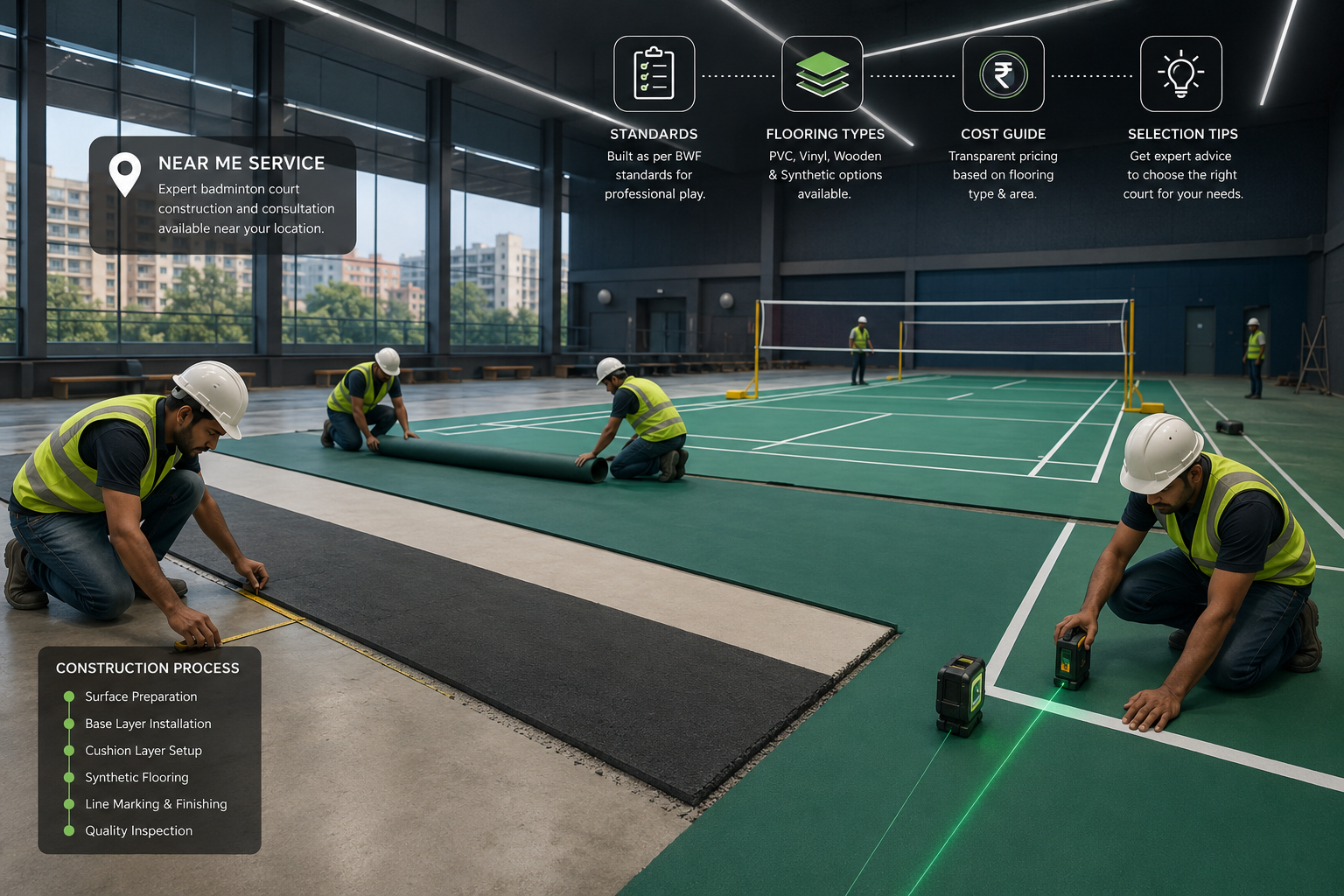
Badminton has rapidly evolved from a casual recreational activity into one of the most widely played competitive sports in India. With increasing participation from schools, housing societies, fitness centers, corporate campuses, and sports academies, the demand for professional badminton court construction services near me has grown significantly across urban and semi-urban regions.
Modern badminton courts are no longer simple play areas marked on a flat surface. They are engineered sports facilities designed with precision flooring systems, shock absorption technology, accurate dimensional layout, and lighting optimization to meet international performance standards. A properly constructed court directly influences player safety, movement efficiency, and overall game quality.
This comprehensive guide explains everything about badminton court construction services, including design principles, flooring systems, construction workflow, cost structure, selection criteria, and long-term maintenance requirements.
Why Professional Badminton Court Construction Services Matter
Building a badminton court requires technical expertise, not just civil construction skills. Professional contractors ensure that the facility meets performance expectations and international guidelines set by the Badminton World Federation (BWF).
1. Precision in Design and Measurements
Professional builders ensure accurate implementation of court geometry, including singles and doubles layouts, service zones, and boundary clearances. Even minor deviations can affect competitive gameplay.
2. Player Safety and Injury Prevention
A professionally designed court incorporates shock-absorbing flooring systems that reduce stress on knees, ankles, and joints, especially during fast movements and jumps.
3. Long-Term Durability
High-quality materials and correct installation methods significantly extend the lifespan of the court, reducing repair and maintenance costs over time.
4. Performance Optimization
Proper surface friction, controlled bounce, and uniform lighting improve gameplay consistency, making the court suitable for both training and tournaments.
5. Aesthetic and Functional Value
Well-constructed courts enhance the visual appeal of sports facilities, making them suitable for academies, clubs, and premium residential developments.
Standard Badminton Court Dimensions (BWF Guidelines)
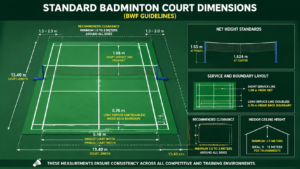
A key aspect of badminton court construction services near me is strict compliance with global standards.
Court Size Specifications:
- Court Length: 13.40 meters
- Doubles Court Width: 6.10 meters
- Singles Court Width: 5.18 meters
Net Height Standards:
- At posts: 1.55 meters
- At center: 1.524 meters
Service and Boundary Layout:
- Short service line: 1.98 meters from net
- Long service line (doubles): 0.76 meters inside back boundary
Recommended Clearance:
- Minimum 1.5 to 2 meters around all sides
- Indoor ceiling height:
- Minimum: 7.5 meters
- Ideal: 9–12 meters for tournaments
These measurements ensure consistency across all competitive and training environments.
Types of Badminton Court Flooring Used by Professionals
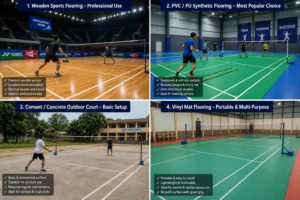
Flooring is the most critical component of any badminton court construction project. The choice depends on usage intensity, budget, and indoor/outdoor requirements.
1. Wooden Sports Flooring
Wooden flooring is widely used in professional stadiums and training academies.
Characteristics:
- High-performance surface with excellent bounce response
- Superior shock absorption for player safety
- Natural playing feel preferred by athletes
Advantages:
- Ideal for tournaments and professional training
- Long-lasting with proper maintenance
- Enhances premium sports environment
Limitations:
- Higher installation cost
- Requires periodic polishing and humidity control
2. Synthetic PVC / PU Flooring
This is the most commonly used option in modern badminton court construction services.
Characteristics:
- Multi-layer cushioned surface
- Anti-slip texture for controlled movement
- Installed over RCC or wooden base
Advantages:
- Cost-effective and durable
- Low maintenance requirements
- Suitable for schools, societies, gyms, and academies
- Resistant to humidity and temperature variations
Why it is popular:
It provides a balanced performance suitable for both beginners and advanced players, making it the most versatile flooring system.
3. Cement or Concrete Base Courts
Concrete courts are basic-level outdoor installations.
Characteristics:
- Hard surface with minimal cushioning
- Economical construction option
Advantages:
- Low installation cost
- Easy to build in open spaces
Limitations:
- High impact on joints
- Not suitable for professional gameplay
- Requires additional coating for usability
4. Modular Interlocking Courts
These are portable systems used for temporary setups.
Characteristics:
- Quick installation and removal
- Prefabricated interlocking panels
Advantages:
- Ideal for events and tournaments
- Can be relocated easily
Indoor vs Outdoor Badminton Courts
The choice between indoor and outdoor courts significantly impacts design, durability, and player experience.
Indoor Courts
Indoor courts are preferred for professional and controlled environments.
Features:
- Wooden or synthetic flooring
- Controlled lighting system
- No weather interference
Benefits:
- Consistent playing conditions
- Longer flooring life
- Suitable for tournaments and coaching centers
Outdoor Courts
Outdoor courts are commonly built in schools, parks, and societies.
Features:
- Acrylic or synthetic coating systems
- Weather-resistant design
Benefits:
- Cost-effective
- Easy accessibility
- Suitable for recreational use
Badminton Court Construction Process
Professional badminton court construction services follow a structured workflow to ensure quality execution.
Site Analysis and Planning
- Measurement of available space
- Ceiling height evaluation (for indoor courts)
- Environmental assessment (ventilation, drainage, humidity)
- Layout planning according to BWF standards
Base Construction
- RCC slab preparation (typically 100–125 mm thickness)
- Surface leveling for uniformity
- Moisture barrier installation
- Crack-free finishing for flooring support
A strong base ensures long-term structural stability.
Flooring Installation
- Installation of synthetic, wooden, or modular systems
- Proper adhesion and alignment
- Cushion layer integration for impact absorption
Court Marking
- Precise line marking as per official dimensions
- Use of high-durability, anti-slip paint
- Differentiation of singles and doubles zones
Lighting and Accessories Installation
- LED lighting setup (glare-free distribution)
- Installation of net posts and standard nets
- Optional additions: seating, fencing, ventilation systems
Final Testing and Quality Inspection
- Surface testing for grip and bounce consistency
- Safety inspection for edges and joints
- Lighting uniformity verification
Cost of Badminton Court Construction
The cost varies based on materials, design complexity, and usage purpose.
Approximate Cost Range:
- Synthetic PVC Court: ₹5 – ₹10 lakh
- Wooden Indoor Court: ₹8 – ₹12 lakh
- Outdoor Synthetic Court: ₹4 – ₹7 lakh
- Basic Concrete Court: ₹2 – ₹4 lakh
Additional Costs:
- LED lighting system
- Ventilation or air cooling
- Seating arrangements
- Maintenance packages
A fully equipped indoor professional court generally costs more but provides significantly higher performance and durability.
Key Features of a Professional Badminton Court
A high-quality badminton facility must include:
- Standard BWF-compliant dimensions
- Shock-absorbing, anti-slip flooring
- Minimum clearance of 2 meters on all sides
- Proper indoor height (9+ meters recommended)
- Uniform LED lighting (300–750 lux)
- Durable nets and adjustable posts
These features ensure tournament-level performance and player safety.
How to Choose the Right Badminton Court Construction
Selecting the right contractor is critical for long-term performance.
1. Experience and Expertise
Choose builders with proven experience in sports infrastructure projects.
2. Material Quality
Ensure they use certified flooring systems and durable materials.
3. Project Portfolio
Check previous installations in schools, academies, or residential complexes.
4. Customization Capability
Good contractors offer tailored solutions based on space and budget.
5. After-Sales Support
Maintenance, resurfacing, and repair services are essential for long-term value.
Installing a Professional Badminton Court
- Encourages sports culture and fitness
- Enhances property value in residential complexes
- Supports professional training and tournaments
- Provides recreational space for all age groups
- Promotes healthy lifestyle habits
Conclusion
The demand for badminton court construction services near me continues to rise as badminton becomes one of the most widely played sports across India. However, building a high-performance court requires more than basic construction knowledge—it demands engineering precision, quality materials, and adherence to international standards.
Whether for a school, sports academy, corporate campus, or residential society, a professionally built badminton court delivers long-term value in terms of durability, safety, and player experience. Choosing an experienced contractor ensures that the facility not only meets expectations but also supports high-level training and competitive play for years to come.
Badminton Court Construction Services Near Me – Short FAQ
Q1. What do badminton court construction services include?
👉 Site planning, base work, flooring installation, marking, lighting, and complete setup.
Q2. What is the standard size of a badminton court?
👉 13.40 m × 6.10 m for doubles and 13.40 m × 5.18 m for singles.
Q3. Which flooring is best for badminton courts?
👉 PVC synthetic flooring is most widely used for durability and low maintenance.
Q4. How much does a badminton court cost?
👉 Around ₹5 lakh to ₹10 lakh for a standard indoor court.
Q5. How long does construction take?
👉 Usually 20–30 days depending on site conditions.
Q6. Is indoor court better than outdoor?
👉 Yes, indoor courts offer better control, safety, and longer flooring life.
Q7. Do contractors provide turnkey services?
👉 Yes, most professional builders handle end-to-end turnkey construction.
Q8. What lighting is required?
👉 LED lighting with 300–750 lux for clear and glare-free visibility.
Q9. Can courts be built in societies or schools?
👉 Yes, courts can be customized for any available space.
Q10. Is maintenance required?
👉 Yes, regular cleaning and periodic inspection ensure long life and performance.