Introduction
India’s sports infrastructure sector is growing rapidly, and hockey remains one of the country’s most respected and widely played sports. With increasing investment in sports academies, educational institutions, government stadiums, and private sports facilities, the demand for professional hockey field construction companies in Delhi NCR has increased significantly.
Modern hockey fields are no longer simple playgrounds. Today’s synthetic hockey turfs are engineered sports surfaces designed for professional gameplay, athlete safety, durability, and international-standard performance. From advanced drainage systems to shock-absorbing layers and high-quality synthetic grass, every component plays an important role in delivering a world-class hockey facility.
Whether it is a school, college, sports academy, government project, or private stadium, choosing the right hockey field construction company in Delhi NCR is essential for creating a durable and high-performance sports infrastructure project.
This complete guide explains everything about hockey field construction, including turf types, construction process, materials, costs, maintenance, and how to choose the best contractor for hockey turf development in Delhi NCR.
Why Hockey Field Construction is Growing in Delhi NCR
The Delhi NCR region has become one of India’s leading hubs for sports infrastructure development. Cities like Gurugram, Noida, Faridabad, Ghaziabad, and Delhi are witnessing major investments in modern sports facilities.
Several important factors are driving the growth of hockey field construction in the region.
1. Government Sports Development Programs
Government initiatives such as Khelo India and state-level sports infrastructure projects are encouraging the construction of synthetic hockey turfs across educational institutions and sports complexes.
The focus on developing Olympic-level athletes has increased the demand for professional hockey grounds.
2. Expansion of Private Sports Academies
Delhi NCR has witnessed rapid growth in sports academies and training centers. Professional coaches and institutions now prefer synthetic hockey turfs because they provide consistent playing conditions and improve athlete performance.
3. Infrastructure Development in Schools and Universities
Schools and universities are upgrading their sports facilities to attract students and provide modern athletic infrastructure.
Synthetic hockey fields have become an important part of modern campus development.
4. Increasing Popularity of Professional Sports
The growth of sports leagues and professional competitions has increased awareness about high-quality sports infrastructure.
Players now require international-standard hockey turfs for advanced training and competitive matches.
5. Rise of Multi-Sport Complexes
Many developers and institutions are constructing multi-sports arenas that include hockey fields, football turfs, basketball courts, tennis courts, and athletic tracks.
This trend is significantly boosting demand for sports flooring and turf construction companies.
What is a Synthetic Hockey Field?
A synthetic hockey field is an advanced artificial sports surface designed specifically for hockey gameplay. These surfaces are constructed using synthetic grass fibers installed over engineered base systems.
Modern hockey turfs provide:
- Consistent ball speed
- Better player grip
- Reduced injuries
- Weather resistance
- Long-term durability
Professional hockey field construction companies in Delhi NCR use advanced engineering techniques to ensure international-standard performance.
Types of Hockey Fields Used in India
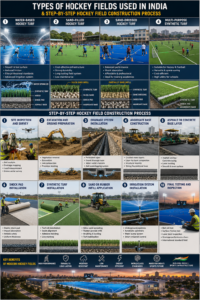
Different types of hockey surfaces are used depending on budget, level of competition, and project requirements.
1. Water-Based Hockey Turf
Water-based turf is considered the highest-quality hockey playing surface.
Features:
- Requires water spraying before matches
- Smooth and fast playing surface
- Reduced surface friction
- International-level playing standards
Advantages:
- Excellent ball control
- Preferred for professional tournaments
- Better athlete safety
Best For:
- International stadiums
- National tournaments
- Elite sports academies
2. Sand-Filled Hockey Turf
This surface contains silica sand between synthetic turf fibers.
Features:
- Strong and durable structure
- Moderate gameplay speed
- Lower maintenance compared to water-based turf
Advantages:
- Budget-friendly option
- Suitable for schools and colleges
- Long-lasting surface
3. Sand-Dressed Hockey Turf
A partially sand-filled surface balancing affordability and performance.
Features:
- Improved player comfort
- Reduced maintenance
- Better shock absorption
Advantages:
- Cost-effective installation
- Suitable for training facilities
- Good durability
4. Multi-Purpose Synthetic Turf
These surfaces are designed for multiple sports activities.
Features:
- Supports hockey and football
- Durable synthetic surface
- Flexible usage
Advantages:
- Space-saving solution
- Affordable for institutions
- High utility value
Step-by-Step Hockey Field Construction Process
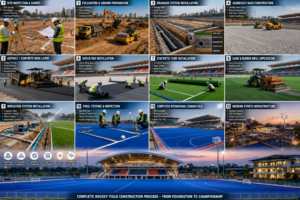
Professional hockey field construction companies follow a detailed engineering process to ensure long-term performance and durability.
Step 1: Site Inspection and Survey
Engineers inspect:
- Soil quality
- Ground stability
- Drainage patterns
- Available area dimensions
Proper planning ensures better construction quality and long-term durability.
Step 2: Excavation and Ground Preparation
The construction area is cleared and leveled.
Activities Include:
- Vegetation removal
- Soil excavation
- Surface grading
- Ground compaction
Proper leveling is critical for drainage and gameplay consistency.
Step 3: Drainage System Installation
Drainage is one of the most important parts of hockey field construction.
Components Include:
- Perforated pipes
- Water outlet channels
- Gravel layers
A strong drainage system prevents waterlogging and protects the turf during heavy rain.
Step 4: Aggregate Base Construction
Multiple layers of crushed stone are laid and compacted.
Benefits:
- Structural stability
- Improved load-bearing capacity
- Efficient water drainage
Step 5: Asphalt or Concrete Base Layer
A smooth asphalt or concrete layer is installed.
Purpose:
- Provides a stable surface
- Ensures smooth turf installation
- Improves durability
Step 6: Shock Pad Installation
Shock pads improve player safety and comfort.
Advantages:
- Better cushioning
- Reduced joint impact
- Enhanced playing experience
Premium hockey projects often include elastic shock absorption systems.
Step 7: Synthetic Turf Installation
Synthetic turf rolls are installed over the prepared surface.
Installation Process:
- Turf alignment
- Seam joining
- Adhesive bonding
- Line marking
Professional installation ensures seamless surface performance.
Step 8: Sand or Rubber Infill Application
Depending on the turf type, infill materials are spread evenly.
Common Materials:
- Silica sand
- Rubber granules
Infill improves turf stability and gameplay quality.
Step 9: Irrigation System Installation
Water-based hockey fields require advanced irrigation systems.
System Components:
- Sprinklers
- Underground pipelines
- Water pumps
Step 10: Final Testing and Inspection
The completed hockey field undergoes quality testing.
Tests Include:
- Ball roll testing
- Surface friction analysis
- Drainage inspection
- Level verification
Materials Used in Hockey Field Construction
High-quality materials are essential for durable and professional sports infrastructure.
Synthetic Turf Fibers
Polyethylene
- Soft and durable
- Better player comfort
- Premium quality material
Polypropylene
- Budget-friendly option
- Strong weather resistance
- Durable surface
Shock Pads
Shock pads improve player safety and reduce injuries.
Types:
- Prefabricated shock pads
- In-situ elastic systems
Base Materials
Commonly Used:
- Crushed stone
- Gravel
- Asphalt
- Concrete
Adhesives and Joining Tapes
Used for seamless turf installation.
Benefits:
- Strong bonding
- Long-term durability
- Smooth playing surface
Advantages of Synthetic Hockey Fields
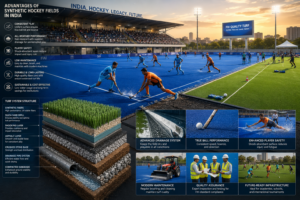
Modern synthetic hockey turfs offer several benefits over natural grass fields.
1. Consistent Gameplay
Synthetic surfaces provide uniform ball speed and bounce throughout the field.
2. All-Weather Usage
The field remains usable during rain and extreme weather conditions.
3. Lower Maintenance
No mowing, fertilizing, or frequent watering is required.
4. Better Player Safety
Shock absorption systems reduce injuries and physical stress.
5. Long Lifespan
Properly maintained hockey fields can last over a decade.
Hockey Field Construction Cost in Delhi NCR
The cost of hockey field construction depends on several factors.
Approximate Cost Range
- Basic synthetic hockey turf: ₹250–₹400 per sq. ft.
- Premium hockey turf: ₹450–₹700 per sq. ft.
- International-standard stadium projects: ₹1 crore to ₹3 crore+
Factors Affecting Construction Cost
1. Turf Quality
Premium imported turf materials increase overall cost.
2. Ground Dimensions
Larger projects require more materials and labor.
3. Drainage System Complexity
Advanced drainage systems improve durability but add to the budget.
4. Shock Pad Installation
High-end cushioning systems increase construction cost.
5. Additional Infrastructure
Lighting, fencing, seating, and scoreboards impact the final pricing.
How to Choose the Best Hockey Field Construction Company in Delhi NCR
Choosing the right contractor is essential for successful project execution.
1. Experience in Sports Infrastructure
Select companies specializing in synthetic turf and sports flooring projects.
2. Use of International-Standard Materials
Ensure the company uses FIH-approved turf systems.
3. Engineering Expertise
Proper leveling, drainage, and installation quality are critical.
4. Portfolio and Client Reviews
Review completed projects and customer testimonials.
5. Maintenance Services
Reliable maintenance support helps extend turf lifespan.
6. Transparent Pricing
Professional contractors provide detailed quotations without hidden costs.
Maintenance of Synthetic Hockey Fields
Regular maintenance ensures durability and performance consistency.
Daily Maintenance
- Cleaning debris
- Brushing turf fibers
- Surface inspection
Monthly Maintenance
- Seam inspection
- Drainage system checks
- Infill level monitoring
Annual Maintenance
- Deep cleaning
- Surface performance testing
- Repair work if required
Future of Hockey Infrastructure in India
India’s sports infrastructure industry is expected to grow rapidly in the coming years.
Major trends include:
- Smart stadium technology
- Eco-friendly synthetic surfaces
- AI-based maintenance systems
- Multi-sports complexes
- International-standard sports academies
The demand for professional hockey field construction companies in Delhi NCR will continue increasing as sports development accelerates.
Conclusion
The need for professional hockey field construction companies in Delhi NCR is growing rapidly due to rising sports awareness, infrastructure investments, and demand for international-standard training facilities.
Modern synthetic hockey fields provide excellent playing quality, long-term durability, lower maintenance, and improved athlete safety. Whether the project is for a school, academy, university, or professional sports complex, selecting an experienced contractor is essential for successful execution.
With advanced engineering, premium materials, and proper maintenance, synthetic hockey fields are shaping the future of sports infrastructure across India.
FAQs – Hockey Field Construction Company in Delhi NCR
1. What is the cost of hockey field construction in Delhi NCR?
The cost of hockey field construction in Delhi NCR generally ranges from ₹250 to ₹700 per sq. ft., depending on turf quality, drainage system, shock pads, and project size.
2. Which type of hockey turf is best for professional matches?
Water-based synthetic hockey turf is considered the best for professional and international-level matches because it provides faster gameplay and better ball control.
3. How long does it take to construct a hockey field?
A professional synthetic hockey field usually takes 6 to 12 weeks to complete, depending on weather conditions and project complexity.
4. What is the lifespan of a synthetic hockey field?
A high-quality synthetic hockey field can last around 10 to 15 years with proper maintenance and regular servicing.
5. Does a hockey turf require maintenance?
Yes, regular cleaning, brushing, drainage inspection, and seam maintenance are important for maintaining turf quality and durability.
6. Can hockey fields be constructed for schools and sports academies?
Yes, schools, colleges, universities, and sports academies commonly install synthetic hockey turfs for training and tournaments.
7. Why should I hire a professional hockey field construction company?
Professional contractors ensure accurate leveling, advanced drainage systems, high-quality turf installation, and long-lasting sports infrastructure that meets modern performance standards.
8. What materials are used in hockey field construction?
Common materials include synthetic turf fibers, crushed stone base layers, asphalt or concrete foundations, shock pads, silica sand, and adhesive joining tapes.