Introduction
Badminton has become one of the most popular indoor sports in Delhi, with growing participation among school students, professional athletes, fitness enthusiasts, residential communities, and corporate groups. As demand for organized sports facilities increases, the need for professionally designed and properly constructed badminton courts is also rising across the capital.
However, a badminton court is not simply a rectangular area with painted lines and a net. A quality court is the result of careful site planning, structural preparation, flooring selection, lighting design, ventilation, accurate measurements, and professional installation. Even a small error in the base or flooring system can affect ball response, player movement, traction, comfort, and the long-term performance of the facility.
Delhi presents its own construction considerations. Hot summers, monsoon humidity, dust, changing temperatures, and heavy usage can place additional demands on sports flooring and supporting infrastructure. For indoor facilities, factors such as roof height, glare control, lighting, ventilation, and temperature management become equally important.
This comprehensive guide explains the major aspects of badminton court construction in Delhi, including court dimensions, flooring options, construction stages, space requirements, approximate costs, lighting, maintenance, common mistakes, and practical considerations for schools, academies, clubs, residential societies, commercial facilities, and institutional projects.
Why Is Badminton Court Construction Growing in Delhi?
Delhi has a large and diverse sports ecosystem. From school-level training to professional coaching academies and recreational clubs, badminton is played throughout the city.
Several factors are contributing to the growing demand for dedicated badminton facilities.
Growing Interest in Fitness
Urban residents are increasingly looking for convenient ways to remain physically active. Badminton provides a combination of cardiovascular exercise, coordination, agility, balance, and quick reflex development.
Because a badminton court requires less land than many other sports facilities, it can be a practical addition to schools, clubs, apartment communities, gyms, and commercial sports centers.
Expansion of Sports Academies
Badminton coaching academies require dependable courts that can withstand repeated daily use. A facility operating several coaching batches each day needs flooring that provides consistent traction and appropriate shock absorption.
This has increased demand for professionally installed PVC, PU, wooden, and other sports flooring systems.
Development of Residential Sports Facilities
Many modern residential developments are incorporating indoor recreation spaces as part of their amenities. Badminton courts are particularly attractive because the facility can serve children, adults, senior recreational players, and organized coaching programs.
Demand for Indoor Sports
Delhi’s climate can make outdoor sporting activities uncomfortable during periods of intense heat, rainfall, dust, and poor weather conditions. Indoor courts provide a controlled environment where training can continue throughout the year.
What Makes a Good Badminton Court?
A professionally constructed badminton court should provide more than correct dimensions.
A high-quality facility should have:
- A stable and level structural base
- Appropriate sports flooring
- Reliable shock absorption
- Controlled surface grip
- Accurate court markings
- Adequate clear space around the playing area
- Proper net-post installation
- Glare-controlled lighting
- Suitable roof and ceiling height
- Good ventilation
- Effective moisture management
- Safe player circulation
- Durable finishing materials
The flooring system and underlying base must also work together. Installing an expensive sports surface over a poorly prepared foundation can result in cracks, bubbles, uneven areas, adhesive failure, or premature deterioration.
Types of Badminton Courts in Delhi
The right court construction system depends on whether the facility is indoor or outdoor, recreational or professional, and temporary or permanent.
The most common options include wooden, PVC, PU, acrylic, and concrete-based courts.
Wooden Badminton Court Flooring
Wooden flooring is generally associated with premium indoor sports facilities. A properly designed sprung wooden floor can provide a comfortable playing experience with controlled impact characteristics.
Advantages of Wooden Flooring
- Excellent playing comfort
- Good shock absorption when correctly engineered
- Premium appearance
- Suitable for high-level indoor facilities
- Can provide consistent playing characteristics
- Suitable for professional training environments
A wooden sports floor should not be treated like ordinary residential timber flooring. Sports-grade systems typically involve engineered layers, substructures, cushioning components, protective finishes, and carefully controlled installation.
Where Is Wooden Flooring Suitable?
Wooden flooring can be considered for:
- Professional badminton academies
- Indoor stadiums
- Premium sports clubs
- Tournament facilities
- Institutional sports complexes
Humidity and moisture management are particularly important in Delhi. The building envelope, ventilation system, substrate moisture, and maintenance program should be considered before installing a wooden system.
PVC Synthetic Badminton Flooring
PVC sports flooring is widely used for indoor badminton facilities because it can provide a durable, resilient, and relatively easy-to-maintain playing surface.
A sports-grade PVC system may contain several functional layers designed to provide stability, cushioning, wear resistance, and surface protection.
Benefits of PVC Sports Flooring
- Comfortable playing surface
- Good traction
- Consistent finish
- Easy routine cleaning
- Suitable for frequent use
- Available in different thicknesses and specifications
- Suitable for academies and institutional facilities
The exact performance of a PVC sports floor depends on its construction, thickness, backing, adhesive system, substrate quality, and installation workmanship.
PU Badminton Flooring
Polyurethane flooring systems are another option for indoor sports facilities. Depending on the specification, PU systems can be designed with resilient layers that improve comfort and impact management.
They are commonly considered for facilities where seamless installation and performance characteristics are important.
A PU sports floor should be selected according to the intended level of play rather than simply choosing the cheapest coating system.
Acrylic Badminton Court Flooring
Acrylic sports surfaces are more commonly associated with outdoor or multipurpose recreational courts.
An acrylic system can be installed over a properly prepared asphalt or concrete substrate and may incorporate multiple layers for surface durability and playing characteristics.
Advantages
- Suitable for outdoor applications
- Relatively economical
- Available in different surface textures
- Easy to customize visually
- Suitable for recreational facilities
Outdoor badminton courts require additional attention to drainage, UV exposure, rainwater, temperature changes, and substrate movement.
Concrete Badminton Courts
Plain concrete may be used for basic recreational outdoor facilities, but it is not generally the preferred surface for serious badminton training.
Concrete provides a strong structural foundation, but its hardness can create an uncomfortable playing environment when used directly as the final playing surface.
For facilities intended for regular badminton activity, a purpose-designed sports surface is generally a better approach.
Standard Badminton Court Dimensions
Accurate dimensions are fundamental to badminton court construction.
Under standard international badminton court specifications, the full doubles court measures:
- Length: 13.40 metres
- Doubles width: 6.10 metres
- Singles width: 5.18 metres
- Net height at the centre: 1.524 metres
- Net height at the posts: 1.55 metres
The boundary lines must also be positioned accurately because the singles and doubles playing areas use different sidelines.
For a professional facility, dimensions should be established using accurate surveying and measuring equipment rather than relying on approximate manual measurements.
How Much Space Is Required for a Badminton Court?
The playing court itself is only part of the required facility.
A 13.40 m × 6.10 m court provides the marked playing area, but additional clear space is required around it for player movement, safety, equipment, officials, and circulation.
For planning purposes, a dedicated indoor badminton facility should be designed with sufficient run-off space around the court rather than fitting the court tightly into the available room.
The exact requirement depends on:
- Number of courts
- Facility level
- Ceiling height
- Seating arrangement
- Walkways
- Spectator requirements
- Coaching area
- Equipment storage
- Building regulations
- Tournament requirements
A professional architect or sports facility consultant should establish the final room dimensions before construction begins.
Indoor Badminton Court Ceiling Height
Ceiling height is often overlooked during initial planning.
Badminton involves a high shuttle trajectory, so the playing environment needs sufficient vertical clearance. Low roofs, beams, ducts, fans, lighting fixtures, and other obstructions can interfere with play.
For recreational facilities, the required clear height may differ from that required for advanced or tournament-level use. Therefore, the facility should be designed according to the intended standard before structural work begins.
The important point is that clear playing height matters more than simply measuring the overall building height.
Badminton Court Construction Process in Delhi
Professional construction follows a sequence of carefully controlled stages.
Step 1: Site Survey and Feasibility Assessment
Before construction begins, the site should be inspected for:
- Available land or building area
- Existing floor condition
- Soil characteristics
- Drainage
- Moisture
- Access for construction equipment
- Electrical requirements
- Roof structure
- Ceiling clearance
- Ventilation
- Existing cracks or settlement
For an existing building, the structural condition should be assessed before adding a sports facility.
Step 2: Site Preparation
For new construction, the site is cleared and prepared for the proposed foundation.
Depending on the project, preparation may include:
- Removal of unsuitable material
- Excavation
- Filling
- Compaction
- Level correction
- Drainage planning
- Moisture control
Proper compaction is important because settlement beneath the court can eventually affect the finished playing surface.
Step 3: Base Construction
The base is one of the most important components of the entire court.
A sports floor cannot compensate for a structurally poor substrate.
Depending on the project design, the foundation may incorporate compacted subgrade, granular layers, concrete or RCC construction, reinforcement, leveling layers, and moisture-management provisions.
The final substrate should be sufficiently stable, level, clean, and compatible with the selected flooring system.
Step 4: Moisture and Substrate Testing
Moisture is particularly important when installing sensitive indoor flooring systems.
Before flooring installation, the substrate should be checked for:
- Moisture
- Flatness
- Surface strength
- Cracks
- Contamination
- Dust
- Uneven areas
The testing method and acceptable moisture level depend on the flooring manufacturer’s specifications.
Skipping this stage can lead to adhesive problems, blistering, flooring deformation, or premature failure.
Step 5: Surface Leveling and Preparation
The prepared base must be sufficiently smooth and level before the sports flooring is installed.
Any high points, depressions, cracks, construction debris, or weak areas should be corrected.
For resilient flooring systems, the quality of substrate preparation can significantly influence the final appearance and performance.
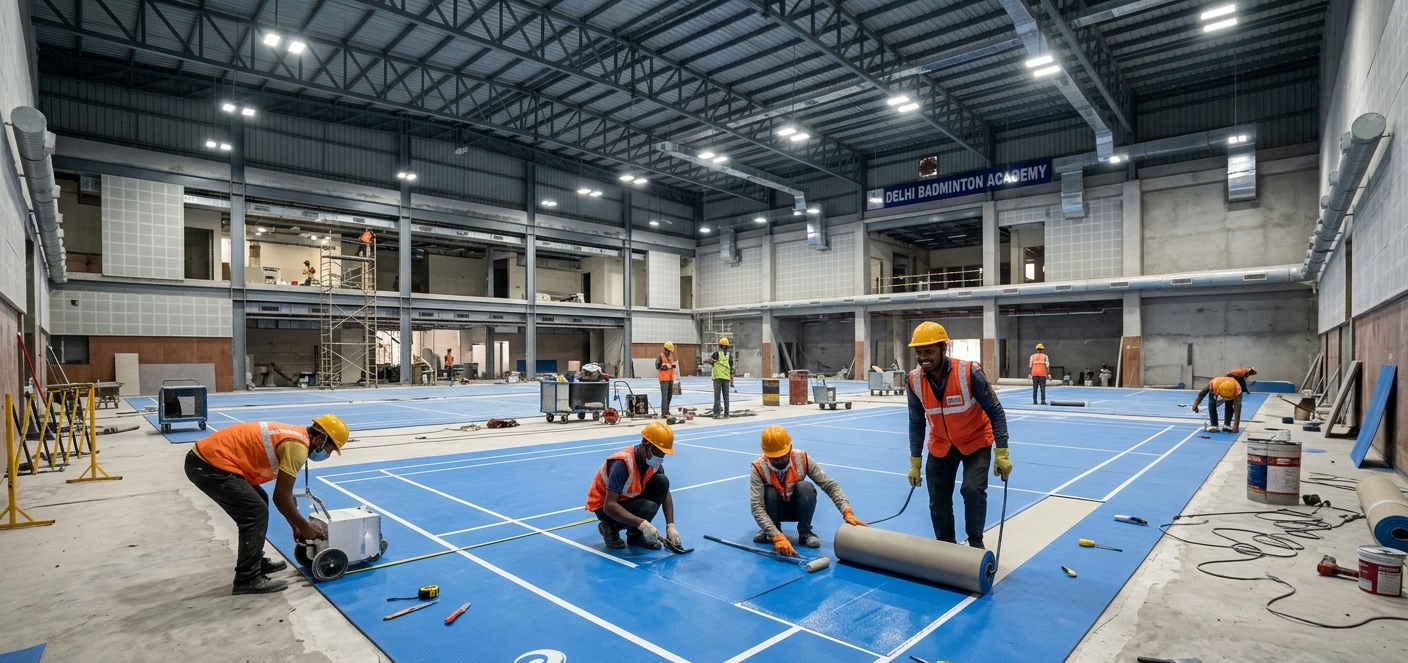
Step 6: Installation of Sports Flooring
The installation process depends on the selected system.
PVC Flooring
PVC sheets or tiles are positioned according to the manufacturer’s installation method and bonded to the prepared substrate using appropriate sports-floor adhesive.
PU Flooring
PU systems may be installed as multiple layers involving primer, resilient layers, leveling components, and protective or wear layers.
Wooden Flooring
A sports-grade wooden system may incorporate a resilient substructure, timber components, shock-absorbing elements, and protective finishing.
Acrylic Surface
Outdoor acrylic systems are generally applied in multiple stages over a suitable concrete or asphalt base.
The manufacturer’s installation specifications should always determine the exact layer sequence and curing requirements.
Step 7: Court Line Marking
Court markings must be accurate, straight, consistent, and clearly visible.
The lines should be applied using suitable sports-floor marking materials compatible with the flooring.
Poor-quality paint can peel, fade, or create surface irregularities.
Professional line marking is especially important when the court will be used for organized competitions.
Step 8: Net Posts and Net Installation
Net posts should be positioned accurately and securely.
The net must be installed at the appropriate standard height, and the supporting structure should not create hazards around the playing area.
For commercial or academy facilities, durable net-post systems are preferable because equipment is frequently used.
Step 9: Lighting Installation
Lighting has a major influence on badminton because players continuously track a fast-moving shuttle against the ceiling and background.
A good lighting design should minimize:
- Glare
- Direct light in the player’s field of view
- Dark patches
- Uneven illumination
- Excessive reflections
- Flicker
LED systems are widely used because they can provide efficient and controllable illumination when properly designed.
Lighting levels should be specified according to the intended use and applicable sports-facility standards rather than using a generic fixture layout.
Step 10: Final Inspection and Handover
Before the facility becomes operational, the completed court should be inspected for:
- Dimensions
- Line accuracy
- Flooring defects
- Surface cleanliness
- Net alignment
- Lighting performance
- Clearance
- Drainage where applicable
- Equipment safety
A final inspection helps identify construction defects before regular players begin using the facility.
Badminton Court Construction Cost in Delhi
The cost of constructing a badminton court in Delhi cannot be represented accurately by flooring price alone.
The final project budget can vary substantially depending on whether the client already has a suitable building or requires a complete indoor structure.
Major Cost Components
The overall project may include:
- Site preparation
- Foundation or RCC work
- Flooring
- Roofing
- Structural steel
- Wall construction
- Electrical work
- Lighting
- Ventilation
- Court equipment
- Net posts
- Marking
- Seating
- Drainage
- Painting
- Safety provisions
Therefore, a quotation based only on the square-foot price of flooring can be misleading.
Approximate Flooring Cost
Indicative market ranges may vary depending on product specification, thickness, brand, installation method, substrate condition, and project quantity.
Typical broad ranges can include:
Synthetic Sports Flooring
Approximately ₹70–₹150+ per sq. ft.
Wooden Sports Flooring
Approximately ₹200–₹400+ per sq. ft.
Outdoor Acrylic Systems
Approximately ₹50–₹100+ per sq. ft.
These figures should be treated as preliminary planning ranges rather than fixed quotations.
What Is the Total Cost of a Badminton Court in Delhi?
A complete project may cost substantially more than the flooring itself.
For an existing suitable indoor space requiring primarily base preparation, flooring, markings, lighting, and equipment, a project can fall within a broad range of several lakh rupees.
A completely new indoor badminton facility involving structural steel, roofing, walls, electrical systems, flooring, ventilation, lighting, and multiple courts can require a significantly larger investment.
The final price depends on:
- Number of courts
- Building condition
- Flooring specification
- Foundation requirements
- Roofing system
- Lighting design
- Ceiling height
- Ventilation
- Equipment
- Site accessibility
- Material quality
- Labour requirements
For this reason, a site-specific quotation is more useful than relying on a generic online cost figure.
Factors That Increase Badminton Court Construction Cost
Several design choices can raise the project budget.
Premium Wooden Flooring
Professional sprung wooden systems require specialized materials and installation.
Structural Indoor Building
If an existing hall is unavailable, constructing the complete building becomes one of the largest project expenses.
Advanced Lighting
Competition-grade lighting requires careful fixture positioning and electrical planning.
HVAC and Ventilation
Large indoor sports halls may require mechanical ventilation or air-conditioning depending on the facility’s usage and design.
Multiple Courts
A multi-court academy requires a larger structure, more flooring, additional lighting, equipment, circulation space, and supporting facilities.
Premium Finishes
Branding, acoustic treatment, spectator seating, reception areas, changing rooms, and other amenities increase the overall investment.
Best Badminton Flooring for Delhi
There is no single flooring system that is automatically best for every project.
The selection should be based on facility type.
| Facility Type | Suitable Flooring Considerations |
|---|---|
| School | PVC or resilient synthetic sports flooring |
| Residential Society | Durable PVC or synthetic system |
| Professional Academy | Premium PVC, PU, or wooden sports system |
| Tournament Facility | High-performance sports flooring selected to applicable standards |
| Indoor Stadium | Sprung wooden or premium synthetic system |
| Outdoor Recreational Court | Properly engineered acrylic sports surface |
The intended playing level, expected traffic, maintenance budget, and building conditions should all be evaluated before making the final decision.
Indoor vs Outdoor Badminton Courts in Delhi
Indoor courts generally provide better control over:
- Weather
- Dust
- Rain
- Temperature
- Lighting
- Surface durability
- Playing consistency
They are especially suitable for academies and facilities with frequent daily use.
Outdoor Courts
Outdoor courts generally require less building infrastructure and can be more economical.
However, they are exposed to:
- Sunlight
- Rain
- Dust
- Temperature variation
- Drainage problems
- Surface deterioration
For regular competitive badminton, indoor construction is usually the more practical long-term solution.
Badminton Court Lighting Requirements
Badminton lighting needs careful planning because the shuttle can travel rapidly through the player’s visual field.
A good lighting system should provide uniform illumination rather than simply producing a high total lumen output.
Important considerations include:
- Fixture height
- Fixture positioning
- Glare control
- Colour rendering
- Uniformity
- Flicker
- Emergency lighting
- Maintenance access
Lighting specifications should be finalized by a qualified electrical or sports-lighting professional based on the facility’s intended use.
Ventilation and Indoor Climate Control
Ventilation is another critical factor in Delhi.
An indoor sports hall can become uncomfortable when heat and humidity accumulate during periods of high occupancy.
The ventilation system should be designed to maintain an appropriate indoor environment without creating strong air movement across the court.
This is particularly important because excessive air movement can affect shuttle flight.
Fans, air-conditioning outlets, exhaust systems, and ventilation equipment should therefore be positioned carefully.
Acoustic Treatment for Badminton Halls
Badminton facilities can become noisy because of multiple players, shoes, shuttle impacts, coaching instructions, and spectator activity.
Acoustic treatment can improve the overall experience.
Depending on the building, solutions may include:
- Acoustic ceiling systems
- Wall panels
- Sound-absorbing materials
- Appropriate structural finishes
Acoustic planning is especially useful for multi-court academies.
Common Mistakes in Badminton Court Construction
Choosing Flooring Based Only on Price
The cheapest flooring may not provide appropriate durability or player comfort.
Ignoring the Substrate
A premium surface installed over an unstable or uneven base can fail prematurely.
Poor Lighting Layout
Improperly positioned lights can create glare and make it difficult to track the shuttle.
Insufficient Ceiling Clearance
Low beams, fans, ducts, or lights can interfere with gameplay.
Inadequate Drainage
For outdoor courts, poor drainage can cause water accumulation and surface damage.
Using Ordinary Paint for Court Lines
Sports flooring requires compatible marking materials.
Neglecting Maintenance
Even a high-quality court deteriorates faster when cleaning and preventive maintenance are ignored.
Maintenance of Badminton Courts in Delhi
A maintenance program should begin from the first day of operation.
Daily Cleaning
Remove dust, dirt, hair, and other debris using cleaning methods recommended for the installed flooring.
Avoid unsuitable household chemicals that may damage the surface or leave a slippery residue.
Regular Inspection
Inspect the court for:
- Cracks
- Loose flooring
- Raised edges
- Surface wear
- Peeling lines
- Moisture problems
- Equipment damage
Flooring-Specific Maintenance
PVC floors should be cleaned using compatible products and methods.
Wooden sports floors may require periodic refinishing depending on usage and manufacturer recommendations.
Outdoor acrylic surfaces should be inspected for cracks, fading, drainage problems, and surface wear.
How Long Does a Badminton Court Last?
The lifespan of a badminton court depends on construction quality, flooring type, traffic, environmental conditions, and maintenance.
As a broad planning reference:
- Synthetic indoor flooring: often around 8–12 years or longer with proper care
- Wooden sports flooring: potentially 15–20 years or more with appropriate maintenance
- Outdoor acrylic systems: commonly require renewal within several years depending on exposure and usage
These are not guaranteed lifespans. Actual performance depends heavily on installation quality and maintenance.
Badminton Court Construction for Schools in Delhi
Schools require courts that balance safety, durability, maintenance, and budget.
A school facility may be used for:
- Physical education
- Coaching
- Inter-school competitions
- Recreational play
- After-school activities
A durable synthetic sports floor is often practical for high-frequency educational use.
The design should also consider student circulation, supervision, storage, emergency access, and safe equipment placement.
Badminton Courts for Sports Academies
Academies typically have significantly higher daily court usage than recreational facilities.
Therefore, the flooring should be selected according to:
- Player volume
- Coaching hours
- Competition level
- Maintenance capacity
- Expected service life
Academy owners should consider lifecycle cost rather than only the initial installation price.
A slightly higher initial investment in a suitable sports flooring system can potentially reduce future repair and replacement requirements.
Badminton Courts for Residential Societies
Residential badminton courts are generally designed for recreational use, community activities, and children’s coaching.
Important considerations include:
- Available hall size
- Noise management
- Operating hours
- Lighting
- Ventilation
- Maintenance
- Safe access
- Equipment storage
A durable, low-maintenance synthetic system can be appropriate where the facility receives frequent community use.
Badminton Courts for Corporate and Commercial Facilities
Corporate campuses, fitness centers, hotels, and commercial sports facilities may use badminton courts as wellness and recreational amenities.
Here, appearance and user experience can be as important as technical performance.
The project may include:
- Premium flooring
- Professional lighting
- Spectator seating
- Changing rooms
- Reception
- Lockers
- Branding
- Digital booking systems
How to Select a Badminton Court Contractor in Delhi
Choosing the contractor is as important as selecting the flooring.
Before appointing a contractor, evaluate:
- Previous badminton projects
- Sports flooring experience
- Technical team
- Material specifications
- Installation methodology
- Substrate preparation process
- Warranty terms
- Maintenance support
- Project timeline
- Safety practices
- References from completed facilities
Ask for a detailed quotation rather than accepting a single lump-sum price without specifications.
The quotation should clearly identify the flooring system, thickness, base preparation, accessories, lighting, civil work, and exclusions.
Questions to Ask Before Starting Construction
Before signing a contract, ask:
- What flooring system is being proposed?
- What is the thickness and layer structure?
- How will the existing substrate be tested?
- Is moisture testing included?
- What base construction is required?
- What is the recommended room size?
- What clear ceiling height will be available?
- What lighting system will be installed?
- What warranty is provided?
- What maintenance is required?
- What work is excluded from the quotation?
- What is the expected completion schedule?
Clear answers to these questions can prevent costly misunderstandings later.
Badminton Court Construction Timeline in Delhi
The project duration depends heavily on whether the building already exists.
For a relatively straightforward indoor flooring project, installation may take a few weeks depending on substrate preparation, curing, material availability, and flooring specification.
A complete new indoor facility can take considerably longer because it involves:
- Civil construction
- Structural work
- Roofing
- Electrical installation
- Flooring
- Lighting
- Finishing
- Equipment installation
Weather can also influence outdoor construction schedules.
A realistic project schedule should therefore be prepared after site inspection rather than promising a fixed number of days in advance.
How to Reduce Badminton Court Construction Costs
Cost control does not mean selecting inferior materials.
A better approach is to optimize the design.
Use an Existing Suitable Hall
Converting a structurally suitable existing building can reduce the cost of constructing a new enclosure.
Select Flooring According to Usage
A recreational court does not necessarily require the same flooring specification as a professional competition venue.
Plan Electrical Work Early
Early lighting and electrical planning avoids expensive modifications later.
Build for Maintenance
Choosing durable, easily maintainable materials can reduce long-term operating costs.
Avoid Unnecessary Features
Prioritize playing quality, safety, structure, flooring, lighting, and ventilation before decorative upgrades.
Safety Considerations
Player safety should be integrated into the design rather than added after construction.
Important elements include:
- Slip-resistant flooring
- Adequate run-off space
- Secure net posts
- Safe electrical installations
- Protected lighting fixtures
- Clear walkways
- Appropriate ventilation
- Proper maintenance
- Emergency access
For commercial facilities, safety procedures and periodic inspections should form part of the operational plan.
Future of Badminton Court Development in Delhi
Badminton infrastructure is likely to continue evolving as more people participate in organized sports.
Future facilities are expected to focus increasingly on:
- High-performance synthetic flooring
- Better shock management
- Energy-efficient LED lighting
- Improved ventilation
- Acoustic control
- Digital court booking
- Multi-court sports centers
- Professional coaching environments
- Better spectator facilities
- Sustainable construction materials
For investors and institutions, a well-planned badminton facility can serve multiple purposes rather than functioning solely as a recreational court.
Final Takeaway
Successful badminton court construction in Delhi requires much more than installing flooring and painting court lines. The project should be approached as a complete sports-infrastructure development involving structural preparation, flooring technology, lighting, ventilation, equipment, safety, and long-term maintenance.
The right flooring depends on how the court will be used. PVC and other synthetic systems can be practical for schools, residential facilities, and academies, while premium PU or sprung wooden systems may be appropriate for higher-performance indoor environments. Outdoor courts require additional attention to drainage, weather exposure, and surface protection.
The most important investment is not necessarily the most expensive material. It is a combination of correct design, reliable materials, accurate installation, proper substrate preparation, and professional workmanship.
Whether the proposed facility is a single court for a residential community or a multi-court academy in Delhi, careful planning at the beginning can improve player safety, reduce maintenance problems, extend flooring life, and deliver better value over the entire life of the facility.
Frequently Asked Questions About Badminton Court Construction in Delhi
1. What is the cost of badminton court construction in Delhi?
There is no single fixed price because the total cost depends on the flooring, base, building structure, lighting, equipment, and site conditions.
A flooring-only project can be considerably less expensive than constructing a complete indoor badminton hall. A proper quotation should therefore be prepared after evaluating the site and project specifications.
2. Which flooring is best for a badminton court in Delhi?
For indoor facilities, sports-grade PVC, PU, or wooden systems can all be suitable depending on the intended level of play, budget, maintenance requirements, and facility design.
For outdoor courts, an appropriately engineered acrylic sports surface is generally more practical than ordinary concrete.
3. What are the official dimensions of a badminton court?
A standard full badminton court is 13.40 metres long and 6.10 metres wide for doubles. The singles width is 5.18 metres.
The net is 1.524 metres high at the center and 1.55 metres high at the posts.
4. How much space is needed for an indoor badminton court?
The court itself measures 13.40 m × 6.10 m, but the building needs additional clearance around the playing area.
The final room size should account for run-off space, walkways, equipment, seating, structural elements, and the intended level of competition.
5. Is an indoor badminton court better than an outdoor court in Delhi?
For regular training and competitive play, indoor courts generally offer more consistent conditions because they protect the playing environment from heat, rain, dust, wind, and direct sunlight.
Outdoor courts can be useful for recreational projects where budget and available land are major considerations.
6. How long does badminton court construction take?
The timeline varies according to project scope.
A flooring installation inside an existing suitable hall can be completed relatively quickly, while a completely new badminton building requires additional time for civil, structural, roofing, electrical, lighting, and finishing work.
7. Can a badminton court be constructed in an existing building?
Yes, provided the building has adequate structural capacity, floor condition, clear height, dimensions, ventilation, lighting possibilities, and access.
A professional site assessment should be completed before construction begins.
8. What type of foundation is required for a badminton court?
The foundation depends on the site and selected construction system.
New facilities may use engineered concrete or RCC construction over properly prepared and compacted ground. Existing buildings may already have a suitable structural floor that only requires preparation and leveling.
9. How often should a badminton court be maintained?
Cleaning should be performed regularly, with inspections scheduled according to usage.
Flooring, markings, net posts, lighting, and building components should all be checked periodically. The exact maintenance interval should follow the flooring manufacturer’s recommendations and actual facility usage.
10. How long does badminton flooring last?
There is no universal lifespan.
A well-maintained synthetic indoor floor may remain serviceable for many years, while premium wooden sports floors can have a longer overall service life when properly maintained and refinished. Outdoor surfaces generally experience faster deterioration because of weather exposure.
11. Is PVC flooring suitable for a badminton academy?
Yes. Sports-grade PVC can be a practical option for academies because it can combine durability, player comfort, traction, and relatively straightforward maintenance.
The exact product should be selected according to usage intensity and performance requirements.
12. What lighting is suitable for badminton courts?
Badminton requires uniform, glare-controlled lighting because players must track the shuttle against the upper background.
LED sports lighting is commonly used, but the fixture arrangement and illumination level should be designed according to the intended facility standard.
13. Why is the court base so important?
The base supports the entire flooring system.
An uneven, weak, cracked, or moisture-affected substrate can cause problems in the finished floor even when premium flooring materials are used. Proper substrate preparation is therefore one of the most important stages of construction.
14. Can multiple badminton courts be constructed in one hall?
Yes. Multi-court halls are commonly developed for academies, clubs, schools, commercial sports centers, and tournament facilities.
The hall must be planned around court spacing, circulation, ceiling clearance, lighting, ventilation, spectator areas, and safety requirements.
15. What should I check before hiring a badminton court contractor in Delhi?
Review the contractor’s sports flooring experience, previous projects, material specifications, installation process, warranty, maintenance support, timeline, and detailed cost breakdown.
A contractor experienced in general civil work may not necessarily have the specialized knowledge required for sports flooring installation.