Introduction
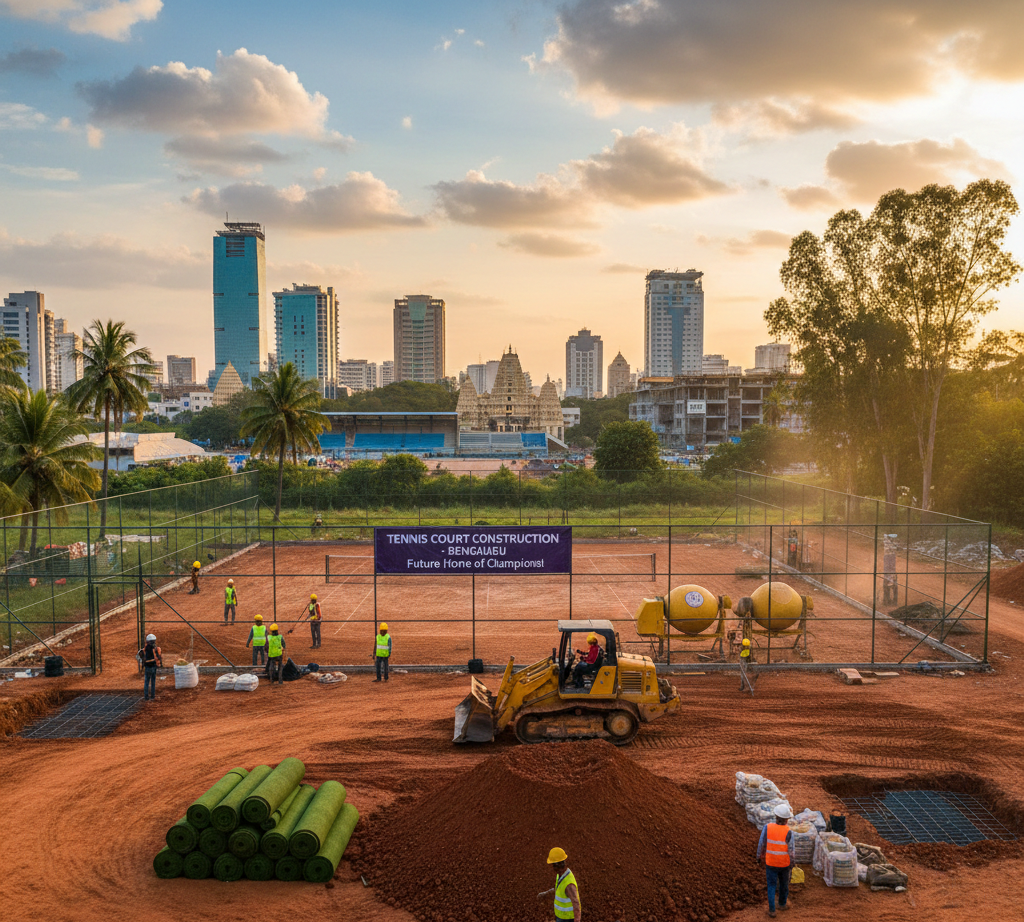
Bengaluru is rapidly developing into a major destination for sports, fitness, and recreational activities in India. With growing interest in tennis among students, professional athletes, fitness enthusiasts, and residential communities, the demand for high-quality tennis court construction in Bengaluru continues to create opportunities for modern sports infrastructure. Schools, colleges, sports academies, private clubs, hotels, corporate campuses, and residential townships are increasingly investing in professionally designed tennis courts to encourage an active lifestyle and provide better training facilities.
Constructing a tennis court requires much more than preparing an open area and applying a playing surface. A successful project involves detailed site assessment, ground preparation, drainage planning, foundation construction, suitable sports flooring, accurate court marking, fencing, lighting, and the installation of essential accessories. Every component must work together to deliver a safe, durable, and consistent playing environment.
At Sports Facility India, tennis court construction projects can be planned around the available space, intended playing level, site conditions, preferred surface, and project budget. Whether you need a tennis court for a school, a professional training academy, a sports club, or a private property, selecting the right construction approach is essential for long-term performance.
This comprehensive guide explains the major aspects of tennis court construction in Bengaluru, including court dimensions, surface options, construction stages, material selection, lighting, estimated costs, maintenance requirements, and the factors to consider when choosing a tennis court construction company.
Why Invest in Professional Tennis Court Construction in Bengaluru?
A professionally constructed tennis court creates a reliable playing environment while helping property owners make better use of their available land. In Bengaluru, where sports facilities serve a wide range of users, the right court design can support everything from beginner coaching sessions to regular competitive practice.
Improved Player Safety
Tennis involves running, jumping, sudden direction changes, and rapid acceleration. An appropriately selected surface with consistent traction and suitable impact characteristics can help reduce unnecessary strain and slipping risks. Proper drainage, smooth transitions, accurate line marking, and a well-maintained playing area also contribute to a safer experience.
Consistent Playing Performance
The quality of the court surface affects ball bounce, movement, traction, and overall gameplay. Professional construction focuses on an even foundation, suitable surface materials, and precise line marking to help create predictable playing conditions.
Long-Term Durability
Bengaluru experiences seasonal rainfall, warm weather, and periods of high moisture. These conditions make drainage, surface selection, crack prevention, and foundation quality particularly important. A properly designed court can withstand normal outdoor exposure more effectively when suitable materials and construction methods are used.
Better Use of Sports Facilities
Schools, residential communities, fitness centres, and sports academies can use a well-planned tennis court to expand their sports programmes, organize coaching sessions, and provide recreational opportunities. A thoughtfully designed facility can also accommodate spectator seating, storage, fencing, and suitable lighting.
Types of Tennis Courts Available in Bengaluru
Choosing the correct tennis court surface is one of the most important decisions during project planning. Different surfaces offer different playing characteristics, maintenance requirements, installation costs, and performance expectations.
1. Acrylic Tennis Court Flooring
Acrylic tennis court flooring is a popular option for outdoor tennis courts in Bengaluru. It is generally installed over a properly prepared asphalt or concrete base using compatible sports-surface coatings and finishing systems.
Acrylic surfaces can provide consistent traction, attractive colours, and playing characteristics suitable for recreational users, schools, clubs, and training facilities. Depending on the selected system, cushioning layers can also be incorporated to improve playing comfort.
Key advantages include:
- Suitable for many outdoor tennis court projects.
- Available in different colours and approved surface systems.
- Relatively straightforward routine cleaning.
- Customizable playing characteristics according to the selected system.
- Compatible with properly engineered asphalt or concrete foundations.
The final performance depends on the coating specification, base condition, drainage, installation quality, and ongoing maintenance.
2. Synthetic Cushioned Tennis Courts
Synthetic cushioned tennis courts use specialized surface systems designed to provide additional comfort compared with certain conventional hard-court finishes. They can be suitable for sports academies, clubs, educational institutions, and facilities with frequent daily use.
The cushioning level depends on the particular product system and the layers incorporated during installation. Before selecting this option, property owners should evaluate the intended playing level, surface maintenance requirements, and total project budget.
Potential benefits include improved comfort, customized playing characteristics, and a professional sports-court finish.
3. Concrete and Asphalt Tennis Courts
Concrete and asphalt are commonly used as structural bases for outdoor hard courts. They provide the foundation needed to support the selected sports-surface system.
The choice between these materials depends on site conditions, engineering requirements, local construction practices, drainage design, and the intended surface finish. Both require appropriate preparation and quality control to minimize unevenness, cracking, and drainage problems.
It is important to distinguish between the structural base and the finished playing surface. A concrete or asphalt foundation may require an additional sports coating to achieve the desired playing characteristics.
4. Clay Tennis Courts
Clay courts offer a distinctive playing experience, typically featuring slower ball movement and a higher bounce than many hard courts. They may be considered for specialist clubs, dedicated training facilities, and projects where clay-court tennis is a priority.
However, clay surfaces require more frequent maintenance than many acrylic courts. Water management, surface redistribution, brushing, and periodic replenishment are important for maintaining suitable playing conditions.
5. Grass Tennis Courts
Grass courts provide a traditional tennis experience and are associated with relatively fast play and a lower, less predictable bounce than many hard surfaces.
In Bengaluru, grass courts may require specialized maintenance planning, irrigation, mowing, drainage, and surface management. They are generally more suitable for projects with the resources and operational commitment required to maintain natural turf.
For many schools, residential communities, and commercial sports facilities, acrylic hard courts offer a practical balance of durability, maintenance, and everyday usability.
Standard Tennis Court Dimensions and Layout
Accurate dimensions are essential for building a tennis court that meets the intended playing requirements. The official playing area for a standard tennis court measures 78 feet in length and 36 feet in width for doubles matches. The singles playing width is 27 feet.
The court dimensions are as follows:
- Court length: 78 feet (23.77 metres).
- Doubles court width: 36 feet (10.97 metres).
- Singles court width: 27 feet (8.23 metres).
- Net height at the centre: 3 feet (0.914 metres).
- Net height at the posts: 3 feet 6 inches (1.07 metres).
The overall site area must be larger than the playing lines because players need sufficient space beyond the baselines and sidelines. Run-off areas provide room for movement and help prevent players from colliding with fences, walls, or other obstacles.
A commonly used planning allowance is approximately 120 feet by 60 feet, although the required footprint can vary according to the intended level of play, site limitations, and applicable facility guidelines. Competitive facilities may require additional clearance and other provisions.
Before construction begins, the contractor should verify the proposed layout, court orientation, surrounding obstructions, access routes, and the requirements applicable to the intended use.
Tennis Court Construction Process in Bengaluru
A reliable tennis court construction project follows a systematic process. Each stage influences the durability, appearance, and performance of the completed facility.
1. Site Inspection and Feasibility Assessment
The first stage involves inspecting the proposed location and evaluating its suitability for tennis court construction. The assessment may include available land area, existing ground levels, soil conditions, access for construction equipment, nearby structures, and potential drainage issues.
The project team should also understand whether the court will be used for recreational play, coaching, club activities, or competitive training. This information helps determine the appropriate layout, surface, fencing, and supporting facilities.
2. Ground Preparation and Earthwork
Once the layout has been approved, the site is prepared for construction. Depending on the existing conditions, the work may involve clearing vegetation, removing unsuitable material, cutting or filling the ground, and compacting the prepared formation.
Proper compaction and level control are important because unstable ground can contribute to settlement and surface defects over time. Any necessary retaining structures or soil improvements should be identified during the planning stage.
3. Drainage Planning
Drainage is particularly important for outdoor tennis courts in Bengaluru because seasonal rainfall can affect court availability and surface longevity.
The construction plan should provide appropriate gradients, drainage channels, and connections to a suitable discharge point. The exact drainage design depends on the site, foundation type, surrounding land levels, and selected surface system.
Water should not be allowed to accumulate on the playing surface or undermine the foundation. Effective drainage planning can reduce waterlogging and help limit moisture-related damage.
4. Construction of the Base Foundation
After ground preparation, the required foundation is constructed. Depending on the project design, this may involve a compacted granular sub-base followed by an engineered asphalt or concrete base.
Material selection, thickness, reinforcement where required, compaction, curing, and level tolerances should follow the approved engineering specification.
The foundation must be suitable for the expected loads and the sports-surface system. Applying an expensive finishing material over an inadequately prepared base can lead to avoidable repairs.
5. Installation of the Tennis Court Surface
Once the base is ready and meets the relevant acceptance criteria, the selected playing surface can be installed.
For acrylic courts, the process may include cleaning, crack treatment where appropriate, application of compatible primers or resurfacing materials, levelling treatments, and multiple sports-coating layers. Line marking is completed according to the approved court layout.
For cushioned or synthetic systems, the installation sequence will depend on the manufacturer’s specifications. Moisture conditions, application temperatures, curing times, and compatibility between layers must be considered.
6. Court Marking and Net Installation
Accurate marking is necessary for correct singles and doubles gameplay. Lines should be positioned according to the standard dimensions and applied using materials compatible with the chosen surface.
The net, posts, and anchoring system must be installed securely. Net height should be checked at the posts and centre before the court is handed over.
7. Fencing, Lighting, and Finishing Work
The final construction stage may include installing perimeter fencing, gates, LED sports lighting, seating, player benches, and other requested accessories.
Lighting layouts should provide suitable illumination while minimizing glare and uneven brightness. Fencing should be selected according to the available space, expected ball containment requirements, and site conditions.
Before handover, the contractor should inspect the completed work for surface defects, drainage concerns, line-marking accuracy, net alignment, and the safe operation of accessories.
Materials Used for Tennis Court Construction
Selecting appropriate materials is essential for achieving the required combination of performance, durability, and maintenance efficiency.
Common materials include:
- Compacted sub-base materials: Provide support beneath the main foundation.
- Concrete or asphalt: Form the structural base for many hard-court systems.
- Acrylic sports coatings: Create the finished playing surface on compatible bases.
- Cushioning layers: Provide additional impact characteristics in selected surface systems.
- Court-marking paint: Creates clear, accurate playing lines.
- Galvanized or coated steel fencing: Provides perimeter ball containment.
- Sports nets and posts: Support the playing net at the specified height.
- LED sports lighting: Supports evening use and improves visibility when properly designed.
Materials should be chosen according to the project specification rather than price alone. Compatibility between the foundation, surface coating, drainage design, and installation method is particularly important.
Tennis Court Lighting and Fencing Requirements
A well-designed tennis court should provide adequate visibility and a secure playing environment.
Tennis Court Lighting
LED sports lights are widely considered for modern tennis facilities because they can provide efficient illumination and flexible lighting layouts. The required lighting level depends on the intended use, such as recreational play, coaching, or competitive matches.
The design should consider fixture placement, mounting height, uniformity, glare control, electrical safety, and maintenance access. Professional lighting calculations can help determine the number and position of fixtures required for the project.
Tennis Court Fencing
Perimeter fencing helps contain balls and separate the playing area from nearby activities. Chain-link fencing or other suitable sports-fencing systems may be used depending on the site and budget.
A fencing height of approximately 10–12 feet is sometimes used for recreational projects, but the final height should be selected according to site conditions, facility requirements, and the level of play.
Gates should allow convenient access without creating unnecessary hazards. Fence posts and foundations must be installed securely, and protruding components should be avoided in player movement areas.
Tennis Court Construction Cost in Bengaluru
The cost of tennis court construction in Bengaluru depends on the site, foundation design, playing surface, drainage requirements, accessories, and overall project scope. A basic estimate should be treated as an initial planning guide rather than a confirmed quotation.
Indicative budget ranges for some projects may include:
- Basic outdoor hard court: Approximately ₹12–18 lakh.
- Premium acrylic or synthetic court: Approximately ₹20–30 lakh.
- Indoor tennis court facility: ₹40 lakh and above, depending on the building and facilities included.
These are broad indicative figures, not verified current market prices. Actual costs may fall outside these ranges. Indoor facilities can be substantially more expensive when land, structural construction, roofing, ventilation, lighting, and other building-related expenses are included.
Factors That Influence Construction Costs
1. Site conditions: Uneven land, unsuitable soil, excavation, and retaining requirements can increase preliminary construction expenses.
2. Foundation specification: The choice of base material, thickness, drainage layers, and engineering requirements affects the overall budget.
3. Flooring system: Standard acrylic, cushioned acrylic, and specialist surfaces have different material and installation costs.
4. Drainage arrangements: Additional drainage channels, underground piping, or site-level corrections may be necessary.
5. Fencing and lighting: The size of the installation, lighting specification, mounting structures, and electrical work influence the final price.
6. Additional amenities: Seating, landscaping, access pathways, changing rooms, storage, and spectator facilities can increase the project cost.
7. Project location and logistics: Transportation, material availability, labour, site access, and project scheduling can affect installation expenses.
For an accurate estimate, request a detailed quotation that identifies the surface system, base construction, drainage, fencing, lighting, accessories, taxes, and any exclusions.
How to Choose the Best Tennis Court Construction Company in Bengaluru
Selecting the right contractor is an important step in ensuring that your investment delivers long-term value. A professional tennis court construction company should be able to explain the technical requirements of the project and provide a clear execution plan.
Before making a decision, consider the following points:
- Relevant experience: Check whether the contractor has completed comparable sports-court projects.
- Material specifications: Ask for clear details about the foundation, coatings, cushioning system, and accessories.
- Construction methodology: Review the proposed sequence for site preparation, drainage, foundation work, and surface installation.
- Quality control: Confirm how levels, dimensions, drainage, surface finish, and line markings will be checked.
- Project transparency: Request a written quotation with a clear scope, timeline, and payment schedule.
- Warranty and after-sales support: Understand what is covered, the applicable conditions, and how maintenance or repair issues will be handled.
- Standards compliance: For competitive facilities, confirm the applicable International Tennis Federation requirements and any relevant event-specific specifications.
Sports Facility India offers a starting point for exploring sports infrastructure and tennis court solutions. Visit https://www.sports-facility.in/ to learn more about available services and discuss the requirements of your proposed project.
Tennis Court Maintenance Tips for Long-Term Performance
Regular maintenance helps preserve the playing surface, maintain traction, and identify minor defects before they develop into more expensive problems.
Clean the Surface Regularly
Remove dust, leaves, and other debris using suitable cleaning equipment. Follow the surface manufacturer’s instructions when selecting cleaning products and methods.
Inspect for Cracks and Surface Damage
Check the court periodically for cracks, peeling coatings, uneven areas, and other signs of deterioration. Repairs should address the underlying cause wherever possible rather than simply covering visible damage.
Maintain Drainage Systems
Keep drainage channels and nearby outlets free from leaves and sediment. After heavy rainfall, check for persistent standing water or signs of water movement beneath the surface.
Check Nets and Fencing
Inspect net tension, posts, gate hinges, fence connections, and other accessories. Replace damaged components when necessary to help maintain a safe playing environment.
Maintain Lighting Equipment
Check fixtures, wiring, mounting structures, and electrical components through qualified personnel. Clean and maintain lighting equipment according to the manufacturer’s recommendations.
Plan Professional Resurfacing
Acrylic court coatings may eventually require repairs or resurfacing, depending on usage, exposure, maintenance, and product specifications. The appropriate maintenance interval should be based on the actual condition of the court rather than a fixed schedule alone.
Why Bengaluru Is an Important Market for Tennis Infrastructure
Bengaluru’s educational institutions, corporate campuses, residential developments, fitness communities, and sports academies provide several potential settings for tennis facilities. The city’s interest in recreational sports and organized coaching creates opportunities for well-designed courts that serve different age groups and playing abilities.
Schools can use tennis courts to expand physical education programmes, while academies can provide structured coaching environments. Residential communities may incorporate courts into shared recreational amenities, and private clubs can use dedicated facilities for training, social matches, and competitions.
Successful projects should be planned around actual user demand, available land, accessibility, operating costs, and maintenance resources. A suitable court design can help property owners develop a useful sports facility without overlooking the technical requirements needed for long-term performance.
Conclusion
Tennis court construction in Bengaluru requires careful coordination between site preparation, foundation engineering, drainage, sports flooring, court dimensions, fencing, lighting, and ongoing maintenance. Selecting the right combination of materials and construction methods helps create a playing surface suited to the project’s intended use, whether it is a school court, residential sports facility, private club, or professional training academy.
Acrylic hard courts are a practical option for many outdoor projects, while cushioned systems, clay surfaces, and grass courts can meet more specialized requirements. The best solution depends on the available space, expected playing intensity, maintenance budget, and performance objectives.
If you are planning a new tennis court or upgrading an existing sports facility, begin with a site assessment and a clearly defined construction specification. Sports Facility India can be contacted through https://www.sports-facility.in/ to explore tennis court construction solutions and discuss your project requirements.
Frequently Asked Questions About Tennis Court Construction in Bengaluru
1. How much does tennis court construction cost in Bengaluru?
The cost varies according to the foundation, flooring system, drainage, fencing, lighting, and site conditions. Broad initial estimates may range from ₹12–18 lakh for a basic outdoor hard court to ₹20–30 lakh for selected premium acrylic or synthetic courts. Indoor facilities can cost ₹40 lakh or more, depending on the building and included amenities. A site-specific quotation is necessary to establish the actual cost.
2. What is the standard size of a tennis court?
A standard tennis court is 78 feet long and 36 feet wide for doubles play. The singles playing width is 27 feet. Additional space is required beyond the playing lines to provide safe run-off areas, and the total site dimensions should be determined during project planning.
3. Which tennis court surface is best for Bengaluru?
Acrylic hard courts are a common practical choice because they offer customizable playing characteristics and relatively straightforward maintenance. Cushioned surfaces may suit facilities that prioritize additional comfort, while clay and grass courts require more specialized maintenance.
4. How long does it take to construct a tennis court?
The construction timeline depends on site preparation, foundation work, drainage, weather, surface installation, and accessory requirements. A project may take several weeks, while more complex developments can require additional time. The contractor should provide a schedule based on the approved scope and site conditions.
5. Can a tennis court be constructed on an existing concrete surface?
Potentially, yes. The existing concrete must be assessed for structural condition, cracks, level variations, drainage, and compatibility with the selected sports-surface system. Repairs or resurfacing may be required before installation.
6. Is acrylic tennis court flooring suitable for outdoor use?
A suitable acrylic sports-court system can be designed for outdoor use when installed over a compatible base with appropriate drainage and surface preparation. Product specifications and installation recommendations should be checked before selecting the system.
7. What facilities are required for a complete tennis court?
A typical project includes a properly prepared foundation, finished playing surface, accurate court markings, net and posts, and suitable surrounding clearance. Depending on the project, it may also include fencing, LED lighting, seating, access gates, drainage infrastructure, and player amenities.
8. How often should a tennis court be resurfaced?
There is no universal resurfacing interval. The timing depends on the coating system, climate exposure, frequency of play, cleaning practices, and the condition of the underlying base. Regular inspections help determine when repairs or resurfacing are necessary.
9. Can an existing badminton or basketball court be converted into a tennis court?
Conversion may be possible if sufficient land and clearance are available. However, a tennis court requires a different playing layout and additional run-off space. The existing foundation, drainage, surface condition, and available area must be assessed before determining feasibility.
10. How do I select a reliable tennis court construction contractor in Bengaluru?
Review the contractor’s relevant experience, completed projects, material specifications, construction methodology, quality-control process, warranty conditions, and after-sales support. Obtain a detailed written quotation and verify the applicable requirements if the court is intended for competitive play.