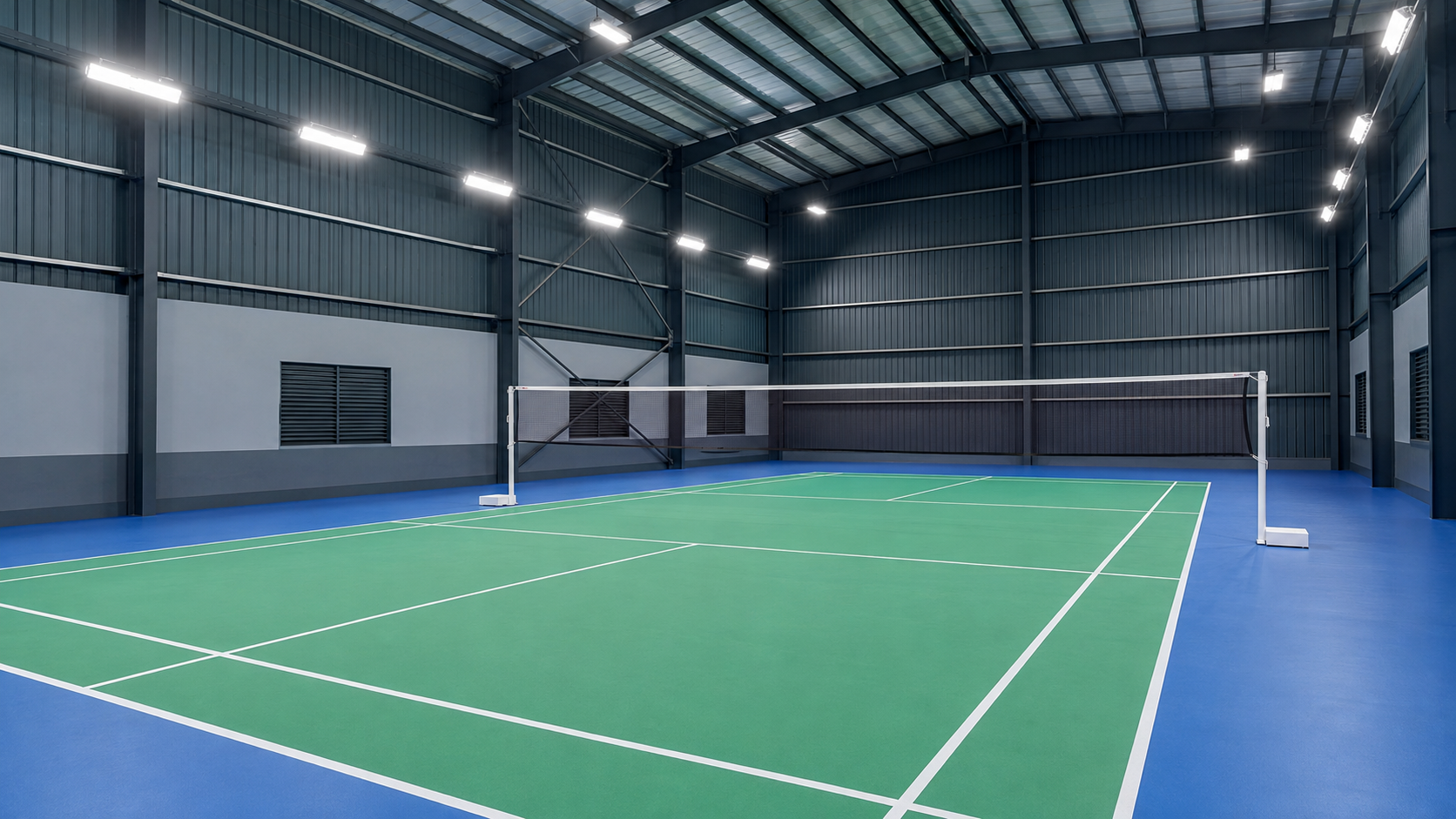
Introduction
Badminton is one of the most popular indoor sports in India, and its popularity is steadily increasing across Chhattisgarh. From schools and colleges to sports academies, fitness centres, clubs, residential communities, and professional training facilities, the demand for well-designed badminton courts is growing. However, constructing a badminton court is not only about preparing the playing area and installing a net. The badminton court flooring plays one of the most important roles in determining player safety, comfort, movement, and overall playing performance.
A professionally installed badminton court floor provides the right balance between grip, flexibility, shock absorption, durability, and ball response. It can help players move confidently across the court while reducing excessive impact on the knees, ankles, and other joints.
For sports facilities in Chhattisgarh, selecting the right flooring system is particularly important because the floor needs to perform reliably under local environmental conditions as well as frequent use. Whether you are developing a new indoor badminton court in Raipur, Bhilai, Durg, Bilaspur, Korba, or another city in Chhattisgarh, choosing an appropriate sports flooring system can significantly improve the quality and longevity of the facility.
What Is Badminton Court Flooring?
Badminton court flooring refers to the specially designed surface installed over a prepared base to create a safe and suitable playing environment for badminton. Unlike ordinary tiles, concrete, or general-purpose flooring, sports flooring is engineered to accommodate the rapid movements, jumps, lunges, and sudden changes of direction associated with badminton.
A suitable badminton floor generally needs to provide:
- Good traction and controlled grip
- Appropriate shock absorption
- Comfortable foot movement
- Consistent playing conditions
- Resistance to regular wear and tear
- Easy cleaning and maintenance
- Long-term dimensional stability
- A smooth and professional finish
The exact flooring system can vary depending on the type of facility, budget, expected usage, available subfloor, and performance requirements.
Why Badminton Court Flooring Is Important
Badminton involves continuous movement. Players frequently accelerate, stop, jump, land, bend, and change direction within a very short distance. A hard or unsuitable surface can increase the impact transferred to the player’s body.
A professionally designed sports floor helps create a controlled playing environment. The surface should not be excessively slippery, but it should also avoid creating too much resistance that interferes with natural foot movement.
Proper flooring can contribute to:
Better Player Safety
A controlled-grip surface gives players confidence when moving around the court. Appropriate traction can reduce the chances of unwanted slipping during quick movements.
Improved Shock Management
Cushioned sports flooring can absorb a portion of the impact generated during jumping and landing. This can make the playing experience more comfortable during extended practice sessions and matches.
Consistent Playing Conditions
A professionally installed floor provides a more uniform surface throughout the court. Uneven areas, joints, bumps, or poorly finished sections can interfere with movement and player confidence.
Greater Durability
Badminton facilities can experience substantial foot traffic. Schools, academies, clubs, and commercial sports centres may have players using the court for several hours every day. A quality sports flooring system is designed to withstand this repeated activity.
Types of Badminton Court Flooring in Chhattisgarh
Different badminton facilities require different flooring solutions. There is no single flooring material that is ideal for every project. The most suitable option depends on the intended use and performance expectations.
PVC Badminton Court Flooring
PVC sports flooring is widely used for indoor badminton facilities because it can provide a combination of cushioning, grip, durability, and relatively easy maintenance.
Modern sports PVC flooring is available in different thicknesses and construction formats. Some systems incorporate multiple layers designed to improve resilience and player comfort.
Key advantages may include:
- Cushioned playing surface
- Controlled traction
- Comfortable movement
- Low-maintenance requirements
- Professional appearance
- Good resistance to regular sports use
PVC flooring can be considered for schools, academies, clubs, indoor stadiums, and recreational facilities.
PU Sports Flooring
Polyurethane, commonly called PU, is another option for indoor sports facilities. PU flooring systems can be designed with cushioning and performance characteristics suitable for athletic environments.
Depending on the specification, PU sports floors can provide:
- Seamless surface appearance
- Good resilience
- Controlled grip
- Shock-absorbing characteristics
- High-quality finish
- Resistance to regular wear
PU systems are often considered where a seamless and professionally finished sports surface is desired.
Wooden Badminton Court Flooring
Wooden flooring is associated with many professional indoor sports venues. A properly designed wooden sports floor can provide excellent playing characteristics when installed over an appropriate substructure.
However, wooden badminton flooring requires careful design and maintenance. Factors such as moisture control, subfloor preparation, ventilation, wood quality, finishing, and environmental conditions need to be considered.
For premium indoor facilities, wooden systems can provide an attractive and high-performance playing environment.
Synthetic Sports Flooring
Synthetic sports floors are available in several configurations and can be selected according to the intended application. These systems can offer a combination of durability, cushioning, traction, and ease of maintenance.
For recreational and institutional facilities, synthetic flooring can provide a practical alternative to more specialized premium systems.
How to Choose Badminton Court Flooring in Chhattisgarh
Selecting the right floor requires more than comparing the initial installation price. The expected usage and long-term performance should be considered.
1. Consider the Type of Facility
A badminton court inside a residential building may have different requirements from a professional academy.
For example:
- Home courts may prioritize comfort and aesthetics.
- Schools may require durable and easy-to-maintain flooring.
- Sports academies may require high-performance surfaces for daily training.
- Commercial facilities may prioritize durability and long-term maintenance.
- Professional venues may require advanced sports flooring specifications.
Understanding the purpose of the court is the first step toward choosing an appropriate system.
2. Evaluate Shock Absorption
Players spend considerable time jumping and landing. The flooring should therefore provide suitable impact management.
A cushioned sports surface can make repeated movement more comfortable and may help reduce excessive impact compared with an unsuitable hard surface.
3. Check the Grip
Grip is critical in badminton. Players need enough traction to stop and change direction, while excessive friction can also affect movement.
The flooring should provide controlled traction appropriate for badminton.
4. Examine the Subfloor
The quality of the flooring installation depends heavily on the base underneath it.
Before installing the final sports surface, contractors should check:
- Levelness
- Moisture conditions
- Surface strength
- Cracks
- Existing damage
- Surface contamination
- Expansion or movement issues
A premium top layer cannot compensate for a poorly prepared base.
Badminton Court Flooring Installation Process
Professional installation normally involves several stages. The exact process depends on the selected flooring system.
Site Inspection
The project begins with an inspection of the proposed location. The available area, existing floor, ceiling conditions, ventilation, lighting, access, and intended court arrangement can be assessed.
Surface Preparation
The base surface is cleaned and prepared. Damaged or uneven sections may need repair before the sports flooring is installed.
Level Correction
A badminton court requires a properly levelled playing surface. Any significant irregularities should be corrected during preparation.
Moisture Assessment
Moisture can negatively affect certain flooring systems and adhesives. Appropriate moisture checks and protective measures should therefore be considered, especially where the floor is installed over concrete.
Installation of Sports Flooring
Depending on the selected system, the flooring may be installed in rolls, tiles, layers, sheets, or liquid-applied sections.
The installation needs to be carried out carefully to achieve proper bonding, alignment, joints, and finishing.
Court Marking
After the flooring has been installed and cured or settled as required by the system, accurate badminton court lines are applied.
The markings should be clear, properly positioned, and visually distinguishable from the playing surface.
Final Inspection
The completed court should be inspected for surface consistency, line accuracy, finishing quality, joints, and overall appearance before being opened for regular play.
Importance of Professional Court Installation
Even high-quality sports flooring can perform poorly when installation is not carried out correctly.
Professional installation helps address important factors such as:
- Correct subfloor preparation
- Accurate measurements
- Proper adhesive application
- Correct flooring alignment
- Seam and joint treatment
- Surface finishing
- Court line positioning
- Expansion and movement considerations
A properly installed badminton floor can provide a more reliable playing experience and potentially reduce premature repair requirements.
Badminton Court Flooring for Schools in Chhattisgarh
Schools are increasingly incorporating sports facilities into their campuses. Badminton is particularly suitable because it can be played indoors and requires less space than many outdoor sports.
For school facilities, flooring should generally focus on safety, durability, maintenance, and value over the long term.
A suitable court can support:
- Physical education programs
- Inter-school competitions
- Student training
- Recreational activities
- Badminton coaching
- Sports events
Schools should also consider proper lighting, ventilation, ceiling clearance, court dimensions, and safe access around the playing area.
Badminton Flooring for Sports Academies
Sports academies require flooring capable of handling frequent training sessions. Players may spend several hours on the court every day, creating substantial demand on the surface.
For academies, flooring selection should consider:
- Daily playing hours
- Number of users
- Training intensity
- Maintenance requirements
- Player comfort
- Surface durability
- Long-term replacement costs
Investing in an appropriate sports floor can improve the overall quality of the training environment.
Badminton Flooring for Indoor Stadiums and Clubs
Indoor stadiums and clubs often accommodate multiple activities and large numbers of players. Their flooring needs can therefore be more demanding.
The selected system should be capable of maintaining performance under frequent use while remaining visually attractive.
For multi-court facilities, consistent installation across all courts is also important. Players should experience similar traction and surface characteristics from one court to another.
Badminton Court Flooring and Chhattisgarh’s Climate
Environmental conditions should be considered while planning sports flooring in Chhattisgarh. Temperature changes, humidity, dust, ventilation, and building conditions can influence the performance and maintenance requirements of an indoor court.
Moisture management is particularly important for flooring systems installed over concrete surfaces.
A professional contractor can assess the site and recommend suitable preparation methods based on the building and flooring specification.
Maintenance of Badminton Court Flooring
Regular maintenance helps preserve the appearance and performance of the playing surface.
A basic maintenance program may include:
- Routine dust removal
- Cleaning with recommended products
- Prompt removal of spills
- Avoiding unsuitable chemicals
- Checking seams and joints
- Preventing unnecessary moisture exposure
- Periodic professional inspection
Players should also use appropriate non-marking indoor sports shoes. Outdoor footwear can bring dust and small particles onto the court, which may affect the surface.
Common Mistakes to Avoid
Choosing Flooring Only on Price
The cheapest flooring option may not always provide the best long-term value. Installation quality, durability, maintenance, and player comfort should also be considered.
Ignoring the Base Surface
Installing a new floor over an unsuitable or damaged base can lead to problems later.
Using General Flooring Materials
Ceramic tiles, ordinary vinyl, polished concrete, or other non-sports surfaces may not provide the characteristics needed for badminton.
Incorrect Court Marking
Even a high-quality floor can look and function poorly if the court dimensions and markings are inaccurate.
Neglecting Maintenance
Regular cleaning and appropriate care can help extend the useful life of a sports floor.
Benefits of Professional Badminton Court Flooring
Choosing a professionally designed and installed sports flooring system can offer several advantages.
Player comfort: A suitable surface provides a more comfortable environment for training and matches.
Safety: Controlled traction and suitable cushioning can support safer movement.
Durability: Quality sports flooring can withstand repeated use when properly installed and maintained.
Professional appearance: A well-finished floor creates a modern and attractive sports facility.
Better maintenance: Many modern sports flooring systems can be cleaned using straightforward maintenance procedures.
Long-term value: Investing in an appropriate system can reduce the likelihood of frequent repairs or premature replacement.
Cost of Badminton Court Flooring in Chhattisgarh
The cost of badminton court flooring varies from project to project. There is no single fixed price because several factors influence the final quotation.
These may include:
- Total court area
- Flooring material
- Flooring thickness
- Subfloor condition
- Required surface preparation
- Moisture treatment
- Number of courts
- Court marking requirements
- Installation complexity
- Accessories and additional sports infrastructure
For an accurate estimate, the site should be inspected and the flooring specification finalized before the project begins.
It is advisable to compare quotations based on the complete scope of work rather than comparing only the price per square foot.
How to Find a Badminton Court Flooring Contractor in Chhattisgarh
When selecting a contractor, consider their experience with sports flooring rather than only general flooring installation.
Ask potential contractors about:
- Previous badminton court projects
- Flooring systems they recommend
- Subfloor preparation methods
- Installation procedure
- Warranty terms
- Maintenance requirements
- Expected project duration
- Product specifications
- After-installation support
Reviewing previous work can also help you understand the contractor’s finishing quality and technical capability.
Why Invest in Quality Badminton Court Flooring?
A badminton court is a sports environment, not simply an empty room with painted lines. The flooring directly interacts with every movement made by the player.
A high-quality floor can contribute to a better playing experience, improved comfort, professional presentation, and long-term usability.
For facilities expecting regular training or commercial use, flooring should be viewed as a long-term infrastructure investment rather than a short-term expense.
Conclusion
Choosing the right Badminton Court Flooring in Chhattisgarh is an important part of developing a safe, durable, and professional badminton facility. Whether the project is for a school, sports academy, club, indoor stadium, fitness centre, residential society, or private facility, the flooring needs to match the expected level of use and performance.
PVC, PU, synthetic, and wooden sports flooring systems can each serve different requirements. The right selection depends on factors such as cushioning, traction, durability, maintenance, budget, subfloor condition, and the intended use of the court.
Professional site assessment, proper base preparation, accurate installation, and regular maintenance are equally important. By investing in a professionally planned badminton flooring system, facility owners can create a better environment for players while improving the long-term value of their sports infrastructure.
If you are planning a new badminton court or renovating an existing facility in Chhattisgarh, selecting the flooring system carefully at the beginning of the project can make a significant difference to performance, safety, appearance, and durability.