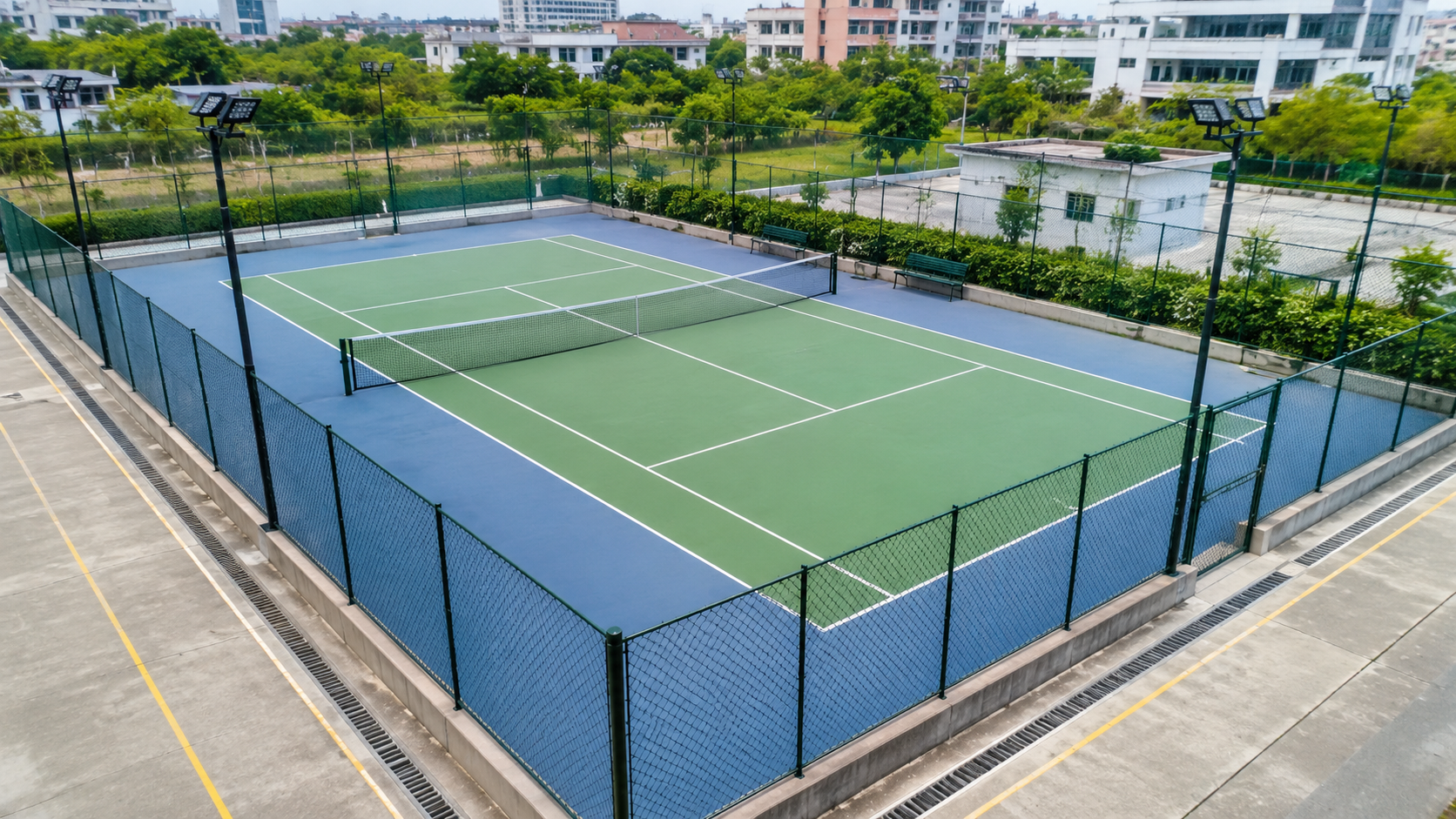
Tennis is one of the most popular racket sports in India, with growing demand from sports academies, schools, colleges, clubs, residential communities, hotels, resorts, and professional training centres. As interest in tennis continues to grow, the need for professionally designed and properly constructed tennis courts is also increasing.
Choosing an affordable tennis court construction company in India can help you develop a high-quality playing surface while keeping the overall project within your budget. However, affordability should not mean compromising on court dimensions, surface quality, drainage, player safety, durability, or finishing.
Sports Facility India provides complete tennis court construction solutions designed for different types of projects and budgets. From site inspection and design planning to base preparation, sports flooring, court marking, fencing, lighting, and final finishing, a professional construction team can manage the complete process.
Why Choose a Professional Tennis Court Construction Company?
Constructing a tennis court involves much more than simply applying a sports surface over an open area. The quality of the foundation, slope, drainage, surface system, dimensions, and installation directly affects the performance and lifespan of the court.
A professional tennis court construction company understands these requirements and develops the court according to the intended use.
Professional construction can provide:
- Proper court dimensions and layout
- Correct foundation and sub-base preparation
- Effective water drainage
- Smooth and consistent playing surface
- Appropriate shock absorption and traction
- Accurate line marking
- Durable sports flooring
- Proper fencing and safety arrangements
- Professional lighting solutions
- Lower maintenance requirements
- Better long-term value
Whether the requirement is for a residential tennis court or a professional sports facility, proper planning can significantly improve the final result.
Affordable Tennis Court Construction Services in India
At Sports Facility India, tennis court construction can be customized according to the available space, project requirements, playing level, surface preference, and budget.
The complete service may include:
- Site inspection and measurement
- Court design and planning
- Ground preparation
- Excavation and leveling
- Sub-base construction
- Concrete or asphalt base preparation
- Drainage development
- Sports surface installation
- Court line marking
- Tennis net and post installation
- Perimeter fencing
- LED sports lighting
- Finishing and quality inspection
This complete approach helps customers avoid coordinating with multiple contractors for different parts of the project.
Types of Tennis Courts We Construct
Different tennis surfaces provide different playing characteristics. The appropriate surface depends on the project’s location, usage, maintenance expectations, and budget.
1. Acrylic Tennis Court
Acrylic tennis courts are among the popular options for schools, academies, clubs, residential projects, and recreational facilities.
Acrylic systems can provide a durable, attractive, and relatively low-maintenance playing surface. Different surface textures and cushioning systems can also be considered depending on the requirements.
Suitable for:
- Tennis academies
- Schools and colleges
- Sports clubs
- Residential communities
- Hotels and resorts
- Recreational facilities
2. Synthetic Tennis Court
Synthetic sports surfaces can be designed to provide a comfortable playing experience with suitable traction and cushioning.
They are often considered where player comfort and controlled playing characteristics are important.
3. Artificial Grass Tennis Court
Artificial grass can provide a distinctive playing experience and an attractive appearance. It can be considered for recreational facilities, resorts, clubs, and other projects where aesthetics are an important consideration.
4. Hard Tennis Court
Hard courts are widely used for training and recreational tennis. Their construction generally involves a properly prepared base followed by an appropriate sports surface system.
A properly constructed hard court should have a level foundation, suitable drainage, accurate dimensions, and a consistent surface.
Standard Tennis Court Dimensions
Correct dimensions are essential for creating a functional tennis court.
A standard tennis court has:
| Specification | Dimension |
|---|---|
| Court length | 23.77 m |
| Singles court width | 8.23 m |
| Doubles court width | 10.97 m |
| Net height at centre | Approximately 0.914 m |
| Net height at posts | Approximately 1.07 m |
In addition to the playing area, sufficient space around the court should be considered for player movement, fencing, lighting, spectator areas, and maintenance access.
For professional or competition-level projects, the overall site should be planned carefully rather than considering only the marked playing area.
Tennis Court Construction Process
A professional construction process helps improve the durability and performance of the finished court.
Site Inspection
The first step is to inspect the proposed location.
The construction team evaluates:
- Available space
- Ground condition
- Existing surface
- Soil characteristics
- Water drainage
- Site accessibility
- Level differences
- Environmental conditions
This information helps determine the appropriate construction method.
Court Layout and Planning
The court dimensions, orientation, fencing, lighting, drainage, access points, and surrounding clearance are planned before construction begins.
The orientation should also be considered carefully to reduce problems caused by direct sunlight during play.
Ground Preparation
The existing ground is cleared, leveled, and prepared for the structural base.
Depending on the site, excavation, filling, compaction, and grading may be required.
Sub-Base Construction
A stable sub-base is essential for long-term performance.
The sub-base must be properly compacted and prepared to support the surface system. Poor foundation preparation can result in cracking, settlement, unevenness, and drainage problems.
Step 5: Drainage Installation
Water management is particularly important for outdoor tennis courts.
Proper drainage helps prevent water accumulation and reduces the risk of surface damage. Drainage requirements should be planned according to local rainfall, soil conditions, court slope, and site layout.
Step 6: Base Surface Installation
Depending on the selected system, an asphalt, concrete, or other suitable base may be installed.
The base should be properly leveled and finished before the sports surface is applied.
Sports Flooring Installation
The selected acrylic, synthetic, artificial grass, or other sports flooring system is installed according to the project’s requirements.
Surface preparation is critical at this stage because imperfections in the base can affect the final playing surface.
Court Line Marking
Precise tennis court markings are applied after the surface has been prepared.
Clean and accurate lines improve visibility and help maintain the correct playing layout.
Net, Posts, and Accessories
Tennis net posts, nets, fencing, gates, windscreens, player seating, and other accessories can be installed according to the project requirements.
Final Inspection
The completed court is checked for surface consistency, dimensions, line marking, finishing, drainage, accessories, and overall quality before handover.
Factors Affecting Tennis Court Construction Cost in India
The cost of constructing a tennis court varies from project to project. There is no single fixed price because several factors influence the overall investment.
1. Court Surface
Acrylic, synthetic, artificial grass, and other surface systems have different material and installation costs.
2. Ground Condition
If the site requires extensive excavation, filling, leveling, soil stabilization, or additional foundation work, construction costs may increase.
3. Base Construction
The quality and type of base required can have a significant effect on the project budget.
4. Drainage
Projects with complex drainage requirements may require additional civil work and materials.
5. Fencing
The height, material, design, and total perimeter of fencing influence the overall cost.
6. Lighting
For courts intended for evening or extended use, professional sports lighting may be required.
7. Number of Courts
Constructing multiple courts can change the overall project economics because site preparation, equipment, transportation, and installation can be planned collectively.
8. Location
Transportation, site accessibility, local labor costs, and logistics can affect the final project estimate.
9. Accessories
Tennis nets, posts, gates, windscreens, seating, lighting poles, and other accessories add to the total project cost.
How to Build an Affordable Tennis Court Without Sacrificing Quality
An affordable tennis court should be designed intelligently rather than simply choosing the cheapest materials.
Here are some practical ways to control construction costs:
Select the Right Surface
Choose a surface based on actual usage rather than automatically selecting the most expensive option.
Prepare the Site Properly
Investing in proper foundation and drainage work can reduce expensive repairs later.
Plan the Entire Project
Consider fencing, lighting, drainage, accessories, and landscaping during the initial design stage. This can prevent costly modifications later.
Choose Durable Materials
Very cheap materials may require frequent repairs or replacement. Durable products can offer better value over the lifetime of the court.
Work With an Experienced Contractor
An experienced tennis court construction company can help identify unnecessary expenses while maintaining essential construction standards.
Tennis Court Construction for Different Applications
Sports Facility India can provide solutions for a wide range of applications.
Tennis Academies
Training academies require durable courts capable of handling regular and intensive usage.
Schools and Colleges
Educational institutions can choose practical tennis court solutions that balance durability, safety, maintenance, and budget.
Sports Clubs
Clubs often require attractive and durable courts suitable for recreational and competitive play.
Residential Communities
Apartment complexes, gated communities, and residential developments can add tennis facilities as part of their sports amenities.
Hotels and Resorts
Hotels and resorts can use professionally constructed tennis courts as an additional recreational attraction for guests.
Corporate Sports Facilities
Companies can develop tennis courts as part of employee recreation and wellness facilities.
Why Drainage Is Important for an Outdoor Tennis Court
One of the most commonly overlooked elements of outdoor tennis court construction is drainage.
Rainwater should be directed away from the playing surface efficiently. Standing water can affect the surface, encourage deterioration, and increase maintenance requirements.
A properly planned drainage system may include suitable court gradients, perimeter drains, collection systems, and connections to appropriate discharge points depending on the site.
The drainage design should be finalized during the planning stage rather than after the court has already been constructed.
Tennis Court Fencing and Safety
Fencing provides security and helps prevent tennis balls from leaving the playing area.
The fencing system can be customized according to:
- Court location
- Required height
- Mesh type
- Gate requirements
- Wind conditions
- Project aesthetics
- Security requirements
Additional features such as windscreens and protective padding can also be considered where required.
Tennis Court Lighting
Good lighting is essential for courts used during the evening.
LED sports lighting can provide efficient illumination while supporting comfortable visibility for players.
The lighting design should consider:
- Pole positioning
- Light distribution
- Glare control
- Playing surface visibility
- Electrical requirements
- Energy efficiency
- Maintenance access
Professional lighting design helps reduce shadows and unwanted glare that can affect gameplay.
Tennis Court Maintenance
Regular maintenance helps extend the life of a tennis court and preserve its playing characteristics.
Recommended maintenance may include:
- Regular cleaning
- Removal of leaves and debris
- Checking drainage systems
- Inspection of cracks and surface damage
- Maintaining court lines
- Checking fencing and gates
- Inspecting tennis posts and nets
- Removing standing water
- Periodic professional inspection
The exact maintenance schedule depends on the surface type, weather conditions, usage intensity, and installation quality.
Why Choose Sports Facility India?
Sports Facility India focuses on providing complete sports infrastructure solutions for different types of projects across India.
When selecting a tennis court construction partner, customers should consider experience, material quality, construction methodology, installation capabilities, after-sales support, and the ability to manage the complete project.
Sports Facility India’s tennis court solutions can be customized for:
- Schools
- Colleges
- Universities
- Tennis academies
- Sports clubs
- Residential societies
- Hotels
- Resorts
- Corporate facilities
- Professional training centres
- Multi-sport facilities
From initial consultation and site planning to construction, flooring, fencing, lighting, and finishing, a complete project approach can make tennis court development simpler and more efficient.
Conclusion
Finding an affordable tennis court construction company in India does not mean choosing the lowest-priced contractor. A truly cost-effective tennis court should combine proper engineering, durable materials, professional installation, suitable drainage, accurate dimensions, player safety, and manageable maintenance requirements.
A professionally constructed tennis court can provide years of recreational and competitive use when the foundation, surface, drainage, accessories, and finishing are properly planned.
Sports Facility India can help businesses, institutions, sports academies, residential communities, clubs, and other organizations plan and develop tennis court projects according to their space, application, and budget requirements.
If you are planning to construct a new tennis court in India, professional site evaluation and project planning are the first steps toward achieving a durable, safe, and high-performance sports facility.
Frequently Asked Questions
1. What is the cost of constructing a tennis court in India?
Tennis court construction cost varies depending on the surface type, site condition, base construction, drainage, fencing, lighting, location, and accessories. A site inspection and project-specific quotation are recommended for an accurate estimate.
2. Which surface is best for a tennis court in India?
Acrylic and other sports surface systems can be suitable for many Indian projects. The best option depends on the intended usage, climate, budget, maintenance requirements, and desired playing characteristics.
3. How long does it take to construct a tennis court?
The construction timeline depends on site preparation, weather, court surface, civil work, drainage, fencing, lighting, and project size. A professional contractor can provide a project-specific schedule after site assessment.
4. Can a tennis court be constructed at a school?
Yes. Tennis courts can be designed for schools, colleges, universities, and educational campuses. The surface and construction system can be selected according to usage frequency, safety requirements, and budget.
5. Do outdoor tennis courts require drainage?
Yes. Proper drainage is an important part of outdoor tennis court construction because it helps manage rainwater and reduces water accumulation on the playing surface.
6. Can you construct multiple tennis courts?
Yes. Multiple courts can be planned as part of tennis academies, sports clubs, resorts, schools, universities, and larger sports facilities.
7. Does tennis court construction include fencing and lighting?
Fencing and lighting can be included as part of a complete tennis court project. The exact specifications can be customized according to the site and intended usage.
8. How can I reduce tennis court construction costs?
Costs can be controlled through proper site planning, selecting an appropriate surface, optimizing the court layout, using durable materials, planning drainage early, and working with an experienced construction company.
9. Why should I hire a professional tennis court construction company?
A professional company can coordinate civil construction, surface installation, drainage, court marking, fencing, lighting, and accessories while helping ensure that the completed court meets the project’s functional requirements.
10. Does Sports Facility India provide tennis court construction services across India?
Sports Facility India provides sports facility construction and flooring solutions for projects in different parts of India. Project feasibility, transportation, site conditions, and service availability can be evaluated based on the specific location.