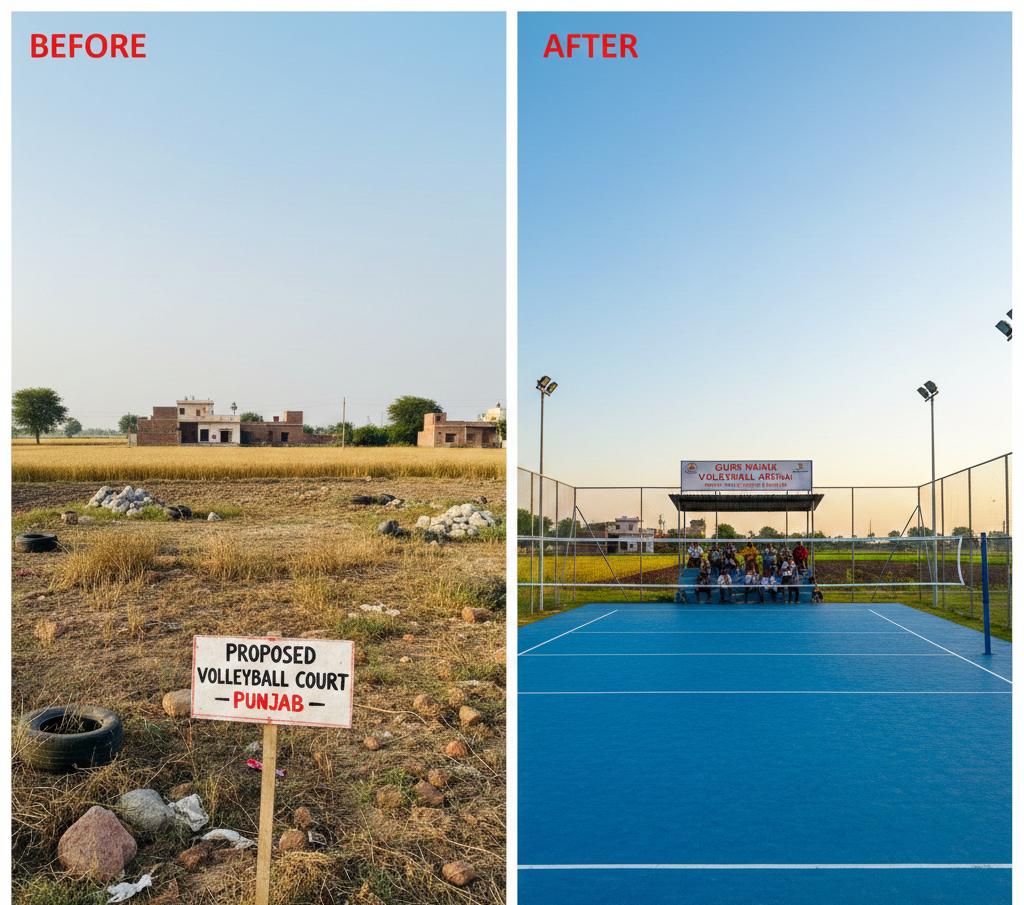
Introduction
Volleyball has become an important part of sports and recreational activities across Punjab. Schools, colleges, universities, sports academies, residential communities, private clubs, and government institutions are increasingly investing in dedicated volleyball facilities to encourage physical fitness and develop sporting talent. This growing interest has created a demand for reliable volleyball court construction in Punjab, with an emphasis on safety, durability, professional playing conditions, and long-term value.
Building a volleyball court involves much more than preparing a flat surface and installing a net. A successful project requires careful planning, appropriate site selection, a structurally sound foundation, suitable sports flooring, accurate court markings, and correctly installed playing equipment. Local weather conditions, drainage requirements, available space, and the intended level of play must also be considered before construction begins.
Whether you are planning a school volleyball court in Ludhiana, a sports academy in Jalandhar, a recreational facility in Amritsar, or a professional sports complex in Chandigarh or Mohali, selecting the right construction approach can significantly influence the court’s performance and service life.
This comprehensive guide explains the essential aspects of volleyball court construction in Punjab, including court types, standard dimensions, flooring materials, construction procedures, estimated costs, maintenance requirements, and the factors to consider when choosing a professional contractor.
Why Is Volleyball Court Construction in Punjab in Demand?
Punjab has a strong sporting culture, with educational institutions, local clubs, and training centres providing opportunities for young athletes to participate in competitive sports. Volleyball is particularly suitable for community facilities because it encourages teamwork, coordination, agility, and cardiovascular fitness.
Several factors contribute to the growing interest in volleyball court development throughout the state.
1. Development of Educational Sports Facilities
Schools, colleges, and universities require well-designed outdoor and indoor courts to support physical education, inter-school competitions, sports training, and extracurricular activities. A professionally constructed volleyball court helps institutions create a dedicated environment for regular practice while providing a safer playing surface for students.
2. Expansion of Sports Academies and Training Centres
Sports academies need dependable facilities where beginners and experienced players can develop their techniques. A properly planned court provides the appropriate playing dimensions, net height, surface consistency, and safety clearances required for structured coaching.
3. Recreational Facilities in Residential Communities
Housing societies, residential townships, resorts, and private clubs are increasingly considering sports amenities that encourage active lifestyles. An outdoor volleyball court can become a valuable shared facility for residents, families, and recreational players.
4. Demand for Durable Outdoor Sports Surfaces
Punjab experiences hot summers, seasonal rainfall, and winter temperature variations. These conditions make material selection and foundation preparation particularly important for outdoor sports construction. A properly designed court with suitable drainage and weather-appropriate surfacing can reduce maintenance problems and improve long-term usability.
Types of Volleyball Courts Suitable for Punjab
The most appropriate court design depends on the available location, expected usage, construction budget, and type of volleyball being played.
1. Outdoor Synthetic Volleyball Courts
Outdoor synthetic courts are suitable for schools, colleges, sports academies, clubs, and residential complexes. Depending on the system selected, they may use acrylic sports coatings or other purpose-designed synthetic surfaces installed over a suitable base.
Acrylic sports flooring is a popular option for outdoor courts because it offers a uniform playing surface, clear line markings, and a choice of colours. Cushioning layers may be incorporated into certain systems to improve player comfort.
The foundation must be stable and appropriately graded, with effective drainage to prevent standing water. Materials should be selected according to the manufacturer’s specifications and the intended level of use.
2. Concrete Volleyball Courts
Concrete courts can be considered for recreational facilities and projects with limited initial budgets. They provide a firm foundation and can be finished with appropriate sports coatings where required.
However, untreated concrete is hard and provides limited impact absorption. Its use should therefore be evaluated carefully, especially where children, regular training groups, or competitive players will use the facility.
Crack control, surface smoothness, drainage, and expansion-joint detailing are important considerations. Applying a suitable sports surface can improve playing characteristics, although the final performance depends on the complete flooring system.
3. Indoor Volleyball Courts
Indoor volleyball courts are designed for year-round use, structured coaching, and competitive events. They are suitable for educational institutions, professional academies, sports halls, and multipurpose indoor complexes.
Common flooring choices include sports-grade timber systems, resilient PVC sports flooring, and other approved indoor sports surfaces. The selected flooring should provide appropriate traction, consistent ball response, and suitable shock absorption.
Indoor construction also requires attention to ceiling clearance, lighting, ventilation, net systems, wall protection, and spectator arrangements. The building must provide sufficient unobstructed space around and above the playing area.
4. Beach Volleyball Courts
Beach volleyball courts are suitable for resorts, recreational clubs, sports campuses, and facilities offering specialised training. These courts use a prepared sand playing surface rather than conventional hard flooring.
Construction involves excavation, drainage preparation, suitable separation layers where necessary, and the placement of clean, appropriately graded sand. The sand depth, composition, and playing characteristics should meet the requirements of the intended use and applicable competition rules.
The surrounding area should also be designed to support safe movement, boundary-line installation, and convenient maintenance.
Standard Volleyball Court Dimensions and Specifications
Correct measurements are essential for creating a court that supports consistent play and complies with the applicable rules.
Under standard international indoor volleyball rules, the playing court measures 18 metres long and 9 metres wide. The court is divided into two equal halves by a centre line beneath the net.
Important dimensions and requirements include:
- Playing area: 18 m × 9 m.
- Court halves: Each half measures 9 m × 9 m.
- Attack lines: Each attack line is positioned 3 m from the centre line on its respective side.
- Net height for men’s competition: 2.43 m.
- Net height for women’s competition: 2.24 m.
- Boundary lines: Generally 5 cm wide and included within the playing court dimensions.
- Free zone: A minimum of 3 m around the playing court is generally required under standard indoor rules, subject to the applicable competition regulations.
Higher-level competitions may require larger free zones, additional vertical clearance, and other facility specifications. Beach volleyball has different court dimensions and site requirements, so its layout should be planned separately.
Before construction starts, the contractor should confirm which rules apply to the project. A recreational school court, a training academy, and a tournament venue may have different requirements for surrounding space, lighting, and equipment.
Step-by-Step Process for Volleyball Court Construction in Punjab
A systematic construction process helps minimise installation problems, improves quality control, and supports the long-term performance of the playing surface.
Site Inspection and Feasibility Assessment
The first stage involves evaluating the proposed location. The construction team should examine the available land, ground conditions, access routes, existing structures, and surrounding obstacles.
For outdoor courts, the assessment should include natural slopes, rainwater flow, soil stability, and the possibility of water collecting beneath the playing surface. Nearby trees, walls, buildings, and utility installations should also be considered.
The site must accommodate the 18 m × 9 m playing area along with the necessary free zones and supporting facilities. A survey before excavation can help identify potential problems early.
Court Layout and Design Planning
After the site assessment, a detailed layout should be prepared. This includes the playing area, boundary clearances, net-post positions, access points, lighting locations, and any spectator or seating areas.
The design should reflect the intended use of the facility. For example, a school court may prioritise student safety and easy maintenance, while a professional training venue may require additional clearance, enhanced lighting, and higher-performance flooring.
A clear construction drawing also helps coordinate civil work, electrical installations, flooring activities, and equipment placement.
Ground Preparation and Earthwork
The selected area is cleared of vegetation, loose material, debris, and unsuitable soil. Excavation and levelling are then carried out according to the approved design.
Where necessary, the subgrade is compacted and stabilised to provide a dependable foundation. The appropriate preparation method depends on soil conditions, groundwater levels, loading requirements, and the type of court surface being installed.
Insufficient compaction can contribute to settlement, surface irregularities, and cracking. For this reason, ground preparation should be completed with suitable equipment and verified before the next construction stage begins.
Foundation and Base Construction
The base is one of the most important elements of a volleyball court. It supports the playing surface and helps maintain a consistent, level finish.
Outdoor courts may use an engineered concrete or asphalt base, depending on the selected surfacing system and site requirements. The base must be designed to support expected use while accommodating drainage, movement joints, and local ground conditions.
Indoor courts may require a concrete slab beneath a resilient sports-flooring system or a specialised subfloor for timber flooring. Beach volleyball facilities require a different foundation arrangement that supports drainage and sand retention.
The contractor should follow the flooring manufacturer’s installation requirements to ensure compatibility between the base and the final surface.
Drainage and Water Management
Drainage deserves special attention in outdoor volleyball court construction across Punjab. Seasonal rainfall can affect court availability when water cannot move away from the playing area efficiently.
The site should be graded according to the selected sports surface and engineering design. Drainage channels, collection points, or underground systems may be required depending on the location.
The objective is to prevent water accumulation without creating an uneven playing surface. Drainage details should be integrated into the foundation design rather than added as an afterthought.
Sports Flooring Installation
Once the base has been completed and approved, the chosen sports flooring can be installed.
For outdoor acrylic courts, the process may involve surface preparation, compatible primer application, levelling or resurfacing layers where needed, and multiple sports-coating applications. The exact system depends on the substrate and manufacturer’s instructions.
Indoor PVC flooring is generally installed over a suitable, prepared base, while timber sports floors require the appropriate subfloor, resilient components, and finishing system.
Beach courts require the placement and levelling of suitable sand to the specified depth. Each flooring type has different installation conditions, so curing times, moisture requirements, and weather limitations should be followed carefully.
Court Marking and Equipment Installation
Accurate line markings are applied after the playing surface has been completed. Measurements should be checked before marking to ensure the court matches the approved dimensions.
The construction team then installs net posts, the volleyball net, post padding where required, and any supporting accessories. Post foundations and anchoring arrangements should be designed to provide stability during use.
Additional facilities may include LED floodlights, benches, spectator seating, fencing, storage space, and access pathways. All electrical and structural installations should meet the relevant safety requirements.
Final Inspection and Handover
Before the court is opened for use, the contractor should inspect the completed installation. Checks should cover dimensions, line visibility, surface consistency, drainage performance, equipment stability, and visible defects.
The client should receive relevant maintenance instructions, product information, warranty details where applicable, and recommendations for routine inspections.
A documented handover makes it easier for schools, academies, and facility managers to maintain the court properly.
Choosing the Right Volleyball Court Flooring
Flooring selection affects player comfort, grip, ball response, maintenance, and overall project cost. There is no single surface that is ideal for every application.
Acrylic sports flooring: Suitable for many outdoor facilities. It offers a consistent finish and clear markings when installed over a properly prepared base. The complete system should be selected for outdoor exposure and the intended playing level.
PVC sports flooring: Commonly used indoors, where a resilient surface can support regular training and competition. Performance depends on the product specification, subfloor preparation, and installation quality.
Timber sports flooring: A premium indoor option for facilities seeking a traditional competition-style surface. It requires appropriate structural support, specialist installation, and controlled maintenance.
Concrete with a suitable sports coating: Can be a practical option for recreational projects, but the surface hardness and intended usage must be considered. A suitable coating does not automatically provide the shock absorption of a purpose-designed resilient floor.
Sand flooring: Essential for beach volleyball. Sand quality, depth, drainage, cleanliness, and regular levelling are central to player comfort and safety.
For outdoor facilities, consider the effects of direct sunlight, temperature fluctuations, rainfall, and the frequency of play. For indoor projects, prioritise traction, shock absorption, ball response, and compliance with the intended competition requirements.
Estimated Cost of Volleyball Court Construction in Punjab
The cost of constructing a volleyball court depends on the site condition, foundation type, flooring specification, equipment, labour, drainage, lighting, and surrounding infrastructure.
The following figures are indicative planning estimates, not verified current market quotations. Actual prices should be confirmed through a site inspection and a detailed bill of quantities.
| Court type | Indicative budget |
|---|---|
| Basic concrete recreational court | ₹3–6 lakh |
| Outdoor synthetic acrylic court | ₹7–12 lakh |
| Indoor sports flooring court | ₹12–20 lakh or more |
| Beach volleyball court | ₹5–8 lakh |
These amounts are preliminary project-level estimates and may not include land acquisition, a new indoor building, major earthwork, extensive drainage, premium lighting, fencing, GST, or other site-specific expenses.
For a standard outdoor acrylic volleyball court, the final quotation should identify the base construction, sports-surface layers, line markings, net and posts, drainage provisions, and finishing work separately wherever possible.
When comparing contractors, avoid selecting a quotation based only on its total price. A lower-cost proposal may exclude important foundation work or specify a different flooring system. Comparing materials, quantities, installation procedures, warranties, and exclusions provides a more reliable basis for decision-making.
Factors That Influence Construction Costs
Several factors can increase or reduce the overall project budget.
- Site conditions: Uneven land, weak soil, excavation requirements, and difficult access can increase preparation costs.
- Foundation specification: The selected base and its structural requirements have a significant influence on the budget.
- Flooring quality: Different synthetic coatings, resilient indoor floors, and timber systems have different material and installation costs.
- Drainage arrangements: Additional channels, pipes, and water-management infrastructure may be necessary.
- Lighting and electrical work: Evening-use facilities may require poles, LED floodlights, cabling, and control equipment.
- Court accessories: Net systems, post padding, fencing, seating, and storage facilities add to the project cost.
- Location and logistics: Material transportation, labour availability, and site accessibility can affect the quotation.
A clearly defined scope of work helps prevent unexpected expenses during construction.
Maintenance Guidelines for Long-Lasting Volleyball Courts
Routine maintenance helps preserve playing characteristics and reduces the risk of premature surface deterioration.
Outdoor Synthetic Courts
Remove leaves, dust, and debris regularly. Clean the surface with methods and products recommended by the flooring manufacturer. Inspect for cracks, coating wear, surface irregularities, and drainage problems.
Avoid dragging heavy equipment across the court or using aggressive cleaning chemicals that may damage the sports coating. Repair minor defects promptly before they spread.
Indoor Courts
Keep the surface clean and remove moisture promptly using approved cleaning procedures. Inspect the flooring for loose seams, damage, changes in traction, or uneven areas.
Timber floors may require periodic refinishing and appropriate indoor environmental control. PVC sports flooring should be maintained according to the supplier’s guidance.
Beach Volleyball Courts
Rake and level the sand frequently to maintain a consistent playing surface. Remove debris and inspect boundary lines, posts, and anchoring systems.
Drainage should remain unobstructed, and the sand should be replenished or cleaned when required. Regular inspections help maintain suitable playing conditions.
Common Challenges in Volleyball Court Construction in Punjab
Weather and Temperature Changes
Outdoor flooring materials must be suitable for the local climate. Construction should be scheduled according to the selected material’s application and curing requirements. Extreme heat, rain, or unsuitable substrate conditions can affect installation quality.
Inadequate Drainage
Poor drainage can lead to standing water, deterioration of coatings, and reduced court availability. Proper grading and drainage design should be completed during the planning stage.
Foundation Defects
Inadequate compaction, unsuitable base materials, and insufficient control of surface movement can contribute to cracking or settlement. A well-prepared foundation is essential for dependable long-term performance.
Incorrect Dimensions
Measurement errors can make a court unsuitable for structured training or competition. Dimensions, net height, boundary markings, and clearance areas should be checked before final handover.
Poor Material Selection
Choosing flooring solely on initial cost may result in higher maintenance requirements or unsuitable playing characteristics. Material specifications should match the intended use, local conditions, and expected frequency of play.
How to Choose a Volleyball Court Construction Company in Punjab
Selecting an experienced contractor is an important part of the project. Look for a company that understands sports-surface installation, civil engineering requirements, court dimensions, and the practical needs of the facility.
Before making a decision, consider the following points:
- Relevant project experience: Ask for examples of completed volleyball courts and similar sports facilities.
- Technical specifications: Request written details of the proposed foundation, flooring system, and installation process.
- Transparent pricing: Check whether the quotation includes civil work, flooring, markings, equipment, transportation, and applicable taxes.
- Quality assurance: Ask how the contractor checks base levels, compaction, surface finish, drainage, and court dimensions.
- After-installation support: Confirm the scope of maintenance guidance, defect rectification, and warranty coverage.
- Project schedule: Obtain a realistic construction timeline that accounts for site preparation, material delivery, weather, and curing requirements.
A dependable contractor should explain the available options clearly and recommend a construction system that suits the project’s needs rather than simply promoting the most expensive flooring package.
Benefits of Investing in a Professionally Constructed Volleyball Court
A thoughtfully designed volleyball court provides long-term value for educational institutions, sports academies, clubs, and residential communities.
It creates a dedicated environment for physical education, recreational games, coaching sessions, and local competitions. Correct dimensions and suitable flooring support consistent playing conditions, while appropriate clearance zones and well-installed equipment contribute to safer use.
A durable foundation and properly selected surface can also help control maintenance requirements over the facility’s life cycle. For organisations that plan to host training programmes or sporting events, a professionally developed court can strengthen the overall quality of their sports infrastructure.
The most effective investment balances initial construction costs with performance, durability, maintenance, and the needs of the people who will use the facility.
Conclusion
Volleyball court construction in Punjab requires careful coordination of site preparation, foundation engineering, flooring selection, drainage, accurate markings, and quality installation. Whether the project involves an outdoor acrylic court for a school, an indoor sports facility for an academy, or a sand court for a recreational venue, each construction decision should be based on the intended use and the conditions of the site.
A properly designed court should provide the correct playing dimensions, a suitable surface, stable net equipment, sufficient surrounding clearance, and manageable long-term maintenance requirements. Selecting suitable materials and working with an experienced sports facility contractor can help reduce construction issues and improve the overall value of the investment.
If you are planning a new volleyball court in Punjab, begin with a professional site assessment and request a detailed quotation that clearly defines the construction scope, materials, installation process, and expected timeline.
For information about volleyball court design and installation services, visit Sports-Facility.in – Volleyball Court Construction. Discuss your site conditions, preferred flooring, and budget with the service provider before finalising the project.
Frequently Asked Questions (FAQs)
1. What is the standard size of a volleyball court?
A standard indoor volleyball court measures 18 metres long and 9 metres wide. Additional free space must be provided around the playing area according to the applicable rules and intended level of competition.
2. What is the estimated cost of volleyball court construction in Punjab?
A preliminary budget may range from approximately ₹3–6 lakh for a basic recreational concrete court to ₹7–12 lakh for an outdoor synthetic acrylic court. Indoor sports flooring and specialised facilities may cost ₹12–20 lakh or more. Actual costs depend on the scope of work and site conditions.
3. Which flooring is suitable for an outdoor volleyball court?
A properly specified acrylic sports surface is a common choice for outdoor courts. The foundation, drainage system, coating specification, and installation quality should all be considered when selecting the complete flooring system.
4. Which flooring is best for an indoor volleyball court?
Sports-grade timber and resilient PVC sports flooring are common indoor options. The right choice depends on the budget, competition requirements, expected usage, maintenance capacity, and desired playing characteristics.
5. How long does it take to construct a volleyball court?
A straightforward outdoor court may take several weeks to complete. A preliminary planning allowance of approximately 4–8 weeks may be appropriate for some projects, but the actual schedule depends on earthwork, foundation curing, drainage, flooring installation, weather, and equipment availability.
6. Can a volleyball court be used for other sports?
Yes, a facility may be designed for multiple sports if sufficient space, suitable flooring, and appropriate markings are provided. However, the requirements of each sport should be assessed before combining court layouts, especially where safety clearances or different surface characteristics are necessary.
7. Is drainage necessary for an outdoor volleyball court in Punjab?
Yes. Effective drainage helps prevent water accumulation and protects the playing surface. The drainage design should account for site slope, soil conditions, rainfall, and the selected flooring system.
8. What equipment is required for a volleyball court?
Essential equipment includes a suitable volleyball net, net posts, stable anchoring arrangements, and accurate boundary markings. Depending on the facility, additional items may include post padding, lighting, fencing, benches, and spectator seating.
9. How can volleyball court maintenance costs be reduced?
Regular cleaning, timely repairs, drainage inspections, and following the flooring manufacturer’s maintenance instructions can help prevent avoidable damage. The appropriate maintenance schedule depends on the surface type and frequency of use.
10. How do I get a quotation for volleyball court construction in Punjab?
Contact a sports facility contractor with details of your location, available land, intended court type, flooring preference, and approximate budget. Request a site assessment and a written quotation specifying the foundation, surfacing, equipment, drainage, exclusions, and estimated completion schedule.