Introduction
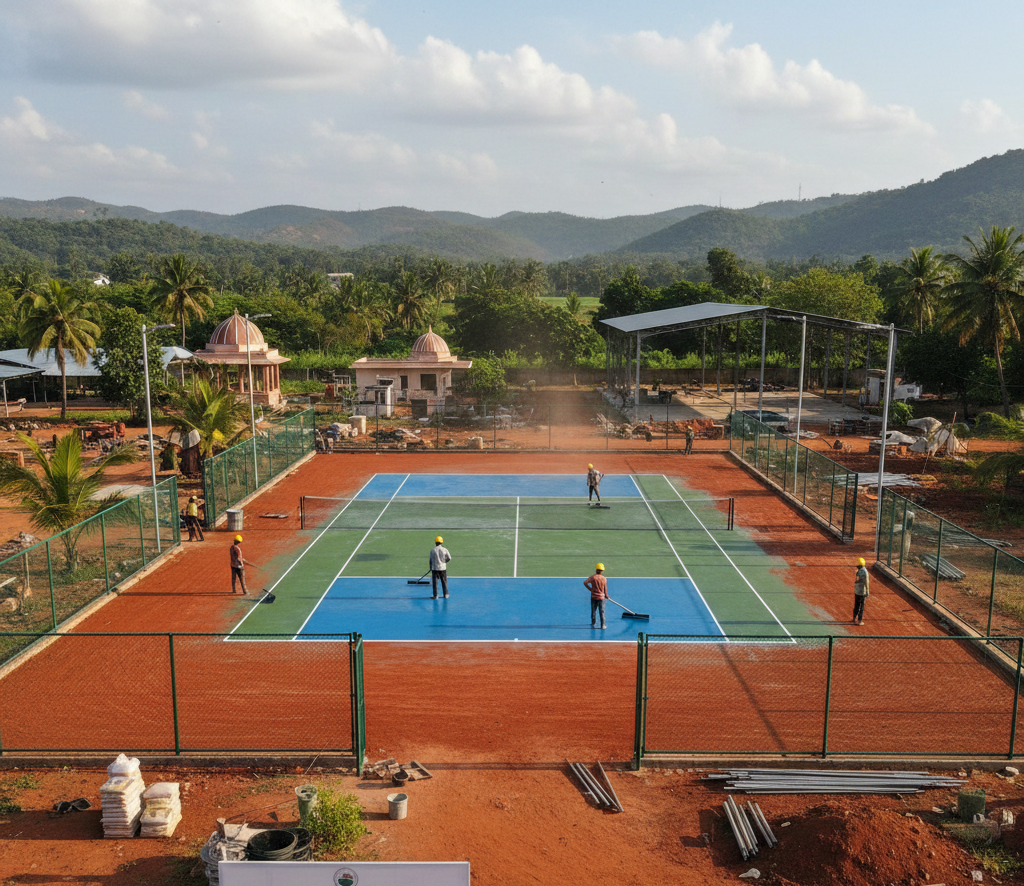
Tennis has steadily gained popularity across India over the past few decades, with players like Leander Paes, Mahesh Bhupathi, Sania Mirza, and Rohan Bopanna inspiring generations of athletes. Today, the demand for tennis court construction in India is rapidly increasing as schools, universities, residential societies, government projects, and private sports clubs invest in professional facilities.
Constructing a tennis court in India requires expertise, quality materials, and compliance with International Tennis Federation (ITF) standards. From choosing the right surface to ensuring durability against diverse climatic conditions, every step plays a vital role in building a safe, long-lasting, and high-performance tennis facility.
This article will serve as a complete guide to tennis court construction in India — covering types of courts, ITF dimensions, construction process, costs, maintenance, and challenges.
Why Build a Tennis Court in India?
-
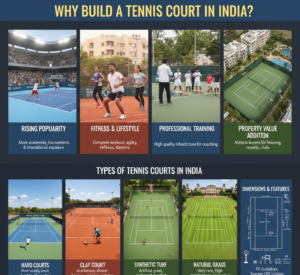
Rising Popularity of Tennis – With more academies, tournaments, and international exposure, tennis is becoming one of the most followed sports in India.
-
Fitness & Lifestyle Demand – Tennis offers a complete workout, improving agility, reflexes, stamina, and focus.
-
Professional Training – Aspiring athletes need high-quality infrastructure for proper coaching and competitive preparation.
-
Property Value Addition – Housing societies, resorts, and clubs with tennis courts attract more buyers and members.
-
Government & Institutional Support – State sports authorities and private academies are funding new facilities to nurture talent.
Types of Tennis Courts in India
India’s diverse climate requires courts that can withstand different weather conditions such as heat, humidity, and heavy rains. The most common types include:
-
Hard Courts (Acrylic / Asphalt / Concrete)
-
Most widely used in India due to durability and all-weather suitability.
-
Offers medium to fast ball bounce and consistent play.
-
Low maintenance compared to other surfaces.
-
Cost-effective option for schools and clubs.
-
-
Clay Courts
-
Preferred for academies and professional training.
-
Slower bounce, improves footwork, stamina, and endurance.
-
Requires regular watering and rolling, making maintenance higher.
-
Popular in South and West India where clay availability is good.
-
-
Synthetic Turf Courts
-
Artificial grass surface with cushioned comfort.
-
Provides a natural grass-like feel without heavy upkeep.
-
Suitable for residential societies, resorts, and recreational play.
-
-
Natural Grass Courts
-
Traditional surface seen in Wimbledon.
-
Very rare in India due to high maintenance and weather challenges.
-
Expensive to maintain (daily watering, mowing, and rolling).
-
Standard Tennis Court Dimensions (ITF Guidelines)
To ensure fairness and safety, courts in India must follow ITF-approved dimensions:
-
Court Length: 23.77 m (78 ft)
-
Court Width (Singles): 8.23 m (27 ft)
-
Court Width (Doubles): 10.97 m (36 ft)
-
Net Height: 1.07 m (3.5 ft) at posts, 0.91 m (3 ft) at center
-
Clearance Around Court: Minimum 6.4 m behind baselines and 3.66 m on the sides
-
Indoor Ceiling Height: At least 9–12 m for professional play
Additionally, fencing, LED lighting, spectator seating, and non-slip line markings are recommended for both recreational and competitive courts.
Step-by-Step Tennis Court Construction in India
-
Site Selection & Planning
-
Select a level site with good drainage.
-
Prefer north-south alignment to reduce sun glare.
-
Allocate extra space for pathways, fencing, and seating.
-
-
Base Construction
-
Soil compaction to prevent settlement.
-
Multi-layer base with stone aggregates and asphalt or RCC.
-
Cross slope of 1% for water runoff.
-
-
Surface Installation
-
Acrylic hard court coatings for schools and clubs.
-
Clay surfacing for academies and training centers.
-
Synthetic turf for societies and resorts.
-
-
Markings & Net Setup
-
ITF-approved paint for accurate line markings.
-
Install net posts, center straps, and poles.
-
-
Lighting & Amenities
-
LED floodlights (minimum 500 lux) for evening play.
-
Seating stands, fencing, and landscaping for spectators.
-
Locker rooms, changing areas, and equipment storage for professional academies.
-
Cost of Tennis Court Construction in India
The cost varies depending on materials, land preparation, and add-ons:
-
Concrete Court: ₹8 – ₹12 lakhs
-
Acrylic Hard Court: ₹15 – ₹25 lakhs
-
Clay Court: ₹18 – ₹28 lakhs
-
Synthetic Turf Court: ₹20 – ₹35 lakhs
-
Indoor Multi-Court Complex with Seating & Lighting: ₹30 – ₹50 lakhs
👉 On average, building a professional tennis court in India costs ₹15 – ₹40 lakhs, including flooring, nets, lighting, and fencing.
Maintenance of Tennis Courts in India
Proper upkeep ensures durability and consistent performance:
-
Hard Courts (Acrylic): Sweep regularly, clean with water, resurface every 5–7 years.
-
Clay Courts: Daily watering, brushing, and rolling to maintain surface quality.
-
Synthetic Turf Courts: Brush to prevent dust buildup, occasional infill replenishment.
-
General Care: Inspect nets, repaint markings, and repair cracks quickly.
Challenges in Tennis Court Construction in India
-
Weather Conditions – Heat, humidity, and monsoons affect surface quality.
-
Space Availability – Large clearances are needed, especially in urban areas.
-
High Initial Investment – Professional courts demand significant upfront costs.
-
Unskilled Contractors – Poor construction can lead to cracks, drainage issues, and uneven bounce.
-
Maintenance Needs – Ignoring resurfacing and cleaning reduces longevity.
Conclusion
The demand for tennis court construction in India is growing rapidly, driven by fitness awareness, rising academies, and government initiatives to promote sports. Whether for a school, sports club, housing society, or private academy, building a tennis court is an investment in health, lifestyle, and future athletes.
By choosing the right surface, hiring experienced contractors, and following ITF standards, India can continue to develop world-class tennis infrastructure. A well-built and well-maintained court not only enhances player performance but also contributes to the growth of tennis as a mainstream sport in the country.
FAQ – Tennis Court Construction in India
1. What is the standard size of a tennis court in India?
A standard tennis court follows international dimensions:
-
Length: 78 feet (23.77 meters)
-
Width (Singles): 27 feet (8.23 meters)
-
Width (Doubles): 36 feet (10.97 meters)
Professional court construction companies in India strictly follow ITF (International Tennis Federation) guidelines.
2. What types of tennis courts can be constructed in India?
The most popular tennis court surfaces in India include:
-
Synthetic Acrylic Tennis Courts
-
Clay Tennis Courts
-
Grass Tennis Courts
-
Concrete / Cement Tennis Courts
-
Artificial Turf Tennis Courts
Acrylic synthetic courts are the most preferred due to durability and low maintenance.
3. How much does tennis court construction cost in India?
The cost depends on:
-
Type of surface
-
Base construction (concrete/asphalt)
-
Location and site conditions
-
Lighting and fencing requirements
On average, tennis court construction in India can range from ₹8 lakh to ₹25 lakh or more, depending on specifications.
4. How long does it take to construct a tennis court?
Typically:
-
Base construction: 2–3 weeks
-
Surface installation: 1–2 weeks
-
Total duration: 4–6 weeks
Weather conditions and project size may affect the timeline.
5. Which surface is best for Indian climate conditions?
Synthetic acrylic courts are highly recommended for Indian weather because they:
-
Resist extreme heat
-
Handle monsoon moisture better than clay
-
Require minimal maintenance
-
Offer long-term durability
6. What is the maintenance requirement for a tennis court?
Maintenance depends on the surface:
-
Acrylic courts: Cleaning and repainting every 4–6 years
-
Clay courts: Regular watering and rolling
-
Grass courts: Frequent mowing and upkeep
Regular cleaning and inspection increase court lifespan.
7. Do tennis courts require proper drainage?
Yes. Proper drainage is essential, especially in areas with heavy rainfall. Professional contractors ensure:
-
Slope-based water runoff
-
Drainage pipes if required
-
Crack-resistant base construction
Good drainage prevents surface damage and water pooling.
8. Can tennis courts be constructed for schools and residential projects?
Yes. Tennis courts are widely constructed for:
-
Schools and colleges
-
Sports academies
-
Residential societies
-
Private villas
-
Clubs and resorts
Custom designs are available based on available space.
9. Is lighting required for tennis courts?
If night play is planned, LED sports lighting is recommended. Proper illumination enhances:
-
Player visibility
-
Safety
-
Professional playing experience
10. How to choose the best tennis court construction company in India?
Look for:
-
Experience in sports infrastructure
-
ITF-compliant construction standards
-
Quality materials
-
Completed project portfolio
-
After-installation support and maintenance services
11. What base is required for tennis court construction?
A strong foundation is critical. Common bases include:
-
Asphalt base
-
Reinforced cement concrete (RCC)
A proper base ensures long-term durability and crack resistance.