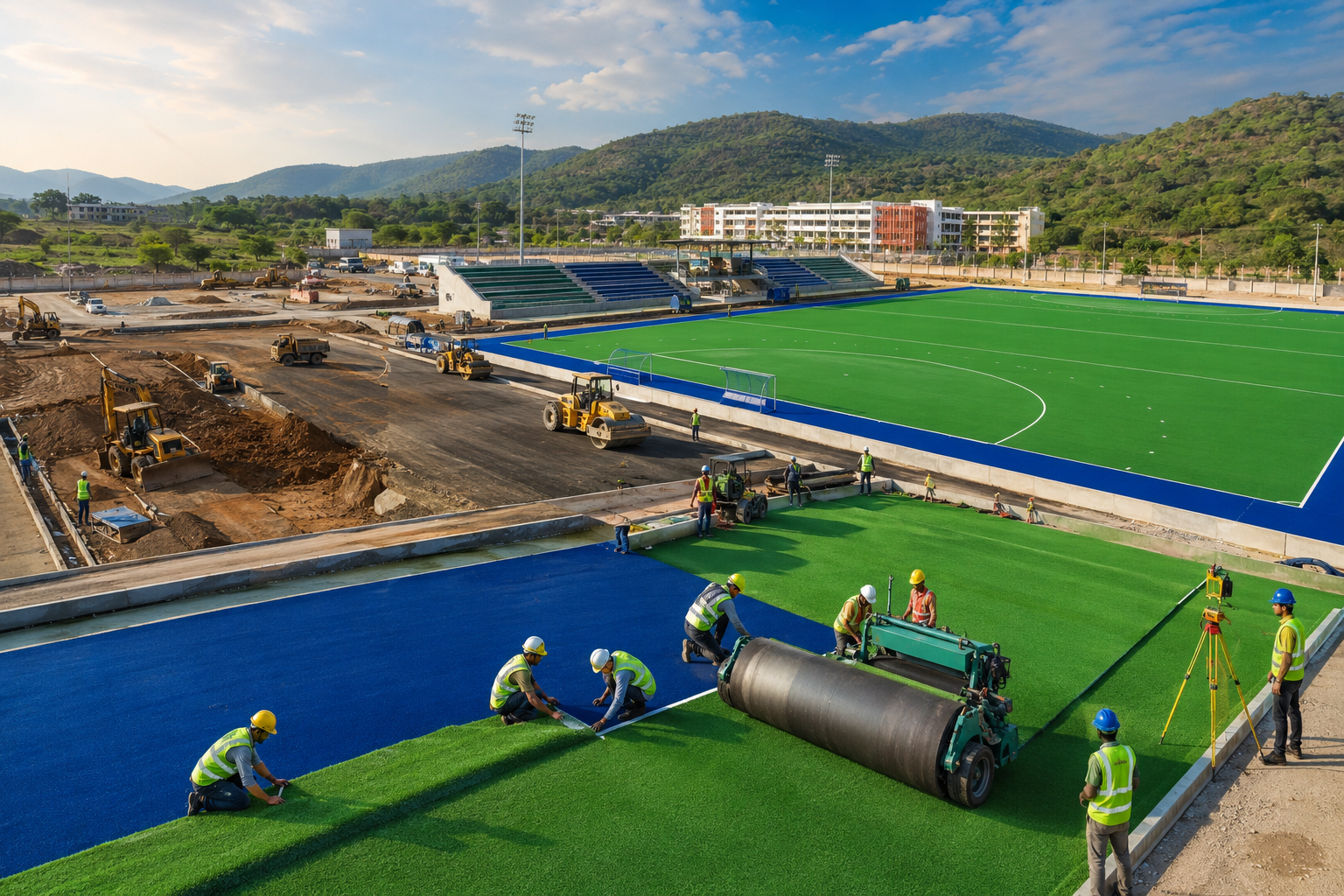
Professional Hockey Court Construction in Chhattisgarh
The demand for world-class sports infrastructure is steadily increasing across Chhattisgarh as educational institutions, sports academies, government organizations, private clubs, and community sports centers invest in modern athletic facilities. Hockey remains one of India’s most celebrated sports, and the development of professionally constructed synthetic hockey courts is playing a vital role in nurturing future talent.
A professionally designed hockey court offers a safe, durable, and high-performance playing surface suitable for training sessions, school competitions, district tournaments, state championships, and professional practice. Unlike conventional natural grass fields, synthetic hockey courts provide consistent ball speed, reliable player movement, and excellent performance throughout the year with significantly lower maintenance requirements.
Professional hockey court construction involves much more than laying synthetic turf. Every successful project begins with detailed planning, engineering design, accurate site evaluation, soil analysis, drainage planning, foundation preparation, precision leveling, premium material selection, and expert installation. Each stage contributes to creating a long-lasting hockey surface capable of meeting modern sports standards.
Whether your project is located in Raipur, Bilaspur, Durg, Bhilai, Korba, Jagdalpur, Raigarh, Ambikapur, Rajnandgaon, Dhamtari, or any other city in Chhattisgarh, investing in a professionally constructed synthetic hockey court ensures excellent performance, enhanced safety, and long-term value.
Why Synthetic Hockey Courts Are Becoming the Preferred Choice
Modern hockey is almost exclusively played on synthetic turf because it delivers superior playing characteristics compared to traditional grass fields.
Synthetic hockey courts provide numerous advantages for players, coaches, institutions, and facility owners.
Uniform Ball Speed
One of the biggest advantages of synthetic hockey turf is its ability to deliver smooth and predictable ball movement. Players can execute accurate passes, controlled dribbling, and powerful shots with greater consistency throughout the game.
Improved Player Safety
High-quality synthetic turf provides excellent shock absorption while reducing friction injuries caused by uneven natural surfaces. A properly installed court minimizes the risk of slips and falls while supporting fast-paced movement.
Long-Term Durability
Premium synthetic hockey turf is manufactured using advanced polyethylene fibers designed to resist wear, UV radiation, heavy foot traffic, moisture, and changing weather conditions.
Minimal Maintenance
Unlike natural grass fields that require frequent watering, mowing, fertilization, and pest control, synthetic hockey courts require only routine brushing, cleaning, debris removal, and periodic inspections.
Year-Round Usability
Synthetic hockey courts remain playable throughout different seasons, allowing uninterrupted practice sessions, tournaments, and recreational activities regardless of weather conditions.
Importance of Professional Hockey Court Construction
The performance of a hockey court depends not only on the quality of the turf but also on the engineering precision applied throughout the construction process.
Professional construction ensures:
- Accurate site planning
- Scientific drainage design
- Stable foundation preparation
- Proper soil compaction
- Laser-guided surface leveling
- High-quality synthetic turf installation
- Strong seam bonding
- Excellent water drainage
- Long-lasting structural stability
- Reduced maintenance costs
Every construction layer beneath the playing surface contributes to the court’s overall durability and performance.
Complete Hockey Court Construction Process
Building a professional synthetic hockey court requires systematic planning and execution. Every phase is carefully monitored to maintain quality and precision.
1. Site Survey and Planning
Every successful project begins with a detailed site inspection.
Professional engineers evaluate:
- Ground condition
- Soil type
- Site dimensions
- Existing slope
- Water drainage pattern
- Accessibility
- Environmental conditions
- Utility connections
- Future expansion possibilities
The collected information helps determine the most suitable construction methodology while minimizing future maintenance requirements.
2. Site Clearing and Excavation
The construction area is cleared of vegetation, rocks, debris, roots, and unsuitable soil.
Ground preparation generally includes:
- Site cleaning
- Earth excavation
- Removal of soft soil
- Surface grading
- Boundary marking
- Initial compaction
Proper ground preparation provides a stable platform for the structural layers that follow.
3. Strong Foundation Development
The foundation serves as the structural backbone of the hockey court.
Multiple engineered layers are installed using carefully selected aggregates that provide long-term stability and load-bearing capacity.
Typical foundation layers include:
- Compacted natural soil
- Granular sub-base
- Crushed stone aggregates
- Fine leveling layer
- Mechanical compaction
Each layer is tested to ensure proper density before the next layer is installed.
4. Precision Surface Leveling
Surface accuracy is one of the most critical factors influencing hockey performance.
Professional contractors use laser-guided leveling equipment to achieve consistent elevations across the entire playing surface.
Benefits of accurate leveling include:
- Smooth ball movement
- Improved player safety
- Efficient drainage
- Uniform turf performance
- Reduced maintenance
- Increased surface lifespan
Even small irregularities can negatively affect gameplay and increase long-term maintenance costs.
Advanced Drainage System
Efficient drainage is essential for maintaining a safe and durable hockey court, particularly during the monsoon season experienced across Chhattisgarh.
Without proper drainage, rainwater can accumulate beneath the synthetic turf, causing structural damage and reducing playing quality.
Professional drainage systems generally include:
- Engineered surface slope
- Perforated drainage pipes
- Drainage trenches
- Gravel filtration layers
- Water collection channels
- Safe discharge outlets
An effective drainage system ensures rapid water removal while protecting the foundation and maintaining year-round usability.
Selection of Premium Synthetic Hockey Turf
Choosing premium-quality synthetic turf is essential for achieving professional playing performance and long-term durability.
Modern hockey turf is manufactured using advanced polyethylene fibers that provide excellent resilience, UV stability, and consistent ball interaction.
Important selection criteria include:
- Fiber density
- Yarn strength
- UV resistance
- Wear resistance
- Shock absorption
- Water permeability
- Dimensional stability
- Color retention
- Surface consistency
- Compliance with international sports specifications
Selecting the appropriate turf depends on the intended level of competition, expected usage, and maintenance capabilities.
Types of Synthetic Hockey Turf
Different hockey facilities require different turf systems depending on performance requirements and available maintenance resources.
Water-Based Hockey Turf
Water-based hockey turf is commonly used for international tournaments and elite competitions. These surfaces offer exceptional ball speed, precise control, and excellent player comfort when properly irrigated.
This option is suitable for professional sports complexes, national training centers, and international-standard facilities.
Sand-Dressed Hockey Turf
Sand-dressed hockey turf incorporates a light layer of specially graded sand to stabilize the synthetic fibers while maintaining balanced playing characteristics.
These systems are ideal for schools, colleges, universities, sports academies, and community sports centers.
Sand-Filled Hockey Turf
Sand-filled hockey turf uses a larger quantity of silica sand infill to improve structural stability and durability.
This surface is frequently selected for educational institutions, recreational facilities, public sports complexes, and multi-purpose sports grounds where heavy daily usage is expected.
Engineering Excellence in Hockey Court Construction
Professional hockey court construction combines civil engineering, sports surface technology, drainage engineering, and precision installation techniques.
Every stage is performed according to strict quality standards to achieve:
- Long-term structural stability
- Uniform playing characteristics
- Excellent drainage performance
- Player comfort
- High safety standards
- Reduced maintenance
- Consistent ball behavior
- Enhanced durability
- Weather resistance
- Professional appearance
A scientifically engineered hockey court becomes a valuable long-term asset for schools, sports academies, universities, clubs, and government sports facilities throughout Chhattisgarh.
Synthetic Hockey Turf Installation Process
Once the foundation, leveling, and drainage systems have been completed, the installation of the synthetic hockey turf begins. This stage requires experienced technicians, precision equipment, and strict quality control to ensure a professional-grade playing surface.
Base Inspection
Before laying the turf, the completed base is thoroughly inspected to verify that it is clean, dry, level, and free from dust or loose particles. Any imperfections are corrected to ensure flawless installation.
Turf Roll Positioning
Large rolls of premium synthetic hockey turf are carefully placed according to the approved court layout. Every roll is aligned accurately to maintain consistent fiber direction and seamless integration across the entire surface.
Seam Bonding
Adjacent turf rolls are joined using high-strength seam tape and premium polyurethane adhesive. Precision seam bonding ensures a smooth playing surface capable of withstanding intensive sports activities and long-term use.
Permanent Line Markings
Official hockey field markings are created by inserting pre-manufactured white synthetic turf strips into the green playing surface. This method provides durable, highly visible lines that remain intact for years without fading.
Final Grooming and Inspection
After installation, the entire court is inspected for alignment, seam quality, surface consistency, and overall finish. Specialized brushing equipment lifts the turf fibers to improve aesthetics and ensure uniform playing performance.
Quality Standards for Hockey Court Construction
A professionally constructed hockey court should meet recognized sports infrastructure standards to deliver safety, durability, and exceptional playing characteristics.
Key quality considerations include:
- Accurate court dimensions
- Proper ground compaction
- Efficient drainage performance
- Premium synthetic hockey turf
- Strong seam adhesion
- Uniform surface levels
- High-quality line markings
- UV-resistant materials
- Weather-resistant construction
- Safe and comfortable playing conditions
Following these standards ensures reliable performance during training sessions and competitive tournaments.
Applications of Synthetic Hockey Courts
Synthetic hockey courts are suitable for a wide variety of sports infrastructure projects across Chhattisgarh.
Schools
Schools benefit from safe and durable hockey facilities that encourage physical education, inter-school competitions, and student participation in sports.
Colleges and Universities
Modern hockey courts enable colleges and universities to host tournaments, improve sports education, and support athlete development.
Sports Academies
Professional coaching centers require high-performance hockey surfaces to provide advanced training environments for aspiring players.
Government Sports Projects
Government organizations invest in synthetic hockey courts to promote grassroots sports, improve public recreational facilities, and develop future athletes.
Multi-Sports Complexes
Modern sports complexes often include synthetic hockey courts alongside football, tennis, basketball, and athletics facilities to serve diverse sporting needs.
Residential Communities
Premium residential developments increasingly incorporate sports facilities to encourage healthy lifestyles and recreational activities.
Benefits of Investing in a Synthetic Hockey Court
A professionally installed synthetic hockey court provides long-term value for educational institutions, sports organizations, clubs, and recreational facilities.
Excellent Durability
Premium synthetic turf withstands heavy usage while maintaining its appearance and playing quality for many years.
Lower Maintenance Costs
Compared to natural grass, synthetic hockey courts require significantly less maintenance, reducing long-term operational expenses.
Better Playing Experience
Players enjoy smooth ball movement, consistent speed, reliable footing, and improved confidence during both training and competition.
Increased Facility Value
High-quality sports infrastructure enhances the reputation of schools, universities, academies, clubs, and public sports facilities.
Continuous Usage
Synthetic hockey courts remain usable throughout the year, allowing uninterrupted training schedules and tournament planning.
Professional Appearance
Modern synthetic hockey surfaces provide a clean, attractive, and professional appearance that reflects positively on the organization.
Hockey Court Maintenance Guidelines
Routine maintenance helps preserve the safety, appearance, and performance of a synthetic hockey court.
Recommended maintenance practices include:
- Remove leaves, dust, and debris regularly.
- Brush the turf fibers to maintain an upright position.
- Inspect seams periodically for wear or separation.
- Clean the surface using approved maintenance equipment.
- Prevent standing water through regular drainage inspections.
- Repair damaged areas promptly to avoid further deterioration.
- Restrict unauthorized vehicles from entering the playing surface.
- Schedule periodic professional inspections.
Proper maintenance significantly extends the lifespan of the hockey court while ensuring consistent playing conditions.
Why Choose Professional Hockey Court Construction Services in Chhattisgarh?
Professional contractors combine technical expertise, engineering knowledge, premium materials, and skilled workmanship to deliver world-class hockey courts.
Benefits of choosing experienced professionals include:
- Customized project planning
- Site-specific engineering solutions
- High-quality construction materials
- Advanced installation equipment
- Skilled technical workforce
- Timely project completion
- Strict quality assurance
- Long-lasting playing surfaces
- Reliable post-installation support
- Cost-effective project execution
Experienced professionals ensure that every stage of construction is completed according to industry best practices and modern sports infrastructure standards.
Growing Demand for Hockey Infrastructure in Chhattisgarh
Chhattisgarh has witnessed steady growth in sports participation and infrastructure development over recent years. Educational institutions, sports academies, government departments, and private organizations are increasingly investing in modern hockey facilities to support athlete development and community engagement.
Synthetic hockey courts provide an ideal platform for school competitions, coaching camps, district tournaments, state championships, fitness programs, and recreational activities. Their durability, low maintenance requirements, and professional playing characteristics make them a practical long-term investment for organizations across the state.
As sports awareness continues to grow, professionally constructed hockey courts will play an important role in developing future talent and encouraging greater participation in hockey throughout Chhattisgarh.
Conclusion
A professionally designed synthetic hockey court is a valuable investment for institutions seeking a durable, safe, and high-performance sports facility. From site assessment and foundation preparation to advanced drainage systems and precision turf installation, every stage of construction contributes to the quality and longevity of the finished court.
Whether the project is for a school, college, university, sports academy, government organization, private club, or community sports complex, a professionally constructed hockey court offers consistent performance, lower maintenance costs, improved player safety, and year-round usability.
By selecting premium materials, following proven construction techniques, and implementing regular maintenance practices, organizations across Chhattisgarh can develop world-class hockey facilities that inspire athletes, support sporting excellence, and contribute to the long-term growth of hockey in the region.
(FAQs)
1. How long does hockey court construction in Chhattisgarh take?
The construction duration depends on the project size, site conditions, weather, and design specifications. Most projects are completed within several weeks after site preparation.
2. Which type of hockey turf is best?
The ideal turf depends on the intended use. Water-based systems are preferred for professional competition, while sand-dressed and sand-filled systems are widely used by schools, colleges, academies, and recreational facilities.
3. Is synthetic hockey turf suitable for all weather conditions?
Yes. Professionally installed synthetic hockey turf performs effectively in different weather conditions and includes drainage systems for quick water removal after rainfall.
4. How often should a hockey court be maintained?
Routine cleaning, brushing, debris removal, and periodic inspections are recommended to maintain performance and maximize the lifespan of the surface.
5. Can schools and colleges install synthetic hockey courts?
Yes. Synthetic hockey courts are ideal for schools, colleges, universities, and sports academies because they provide safe, durable, and low-maintenance playing surfaces.
6. Why is drainage important in hockey court construction?
An efficient drainage system prevents water accumulation, protects the foundation, minimizes maintenance requirements, and keeps the playing surface safe after rain.
7. What factors influence the cost of hockey court construction?
Project costs depend on court dimensions, site conditions, excavation work, foundation construction, drainage systems, turf quality, fencing, lighting, and additional sports infrastructure requirement